The time for new entrepreneurs is very auspicious in India’s food manufacturing sector. The article takes you through a set of food manufacturing business ideas that first generation entrepreneurs, MSME planners and industrial investors can truly implement and make a profit. We have relied on consulting logic, the feasibility reasoning, and real market signals, not empty enthusiasm. Currently, processed food business ideas are less risky in terms of execution risk than most of the manufacturing categories as the consumption of processed food goes on increasing across metro and semi urban India if the basic things are right.
Why This Sector Is Growing Fast
Food manufacturing is right on trend at the crossroads of two trends. Food expenditures continue to grow in the home, and are increasingly being allocated to packaged and processed foods. This means that small and medium-sized manufacturers have a real chance to win new market share, rather than simply the remainder of the market share from the large players.
The food processing industry has already made a significant contribution to the manufacturing sector in India and its exports are also rising. According to the government’s bodies for export promotion, processed food now represents an increasing share of the country’s agricultural exports.
Rising Domestic Consumption
Families in urban areas are more likely to purchase ready to eat meals, packaged snacks, and branded dairy products rather than making these products themselves. This change isn’t a fleeting fad. It is a sign of a more active household, more working women and smaller nuclear families who prefer to have something ready to eat rather than cook a gourmet meal.
Tier-2 and Tier-3 towns are catching up rapidly as well. So, the manufacturer doesn’t need a metro-only distribution strategy to make a profitable brand.
The speed at which a new food brand can reach its customers has also been altered by the modern retail and quick-commerce platforms. Ten years ago a small manufacturer had to wait years to get a foot in the door of a regional supermarket chain. Now, a good-compliance and quality document can help a well-packaged product to be listed on a quick-commerce app within weeks. This indeed works in the favour of smaller, more agile manufacturers.
Export Potential Beyond Borders
Food manufacturers have a natural edge in India with their agricultural base compared to other countries. This means that some categories, such as spices, marine products and processed fruit, enjoy a more regular demand from abroad, particularly from the Middle East, Southeast Asian and African markets. Manufacturers who are focused on exports can benefit from this advantage early, before the competition from the domestic market gets tough.
Government Policies and Incentives Supporting New Businesses
New food manufacturers need not bear the burden of all the costs. There are a number of schemes handled by the Ministry of Food Processing Industries, which are targeted towards this sector and understanding them in early stages can have a significant impact on the financial structure of a project.
PMFME Scheme for Micro Units
The Ministry of Food Processing Industries provides assistance under the Pradhan Mantri Formalisation of Micro Food Processing Enterprises (PMFME) Scheme for credit-linked capital subsidy to unorganised micro units, FSSAI and Udyam registration assistance and seed capital to the SHG. As a result, this scheme is one of the first to be visited by founders who wish to develop small, single-product units under the One District One Product approach.
PLI Scheme for Larger Manufacturers
Larger and growth-oriented manufacturers can consider the Production Linked Incentive Scheme for Food Processing Industry that covers ready to eat and ready to cook foods, processed fruit and vegetables, marine products and mozzarella cheese etc. The scheme also includes branding support abroad which helps Indian food brands gain the recognition in the international retail shelves.
Infrastructure Support Through PMKSY
Cold chains, mega food parks and agro-processing clusters are funded under Pradhan Mantri Kisan Sampada Yojana. This scheme is significant for those who are entering into dairy, fruit, vegetable and marine processes as cold storage and logistics are still a very real constraint for perishable products.
Mega Food Parks, especially, provide common infrastructure, including cold storage, processing sheds, testing laboratories etc. ready-built. A small manufacturer occupying one of these parks will save on an initial big capital investment. Meanwhile, agro-processing clusters have been established to link the farmers to the agro processors and it is hoped that the raw material quality will be uniform for the new agro processors and supply chain become shorter.
MSME Registration and Credit Benefits
Udyam registration with MSME unlocks collateral-free loans with the Credit Guarantee Fund Trust, priority sector lending and availed of government tenders. Likewise, Make in India brings the information that investors would need across the food processing sub-sectors in a single place that is helpful for early feasibility.
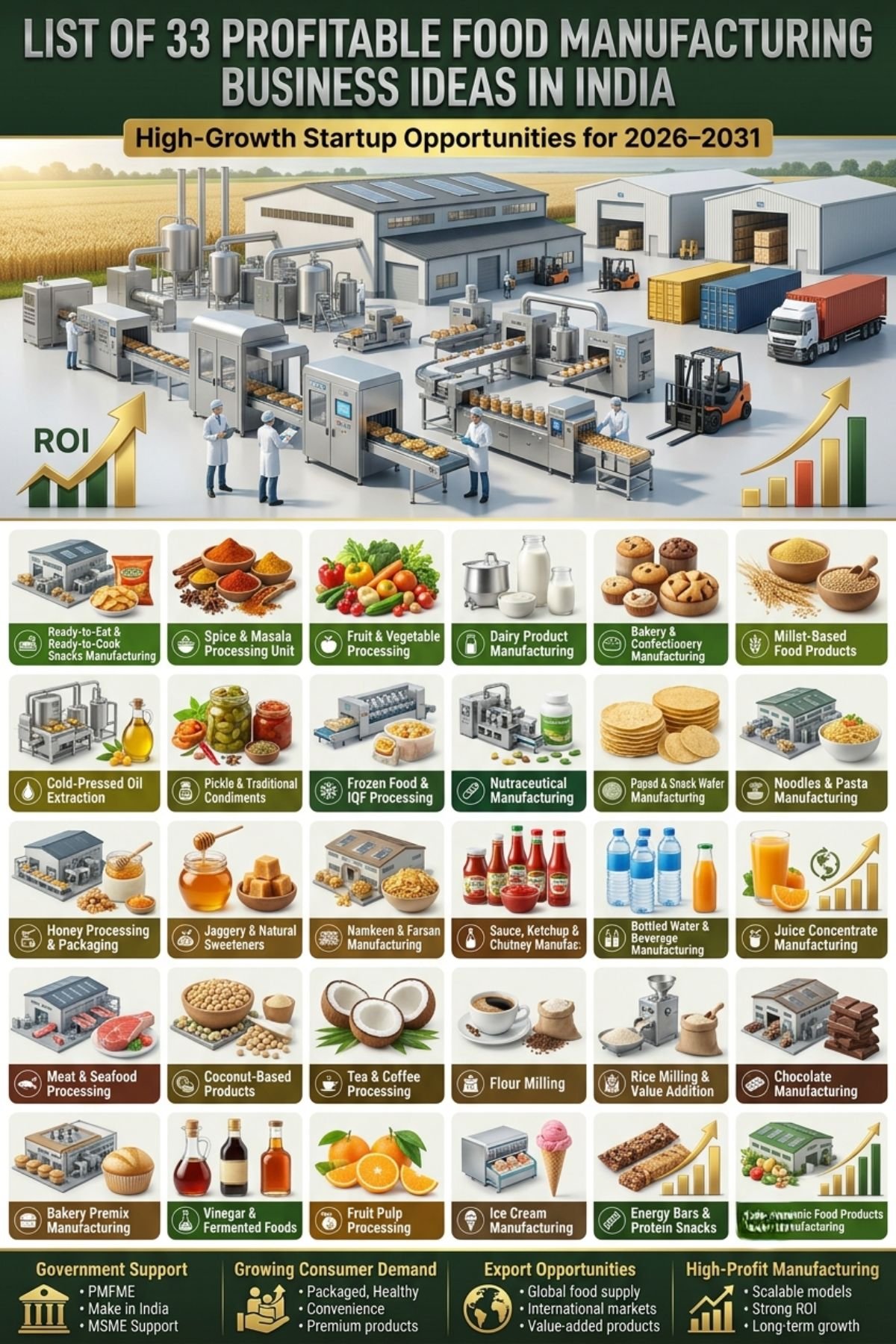
33 Profitable Food Manufacturing Business Ideas at a Glance
Before getting into the details, it’s beneficial to observe the entire array of business concepts offered in this field. The following is the list of 33 food manufacturing business ideas ranging from low investment starter to food export business which requires high investment. Then use it as a short list to whittle down the segment that meets your budget, location and raw material access requirements.
- Ready-to-Eat and Ready-to-Cook Snacks Manufacturing
- Spice and Masala Processing Unit
- Fruit and Vegetable Processing (Juices, Pulp, Jams)
- Dairy-Based Product Manufacturing (Paneer, Ghee, Flavoured Milk)
- Bakery and Confectionery Manufacturing
- Millet-Based Food Products
- Cold-Pressed Oil Extraction Unit
- Pickle and Traditional Condiment Manufacturing
- Frozen Food and IQF Processing
- Nutraceutical and Health Food Supplements Manufacturing
- Papad and Snack Wafer Manufacturing
- Noodles and Pasta Manufacturing
- Breakfast Cereal Manufacturing
- Honey Processing and Packaging Unit
- Jaggery and Natural Sweetener Production
- Namkeen and Farsan Manufacturing
- Sauce, Ketchup, and Chutney Manufacturing
- Bottled Water and Packaged Beverage Manufacturing
- Fruit-Based Juice Concentrate Manufacturing for Export
- Egg Processing (Egg Powder and Frozen Egg Products)
- Meat and Seafood Processing Unit
- Soya-Based Food Products (Soy Milk, Tofu, Textured Soy Protein)
- Coconut-Based Products (Desiccated Coconut, Coconut Milk, Virgin Coconut Oil)
- Tea and Coffee Processing and Blending Unit
- Flour Milling (Atta, Besan, and Maida Production)
- Rice Milling and Value-Added Rice Products
- Chocolate and Cocoa-Based Product Manufacturing
- Bakery Premix Manufacturing (Cake Mixes and Bread Improvers)
- Vinegar and Fermented Food Production
- Fruit Pulp Processing for Export Markets
- Ice Cream and Frozen Dessert Manufacturing
- Energy Bar and Protein Snack Manufacturing
- Organic Food Products Manufacturing
10 Business Ideas Explored in Depth
The following 10 ideas are worth examining in a more consultant fashion of the 33 ideas listed above. They all exhibit healthy margins and low first-fee requirements, making them a solid basis for a first feasibility.
Ready-to-Eat and Ready-to-Cook Snack Manufacturing
Packaged snack sales are no longer something that students or working adults buy from time to time, but more of a regular routine. A small extrusion/frying unit for namkeen, multi-grain chips or ready-to-eat foods, may begin with a small amount of capital and grow slowly over time as the area expands and distribution grows. Margins remain good as raw material costs are not seen as much as the final retail price, particularly after a brand achieves repeat purchase. However, it is the founders’ responsibility to invest early on shelf-life testing and packaging. These two factors will determine whether a product lasts beyond the first purchase cycle. Regional flavour customisation also gives small manufacturers an advantage over national brands, which are likely to create a standardised taste profile.
Spice and Masala Processing Unit
India’s spice belt will allow manufacturers to have direct access to raw material and hence the cost of inputs is predictable. A turmeric, chilli, coriander or blended masala cleaning, grinding and blending unit requires relatively simple equipment and can be started from a small shed. When masala is bought in a packaged and branded form, it is always priced higher than loose masala in the local market. Plus, export demand for Indian spices in West Asian and European markets continue to be robust, providing an impulsive growth trajectory to an ambitious manufacturer as the domestic demand stabilises. Once plans for export are involved, however, quality certification is a deal-breaker.
Download the Full Guide: The Complete Book on Spices & Condiments (with Cultivation, Processing & Uses)
Fruit and Vegetable Processing for Juices, Pulp, and Jams
A large proportion of the fruit and vegetables crops produced in India go bad each season and this is one reason why processing capacity is inadequate in most parts of the country. A unit can get pulp, jams, purees or preserved juices directly from the nearby farms which reduces the cost and wastage too. cold storage is not an option, but a necessity for this seasonal, perishable category. Early and good relationships with farmers makes for better raw material prices and quality, a significant consideration once buyers begin to compare batches. This concept also fits in well with cold-chain support by the government: access to subsidy is fairly easy.
Read the Complete Book Here: Handbook on Fruits, Vegetables & Food Processing with Canning & Preservation
Dairy-Based Product Manufacturing
Paneer, ghee, flavoured milk are products with assured demand and are even recession-proof in India and so are the yoghurt-based products as well. The benefits for a small dairy processing unit located close to a milk producing belt are lower procurement prices and fresh milk. The margins of ghee are strong, especially since consumers are willing to pay for trusted brands and are aware of its quality attributes. The other side of the coin, however, is that this category requires a high level of hygiene and cold chain discipline, so founders must be careful from the beginning to budget for refrigeration, and FSSAI compliance, as this is not something they can simply add on at the last minute.
Explore This Book: Modern Technology Of Milk Processing & Dairy Products
Bakery and Confectionery Manufacturing
The sale of bread, biscuits, cakes, and regional sweets takes place through an unusually large number of channels, including the neighbourhood kirana stores, modern trade and online grocery stores. A semi-automated bakery unit is capable of providing a city cluster profitably without having to be national scale from the beginning. Depending on the product, shelf life is very different and founders must decide carefully on the product mix, combining biscuits of longer life with fresher products of higher margin, such as cakes or regional sweets. Local festivals and seasonal demand also provide a steady, repeatable income stream for savvy founders, and lead to production planning far in advance.
Get Detailed Project Report (DPR): Bakery & Confectionery Products Manufacturing Guide
Millet-Based Food Products
The millets have come a long way from being a health food niche product to being available on most retail shelves and have experienced significant government promotion and increased consumer interest in traditional grains. A mill that makes millet flour, ready-mix batters or millet snacks captures the appeal of health-conscious urban consumers and export demand for ancient grains. Sourcing costs are comparatively stable as millets have comparatively low requirements for water and inputs and thus less effect on them during the variable monsoon rains. Also, some state governments now have special promotion schemes for millets that can make a significant dent in the initial capital investment for a new entrant in the field.
Cold-Pressed Oil Extraction Unit
People now prefer to opt for cold pressed groundnut, mustard and coconut oils as they believe that these oils are healthier and taste authentic rather than refined oils. The expeller is a relatively simple piece of equipment and works well at smaller daily throughput even on a small scale. The role of branding is significant here, as with cold-pressed oil, once the consumer is convinced of the quality and origin of the production, it has a real premium. Early on, sometimes local direct-to-consumer markets like farmers’ markets or online sales are more effective than wholesale distribution sales.
Related Article: How to Start Groundnut and Oilseeds Export Business in India: Manufacturing & Export Opportunities
Pickle and Traditional Condiment Manufacturing
Pickles and local spices have long since been a part of Indian cuisine and demand is rarely affected by the economic condition of the country. A small-scale unit, even one in the home or shed, can become a unit for making mango, lime, or mixed vegetable pickles or pickles of a particular area, and then expand into a proper factory. Recipes are very different across different regions and if a founder focuses on a true, popular local dish, they are likely to be a better performer than a “generic” mass-market dish. Packaging and shelf stability testing still are important, as the behaviour of oil-based pickles in storage varies from that of vinegar-based pickles.
Frozen Food and IQF Processing
With the growing number of Indian households purchasing home freezers and shopping smart, individually quick frozen, or IQF, vegetables, parathas and ready meals are taking off like a rocket. A frozen food unit requires a bigger initial investment in refrigeration equipment than the ambient-shelf categories, and will generate significantly higher margins and extend product life once in operation. New entrants find no intimidation from established brands as modern trade chains and quick-commerce platforms continue to expand their frozen food sections, creating a true level playing field.
Access Complete Business Plan: Frozen Foods, Fresh Produce, Purees & Sauces Manufacturing Project Report
Nutraceutical and Health Food Supplements Manufacturing
The protein bar, fortified cereal, herbal health mix and functional beverage market are growing at the pace of a whirlwind and are at the forefront of paying attention to fitness awareness and preventive healthcare thinking in food manufacturing. A small manufacturing unit based on this category can charge premium price much higher than standard packaged food so long as the formulation and labelling are done correctly according to FSSAI’s nutraceutical guidelines. Founders who put resources into good formulation research reap higher rewards in this segment than do those who simply take an existing product into their market, as this segment rewards true product differentiation.
Matching the Right Idea to Your Investment Level
Entrepreneurs with limited capital can achieve success in the pickles, spice mixes, or bakery sectors because these businesses require relatively low investment in equipment, and entrepreneurs can acquire the necessary skills in a short period. Founders with a slightly larger capital and time horizon may want to go into dairy, frozen food or nutraceutical categories because margins are bigger, entry costs are bigger, and brand defensibility is bigger. In either case, the sensible way to go would be to begin a single product line, establish local demand, and then branch out. Attempting to introduce five categories simultaneously, however, is likely to push working capital and quality control beyond the manageable range.
Import-Export Opportunity Analysis
Spices, marine products, processed fruits, rice preparations and more recently, ready-to-eat food are already a part of India’s food basket that is exported. Exporting manufacturers need to plan for quality certification, however, not as an end product, rather as a start.
Export documentation and market intelligence is primarily available through APEDA, Agricultural and Processed Food Products Export Development Authority, which keeps buyer-seller data, norms for certification and country-wise compliance. A manufacturer can gain a real competitive advantage by obtaining HACCP, ISO 22000, or BRC certification early, as completing the certification process may take considerable time.
In the export side, many Indian manufacturing units continue to import specialised ingredients like flavouring ingredients, packaging film for food products, and machinery for food processing. As a result, a founder well-versed in both aspects of this trade equation can negotiate better terms with suppliers and plan for currency risk in a more enlightened way.
Importation of Indian spices, snacks and milks is significant, particularly for the Gulf Cooperation Council countries, due to the well-established Indian presence in those countries. Likewise, interest in Indian ready-to-eat foods and millets is growing in the Southeast Asian markets. A company that starts with a global export vision should therefore examine these specific corridors and not take it for granted that there’s a global demand for all the products.
Indian MSME Success Stories Worth Studying
Haldi rams started as a small namkeen shop at Bikaner and is now one of the biggest branded snack and sweets manufacturers in India. Their guiding principles and rules focused on preserving the original taste of the region and at the same time improving packaging and delivery, and many new food producers still have a hard time doing these two together.
Amul had a much different approach. Dr. Verghese Kurien designed it as a farmer cooperative and transformed a scattered dairy system into one of the world’s largest dairy brands. The lesson for new entrepreneurs is simple: larger private players can overcome scale challenges by aggregating and standardising supply and quality.
MTR Foods, a restaurant in Bangalore, decades ago migrated into the realm of packaged ready to eat and instant mix makers, before the segment became the mainstream. They were early to turn a trusted recipe into a shelf-stable product, thus providing them with a head start that newer competitors struggle to match.
All three stories have a common theme. For each company, it was a single authentic attribute, aggregation of supplies or early conversion of products; they each built manufacturing around a single strength they saw. New entrepreneurs tend to go all-in on all fronts. It is much better if it is more defined and targeted.
Getting Professional Feasibility Support Before You Invest
The common mistakes made in food feasibility are the lack of appropriate techno-economic analysis before investing. NIIR Project Consultancy Services (NPCS) prepares Market Survey-cum-Detailed Techno-Economic Feasibility Reports for entrepreneurs planning to establish new food manufacturing businesses. Our reports include manufacturing processes, demand analysis, process flow diagrams, product mix planning, detail of machinery and raw materials, project financials including profitability analysis. In all interactions, the goal remains the same: assess feasibility and scalability of a business correctly, before ordering the first machine.
Discover business ideas that actually make money
Market Snapshot: Investment and Margin Comparison
The table below gives a broad, indicative comparison across the business ideas discussed above. Actual figures vary by location, scale, and product mix, so treat this as a directional planning tool rather than a fixed benchmark.
| Business Idea | Approx. Entry Investment | Typical Gross Margin | Demand Outlook |
| RTE / RTC Snacks | ₹10–40 lakh | 25–35% | Strong, urban-led |
| Spice & Masala Processing | ₹8–25 lakh | 20–30% | Steady, export-linked |
| Fruit & Vegetable Processing | ₹15–50 lakh | 20–28% | Seasonal, growing |
| Dairy-Based Products | ₹15–60 lakh | 18–25% | Consistently high |
| Bakery & Confectionery | ₹8–30 lakh | 22–32% | Broad-based, stable |
| Millet-Based Foods | ₹10–35 lakh | 20–30% | Fast-rising |
| Cold-Pressed Oil | ₹12–40 lakh | 18–26% | Premium niche growth |
| Pickles & Condiments | ₹5–20 lakh | 25–35% | Stable, region-driven |
| Frozen Food / IQF | ₹30–90 lakh | 22–30% | Strong, retail-led |
| Nutraceutical Foods | ₹20–70 lakh | 28–40% | High-growth, premium |
Frequently Asked Questions
What is the right amount of capital to begin a small food manufacturing business?
However, most micro businesses in the pickles, spice processing segment, or bakery businesses can start between ₹5 lakh and ₹25 lakh, particularly by availing PMFME credit-linked subsidy support instead of taking loan from their personal savings.
What kind of food manufacturing business is best for your first time?
The most straightforward categories with less equipment and less training, like pickles, spices, or bakery items, tend to be more appropriate for first-time entrepreneurs than more capital-intensive options, like frozen foods or dairy processing.
Is FSSAI Registration mandatory before Production?
Yes, every food manufacturing business, regardless of its size, must obtain an FSSAI registration or license before starting production.
Typical time to break even?
The break-even time period for micro and small units in this sector is variable, but typically the time period ranges from 18-30 months with careful management of distribution and working capital.
Is it realistic for a small manufacturer to export food products?
Yes, but after obtaining the appropriate quality certifications and registration with APEDA (if applicable). This is a step that should never be rushed since export buyers are not likely to be satisfied with less than a satisfactory presentation.
Do you qualify for a government subsidy loan without a bank loan?
Normally subsidy support under a scheme such as PMFME only covers part of the project costs, and the founder(s) will require a bank loan or other means of financing the project in addition to the subsidy.
Conclusion
In the food business world, it’s more about the vision and the execution than the hype around a product category. The business ideas here range from low investment start-up categories to those that have a higher margin and commitment, allowing the business founder to align the type of business they are looking to start to the capital they will have at their disposal and the appetite for risk that they have. When used properly, government schemes such as PMFME to PLISFPI can have a positive impact on alleviating financial stress early on. In the end, however, it will be the results of a good feasibility study, an honest demand analysis and a disciplined quality control that determine the success or failure of a manufacturing business after a few years.