A ₹7,200 Crore Signal the Market Cannot Ignore
The agriculture sector in India has just got a big push in the right direction through the policy. The Press Information Bureau (PIB) on 21 August 2026 issued an in-depth explainer about the government’s flagship price-support programme for farmers, named Pradhan Mantri Annadata Aay Sanrakshan Abhiyan (PM-AASHA). The Union Budget 2026-27 has allocated ₹7,200 crore to the scheme, compared to ₹6,941 crore last year, making it abundantly clear that India is investing in further enhancing agricultural value chains, procurement mechanisms, and rural market connectivity.
This is more than just a social welfare update for entrepreneurs, manufacturers and investors. The increased food basket handled by PM-AASHA (pulses, oilseeds, copra, onions, potatoes and perishable horticultural crops) establishes a formal demand pipeline with government purchase guarantees. As a reliable buyer through Minimum Support Price (MSP), the Government of India helps to stabilise the income of the farmers, thereby generating demand for agri-processing, cold-chain logistics, packaging, warehousing, and precision agricultural inputs. This article derives the business opportunity from a government welfare programme.
What the PIB’s PM-AASHA Update Means for Business
The PM-AASHA’s 21 August 2026 explainer throws light on a much-expanded procurement ecosystem. In order to meet the different market failures in Indian agriculture, the scheme is now handled through four integrated schemes namely Price Support Scheme (PSS), Price Stabilization Fund (PSF), Price Deficiency Payment Scheme (PDPS) and Market Intervention Scheme (MIS).
The welfare aspect is not the commercial aspect of this update. The magnitude of the infrastructure investment on which the government is relying to get this right is what really makes this so significant:
- Agriculture Infrastructure Fund (AIF) has disbursed loans of ₹96,426 crore for 2,14,437 projects.
- As of now, e-NAM has 1,656 mandis in 23 States and 4 UTs with over ₹4,94,847 crore trade through its platform.
- Government has allowed 50,249 warehouses with 992.6 lakh MT of storage capacity.
- Now, 7,334 Farmer Producer Organisations (FPOs) are connected on the Open Network for Digital Commerce (ONDC).
All these data points are points where private entrepreneurs can connect to the procurement, processing, or logistics process. MSP-based purchases of pulses such as tur, urad, masur etc., which can now be made up to 100% of state production, helps augment feedstock for dal mills, protein extractors and dal flour producers in India which depend on these pulses heavily.
The PIB also notes that Bihar has started organised procurement of lentil for the first time under NCCF and Chhattisgarh is actively conducting chana, masur, mustard procurement through 200 PACS and 12 FPOs. Such growth at a state level will result in new geographical areas of raw material supply where agri-businesses can develop strategically.
Why India’s Agri-Processing Industry Is Ready to Leap
India ranks as the world’s largest producer as well as consumer of Pulses and is a major producer of oilseeds. Under notwithstanding, it still is a net buyer of edible oils, and suffers billions of dollars annually at the hands of the overseas refineries. In PM-AASHA guidelines, the government has now made it clear that procurement of tur, urad and masur may be up to 100 percent of the state production to ensure “boost pulse output from the domestic sources and minimize imports.” An open call to domestic processors.
MSP margins are attractive for oilseeds. A farmer margin of ₹1,903 (MSP – production cost) is recorded for Soybean which is one of the highest among the crops. This margin encourages more planting which then ensures that there is more feedstock available for oil extraction equipment.
In India, post-harvest losses are responsible for 15-20% of the total food production and incur billions of dollars of losses. This is where PM-AASHA’s efforts on procurement infrastructure, namely AIF-supported warehouses, investments in cold-chain facilities, mandis, come to the fore to address the problem. Private business and enterprise that invests in complementary infrastructure around this public investment will reap a long-term, government-protected market.
Government Policies and Incentives Backing This Opportunity
The PM-AASHA scheme (PIB Explainer, 21 August 2026) is the core policy framework that brings coordination in place regarding price-support interventions implemented by central and state level agencies.
- Agriculture Infrastructure Fund (AIF): ₹1 lakh crore AIF provides low-cost financing for post-harvest management and agri-logistics. agriinfra.dac.gov.in
- Ministry of Agriculture & Farmers Welfare: Oversight of PM-AASHA, FPO support, and MSP policy.
- NAFED (National Agricultural Cooperative Marketing Federation): Primary procurement agency under PM-AASHA. nafed-india.com
- e-NAM (Electronic National Agriculture Market): Digital market connecting 1,656 mandis. enam.gov.in
- MSME Ministry (Udyam Portal): MSME registration and scheme access for new agri-processing units. udyamregistration.gov.in
- Food Processing Industries Ministry (MOFPI): PLI schemes, PMKSY, and cold-chain grants. mofpi.gov.in
- APEDA (Agricultural & Processed Food Products Export Development Authority): Export promotion for processed agri commodities. apeda.gov.in
- Bihar Agriculture Department: State-level support for new lentil procurement and processing ventures.
- Chhattisgarh Department of Agriculture: Active pulse and oilseed procurement zone with PACS network.
Manufacturing Business Opportunities Directly Linked to PM-AASHA
Here are six manufacturing and agri-processing ventures that directly benefit from PM-AASHA’s expanded procurement architecture:
1. Dal (Pulse) Milling and Dehusking Units
Now, PM-AASHA has allowed for the 100% procurement of tur, urad and masur from states, which means that these pulses will be supplied to the government and private markets in higher and regular quantities as compared to the earlier period. The mills who can contract with government to procure pulses or purchase raw stock from PACS and FPOs, who get transparently charged at MSP linked prices are on the safe side. A mid-size dal milling unit (2-5 MT/hr) in Bihar or Chhattisgarh (both are now PM-AASHA procurement zones) is an investment opportunity with the assured raw material supply from the government.
The investment range is between ₹50 lakh and ₹2 crore. The state governments in Bihar and Chhattisgarh are actively promoting them via PMKSY (Pradhan Mantri Kisan Sampada Yojana) food processing grants.
Get Detailed Project Report (DPR): Dall Mill Manufacturing Plant – Detailed Project Report
2. Edible Oil Extraction and Refining Plants
Oilseed availability has become structurally more reliable as soybean MSP is at ₹5,708/quintal and the procurement under PM AASHA is in full swing in Chhattisgarh. Domestic solvent extraction and refinery units have an opportunity to expand their operations due to the government’s explicit objective to reduce edible oil imports. There are small-scale expeller and solvent extraction facilities that produce refined oil from soybean, mustard and groundnut, which can be marketed to the institutional customers (government canteens, NCCF distribution networks) and retail markets.
The investment range is between ₹75 lakh and ₹5 crore. Qualifying units are eligible for AIF loans at low interest rates.
View Full Project Details: Edible Oils in India Market Research Report
3. Cold Storage and Controlled Atmosphere Warehousing
The Market Intervention Scheme (MIS) under PM-AASHA has specifically identified the commodities such as tomatoes, onions and potatoes as perishables. These crops are purchased by the government during the surplus seasons and requires cold chain facilities to preserve and transport the crops. The PIB report states that 50,249 warehouses have received approval, but demand far exceeds supply. District-based entrepreneurs can earn assured rental income by offering cold storage facilities to NAFED and NCCF operations. They can also rent these facilities to private traders.
The investment range of the project is 1 crore to 10 crore, depending on the project’s capacity. Subsidy would be available under PMKSY Agro-Processing Cluster.
Access Complete Business Plan: Warehouse
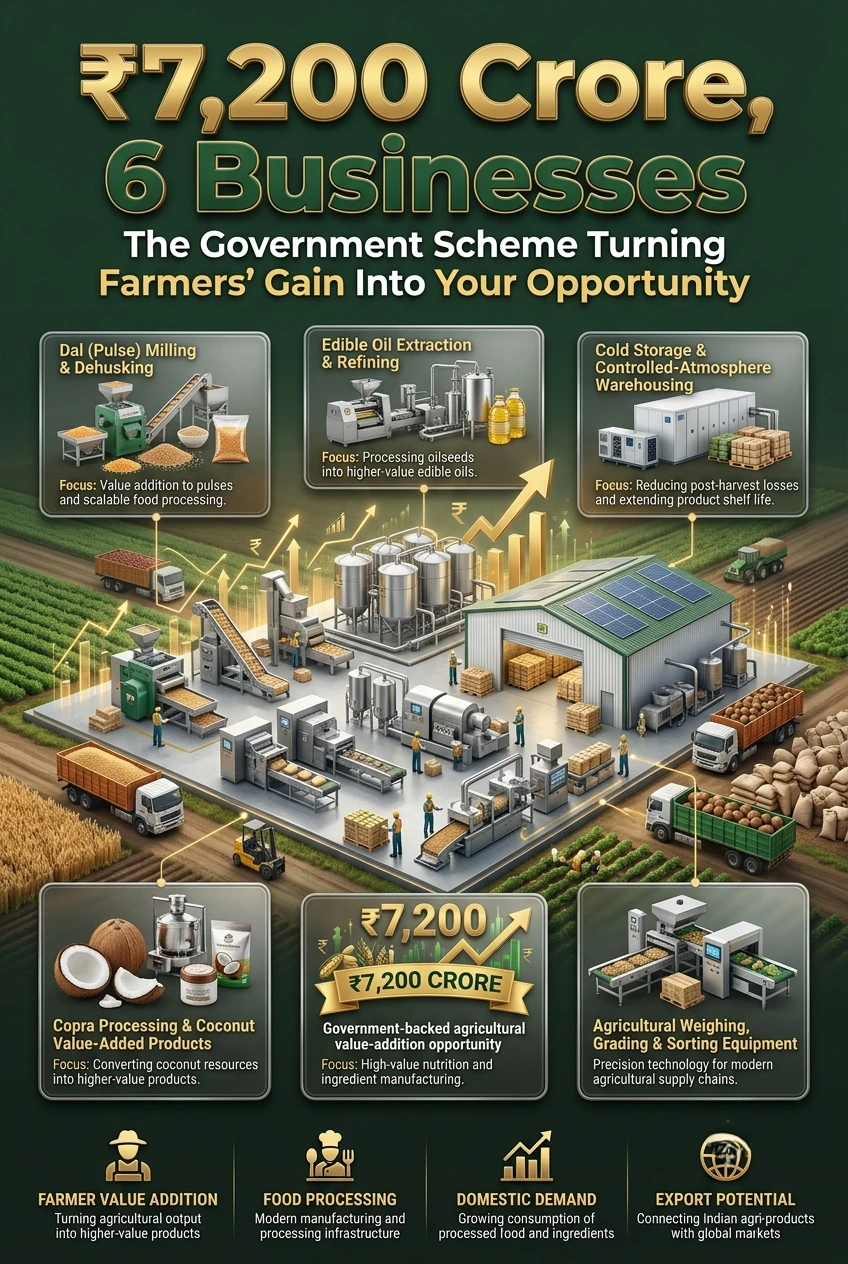
4. Copra Processing and Coconut Value-Added Products Manufacturing
Copra is one of the three commodities specifically mentioned in PM-AASHA’s Price Support Scheme (PSP). The MSP procurement of copra at the central level and linkages with the NAFED ensures that processors who are capable of extracting virgin coconut oil, coconut milk, coconut flour and desiccated coconut, have both access to affordable raw material (at or near MSP prices) and a market for which global food brands are craving for. It can be expected to be concentrated in natural hubs like Kerala, Karnataka and Tamil Nadu.
The investment range is between ₹30 lakh and ₹3 crore. Coconut Development Board (CDB) also provides grants for the unit.
Related Article: Profitable Coconut Business Ideas for Beginners
5. Pulse and Oilseed-Based Protein Isolate Manufacturing
The processed food and nutraceutical market in India is expanding and the demand for pulse and soybean protein isolates are increasing rapidly from the food manufacturers and supplement companies. This is a viable manufacturing vertical, as the availability of raw materials has been stabilised by the PM-AASHA procurement. The manufacturing of pea protein (from chana), soy protein isolate, and protein flour from masur can target the domestic FMCG market and overseas markets in the Middle East, Southeast Asia, and Europe.
Capacity range: ₹2 crore to ₹15 crore (for a mid-size facility). Select processed food categories are covered under MOFPI PLI scheme.
Get Detailed Insights from This Book: Fruits, Vegetables, Corn and Oilseeds Processing Handbook
6. Agricultural Weighing, Grading, and Sorting Equipment Manufacturing
Investment range: ₹25 lakh to ₹2 crore. Benefits of Make in India are applicable.
Import–Export Opportunity Analysis
One of the largest heads of India’s import bills is on edible oils, which cost more than $20 billion a year. PM-AASHA’s efforts to achieve maximum domestic oilseed procurement and processing directly help to lower this dependency. Domestic refinery of mustard, soybean and groundnut oil by the manufacturers at competitive quality levels will avail them not only of the opportunity of import substitution but also of export possibilities to Bhutan, Nepal, Sri Lanka and ASEAN countries where Indian brand edible oils are in premium position.
India continues to be a major exporter of processed Dal to the worldwide South Asian diaspora market in the UK, USA, Canada and the Gulf. With the increased domestic production, Indian dal mills can boost export volumes as a part of the government’s incentive measure — guaranteed MSP under PM-AASHA. APEDA offers export development support and market promotion facilitation to the exporters of processed pulses.
Copra and coconut-based products are high value exportable products. Vietnam and Indonesia are the two countries that are competing for the largest share of the world’s market for coconut products. Indian manufacturers, especially those from Kerala, can stand out by marketing FSSAI certified organically produced products to high-end western markets. The new integration of FPO on the e-NAM platform also enables the processors to directly procure certified organic copra from the farmer groups.
Another export opportunity is agricultural processing equipment, the power for PM-AASHA’s procurement infrastructure. Indian manufacturers already export to Bangladesh, East Africa and South East Asia for producing mills for dal, oil expeller and grain sorters. The government’s emphasis on developing domestic procurement facilities will stimulate R&D and scaling up, which will deepen export competitiveness.
Indian MSME Success Stories in Pulse and Oilseed Processing
Bafna Dal Mill, Indore, Madhya Pradesh
Bafna Dal Mill, a third-generation family-owned unit in Madhya Pradesh’s Malwa region, upgraded its 1 MT/hour plant to a 5 MT/hour automated plant. It used food processing grants under PMKSY and cold storage loans with AIF support. Today, the unit sells toor dal to institutional buyers, including state government PDS networks. This shows how PM-AASHA procurement can create a sustainable downstream market for MSME mills.
Coconut Processing Cooperative, Thrissur, Kerala
In 2022, 1200 farmers from a producer cooperative from Thrissur District in Kerala, established a copra processing unit with the enablement of Coconut Development Board grants and NABARD support. This unit has recently begun exporting virgin coconut oil under its own brand to Germany and to the UK. The copra MSP, provided by PM-AASHA, guarantees remunerative prices to the member farmers for the raw material sent to the processing unit, which ensures a virtuous cycle of stable income of PM-AASHA’s member farmers and viability of the processing unit.
Chhattisgarh Agri Exports Pvt. Ltd., Raipur
Chhattisgarh Agri Exports secured AIF financing and MOFPI PLI incentives to scale up production. The young start-up uses the PACS network to aggregate government-procured chana (chickpeas). It then transforms the chana into roasted chana flour and protein-enriched snack ingredients. The start-up now serves three organised snack brands in Western India. Therefore, State-level PM-AASHA procurement zones directly support agri-processing entrepreneurs.
Smart entrepreneurs start here—find your perfect venture
About Niir Project Consultancy Services (NPCS)
Niir Project Consultancy Services (NPCS) is one of India’s most trusted industrial consultancy firms, helping entrepreneurs, MSMEs, and large companies launch and scale manufacturing businesses across sectors. NPCS supports agri-processing ventures with:
- Detailed Project Reports (DPRs) for dal mills, oil extraction plants, cold storage, and food processing units — bankable documents accepted by banks and financial institutions.
- Market Research covering raw material availability, competitive landscape, MSP trends, and demand projections.
- Feasibility Studies assessing economic viability, ROI timelines, and risk factors for new manufacturing investments.
- Technology Consultancy identifying optimal machinery, process flows, and supplier networks for agri-processing units.
- Project Implementation Support from plant layout design to regulatory approvals under FSSAI, MSME, and state industry departments.
For entrepreneurs looking to enter pulse milling, oilseed processing, cold storage, or agricultural equipment manufacturing — businesses directly energised by PM-AASHA — NPCS project reports provide the strategic and financial foundation needed to move from idea to funded operation.
PM-AASHA Business Opportunity at a Glance
| Parameter | Details |
| Industry | Agri-Processing, Pulse Milling, Edible Oil, Cold Chain, Agri-Equipment |
| Market Driver | PM-AASHA ₹7,200 Crore Budget 2026–27; MSP-backed procurement guarantees |
| Investment Range | ₹25 Lakh (Equipment Units) to ₹15 Crore (Protein Isolate Plants) |
| MSME Opportunity | Dal Mills, Oil Expellers, Cold Storage, Copra Processing, Grading Equipment |
| Export Potential | Edible Oils (ASEAN, Middle East), Dal (Diaspora Markets), Coconut Products (EU, USA) |
| Government Support | AIF, PMKSY, MOFPI PLI, APEDA, Udyam, NAFED/NCCF Linkages |
| Risk Level | Low–Medium (MSP floor price reduces raw material price volatility) |
| Growth Outlook | High — PM-AASHA budget growing year-on-year; pulse import substitution policy active |
Conclusion: Act Now While the Policy Window Is Open
The government’s commitment to PM-AASHA is growing stronger every year, as confirmed by PIB’s August 2026 explainer. The budget has risen from ₹5,437 crore in actual spend (2024–25) to a ₹7,200 crore allocation in 2026–27 — a 32% increase in two years. This upward trajectory signals sustained government commitment and a growing procurement infrastructure that private agri-businesses can anchor themselves to.
The business opportunities are real and varied. Dal mills in Bihar and Chhattisgarh have government procurement volumes and PACS networks as ready raw material pipelines. Cold storage operators can earn institutional revenue from MIS operations. Oilseed processors can ride the edible oil import substitution policy while tapping AIF loans at subsidised rates. Copra processors in Kerala and Karnataka can access MSP-linked copra and target premium export markets.
India’s agri-processing sector is not a sunset industry. It is a structurally strengthening opportunity, powered by demographic demand, policy support, and an unprecedented government investment in farm-to-market infrastructure. The PM-AASHA framework removes one of the biggest risks entrepreneurs face in this sector: raw material price volatility. With MSP as a floor price and AIF as a financing vehicle, the downside is managed. The upside — growing domestic food demand and export potential — is yours to capture.
Entrepreneurs who identify their processing niche, commission a bankable project report, and engage with state nodal agencies within the next two to three months will position themselves ahead of the investment cycle. Waiting means competing against better-capitalised players who moved first.