A Consultancy-Grade Business Opportunity Report for Entrepreneurs, MSMEs & Investors
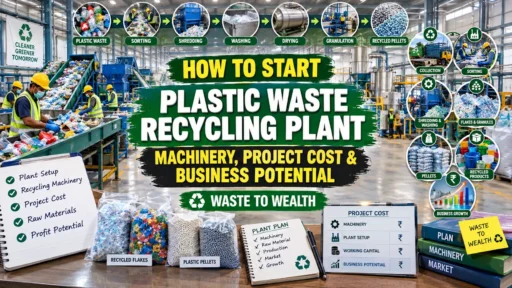
Recently, Moneycontrol published a report about how an entrepreneur made a business of selling products to ₹40 lakh per month from just ₹13 per kilogram of plastic waste. This is not only inspirational but also a message to all MSMEs in India, including key stakeholders such as the founders, investors, and manufacturers in the plastic waste recycling sector, that it is no longer a side hustle. It is a regular, scalable and revenue-generating sector that is ripe for organised players.
The Central Pollution Control Board (CPCB) estimates that India produces plastic waste of about 26,000 tonnes each day.
The business owner, whom Moneycontrol had profiled, did just that. He was able to find a reliable, abundant and significantly underpriced raw material — post-consumer plastic waste — set up collection and processing facilities and establish a business that makes his salary men much more money to generate in a year. In this article, we will discuss what that means for you and how you can deal with it or build on it.
Get Detailed Project Report (DPR): Plastic Waste Recycling Plant – Detailed Project Report
What Recent Reporting Means for Entrepreneurs and MSMEs
The Moneycontrol feature (read the article here) isn’t simply a human-interest story. It’s difficult to validate in the market. It reiterates three structural truths for all business people:
- Plastic waste is available in copious amount with an absurd low procurement cost (₹13/kg in this case), which gives one of the greatest margins in terms of raw material in Indian manufacturing.
- Basic processing facilities can generate revenues that are multiples of those of traditional “small” manufacturing operations.
The market for recycled plastic material – as pellets, aggregates, fibre or fuel – is expected to grow significantly as governments impose more Extended Producer Responsibility (EPR) targets and brands increase demand for post-consumer recycled content.
This is an obvious arbitrage opportunity for entrepreneurs. Purchase waste at low prices, process efficiently, and market at prices required by law. MSME manufacturers can consider integrating a plastic waste processing line into their current facility to create an additional stream of revenue with good margins. Investors make a defensible, ESG-friendly bet on organised recyclers that are aggregating collection networks in an industry that is regulated in an investor-friendly way.
The major learning point was the ability to recognize the quality of plastic waste as well as establishing a disciplined chain of waste collectors and consistent arrangements with buyers of processed waste, as Moneycontrol reported. These are steps that can be learned, replicated — not black-box secrets.
Plastic Recycling Industry Is Growing Fast in India
The Indian plastic waste management industry is experiencing unprecedented growth, which is being fuelled by three converging forces.
1. Regulatory Pressure on Brands
2. Raw Material Abundance
The amount of plastic waste generated in India has doubled in four years, from about 1.75 million metric tonnes in 2016 to about 3.5 million metric tonnes in 2020, according to US International Development Finance Corporation. The path rises further with the growth of e-commerce and food delivery which accounts for millions of plastic parts in the waste flow d.
3. Rising Prices for Recycled Material
The cost of recycled plastic pellets and granules, certified for EPR, is increasing as brands race to achieve their targets. The days of paying less for recycled content are behind us, and big FMCG companies are willing to pay more for traceable, certified recycled content. This premium goes straight to organized processors that can assure the quality of the material and can also offer EPR certificate.
Government Policies and Incentives
Nine key government programmes and portals are directly relevant to plastic waste entrepreneurs:
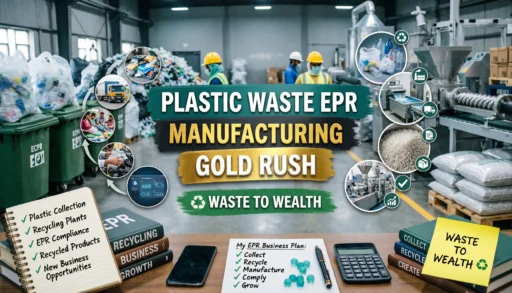
- MoEF&CC EPR Framework for Plastic Packaging — Mandates recycling targets for producers and creates a certificate trading market that recyclers can monetise.
- Central Pollution Control Board (CPCB) — Plastic Waste Registration Portal — All plastic waste processors must register with the CPCB. The portal manages EPR certificate issuance.
- MSME Ministry — Credit Guarantee Fund Trust for Micro & Small Enterprises (CGTMSE) — Provides collateral-free loans up to ₹5 crore for MSME recycling units.
- Ministry of Housing & Urban Affairs — Swachh Bharat Mission — Funds waste management infrastructure including collection, segregation, and processing centres.
- SIDBI — Make in India Fund for Recycling Sector — SIDBI offers concessional credit lines to green and recycling enterprises under its SMILE and Udyami Mitra schemes.
- National Mission for Clean Ganga (NMCG) — Actively funds plastic waste interception and riverbank collection infrastructure, creating business opportunities for private collectors.
- Department for Promotion of Industry and Internal Trade (DPIIT) — Startup recognition and tax exemptions for waste management ventures under the Startup India scheme.
- NABARD — Rural Plastic Waste Collection Financing — NABARD finances rural collection infrastructure through its Rural Infrastructure Development Fund.
- BIS — Bureau of Indian Standards — Recycled Plastics Standards — Sets quality standards for recycled plastic products, enabling export certification for processors.
6 High-Potential Manufacturing Business Ideas from This Story
1. PET Bottle-to-Polyester Fibre Plant
Urban PET bottles collected are shredded, washed and extruded into polyester staple fibre that is used for pillows, mattresses, carpets and automotive interiors. Import-substitution potential is available with the import of a considerable quantity of polyester fibre into India. If the fibre is of good quality and there is a guaranteed demand from the buyer, the revenue from a mid-scale plant, treating 2 tonnes of fibre daily, vary between ₹25 lakh to ₹35 lakh a month.
This opportunity comes directly from the news story: PET is the most sorted, most abundant and highest value plastic waste stream of households, making the entrepreneur’s model of sourcing waste at ₹13/kg an ideal match.
Access Complete Business Plan: Pet Bottle Manufacturing Business Guide
2. HDPE/PP Pelletising and Granule Manufacturing Unit
Recycled granules of High-Density Polyethylene (HDPE) and Polypropylene (PP) waste from containers, pipes, and packaging are available for sale to injection moulding units. These units use the granules in non-critical applications where recycled plastic can replace virgin plastic. Recycled PP and HDPE granules are expected to see strong market growth due to EPR compliance. The price of a basic pelletiser costing ₹20–35 lakh and having a capacity of 300–500 kg/hr can give an EBITDA margin from 25–35%.
Related Article: How to Start a HDPE/PP Plastic Recycling Plant in India: Investment, Machinery & Profit Margins
3. Plastic Lumber and Construction Board Manufacturing
Mixed and multi-layered plastic waste—the type that cannot be recycled into grade 1 plastic granules—can be extruded into plastic lumber (boards, planks, tiles and hollow sections) for use in outdoor furniture, fencing, roofing supports and construction shutter. This material can directly replace wood and offers very good resistance to weathering. The finished product costs ₹120-200 per kg, while the raw material costs as little as ₹15-20 per kg. The Government of Karnataka is adopting this material and requires 5-10% plastic waste in rural road construction work, making it another institutional buyer of plastic blends.

4. Plastic-to-Fuel (Pyrolysis Oil) Plant
Thermal cracking (pyrolysis) of non-recyclable multilayer and contaminated plastic waste produces diesel equivalent fuel oil, carbon black and combustible gas. Pyrolysis oil is sold at ₹30 to ₹45 per litre and is used as industrial fuel in Kiln, Boilers and Brick furnace. Another offtake channel is co-processing of plastic wastes with cement manufactures as allowed by Central Pollution Control Board. The investment required for 500 kg per day units is ₹15-25 Lakhs.
5. Recycled Plastic Geotextile Fibre Manufacturing
Processed PET waste is used in road construction, erosion control, slope stabilisation and drainage, as a spunbond fabric or woven geotextile fabric. The government’s infrastructure spending is contributing to an Indian geotextile market growth rate of more than 12% per year. The product is also export ready as it is in good demand in South East Asia and Africa. Value addition on raw PET is 5-8 times and margins are very attractive.
6. Plastic Waste Collection and EPR Certificate Aggregation Business
The easiest step to take: establish a plastic waste collection system in urban residential complexes, industrial estates and commercial buildings. Enroll as a Plastic Waste Processor with CPCB, and sell EPR certificates to the brands that are looking for compliance. Not all plastic has to be processed by you, it can be worked by processors and you will get the margin for aggregation. This model is a logistics-based model, which needs mainly logistics capability and administrative registration, but does not need heavy capital.
Get Detailed Insights from This Book: Medical, Municipal and Plastic Waste Management Handbook
Import–Export Opportunity Analysis
Export Markets for Recycled Plastic Products
India already has a ready market for recycled plastic granules, PET flakes, and plastic lumber in the Middle East, Southeast Asia, and East Africa. Global recycled plastics are forecast to grow significantly by the end of the decade. This growth is driven by brand commitments to use recycled content in post-consumer plastics. Processors in India that can assure customers of certified recycled content are more likely to qualify for export contracts. They must also maintain consistent quality control.
Major export markets include UAE, Bangladesh, Vietnam, Kenya and Sri Lanka. There is no home collection system and recycled plastics are imported in these markets.
Import Substitution Opportunity
India imports a huge amount of virgin plastic granules and polyester staple fibre. Organized domestic recyclers have the ability to provide import competitive prices on recycled equivalents, especially in uses where virgin quality is not required. With brands voluntarily and under EPR obligation, this substitution market is expanding.
Emerging International Demand
As the EU Single-Use Plastics Directive and the pending Global Plastics Treaty take effect, demand for traceable recycled plastics is growing in developing markets. As trade becomes formalised, Indian MSME recyclers that develop certification processes will be well placed to meet the demands of this new market.
Indian MSME Success Stories in Plastic Recycling
1. Srichakra Polyplast — Rajkot, Gujarat
2. Without (Ashaya) — Pune, Maharashtra
A Pune-based start-up specializes in recycling multi-layered plastic waste, which many processors do not prefer, into reusable materials using proprietary technology. The company works directly with the waste-pickers, providing them with a stable per-kg fee for sorted collection, and creates a social supply chain and a defensible raw material position. They’ve added outside investment and are expanding their processing power.
3. IFFS (Isha Fiber and Fuel Source) — Bengaluru, Karnataka
Identify high-growth industries before others do
About Niir Project Consultancy Services (NPCS)
Niir Project Consultancy Services (NPCS) is amongst the premier industrial and technical and business consultancy organizations in India with a rich experience of more than 40 years in the industrial project development field in manufacturing, agro-processing, chemicals, plastics, waste management and other allied fields.
NPCS provides:
- Detailed Project Reports (DPRs) of recycling plants for plastic waste, pelletising units, pyrolysis plants and geotextile manufacturing plants
- Development of new ventures and capacity expansion Feasibility Studies and Techno-Economic Viability Assessments
- Market Research of raw material availability, competitor mapping, pricing benchmark and demand forecasting
- Technology Consultancy covering Equipment Selection, Plant Layout, Process flow Design and Vendor Identification
- Project Reports preparation in the required format as per PSU Bank, SIDBI and NBFC Banks guidelines and procedures</li>
To help entrepreneurs and MSMEs develop projects in the plastic waste recycling business, they can seek assistance from NPCS for end-to-end project development support. Request project reports and feasibility studies on plastic recycling sector from www.niir.org.
Industry Snapshot: Data TableIndustry Snapshot: Data Table
| Parameter | Details |
| Industry | Plastic Waste Collection, Processing & Recycling |
| Market Driver | EPR Mandates, Brand Recycled Content Targets, Government Infrastructure Spending |
| Raw Material Cost | ₹10–20 per kg (post-consumer) to ₹35–55 per kg (industrial) |
| MSME Opportunity | Pelletising, Plastic Lumber, PET Fibre, Pyrolysis Oil, EPR Certificate Aggregation |
| Entry Investment Range | ₹15 lakh (collection/aggregation) to ₹2 crore (processing plant) |
| Export Potential | Recycled granules, PET flakes, geotextiles — UAE, Bangladesh, Vietnam, East Africa |
| Government Support | EPR Framework, CGTMSE Loans, Swachh Bharat Mission, SIDBI Green Credit, Startup India |
| Risk Level | Medium (supply chain, quality consistency, EPR compliance complexity) |
| Growth Outlook | Strong — regulatory tailwinds, growing brand demand, expanding waste volumes |
Conclusion: The Window Is Open — Will You Walk Through It?
The entrepreneur profiled by Moneycontrol did not invent a new technology. Instead, He identified an undervalued raw material, built a disciplined collection and processing operation, and found buyers willing to pay for the output. Therefore, That is classical entrepreneurship applied to one of India’s most pressing environmental problems — and one of its most profitable opportunities.
Moreover, India’s plastic waste stream is not going to shrink. E-commerce, food delivery, and rising consumption are all structural tailwinds for plastic generation. Additionally, The government’s EPR framework ensures that this waste has guaranteed buyers when processed correctly. Meanwhile, The raw material is cheap and abundant. The policy environment rewards organised players.
Therefore, What this sector needs now is more MSMEs willing to build collection networks, invest in basic processing infrastructure, and register with the regulatory framework. The entry barriers are lower than in almost any other manufacturing sector. The margins are genuine. The market is growing.
Founders who act in the next 12–18 months, before large-scale corporate entrants enter the sector, can secure key supply chains and buyer relationships. They can also build a strong position through EPR certificates. These factors will shape competitive advantage in the industry for the next decade.