Pharmaceuticals are one such high growth and robust manufacturing industry in India. Medicine making is an industry that can be sold domestically, has high governmental support, and is one with a potential for measurable exports for the first-generation entrepreneurs and start-up entrepreneurs who are looking to explore business ideas over which they had a long-term plan. India is a leading contributor to the world’s health supply chain with almost 20% contribution in terms of volume of the global market in generic medicines. The space today is ripe with opportunity to a new manufacturer in the long-term, with the right business model, regulatory clarity and project planning.
Why the Medicine Manufacturing Business Is Thriving
Demand for healthcare is structurally growing in India. Chronic disease prevalence is growing, as is the middle-class population and coverage under health care programs, all of which are contributing to a steady uptake of pharmaceuticals. Also, global buyers from Africa, South East Asian Countries, Latin America, and regulated markets like the U.S. and EU are heavily dependent on Indian generics manufacturers for price competitive procurement. The simultaneous impact of these two engines makes medicine manufacturing a very appealing business for investors and entrepreneurs interested in a stable and scalable business model.
Moreover, Indian pharmaceutical manufacturing infrastructure is well developed comprising of formulation clusters, API parks and packaging suppliers. New players are not required to start from scratch. They can work inside the current systems, decrease the amount of required capital, and get into the marketplace quicker. Pharma exports have been growing regularly, year on year and further, it is a strong business case for new MSMEs as per Pharmexcil (Pharmaceuticals Export Promotion Council of India) .
Related Article: Top Pharmaceutical Industry Consultants in India: A Practical Guide for Entrepreneurs
Government Policies and Incentives Supporting New Manufacturers
The Government of India has increased the support system of pharmaceutical manufacturing firms considerably. Production linked incentive (PLI) scheme for pharmaceuticals shall be offered for key starting materials, drug intermediates and active pharmaceutical ingredients (APIs). The scheme offers financial incentives directly tied to incremental sales; one of the most practical funding mechanisms for a new medicine manufacturing unit.
Furthermore, the Ministry of MSME has set up Credit Guarantee Fund Trust for Micro and Small Enterprises (CGTMSE) for offering collateral-free credit to deserving enterprises up to INR 2 crore. PMMY, run by the Government, helps in providing the initial funds for the small formulation units. “Make in India”, being a prioritized area for growth in domestic manufacturing, is definitely one such sector; another being pharmaceutical manufacturing. Even Startup India by Department for Promotion of Industry and Internal Trade (DPIIT) has identified startup pharmaceutical enterprises, offered them tax benefits and helped speed up their regulatory approval process.
There is an additional benefit: the NPPA fixes medicine prices, creating a level playing field. This allows smaller units to compete with large drug corporations that use predatory pricing tactics. Moreover, pharmaceutical parks in Gujarat, Himachal Pradesh, Telangana, and Uttarakhand offer ready-to-use infrastructure at subsidized rental rates.
Multiple Business Ideas for Medicine Manufacturing Startups
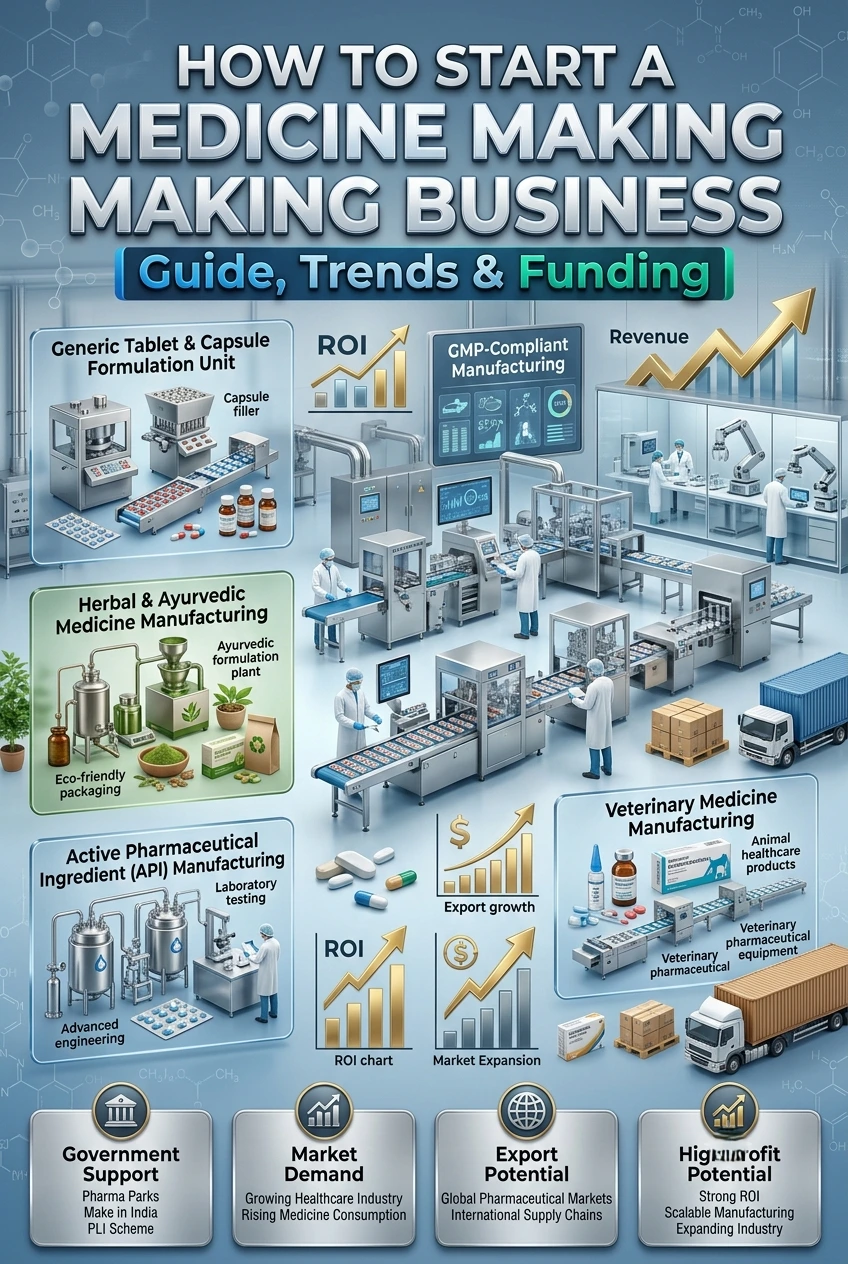
1. Generic Tablet and Capsule Formulation Unit
One of the easiest avenues into medicine making is to start a generic oral solid dosage (OSD) manufacturing unit, which makes tablets and capsules. Oral formulations are by far the biggest portion of pharmaceutical consumption worldwide and there is never a shortage of demand for affordable generic oral medication, both in the domestic and export markets. A small-scale formulation unit that is WHO-GMP certified can obtain contracts from Government supply chains such as the ESIC, CGHS and State Health Department. The investment cost of a basic setup is between ₹20 lakh and ₹60 lakh based on the capacity and infrastructure. The idea is to start with a contract manufacturing arrangement (existing GMP (Good Manufacturing Practice) facility), and later invest in their own facility. This reduces liability risk and builds up regulatory experience and customer relationships.
2. Herbal and Ayurvedic Medicine Manufacturing
The structural demand for herbal and ayurvedic medicine manufacturing has picked up since there has been a rise in consumer demand for natural medicine products. This is a space that is very competitive for Indian manufacturers, given the traditional knowledge system of India and a well-established raw material supply chain of medicinal plants. Barrier to new entrepreneurship is comparatively less in regulatory framework under AYUSH (managed by Ministry of AYUSH), than allopathic drug licensing. There is considerable local retail and export demand for products such as immunity boosters, digestive formulations, medicinal products for skin care and women’s health products. A startup could become a private label manufacturer for a wellness brand, a business arrangement with high margins, lower capital investment and high-quality control.
Read the Complete Book Here: Herbal Cosmetics & Ayurvedic Medicines (EOU)
3. Active Pharmaceutical Ingredient (API) Manufacturing
API manufacturing is the upstream step in the medicine-making process — and it offers a great business opportunity for entrepreneurs who possess a chemistry or chemical engineering background. With India importing a considerable number of APIs, especially from China, there is a huge opportunity for the formulation industry to meet import substitution requirements. The PLI scheme provides a direct incentive to the government to encourage domestic production of API, by providing incremental incentives on sales of eligible API over a specified tenure. The capital cost of establishing an API manufacturing unit is higher, ranging from ₹1 crore to ₹5 crore per molecule, but the margins from the long-term and strategic positioning as a domestic supplier to formulation companies can bring in good returns. The molecules can be sold to entrepreneurs starting out with molecules that are off patent and have sustained market demand with high volumes.
Get Detailed Project Report (DPR): Active Pharmaceutical Ingredient (API) Products, Bulk API Manufacturing
4. Veterinary Medicine Manufacturing
The veterinary pharmaceutical market is a relatively untapped manufacturing market in India. Demand is on a sharp upswing as organised livestock farming, poultry and the growing pet care market contribute to this. Veterinary drugs are also regulated under the Drugs and Cosmetics Act, with approval processes typically being quicker than for human drugs. Companies that manufacture animal feed, veterinary distributors, and cooperative dairy networks will be ready to purchase a small unit making veterinary antibiotic tablets, dewormers, vitamins and mineral supplements. This business model is suitable for people running their business in semi-urban and rural areas and have a natural distribution advantage because they can be closer to the target market. Furthermore, many veterinary drug formulations share some of the process technology used in the production of human generic drugs, allowing for a dual use facility.
Import–Export Opportunity Analysis
India’s pharmaceutical export engine is one of the country’s most consistent foreign exchange earners. Generic formulations, APIs and biosimilars find markets in 200 plus countries. The fastest growing markets for Indian medicine companies at the moment are across Africa, in the Asean countries and in regulated markets like the USA, UK, Canada where a WHO-GMP or US FDA certification can get them a premium price.
For fresh startups, the merchant export model offers a practical route into international markets. Startups sell finished formulations to larger export houses. These companies handle regulatory and logistical challenges. However, startups with WHO-GMP certification can pursue direct exports. Tender-based markets in Africa and Southeast Asia often offer opportunities. These markets primarily focus on volume and established business relationships. Pharmexcil helps new exporters with market information, trade fairs, buyer-connect programs, etc. For imports, manufacturers based in India can leverage the low-cost manufacturing proposition to produce drugs for global players.
Indian MSME Success Stories in Medicine Manufacturing
There are several noteworthy success stories in the Indian pharmaceutical MSME space which can hold valuable lessons for new businesses.
Originally set up as a small formulation unit in Mumbai by Mannalal Agrawal, Ajanta Pharma was grown into a global generics company by his family. They made a strategic choice to enter into few chosen therapeutic areas such as ophthalmology and dermatology, rather than fighting it out in very competitive areas of the market, which has enabled Ajanta Pharma to create a pricing power and a global export business. Message for MSMEs: in pharma, focus and niche positioning always beats me-too strategy.
Alkem Laboratories, the Samprada Singh-founded firm which rose from a pharma distributor to one of the largest Indian formulation businesses, the original and sustained focus on physician marketing coupled with robust quality made for a devoted prescriber base that fuels organic revenue. New entrepreneurs can draw from this model — investing in quality and professional sales relationships early creates compounding returns over time.
Dabur India’s growth from S.K. Burman’s journey from a small Ayurvedic formulation unit to a multi-thousand-crore consumer healthcare company demonstrates the potential of traditional medicine manufacturing under AYUSH. Its success combines traditional products with modern branding, marketing, and distribution. For MSME founders exploring herbal medicine manufacturing, this journey shows that the market is substantial. However, businesses must maintain consistent quality to succeed.
How NPCS Supports Medicine Manufacturing Entrepreneurs
At Niir Project Consultancy Services (NPCS), we provide professional consulting for the preparation of Market Survey cum Detailed Techno-Economic Feasibility Reports (DPRs) for setting up new pharmaceutical and medicine manufacturing businesses. Our reports cover detailed manufacturing processes, market research and demand analysis, process flow diagrams, product mix and capacity planning, machinery and raw material specifications, and complete project financials with profitability analysis. Our objective is to help entrepreneurs evaluate feasibility, profitability, and long-term scalability — before committing capital. For medicine manufacturing businesses in particular, where regulatory compliance and process engineering significantly affect project costs, a well-structured DPR can be the difference between a well-planned launch and expensive mid-course corrections. You can explore sector-specific resources through India Brand Equity Foundation (IBEF) Pharmaceuticals for market benchmarks and investment context.
Find the most profitable startup for your investment range
Medicine Manufacturing Business: Key Data Reference
| Business Segment | Estimated Setup Cost | Key Market Driver |
| Generic Tablet/Capsule Unit | ₹20 Lakh – ₹60 Lakh | Domestic demand + Govt. tenders |
| Herbal/AYUSH Formulations | ₹15 Lakh – ₹40 Lakh | Wellness boom + export markets |
| API Manufacturing | ₹1 Crore – ₹5 Crore | Import substitution + PLI scheme |
| Veterinary Medicine Unit | ₹20 Lakh – ₹50 Lakh | Livestock & pet care sector growth |
| Contract Manufacturing (CMO) | ₹30 Lakh – ₹1.5 Crore | Brand outsourcing + MNC partnerships |
Frequently Asked Questions (FAQs)
Q1. What licences does a medicine manufacturing business need in India?
The requirements for the business of manufacturing drugs include: A licence for drug manufacturing is issued by the State Drug Controller in terms of the provisions of the Drugs and Cosmetics Act, 1940. Other statutory requirements include a Good Manufacturing Practices (GMP) license (Schedule M), a GST registration number and a local factory and pollution control clearances. Separate licence for manufacturing AYUSH medicines from the State AYUSH Licensing Authority is required. The entire regulation can be accessed at Central Drugs Standard Control Organisation (CDSCO) website.
Q2. What is the minimum investment to start a small pharmaceutical manufacturing unit?
Setting up even a basic unit for production of solid oral dosage forms like tablets and capsules is possible at around 20-30 lakh in an SSI industrial zone. But you have to also include costs of land, plant and machinery, regulatory compliance, and working capital in your budget. Herbal formulation units can sometimes be started with lower capital. Contract manufacturing partnerships can further reduce initial outlay.
Q3. Can a first-generation entrepreneur enter medicine manufacturing without a pharmacy background?
Yes, a lot of very successful pharmaceutical entrepreneurs started off with a business, engineering or finance background. But you do need to hire a B. Pharm/M. Pharm as the licensed technical person overseeing manufacturing and a good quality and regulatory affairs head early in the process will de-risk your business immensely.
Q4. Which government scheme provides the best funding support for medicine manufacturing startups?
The PLI scheme for pharmaceuticals is the most significant central government incentive, primarily suited to medium and larger API and formulation manufacturers. For smaller startups, the CGTMSE scheme under the Ministry of MSME provides collateral-free credit guarantee up to ₹2 crore. The MUDRA Yojana Kishore and Tarun categories are also applicable for equipment financing in early-stage manufacturing units.
Q5. Is it possible to export medicines as a small Indian manufacturer?
Indeed, MSME units can export through registered pharmaceutical export houses that handle global regulatory and logistics requirements. Alternatively, they can export directly after obtaining WHO-GMP certification or the necessary regulatory approvals for their target countries. There are separate help lines for the new exporters under Pharmexcil. Regulatory approvals for the African or the ASEAN countries are comparatively easier than for the US FDA or EU EMA.
Q6. How long does it take to get a drug manufacturing licence in India?
How long does it take to get a drug manufacturing license? The drug manufacturing licence application procedure can vary from state to state. In general, the licence may be received between 60 days and 180 days, counting from the time when the application was successfully submitted. The State Drug Controller must have conducted inspections and verified compliances. Proactive preparation — including aligning plant layout with Schedule M requirements before applying — significantly speeds up the process. Consulting a regulatory compliance expert during plant setup is strongly recommended.
Conclusion
As Indian industry grows, this one of the safest business opportunities currently available -medicine manufacturing. Domestic healthcare needs, an advanced export ecosystem, a favourable environment thanks to Government PLI and MSME incentives, and adequate industrial ecosystem are factors that make it attractive to smart entrepreneurs. So, whether you’re planning a generics formulation facility, an AYUSH herbal drug, a veterinary medicine or an API venture, careful planning of your project, a headstart on regulatory approvals and strong go-to-market clarity are what matter. Data-based decision-making and quality-focused manufacturing should drive your venture to become sustainable and scale to a much larger entity.(Medicine making business)