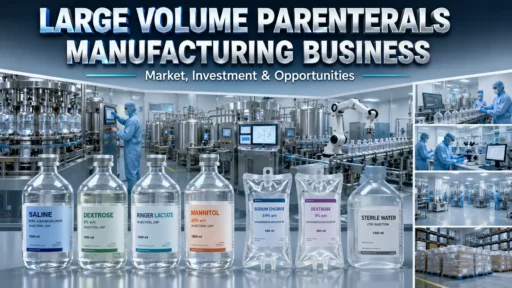
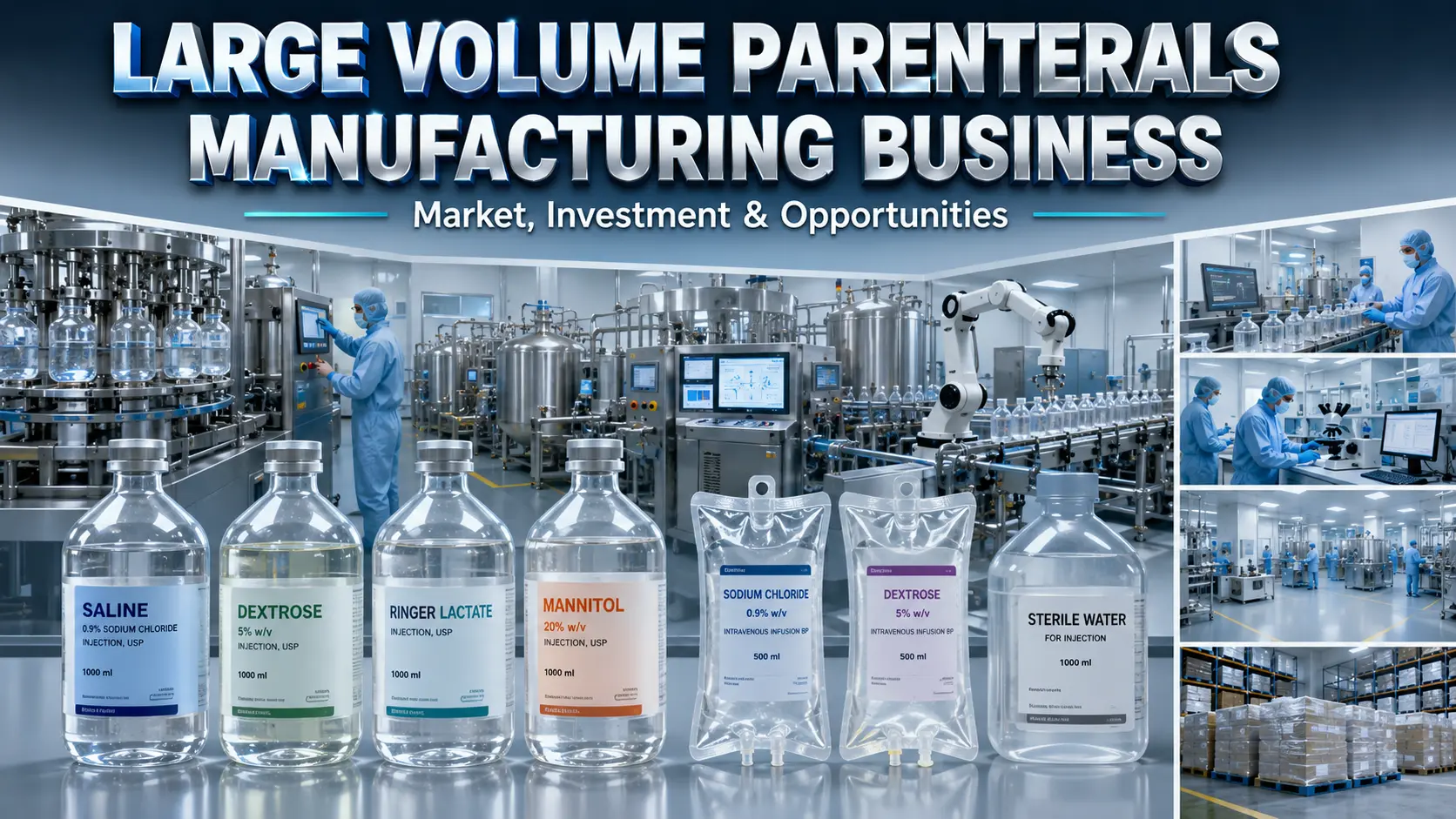

Large Volume Parenterals Manufacturing Business
While many entrepreneurs ignore this particular product category, it’s the quiet, unglamorous category that drives every hospital bed in the nation. The fluids that run into your IV after you’ve been admitted to the hospital are sterile fluids such as saline, Ringer Lactate, dextrose, mannitol. If you’re looking for a recession proof business idea in the pharmaceutical manufacturing industry, then LVP is definitely worth a second look at.
The demand for LVP is not as dependent as the trend-driven consumer products on marketing or seasonal buying moods. Depends on surgery, emergencies, dehydration cases and hospital routine. This is a completely different risk picture to what was originally presented and is why this article dissects the sector, the policy support available and a few examples of concrete business ideas to consider.
Why This Sector Deserves Serious Attention
The hospital facilities in India are growing at a fast pace, and with each new bed that is installed in a district hospital, a trust hospital or a private nursing home, the demand for IV fluids in these facilities is inescapable, recurring and non-negotiable. Patients will receive 2 to 4 bottles of normal saline (NS) or Ringer’s Lactate (RL) during a surgical procedure, regardless of the size of the surgery. That’s multiplied by thousands of facilities and the volumes can get large very fast.
There’s the export angle too, which many domestic manufacturers fail to realize. Local manufacturing of LVPs is lacking in neighbouring markets in Africa and some parts of South Asia, and these markets are dependent on imports. Indian manufacturers with a WHO-GMP are ideally suit.(Large Volume Parenterals Manufacturing Business)
While LVP margins aren’t a record breaker per unit, a bottle of saline comes with a relatively modest price tag, and scale and consistency are paramount in the business. The revenue scenario is far more predictable in a mid-sized plant operating two or three shifts as it is possible to maintain steady offtake through government tenders, private hospital contract and distributor network, as compared to many other pharma sub-sectors.
Get Detailed Project Report (DPR): IV Fluids and Intravenous Solutions A Complete Guide
Government Policies and Incentives Supporting New Entrants
In this space, entrepreneurs are not coming without support. The push towards self-reliance has been targeted in a specific way at the Production Linked Incentive scheme for pharmaceuticals under the Department of Pharmaceuticals, which has been specifically targeted at the bulk drugs and formulations which reduce import dependence, and LVP raw material falls in this general thrust for self-reliance.
MSME schemes for the first-generation entrepreneurs like Credit Guarantee Trust Fund for Micro and Small Enterprises (CGTMSE) are helpful in getting loans at no collateral, as it will be crucial in the capital-intensive of a GMP Plant. The Ministry of MSME’s Prime Minister’s Employment Generation Programme also is applicable to smaller scale units who want to venture into ancillary parenteral products.
The state level is another layer of industrial policies. Some states provide capital subsidy, stamp duty exemption and power tariff concession for the project units for pharmaceutical industry in industrial park. These incentives will have a positive impact on the initial cost or burden of clean-room construction and water-for-injection systems, since LVP manufacturing must be done in a Schedule M compliant facility.
In terms of regulation, licensing is regulated by the Central Drugs Standard Control Organisation and the respective State Drug Control departments. It is important for newly starting businesses to consider compliance as an input to planning from the outset as plant layout and plant utility design are both influenced by compliance requirements.
Multiple Business Ideas Within Large Volume Parenterals
Normal Saline (0.9% Sodium Chloride) Manufacturing Unit
Normal Saline is the top volume product in the LVP basket, and it’s a product that is in constant demand in all hospital departments – hence its selection by a new entrant. A plant that is set up for Normal Saline will most likely be using Form-Fill-Seal or blow-fill-seal technology to minimize manual handling and contamination hazards significantly. The business is appealing because its formula, sodium chloride in water for injection, is not that complex, yet it can be institutionalized via government hospital tenders, and there are regular bid cycles.
The actual skill is operating discipline; keeping the filling area sterile, validating batch records and establishing a distribution network with the Government medical stores depots. When entrepreneurs master these building blocks, they can create a successful product line with Normal Saline as the anchor product, driving high sales volume and competitive pricing. When entrepreneurs master these blocks, they are able to develop a thriving portfolio of low-cost, high-volume products that complement Normal Saline.(Large Volume Parenterals Manufacturing Business
Ringer Lactate Solution Production Line
In the trauma, burns treatment and major surgery, the fluid of choice is Ringer Lactate, making its demand a little different from plain saline. Hospitals use this solution extensively during the golden hour of emergency care for road accident victims, who account for a significant share of road accident cases in India. It makes sound business sense for a startup to offer Ringer Lactate in addition to Normal Saline on the same filling line since the manufacturing/line is essentially the same and a different tender is provided.
The other raw materials needed are sodium lactate, potassium chloride (KCl) and calcium chloride (CaCl2), and it is an early challenge in the operating process to find reliable suppliers of these pharma grade materials. Manufacturers with the ability to offer short lead times, even against larger companies, can secure repeat orders from the hospitals owing to their buffer stock policies at trauma centres and government emergency wards.
Find high-return business ideas based on your budget & ROI
Dextrose Normal Saline (DNS) Combination Fluids
Doctors use Dextrose Normal Saline to correct electrolyte imbalances and replenish energy in patients, especially after surgery and in paediatric care. This product requires slightly more complex process control than plain saline because dextrose solutions become more susceptible to microbial growth when manufacturers do not optimize process parameters. Therefore, validating the autoclave becomes a critical quality control step. In the business planning arena, the ability to supply paediatric hospitals and nutrition wards would be a missed opportunity for the plain saline producers, while DNS can supply them. Many state government tenders include Normal saline, Ringer lactate and DNS as a composite LVP tender, meaning that a manufacturer with all three tends to have a significant competitive advantage when bidding.(Large Volume Parenterals Manufacturing Business)
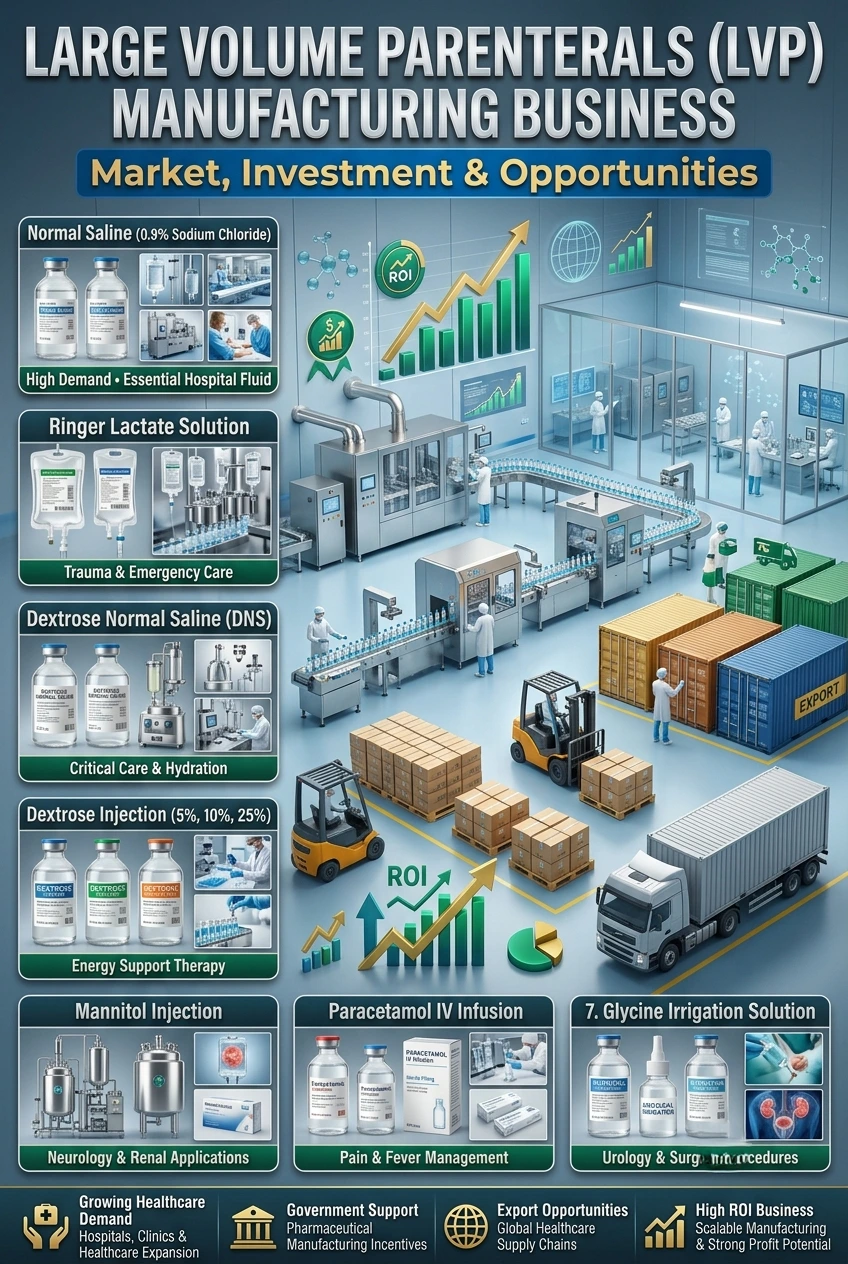
Dextrose Injection (5%, 10%, 25% Concentrations)
Available in a variety of concentration strengths, Dextrose Injection provides glucose supplementation without the additional sodium burden found in DNS. Healthcare professionals use it when extra sodium intake is undesirable, such as for patients in diabetic monitoring wards, ICU settings, and during the management of hypoglycemia. Dextrose monohydrate procurement cost management plays a crucial role in the profitability of manufacturing this product because the cost of the raw material dextrose monohydrate fluctuates periodically according to the fluctuation of agricultural production. Buying dextrose on the spot market is less of a protection to entrepreneur margins than buying on annual contract with established dextrose manufacturers. Having the complete spectrum (not just one concentration) makes a new manufacturer a more desirable single-source supplier for hospital procurement offices that may otherwise have to place orders with several different manufacturers.
Mannitol Injection for Neuro and Renal Care
The other LVP, mannitol, has a smaller but higher value role in neurosurgery to lower ICP and in selected clinical situations, in renal support. This product primarily serves neurology and nephrology departments instead of general hospital wards. It targets manufacturers that already offer base LVP products and want to expand their portfolio with a more differentiated, less commoditised product. Because therapeutic effect relies on a precise osmotic gradient, concentration control is crucial for mannitol solutions and investment in quality control here will pay off in the number of batch rejections. This enables a manufacturer to raise realisation relative to the standard saline and dextrose product lines, and also to spread their risk out of pure tender-driven price competitive product lines.(Large Volume Parenterals Manufacturing Business)
Paracetamol IV Infusion Manufacturing
Paracetamol IV Infusion is an important drug in hospital protocol as it has been steadily gaining ground in recent years as an alternative to oral or intramuscular Pain and Fever control in post-surgical patients who are incapable of oral intake. This product is a formulated pharmaceutical preparation, rather than a mere solution, and therefore may have a somewhat more complex formulation and stability testing program, and the possibility of light protection packaging requirements.
While the budget for entrepreneurs entering this particular segment may be a little higher due to the added analytical testing infrastructure and a longer product approval runway compared to plain saline, it’s worth the effort. But the fact that Paracetamol IV Infusion has a better realisation than commodity electrolyte fluids, plus it is more popular and is making its way into hospital formularies makes it a logical path for the LVP manufacturer to move up the value chain once the base saline and Ringer Lactate lines are solidified and cash flowing.
Related Article: Large Volume Parenterals Manufacturing in West Bengal: Market & Business Opportunities
Glycine Irrigation Solution for Urology Procedures
In urology, doctors use a specialized, non-electrolyte fluid called glycine irrigation solution during transurethral resection procedures to prevent interference with electrocautery equipment. It is a small but secure niche, because every hospital that conducts TURP surgery has a dedicated requirement for glycine and changing the supplier of a protocol mid surgery is something that hospitals don’t want to do. If the manufacturer already has other lines of LVP, then the investment in adding glycine irrigation solution is relatively small, and it is possible to establish a separate supply relationship with urology hospitals and multi-specialty hospitals. This is a good diversification option and will be a better option than a new entrant starting with a new product since there is less competition from mainstream saline or dextrose in the market.(Large Volume Parenterals Manufacturing Business)
Import-Export Opportunity Analysis
India’s LVP export proposition draws significant credibility from its pharmaceutical export success, where the country has built a strong reputation as a reliable and cost-effective supplier to markets that cannot sustain their own manufacturing capabilities. There is significant import of hospital fluid for several countries in Africa, Gulf countries and parts of Central Asia and Indian WHO-GMP certified plants regularly bid for these hospital fluid tenders.
The opposite is true when looking into the export market. India imports very few finished LVP products because the domestic market meets most regular requirements. But manufacturers still import some raw materials and packaging materials—particularly high-barrier polypropylene resins for IV bags and some specialised stoppers—from overseas. Therefore, new manufacturers should consider import lead times when planning their working capital.
An early registration with Pharmaceuticals Export Promotion Council of India is of great help to the entrepreneurs who wish to venture into export markets as the export documentation, export buyer contacts and market intelligence pass through this channel. In addition, export orders are likely to realise better than domestic tender orders, which can make a significant contribution to the plant’s profitability once a manufacturer develops export grade compliance.
Indian MSME Success Stories Worth Studying
A number of Indian pharmaceutical entrepreneurs established significant businesses starting from the most basic high-volume parenteral products and gradually branched out to specialty products. What is clear from the history of Kiran Mazumdar-Shaw’s early years in Biocon is that she began with a small fermentation-based business, and systematically ploughed profits into technology improvement instead of compulsive, quick growth on borrowed money – a lesson that rises to the level of a philosophy that applies to all aspects of her life, not just as a biotech entrepreneur. The ‘that patient’ mindset is so relevant to an LVP entrepreneur who is wondering whether to diversify into new product lines or, first and foremost, stabilise cash flow from the basic saline business.
Habil Khorakiwala established Wockhardt in the modest formulation industry and one of the recurring themes from his early business choices was the need to have a stable revenue stream in the form of institutional and government products before targets a more volatile branded segment. Today’s LVP manufacturers can do the same: they can rely on the safe ground of government hospital supplies and slowly establish private hospital and export contacts.
Get Detailed Insights from This Book: Drugs & Pharmaceutical Technology Handbook
Another case which is less known but equally instructive is of a number of medium-sized Gujarat/Himachal Pradesh based manufacturers who grew up from a single-line saline factories to multi-product LVP factories over five to seven years. The point of their common decision-making was that they reinvested early tender profits into more filling lines instead of giving that money back to the shareholders, which enabled them to outbid smaller single-product firms to win bigger composite tenders. For a new business owner, the lesson is simple: don’t start out looking for any profits for two to three years.The lesson for a new entrepreneur is one that’s very simple: don’t look for any profits for 2-3 years until you build the business up.
A Word on Feasibility Planning
We at Niir Project Consultancy Services (NPCS) provide professional consulting for the preparation of Market Survey cum Detailed Techno-Economic Feasibility Reports (DPRs) for setting up new industries or businesses. Our reports include detailed manufacturing processes, market research and demand analysis, process flow diagrams, product mix and capacity planning, machinery and raw material details, and complete project financials with profitability analysis. For an entrepreneur evaluating an LVP manufacturing project specifically, this kind of structured feasibility work matters more than usual, given the licensing sequence and capital layout involved. Our objective is to help entrepreneurs evaluate feasibility, profitability, and long-term scalability before investing.
Large Volume Parenterals: Product-Wise Market Snapshot
| Product | Typical Pack Size | Primary Clinical Use | Relative Market Demand |
| Normal Saline | 500 ml / 1000 ml | General hydration, surgery, wound care | Very High |
| Ringer Lactate | 500 ml / 1000 ml | Trauma, burns, major surgery | High |
| Dextrose Normal Saline | 500 ml | Post-operative, paediatric hydration | High |
| Dextrose Injection (5/10/25%) | 100 ml – 500 ml | Glucose supplementation, ICU support | Moderate to High |
| Mannitol Injection | 100 ml / 350 ml | Neurosurgery, renal support | Moderate (specialty) |
| Paracetamol IV Infusion | 100 ml | Post-surgical pain and fever management | Growing |
| Glycine Irrigation Solution | 3000 ml / 5000 ml | Urology (TURP) procedures | Niche, stable |
Frequently Asked Questions
How much capital is typically needed to start a small LVP manufacturing unit?
A GMP-compliant unit with one or two filling lines, clean-room infrastructure, and a water-for-injection system generally requires substantial capital investment, and the exact figure depends heavily on chosen technology (blow-fill-seal versus conventional bottle filling), plant capacity, and location. A detailed techno-economic feasibility report is the right starting point before finalising this figure.
Is a Schedule M licence mandatory before construction begins?
The facility layout, the design of the heating ventilation and air conditioning systems and other utility systems, should take into account the requirements of Schedule M and WHO-GMP right from the conceptual stage, as any effort to upgrade a completed building to meet the requirements would be considerably more expensive than designing it accordingly.
Can a new entrant realistically compete for government hospital tenders?
Yes, but only once you can show proof of manufacture’s license batch of quality and usually minimum plant capacity in most tenders. As new entrants into the field one first tends to try their hand on state and district tenders to gain experience, following which one may become eligible for bigger central government contracts.
Which LVP product is easiest to start with as a first product?
Normal Saline is the most common starting product because the formulation is simple and demand is universal, which allows a new manufacturer to stabilise operations and cash flow before adding more complex products like Mannitol or Paracetamol IV Infusion.
Do LVP manufacturers need separate approval for export markets?
Export destinations often require additional certifications such as WHO-GMP or country-specific registration, which is separate from the domestic manufacturing licence. Entrepreneurs planning export from day one should budget both time and cost for this parallel compliance track.
How important is packaging technology in this business?
Very important. The shift from glass bottles to multi-layered polypropylene bags or blow-fill-seal plastic containers has become a key differentiator in tenders, since hospitals increasingly prefer lighter, unbreakable, and easier-to-dispose packaging formats.
Conclusion
Large Volume Parenterals will never be a glamorous business idea, and that is precisely its appeal. Demand does not depend on discretionary spending, competitive intensity is manageable for a well-capitalised entrant, and government policy continues to support domestic pharmaceutical manufacturing. Entrepreneurs who approach this sector with a phased plan — starting with Normal Saline and Ringer Lactate, then adding Dextrose variants, and eventually specialty products like Mannitol, Paracetamol IV Infusion, and Glycine Irrigation Solution — build a business that grows in both volume and value over time. For anyone serious about entering this space, a properly structured feasibility study remains the single most important first step before committing capital.(Large Volume Parenterals Manufacturing Business)
References & Further Reading
Central Drugs Standard Control Organisation
Credit Guarantee Fund Trust for Micro and Small Enterprises