Indian Chemical Industry 2026
The chemical industry is at a turning point in India. The demand for agriculture, pharmaceuticals, textiles and construction products is growing at unprecedented speed, the policy support is reaching new highs and the restructuring of global value chains is away from China, making the time now more relevant than ever for new business ideas in this sector. Chemical industry has created second opportunity for the first-time entrepreneurs and MSME owners to invest in the industry at various levels ranging from small specialty chemical units to the involvement in large-scale manufacturing of agrochemical or dye-intermediate. There are real opportunities, there is a deep market and the government is aggressively encouraging new players in the market.
Why the Chemical Sector Is a Smart Bet Right Now
India ranks among the top six countries in the world for chemical production. The sector plays a significant role in the country’s GDP and is responsible for employing millions of people throughout the manufacturing, logistics and downstream processing stages. But in this case, several structural tailwinds are coming together that is making it particularly interesting
But first, China-plus-one marketing strategies undertaken by the global buyer have turned into a genuine void in specialty and performance chemicals. Buyers in Europe, Japan and the USA are now enquiring with Indian manufacturers to diversify their sourcing. Secondly, the use of chemicals in the domestic market is growing at a rapid pace with a surge in industries of construction, automotive, consumer goods and the pharma industry. In addition, India’s formal agricultural-based industry is changing its focus to value-added agrochemicals and bio-sourced inputs, creating an entirely new product category for startups.(Indian Chemical Industry)
So, anyone who is starting in this area now isn’t getting into the trend. They are gaining ground in a structurally expanding market that has export and domestic demand. Where and how to get in is what matters, not whether.
Related Article: India’s Chemical Industry Growth to $255 Billion: Best Business Opportunities for Startups and MSMEs
Government Policies and Incentives Supporting New Entrants
The policy landscape has dramatically turned in favour of startups in the chemical industry. There are a number of initiatives from the central government which directly assist new businesses in this area.
The Production Linked Incentive (PLI) Scheme for specialty chemicals and pharmaceuticals is a scheme that provides financial incentives based on incremental output. Early production is de-risked with direct cash transfers available to eligible companies. Likewise, the Make in India programme has been further relaxed to provide regulatory facilitation and support to establish manufacturing units in chemical parks and special economic zones.
Ministry of MSME has several credit linked capital subsidy schemes, which provide subsidy for plant and machinery for small chemical manufacturers up to 15%. Credit Guarantee Fund Trust for Micro and Small Enterprises (CGTMSE) is a mechanism to avail collateral-free loans for eligible units. Further, the Startup India initiative by DPIIT is offering registered startups tax holiday, fast-track IP registration, and a fund-of-funds mechanism.(Indian Chemical Industry)
The policy of the government for chemical manufacturers is the Petroleum, Chemicals, and Petrochemicals Investment Region (PCPIR), which defines large integrated regions like Gujarat, Andhra Pradesh, and Odisha, providing entrepreneurs with ready infrastructure, common utilities and single-window clearance. The time to production of a new unit is significantly shortened and capital expenditure is reduced by a significant amount when entering a PCPIR.
High-Potential Business Ideas for Startups in the Chemical Sector
1. Specialty Agrochemicals and Bio-Pesticide Manufacturing
Agriculture consumes a huge amount of chemicals in India. But the real opportunity today isn’t in the generic commodity such as urea or DAP, it’s in the specialty agrochemicals: technical grade fungicides, herbicide formulations, plant growth regulators and bio-based pest management products. With the shift towards residue free food and the promotion of natural farming practices such as the Paramparagat Krishi Vikas Yojana, the demand for bio-pesticides and botanical extracts has surged globally. Even the entrepreneur who has established a small formulation unit at a cost of ₹30-50 lakh can supply to institutional buyers such as cooperative societies, agri-input distributors and direct export customers. One of the most lucrative ways to enter the specialty agrochemical industry is by being involved with producing specialty formulations, where gross margins are usually in the 30- to 50-percent range.
2. Dye Intermediates and Textile Chemicals
The textile and garment sector in India is a continual consumer of dyes, pigments and processing chemicals. India is one of the biggest dye manufacturers in the world and yet import of dye intermediates is significant. This is a high margin opportunity for a startup that has basic chemical processing. H-acid, vinyl sulphone & reactive dye intermediates are other such products which have consistent industry demand from clusters in Surat, Ahmedabad, Tiruppur & Ludhiana. The potential annualised revenues of a unit with a capacity of 2-5 tonnes/day for a single intermediate product are in the range of ₹1.5-3 crore at current market prices with payback periods ranging between three and four years at moderate capacity utilisation.(Indian Chemical Industry)
Get Detailed Insights from This Book: Modern Technology of Textile Dyes & Pigments
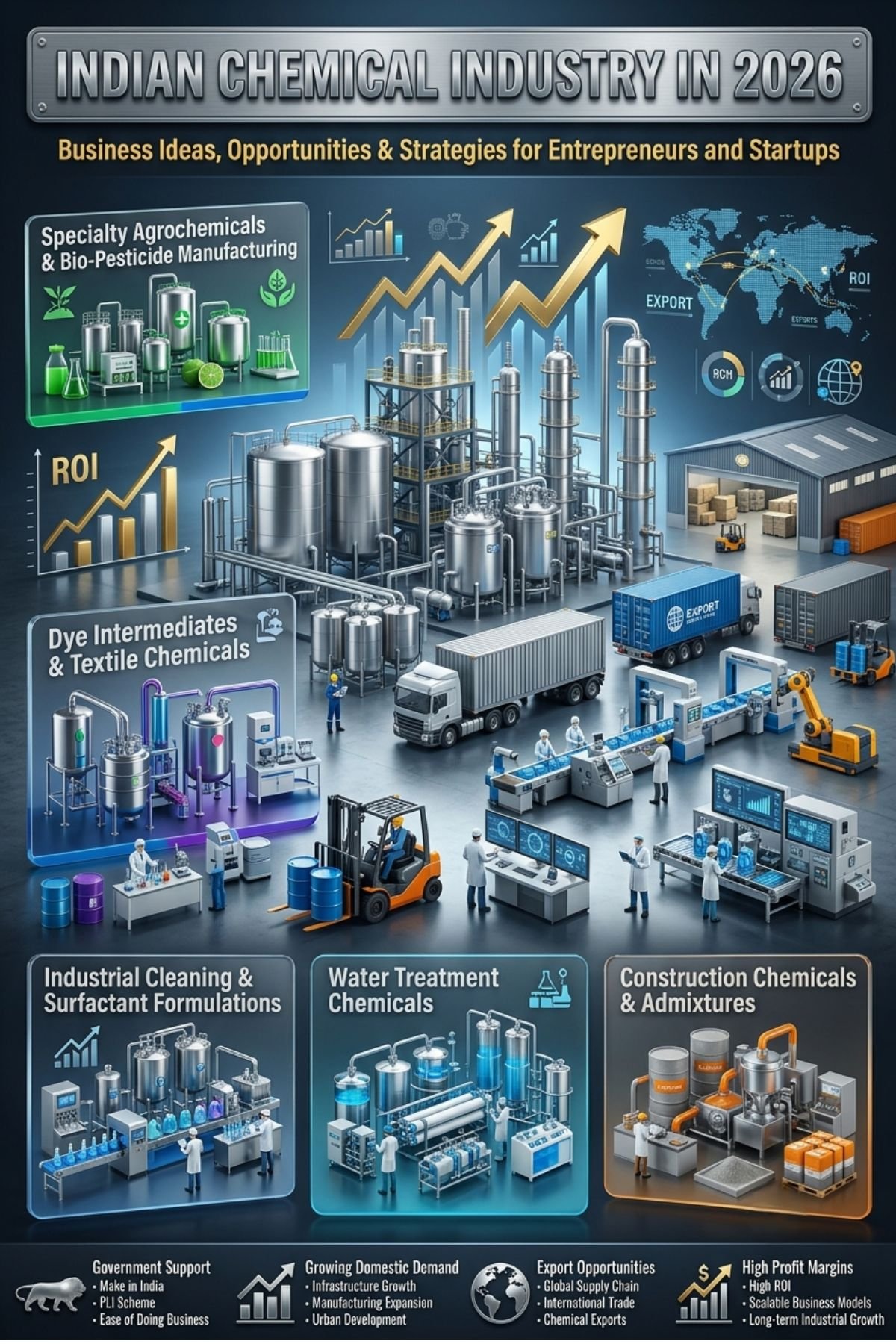
3. Industrial Cleaning and Surfactant Formulations
Post-pandemic hygiene and industrial sanitation has grown the pipeline of potential cleaning chemical and surfactant customers. But, the unorganised suppliers or big MNCs are serving most of this market now. There is a definite demand gap for medium scale quality certified Indian manufacturers to cater the institutional buyers (hospitals, food processing units, hospitality chains, automotive factories etc.). Formulating products such as liquid hand wash base, industrial degreasers, dishwashing compounds and floor care concentrates are relatively simple, require the minimum start-up investment (₹15-25 lakh for a basic plant) and can command EBITDA margins ranging from 20-35% with appropriate distribution. The private-label contracts offered by supermarket companies and B2B distribution companies offer a form of revenue certainty that is hard to come by in most manufacturing startups.
4. Water Treatment Chemicals
Water treatment chemicals are being required in growing demand in all industries as environmental compliance is no longer an option in the industrial sector. Specialised chemical inputs are required for effluent treatment, cooling water, boiler water and desalination. There are other important municipal buyers, including those who are part of the AMRUT and Smart Cities programmes. A water treatment coagulants, flocculants, scale inhibitors and biocides startup can supply a wide range of B2B customers under multi-year contracts. The recurring demand yields revenue stability, and the technical difficulty to enter the market (though somewhat high) excludes price competition.
Get Detailed Project Report (DPR): Water Treatment Chemicals Manufacturing Plant Report
5. Construction Chemicals and Admixtures
The infrastructure investment programme in India is at a record scale. Engineers and construction companies use construction chemicals—including admixtures, waterproofing compounds, tile adhesives, grouting materials, and structural repair products—in massive amounts for roads, bridges, metro rail projects, airports, smart cities, and affordable housing. Construction chemicals market is expanding at a fast pace and continues to be an underserved market in Tier-2 and Tier-3 markets. A start-up can establish a small-scale admixture blending facility in close proximity to a construction cluster, thus developing distribution ties with the contractors, RMC facilities and precast manufacturers. The capital is relatively small, starting at ₹20-40 lakh per annum; there is good opportunity of local brand building.(Indian Chemical Industry)
Import–Export Opportunity Analysis
There is an inherent imbalance in the Indian chemical trade profile. The country is exporting bulk chemicals, commodity chemicals (basic petrochemical derivatives, inorganic acids, dye stuffs etc.), while it is importing high value specialty chemicals, performance polymers and electronic chemicals. While import substitution in the field of specialty chemicals continues to be one of the biggest unexploited industrial sectors in the country, the data published by the Chemicals and Petrochemicals Manufacturers Association (CPMA) indicates.
Indian chemical companies are becoming more competitive in the international markets, especially in Latin America, South East Asia, and Africa. The Chemicals Export Promotion Council (Chemexcil) organizes buyer-seller meets, export development programmes and offers market intelligence to chemical exporters. A realisation premium of 25-40% over domestic prices can be realised by a startup catering agrochemical export market, especially technicals for re-registration in African and Southeast Asian countries. In addition, the Remission of Duties and Taxes on Exported Products (RoDTEP) scheme allows exporters to recover taxes if importers paid them in the local country on goods used in the export process, which is beneficial for their net margin competitiveness.
Further, under the current Free Trade Agreement (FTA) negotiations with European Union and UK, India’s bilateral trade could see substantial growth in market opportunities for certified exporters of chemicals. Entrepreneurs who invest in quality systems early — such as ISO, GLP labs, REACH certifications — are in a position to reap these export premiums when the agreements go into effect.
Indian MSME Success Stories Worth Learning From
Aarti Industries Limited – Vinay Rajkumar Gupta
Aarti Industries started as a small player in the benzene-based intermediates segment and developed into one of the top listed specialty chemicals firms listed on Indian exchanges having a turnover of more than Rs. 1500 crores. The key to the promoter’s success was his simple understanding: It is best to stick to one chemistry platform, learn process efficiency, go backward to raw materials and cultivate long-term relationships with global customers. Aarti’s model suggests that it is not necessary for chemical startups to diversify early on. Deepening a range of products, rather than making a wide divergence, has a greater chance of sustaining growth and scale than broad diversification in the product line.(Indian Chemical Industry)
Fairchem Speciality – Anand Mahindra-backed MSME Spin-off
Fairchem Speciality developed a niche business in oleo chemicals, namely fatty acids and nutraceuticals from the by-products of vegetable oil. The company’s approach to capturing waste streams and putting them to good use highlighted that the chemical industry’s value addition does not necessarily depend on product innovation. The Fairchem model works well for new startups because it focuses on identifying underserved feedstocks, developing proprietary processing expertise, and building intellectual property around the process.
Sudarshan Chemical Industries – Rajesh Rathi
Sudarshan Chemical, Pune has consistently invested in R&D, quality systems and development of export market to become one of the biggest producers of organic pigments in Asia. The most interesting lesson for startup founders is that Sudarshan had been working and creating deep moats within an often-overlooked product category — colour pigments — for decades with technical expertise, customer intimacy and regulatory compliance. It’s a lesson in product category isn’t the depth of execution and the management of customers more important?
Discover business ideas that actually make money
How NPCS Helps Chemical Entrepreneurs Plan Their Investment
Niir Project Consultancy Services (NPCS) provides Market Survey cum Detailed Techno-Economic Feasibility Reports (DPRs) for chemical manufacturing businesses for first generation entrepreneurs, investors and MSME promoters. Our reports encompass all aspects of investment planning including detailed manufacturing processes, the market, demand and its analysis, process flow diagrams, product mix and capacity planning, details of raw material procurement and machinery, and complete project financial statements along with profitability analysis and payback projections.
We have a very simple goal. Prior to an entrepreneur investing capital, we assess feasibility, profitability and long-term scalability through in-depth data-drivens analysis. From a small surfactant blending unit to a large specialty chemical plant, our reports provide founders with critical information to make informed and confident decisions—and to make credible presentation to banks, investors, and government agencies.(Indian Chemical Industry)
Indian Chemical Sector: Indicative Startup Parameters
| Business Segment | Min. Investment (₹) | Gross Margin (%) | Key End Markets | Export Potential |
| Specialty Agrochemicals | 30–50 Lakh | 30–50% | Agri-input distributors, Co-ops | High (Africa, SE Asia) |
| Dye Intermediates | 50 Lakh–1.5 Cr | 25–40% | Textile clusters (Surat, Tiruppur) | Moderate |
| Industrial Cleaning Chemicals | 15–25 Lakh | 20–35% | Hospitality, FMCG, Healthcare | Low–Moderate |
| Water Treatment Chemicals | 40–80 Lakh | 25–40% | Municipalities, Industry, Power Plants | Moderate |
| Construction Chemicals | 20–40 Lakh | 28–42% | Infrastructure, RMC, Real Estate | Low (initially) |
Frequently Asked Questions (FAQs)
Q1. What is the minimum investment needed to start a chemical manufacturing unit in India?
The minimum investment varies significantly by product segment. Small-scale formulation units — such as cleaning chemicals or basic agrochemical blending — can be set up for ₹15–30 lakh. However, units involving synthesis or reaction-based manufacturing typically require ₹50 lakh to ₹2 crore, depending on the product, scale, and safety compliance requirements. MSME credit schemes can fund a significant portion of this.
Q2. Which chemical business ideas have the highest demand in India right now?
Higher demand has been for such products as water treatment chemicals, construction admixtures, specialty agrochemicals and industrial cleaning compounds as these products have a steady stream of consumption, large institutional buyers and structural demand associated with India’s infrastructure and agricultural narrative. The high demand in dyes intermediates due to the scale of the Indian textile industry has also remained robust.
Q3. What licenses and approvals are required to start a chemical business in India?
What licences you’ll need. The licence requirements would depend on your product type and hazard classification. Typically, entrepreneurs require factory licence under the Factories Act, No Objection certificate from the State Pollution Control Board, GST registration, and product specific approval such as CIB registration (if manufacturing pesticides), drug licence (if making pharma intermediates), etc. If you set up your unit in a notified chemical industrial zone, you can obtain some of the licences more easily.
Q4. Can chemical startups in India access government subsidies?
Yes. MSME Ministry’s Credit Linked Capital Subsidy Scheme (CLCSS) provides a capital subsidy of upto 15% on machinery for small scale manufacturers and; the PLI scheme is available for eligible specialty chemical manufacturers. Several states like Gujarat, Maharashtra, Rajasthan, and Andhra Pradesh also offer concession on land, power tariff and stamp duty to chemical industries in particular areas.
Q5. Is export a realistic goal for a new chemical startup in India?
Yes, especially in agrochemicals, dye intermediates. There are several small Indian manufacturers who provide technical grade materials to formulators from Africa, southeast Asia and Latin American countries. All they need is to have quality certification likewise 9001/GLP, packing and also a good relation with a freight forwarder who exports chemicals. Chemexcil, APEDA assist in get
Q6. How long does it typically take to recover the initial investment in a chemical business?
A thoughtfully put together chemical unit for MSMEs usually pays back the investment within three to five years at 60–70% utilization. Specialty segments with good margins and institutional buyers for captive purposes recover the costs faster than traditional segments. A feasibility study report, painstakingly done by experts, which sets out reliable costs and revenue projections is vital for a entrepreneur to temper his expectations and lay claim for banks’ financing.
Conclusion: The Window Is Open — But Strategy Matters
The chemical industry in India is not a waiting game but a space that demands entrepreneurship, preparedness and realistic understanding of capital needs and market dynamics. The factors driving growth are real: strong domestic demand, China+1 sourcing opportunities, government support, and access to export markets. But, the key to success in this industry is the product choice, process control and financial management.(Indian Chemical Industry)
Entrepreneurs who obtain a detailed project report and a market feasibility report from the Ministry of Chemicals and Petrochemicals will be better positioned to secure financing, comply with regulations, and build sustainable operations. Chemicals business is booming in India — and for the forward-thinking, it can be very rewarding.