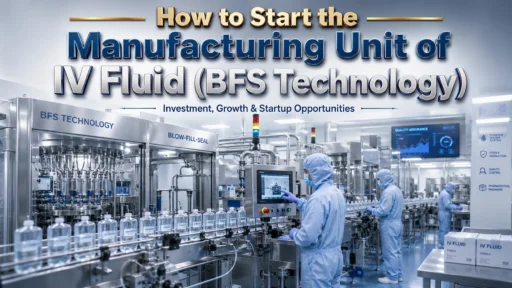


IV Fluid Manufacturing Plant in India (BFS Technology)
The Intravenous (IV) Fluid Blow-Fill-Seal (BFS) manufacturing process is one of the most strategic among the business ideas in the Indian pharmaceutical manufacturing sector. Saline, glucose, Ringer’s lactate, and their salts are all vital medications, known as intravenous fluids. They are essential for hospitals to operate. However, India still has a huge need for BFS grade IV fluids and is dependent on a few big players in the country. The gap in the market is a high demand, policy supported and protected market entry opportunity for a first-generation entrepreneur or an MSME investor.
The dynamics in the market are very strong. The healthcare infrastructure is rapidly growing in India, with government hospitals, private hospital chains and tier-2 city clinics all scaling rapidly. Furthermore, the stable and large volume demand of the government is provided through Central Medical Services Society (CMSS), state health departments, etc. Today, to enter the IV fluid production business with BFS technology requires up to date IV production machines, quality regulation output, and established long-term buyer relationships.
Find the most profitable startup for your investment range
Why IV Fluid Manufacturing Is a High-Potential Sector Right Now
The Indian IV fluid market has expanded over the years, as a result of increasing hospitalisation rates and surgical volume, along with the management of chronic diseases. Further, the pandemic of COVID-19 highlighted the importance of the domestic supply chain for IV fluids and the inability to import these. Thus, the preference of both private and public buyers is now overwhelming towards BFS IV fluids produced in India as compared to imported alternatives.
Among the most important advantages of BFS (Blow-Fill-Seal) technology is that this packaging is completely free of contamination and aseptic and is manufactured in an uninterrupted, automatic process. This results in reduced risk of contamination, better product integrity and adherence to WHO-GMP standards. Therefore, IV fluids packed using BFS are preferred by the hospitals, nursing homes and export markets.
The Indian pharmaceutical export is still on the rise with India’s formulations and IV fluids making up a large chunk of the export business, reports Pharmexcil (Pharmaceuticals Export Promotion Council of India). Also, the markets of Africa, South East Asia and Middle East are actively seeking Indian manufacturers for their IV fluids, thus giving them an export market of significant size.(IV Fluid Manufacturing Plant)
Government Policies and Incentives Supporting IV Fluid Manufacturing
There are several schemes directly related to pharmaceutical and IV fluid industries that have been initiated by the Government of India. The financial incentives offered by the Production Linked Incentive (PLI) Scheme for Pharmaceuticals by the Department of Pharmaceuticals are up to 10%–20% of incremental sales of eligible pharmaceutical products including large volume parenterals (LVPs) including IV fluids.
In addition, the Ministry of MSME extends the Credit Guarantee Fund Trust for Micro and Small Enterprises (CGTMSE) scheme that offers collateral-free loans of up to ₹5 crore for eligible manufacturing startups. This is especially true of first-generation entrepreneurs establishing a small scale BFS IV fluid unit.
Other initiatives in the Make in India program include single window clearance facilitation for pharmaceutical industries, creation of industry specific investment zones (bulk drug parks and medical device clusters) and streamlining environmental approvals. Furthermore, state governments like Gujarat, Himachal Pradesh, Madhya Pradesh and Telangana provide extra capital subsidy ranging from 15% to 25% for the manufacturing units of pharmaceuticals established under the specific industrial area.
Entrepreneurs should take the first step towards MSME registration on the Udyam Registration Portal for other advantages.
Explore This Book: Business Ideas for Startup in Drugs & Pharmaceutical Industry with Project Profiles
Multiple Business Ideas Within IV Fluid (BFS Technology) Manufacturing
1. Large-Volume Parenteral (LVP) Unit for Government and Hospital Supply
The most direct access is to start a dedicated unit for the manufacture of IV fluids with high demand, such as Normal Saline (0.9% NaCl), Dextrose 5% and Ringer’s Lactate. Government hospitals, district health centres and the procurement tenders under the CMSS constitute one of the largest institutional buying segments in India. A unit of 10–15 lakh bags per month can participate in state tenders through GeM (Government e-Marketplace) and can earn recurring revenue. The capital cost for such a unit is a combination of land, BFS machinery, clean rooms and WHO-GMP certification that is estimated to cost between ₹4 crore and ₹7 crore based on the state and location.
The benefit is that they have predictable offtakes here. Government procurement orders are invariably of a year-on-year basis and are valued in multi-crore rupees, thereby providing a bankable revenue stream to the new manufacturer from the first year itself.(IV Fluid Manufacturing Plant)
2. Contract Manufacturing Unit (CMO) for Branded Pharma Companies
Some big pharma companies are outsourcing their production of IV fluids to a third party that is qualified with WHO-GMP to minimize capital investment and to keep the supply chain flexible. The entrepreneur can establish a BFS IV fluid unit as a Contract Manufacturing Organisation (CMO) and cater to various brands without investing in brand development and marketing. The manufacturer only keeps the product to GMP standards, keeps the product going efficiently and keeps the production and delivery time on track, while the brand owner distributes it. This model is more risk-free, break-even quicker and has more consistent capacity utilisation. This is also appealing for entrepreneurs with some background or contacts in the pharma sector, or who wish to have their first business venture in the pharma industry.
3. Export-Oriented IV Fluid Unit Targeting African and ASEAN Markets
The surge in exports to Africa, South East Asia and Middle East is unlocking high margin revenues for an increasing number of Indian IV fluid manufacturers given the limited manufacturing capabilities in these regions, coupled with an increasing demand for quality IV fluids. The WHO-GMP is required for most export markets and may be required in some instances such as NAFDAC (Nigeria) or SFDA (Saudi Arabia); these are all export market registrations that are required for an export focused BFS unit. The margins in export contracts, however, can be quite wide, typically between 20%–35% above domestic realisation. Entrepreneurs who are willing to invest in regulatory compliance early can create an enduring export-revenue stream, and have a domestic business at the same time.
4. Specialty IV Fluid and Electrolyte Solutions Manufacturing
In addition to the regular saline/glucose products, there is a niche, but increasing market for specialty IV products such as Potassium Chloride, Sodium Bicarbonate IV, Amino Acid infusions for patients in an ICU and Multi-electrolyte IV fluids. These special products have a higher realisation and they are less competitive than commodity IV fluids. Besides, hospitals with advanced nephrology and ICU particularly prefer suppliers that reliably provide them with such products. With the suitable manufacturing licenses, a BFS unit is able to manufacture standard and specialty formulations, leading to an improvement in the product mix and margin profile. This multi-product strategy also de-risks the business from relying on any one product or customer.(IV Fluid Manufacturing Plant)

Get Detailed Project Report (DPR): IV Fluids and Intravenous Solutions Guide
Import–Export Opportunity Analysis for IV Fluid Entrepreneurs
India’s export of pharmaceutical products is still going strong. According to DPIIT (Department for Promotion of Industry and Internal Trade) data, in India, formulations account for the highest percentage of the pharma exports. This includes IV fluids, which have seen steady export growth each year.
From the imports point of view, India is presently importing specialised BFS machinery parts and some raw material intermediates, such as for specialty amino acid infusion. However, the process utilizes domestically sourced raw materials such as sodium chloride, dextrose, and water for injection; these materials are well established and cost-effective, thereby helping to control input costs.
The African continent especially Nigeria, Kenya, Tanzania and Ethiopia is the highest growth market for export-oriented entrepreneurs. Local manufacturers produce limited quantities of IV fluids, while government hospitals and NGO-supported health programmes generate high demand for these fluids. Thus, Indian manufacturers having the WHO-GMP certification are able to obtain the long-term contracts due to their competitive pricing in these territories.
Indian MSME Leaders in IV Fluid Manufacturing: Lessons for New Entrepreneurs
Claris Lifesciences – Ahmedabad
Established in 1987 by Arjun Handa, Claris Lifesciences has evolved from being a small IV fluid manufacturing unit in Ahmedabad to one of the internationally renowned brands which exports its products to more than 65 countries. Claris’s success was due to two factors: early investment in WHO-GMP-compliant BFS technology and aggressive export market registrations. The Company proved itself that a quality-first approach towards manufacturing of IV fluid can generate substantial enterprise value in a focused way. The message is loud and clear to new entrepreneurs – GMP, the key to the business model, and export readiness is not an option.(IV Fluid Manufacturing Plant)
Fresenius Kabi India – A Joint Venture Learning
The partnership with local manufacturers of the MSME scale has been a major strength of Fresenius Kabi’s operations in India; it further emphasizes the significance of the CMO relationship in the IV fluid industry. A number of medium sized Indian entrepreneurs, who set up BFS units with GMP certification subsequently became the preferred partners for the Multinationals who were looking for manufacturing capabilities in India. This still is a very effective method for business growth for today’s entrepreneurs — build a compliant unit, then find a strategic partner.
Denis Chem Lab – Gujarat
A good example from the Patel family in Gujarat that is an MSME scale IV fluid manufacturer that scaled up consistently by emphasizing on the tender process in the state and quality control. Their geographic focus approach of establishing robust supply partnerships with Gujarat and neighbouring state health departments and then expanding it nationally offers a blueprint for first-generation entrepreneurs looking to scale up without over-investing in capital.
How NPCS Supports IV Fluid Manufacturing Entrepreneurs
Niir Project Consultancy Services (NPCS) offer professional consulting services for the preparation of Market Survey cum Detailed Techno-Economic Feasibility Report (DPRs) for the establishment of new industries/businesses. Our reports for manufacture of IV fluids contain in-depth BFS technology process flow, inclusion of WHO-GMP compliance roadmap, raw material and machinery specifications, clean room design guidance, regulatory licensing route and complete project financial details with profitability analysis. We will help entrepreneurs assess feasibility, profitability and potential long-term scalability so that every investment decision is data and process-driven.
Related Article: Start a Medical Products Manufacturing Business in India: IV Fluids, Dialysis, Implants & More
IV Fluid (BFS Technology) Manufacturing Unit – Key Project Parameters
| Parameter | Estimated Range / Details |
| Project Category | Pharmaceutical / Large Volume Parenterals (LVP) |
| Technology | Blow-Fill-Seal (BFS) – Aseptic Manufacturing |
| Plant Capacity (Small Unit) | 5–10 lakh bags/month |
| Plant Capacity (Medium Unit) | 10–30 lakh bags/month |
| Estimated Project Cost (Small) | ₹3.5 – ₹6 Crore |
| Estimated Project Cost (Medium) | ₹7 – ₹15 Crore |
| Key Products | NS, DNS, RL, Dextrose 5%, Specialty Electrolytes |
| Regulatory Approvals Required | Drug Licence, WHO-GMP, Pollution NOC, Factory Act |
| Key Raw Materials | Sodium Chloride, Dextrose, WFI, LDPE Granules |
| Revenue Potential (Small Unit) | ₹3 – ₹8 Crore/year |
| Revenue Potential (Medium Unit) | ₹10 – ₹25 Crore/year |
| Break-Even Period | 3–4 Years (estimated) |
| Key Government Schemes | PLI (Pharma), CGTMSE, MSME Subsidies, State Capital Subsidy |
| Export Markets | Africa, Southeast Asia, Middle East, CIS Countries |
Frequently Asked Questions (FAQs)
Q1. What is BFS technology and why is it preferred for IV fluid manufacturing?
BFS is the method of filling fluids under stringent aseptic conditions using special machines. They create containers and fill and seal them within just one process without manual intervention. Most regulatory agencies and hospital procurement bodies now prefer BFS-packed IV fluids precisely because of this superior contamination control. For new manufacturers, BFS is not just a technology choice; it is a market access decision.
Q2. What licences and approvals are required to start an IV fluid manufacturing unit in India?
The licenses required are Drug Manufacturing Licence (State Drug Controller), Factory Registration (Factories Act), Pollution Consent (NOC) (State Pollution Control Board) & WHO-GMP Certification (for export / Govt. tender). Other essential requirements may include Fire NOC, GST Registration & MSME (Udyam) registration. Licensing normally takes 12-18 months thus one needs to plan in advance, consult with a pharma-regulatory- consultant in early stage of project.
Q3. How much investment is needed to start a small-scale BFS IV fluid unit?
Estimated investment in setting up a production plant for BFS IV from 5 to 10 lakh bags per month varied between INR 3.5 Crores to 6 Crores, comprising the project cost covering land and civil construction, plant & machineries, clean room area, water management system, quality control laboratory, utilities and working capital requirements. This was financed with capital subsidy provided by state Governments, and CGTMSE aided debt components allowing collateral free loans.
Q4. Can an MSME-scale IV fluid unit export products?
Yes, surely. Several Indian MSME Manufacturers have managed to export IV fluids and IV bags to African and Asean region countries. However, they also need to get WHO GMP certification as the base eligibility and Country Registration (NAFDAC registration for Nigeria, MOH registration for Gcc countries) would also be necessary. Pharmexcil does actively help indian companies for the export registration and many of the state government’s provide export incentives for the pharmaceutical MSME Manufacturers.
Q5. What are the key raw materials for IV fluid manufacturing and are they available in India?
The major raw materials namely pharmaceutical grade Sodium Chloride, Dextrose (anhydrous), Potassium Chloride, Calcium Chloride and Water for Injection (WFI) are indigenously available in India. HDPE granules for BFs container also sourced from Indian Petrochemical Vendors. The Indian Chemical Council can be referenced for raw material suppliers lists and price benchmarks.
Q6. Is the IV fluid market price-competitive, and how can a new unit remain profitable?
IV fluids are indeed price-sensitive in the commodity segment (standard saline, dextrose). However, profitability comes from volume efficiency, product mix (adding specialty formulations), government tender participation, and — most importantly — export revenue where margins are 20%–35% higher than domestic pricing. New entrepreneurs should plan their product portfolio with at least 30% specialty or export-oriented SKUs from day one to protect margin profile.
Conclusion: A Business Built on Medical Necessity
The manufacturing of IV fluids with BFS technology is at a unique intersection: high social impact, institutional demand that is predictable, government policy tail wind and true export potential. It’s a business that’s not flashy, but it’s necessary — and necessary businesses don’t undergo demand destruction.(IV Fluid Manufacturing Plant)
It is a long-term and defensible business with revenue visibility that, for startup founders or MSME investors ready to deal with the regulatory rigours and initial capital investment, is an excellent option. What is important is getting the technology, the compliance programme right and a clear go to market strategy, whether it is government tender or CMO or export. Improved feasibility enables profits and scalability within a realistic timeline..(IV Fluid Manufacturing Plant)