
Shyam Steel West Bengal Expansion
A ₹15,000 Crore Signal No Founder Can Ignore
The market is giving a clear call to the ages when a steel major wagers ₹15,000 crore on a single state. According to recent reporting by Economic Times Manufacturing, Shyam Steel Group has begun one of the largest private investments in industrial development in recent times in West Bengal, which is expected to increase its steel production capacity to 3.5 MTPA from current 1.5 MTPA, Economic Times Manufacturing reported.
This isn’t merely a corporate announcement. It’s a change with harsh repercussions for suppliers, fabricators, component manufacturers and industrial service providers in eastern India. Together, the ₹10,000 crore integrated steel plant at Mejia, Bankura, and the other ₹5,000 crore allocated for defence manufacturing, aviation, construction chemicals, industrial paints, and engineering are an ecosystem-level opportunity, which will play out over the next five to seven years.
This is a green light for the MSMEs, component startups, ancillary manufacturers and industrial entrepreneurs. So, who gets to be the first to get in and who’s on the sidelines?
What Recent Economic Times Reporting Means
Foundation stone laid by West Bengal CM: Mejia plant of Shyam Steel Group will comprise 2 MTPA Integrated Steel Plant with one DRI plant, one Pellet and Beneficiation Plant, one Steel Melting Plant, and a high-speed rolling mill to manufacture TMT bars and structural steels. Foundation stone was laid by Chief Minister West Bengal Suvendu Adhikari on 17-07-2026 as stated by ET.
The investment conveys three messages that every founder and MSME owner should be aware of:
- Infrastructure demand surge: The large capacity additions of steel always create the need for infrastructure on both the upstream and the downstream side of manufacturing – raw material logistics to finished product distribution.
- Ancillary vendor ecosystem – The integrated steel plant of this size engages hundreds of MSME vendors to supply its industrial consumables, maintenance, safety equipment, engineering components etc.
- The extra funding of ₹5,000 crore for the defence, aviation, industrial chemicals and paints sector indicates new manufacturing clusters in West Bengal that will require local supply chains.
This is also being viewed as the latest project in West Bengal’s redevelopment drive to bring in investments worth ₹28,000 crores within a span of two and a half months after the new government came to the power, the Economic Times has noted.
View Full Project Details: West Bengal Business Opportunities Guide
Why the Steel and Allied Manufacturing Sector Is Growing Now
National Steel policy of India says a steel production capacity of 300 mt per year by 2030-31. Current production in India would reach nearly 144 MT per year in 2025-26. This gap can be filled only by the kind of mega-scale investment Shyam Steel has now made, and it has a cascading impact on the manufacturing value chain as a whole.
According to statistics from the Economic Times, India’s steel demand surged by more than 13 percent during FY2025-26, fuelled by newfound vigor in infrastructure projects, housing initiatives, defence modernization efforts, and the expansion of the railway network. The ancillary sector creates a demand for about 40-50% of the value of production for each tonne of steel produced in the main sector, for steel components, consumables and services.(Shyam Steel West Bengal Expansion)
The Bankura–Purulia–Paschim Bardhaman belt is an area that has been largely neglected by industrial development and where Shyam Steel is focusing its investments. This gives a first-mover’s advantage to entrepreneurs who set up manufacturing facilities in this geography ahead of the development of the ecosystem, and before the costs of land and labour increase.
Government Policies and Incentives Supporting This Opportunity
Steel, defence and infrastructure have been pinpointed as priority manufacturing sectors by the central government in the Make in India initiative. Various support measures are available for MSME manufacturers to supply their products to the large steel plants or allied industries:
1. MSME Ministry Support
The Ministry of MSME offers credit linked capital subsidy schemes, cluster development programmes and technology upgradation funds exclusively to ancillary manufacturers in the steel industry and engineering industry. MSMEs having their base in West Bengal and supplying to notified industrial projects can avail subsidies at higher rates.
2. Startup India for Industrial Startups
To avail of tax exemptions, fast-track courts and regulatory clearances, and government procurement, industrial manufacturing startups can register under the Startup India programme. The construction chemicals and industrial coatings, and engineering components markets, which are closely linked with Shyam Steel’s diversification strategy, are especially promising for startup businesses.
3. West Bengal Industrial Policy 2026–27
The State budget has reserved ₹5,000 crore for industrial incentives, and it has also proposed to phase out project clearance from Panchayats for those costing up to ₹100 crore. This directly helps to accelerate the establishment of ancillary manufacturing units in Bankura district and its neighboring districts.
4. DPIIT Investment Support
The Department for Promotion of Industry and Internal Trade (DPIIT) also provides investment facilitation for manufacturers who establish their facilities near major industrial projects through its investment facilitation programmes, by handling single window clearances and providing various investment incentives.
Manufacturing Business Ideas Emerging from This Investment
The Shyam Steel expansion unlocks a direct supply chain opportunity in a number of manufacturing segments. The reporting by Economic Times is consistent with the fact that there are 3x to 5x ancillary business opportunities for every large anchor investment. There are six marketable manufacturing enterprises to consider:
1. TMT Bar Fabrication and Cut-and-Bend Unit
The demand for cut-and-bend services, where raw TMT bars are cut and bent into precise lengths and shapes for construction projects, will increase significantly in the downstream segment as Shyam Steel increases its TMT production capacity to 3.5 MTPA. Establishing a fabrication unit in Bankura or Paschim Bardhhaman with CNC bending machine puts you right in the chain. Initial investment: ₹50 lakh to ₹1.5 crore. The processing fee is per tonne, plus value added services.
Get Detailed Insights from This Book: Handbook on Steel Bars, Wires, Tubes, Pipes, S.S. Sheets Production with Ferrous Metal Casting & Processing
2. Industrial Safety Equipment Manufacturing
PPE, such as helmets, safety shoes, gloves, face shields, fire resistant clothing and respirators are all used in massive amounts at large integrated steel plants. A direct B2B opportunity is a manufacturing unit with a specialty in manufacturing safety equipment for the workers in steel plant who are certified with the BIS. The plant has 20,000 employees, direct and indirect, who are an immediate captive market.
3. Construction Chemicals Manufacturing
The diversification strategy of Shyam Steel under the leader has clearly mentioned construction chemicals with an investment of ₹5,000 crore. This indicates a demand for admixtures, waterproofing compounds, grouting materials and special coatings for industrial buildings. The small-scale construction chemicals manufacturing unit can get early anchor customers from within the Shyam Steel ecosystem itself with an emphasis on industrial applications.(Shyam Steel West Bengal Expansion)
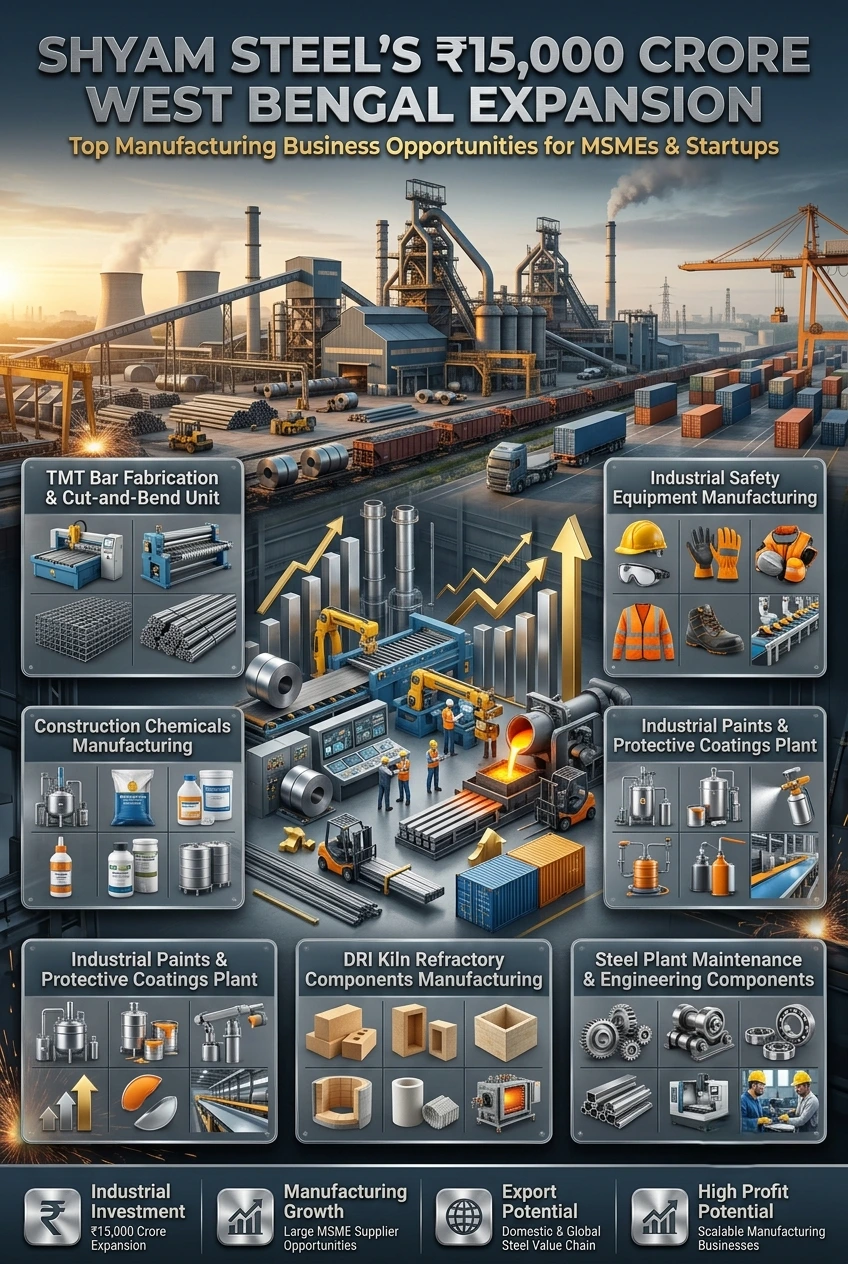
4. Industrial Paints and Protective Coatings Plant
The diversification plan also covers industrial paints. Steel plants and related infrastructure require epoxy coatings, anti-corrosion paints, heat-resistant coatings, and floor coatings in large volumes. Manufacturing industrial-grade protective coatings for steel structures, pipes, and plant equipment is a capital-moderate business (₹80 lakh to ₹2 crore) with recurring demand from industrial customers.
5. DRI Kiln Refractory Components Manufacturing
The new integrated plant will include a Direct Reduced Iron (DRI) unit. DRI kilns and furnaces require constant replacement of refractory bricks, mortar, and insulation components. Manufacturing specialised refractory products for steel and sponge iron applications is a technically barrier-protected niche with strong repeat purchase cycles. Entry investment: ₹1.5 crore to ₹3 crore.(Shyam Steel West Bengal Expansion)
6. Steel Plant Maintenance and Engineering Components
Every operational steel plant needs a continuous supply of replacement parts — gears, bearings, couplings, conveyor components, hydraulic fittings, and roller assemblies. Setting up a precision engineering components manufacturing unit near the Mejia plant addresses demand that will only grow as the plant scales from commissioning to full capacity.
Related Article: How to Start a Steel Fabrication Business in India: Plant Setup, Investment & Profit Guide
Import–Export Opportunity Analysis
India’s steel expansion has an important trade dimension. At the present moment the Indian domestic capacity is not capable of fulfilling the need of heavy import. India still imports great amount of steel and steel made products such as electrical steel, stainless steel coils, structural high-strength steel, etc. With rise of the integrated steel capacity of Shyam steel and other domestic companies it is possible for small component producers to start import substitution with their respective intermediate inputs locally manufactured.
In respect of exports, construction chemical, industrial coatings, engineered goods produced in India enjoy high degree of competitiveness in markets of South-east Asia, Middle East and Africa. The DGFT gives export promotion schemes such as RoDTEP and other benefits such as duty drawback, advance authorisation for manufacturers in these categories. West Bengal’s port infrastructure at Kolkata and Haldia provides natural export logistics advantages for manufacturers in the Bankura–Burdwan belt.
Founders who build manufacturing units with dual supply chain strategy — serving the domestic steel ecosystem while developing export customers — create more resilient business models than those relying solely on one anchor customer.
Indian MSME Success Stories in Steel Ancillary Manufacturing
Electro steel Steels Ancillary Cluster, Jharkhand
When Electro Steel set up its Bokaro plant, it catalysed the growth of over 200 MSME vendors within a 50-kilometre radius. This growth occurred within eight years of commissioning. Suppliers of industrial gases, lubricants, refractory materials, and fabricated components became certified vendors to the anchor plant. As a result, their revenues grew 3x to 7x.
SAIL Burnpur Vendor Ecosystem, West Bengal
The Steel Authority of India’s Burnpur plant in Asansol has sustained an MSME ecosystem of engineering component manufacturers, safety equipment suppliers, and industrial service providers for over four decades. Several of these MSMEs have now diversified to supply multiple steel plants across eastern India.
Rourkela Steel Cluster, Odisha
The Rourkela industrial cluster around the SAIL integrated plant now includes manufacturers of railway wagons, pressure vessels, structural fabrications, and specialised coatings. Many started as simple vendors and later expanded into full-scale industrial manufacturers.
Choose the right startup backed by real market demand
About Niir Project Consultancy Services (NPCS)
An entrepreneur considering participation in any of the aforementioned subsectors of manufacturing can begin by assessing the projects and techno-economic studies feasibility; thus, for entrepreneurs venturing in sectors like steel ancillary, construction chemicals, industrial coatings, refractory products and engineering components and similar, NPCS (Niir Project Consultancy Services) offers project report, market feasibility survey and technology study of the related industries.
NPCS reports cover investment costs, plant layouts, raw materials, and required compliances. They provide the key information needed before investing in the segmented opportunities highlighted in this article.
Data Table: Key Manufacturing Opportunities from Shyam Steel Expansion
| Business Segment | Investment (INR) | Target Customers | Revenue Model | Time to Revenue |
| TMT Fabrication Unit | 50L–1.5Cr | Contractors, Builders | Processing fee/tonne | 6–9 months |
| Safety Equipment Mfg | 60L–1.2Cr | Steel Plants, Industry | B2B supply contracts | 8–12 months |
| Construction Chemicals | 80L–2Cr | Infrastructure Builders | Product sales + AMC | 9–14 months |
| Industrial Paints | 80L–2Cr | Steel, Oil & Gas, Ports | Product + application | 10–15 months |
| Refractory Components | 1.5Cr–3Cr | Steel & Cement Plants | Vendor contracts | 12–18 months |
| Engineering Components | 1Cr–2.5Cr | Steel Plants, Heavy Industry | OEM + maintenance | 10–16 months |
FAQ: Founder Questions About the Shyam Steel Opportunity
Q1. Do I need to be in West Bengal to benefit from this investment?
Not necessarily. While manufacturers in Bankura, Paschim Bardhaman, Purulia, and Birbhum have geographic advantages for logistics, suppliers of specialised products — industrial coatings, precision components, refractory materials — can win contracts from anywhere in India if their product quality and pricing are competitive.
Q2. How long before the Mejia plant starts generating vendor demand?
Large integrated steel plants typically begin generating substantial vendor demand 18 to 36 months after groundbreaking — as plant construction accelerates. Founders who establish vendor credentials during the construction phase are better positioned when production ramp-up creates recurring procurement.
Q3. What certifications do MSME suppliers typically need?
Steel plant Procurement divisions normally insist on an ISO 9001:2015 quality management system certification, an BIS certification for the required safety equipment, a Material Test Certificate for any engineering components and compliance to the factory licence requirements. Arrange to budget for the cost of these certifications during your project design.
Q4. Is the construction chemicals opportunity limited to Shyam Steel?
No. Construction chemicals manufacturers in West Bengal will benefit from the broader ₹28,000 crore investment pipeline the state government has announced, plus national infrastructure projects under PM Gati Shakti, PMAY, and NIP. Shyam Steel is one catalyst — the underlying market is larger and more durable.
Q5. How can I access government schemes to finance manufacturing setup?
SIDBI has provisions for both long-term loans and working capital support for MSME manufacturing units. CGTMSE – The Credit Guarantee Fund Trust for Micro & Small Enterprises, offers loan on collateral free basis of up to 5 crores. The scheme by MSME Ministry – CLCSS – Capital Subsidies Scheme for them has a capital subsidy for 15 % on machinery & plant, meant for SSI in all priority industry.
Q6. Which industrial body can help me connect with steel sector procurement networks?
CII and FICCI promote programmes MSME Connect for promoting vendor development amongst the large corporates, The West Bengal Industrial Development Corporation (WBIDC) also keeps the vendor directory ready for the West Bengal Government’s investment projects.
Conclusion: The Window Is Open — But Not Forever
Economic Times reporting on Shyam Steel’s ₹15,000 crore West Bengal expansion marks a clear turning point for eastern India’s manufacturing ecosystem. The story goes beyond one company’s growth strategy. It signals the direction of capital, policy, and industrial demand in a region that has historically remained underdeveloped despite its potential.
For MSME founders and manufacturing entrepreneurs, the strategic window is right now. In 18 to 24 months, as construction of the Mejia plant accelerates, vendor development programmes will already have shortlisted preferred suppliers. Companies that establish production capability, earn certifications, and begin building relationships with Shyam Steel’s procurement network in the next 12 months will have a material advantage over those who wait.
The sectors that matter most — TMT fabrication, safety equipment, construction chemicals, industrial coatings, refractory components, and precision engineering — are all capital-accessible at the MSME scale. What they require is decision speed and execution discipline.
As Economic Times has consistently reported, India’s steel sector is entering a decade of capacity-led expansion. The Shyam Steel investment is one chapter in that story. The question for every manufacturing entrepreneur is not whether the opportunity exists. The question is: will you be part of it?