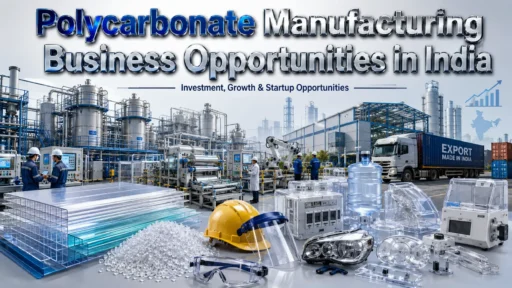
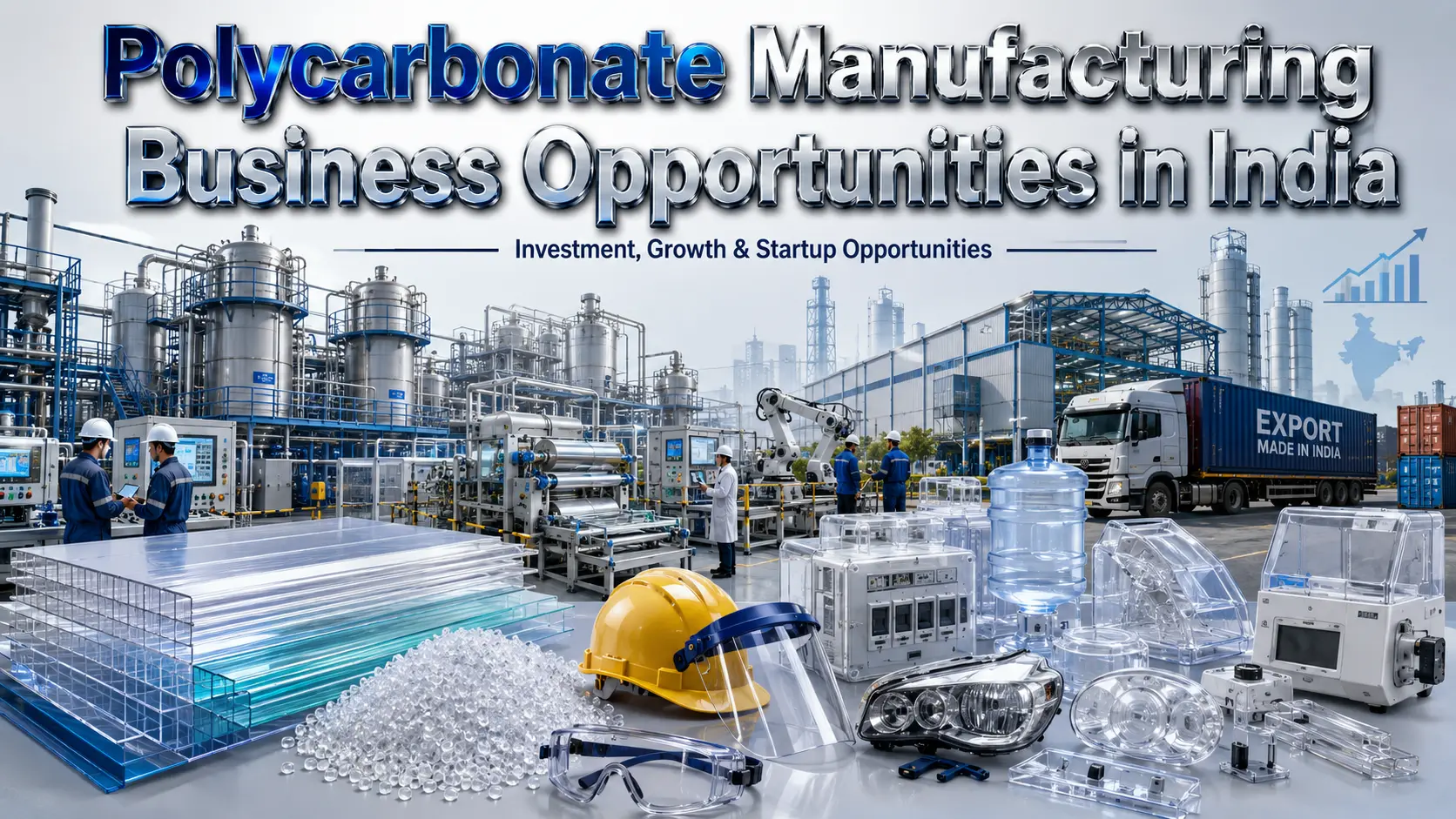

Polycarbonate Manufacturing Business
India is about to undergo a historic transformation in the advanced materials manufacturing sector. According to a never-seen-before interview of Deepak Group’s Deputy Managing Director Maulik D Mehta, released by Indian Chemical News, Deepak Group has laid out plans to make the largest ever investment exceeding 11,000 crores to build India’s first wholly-integrated Polycarbonate (PC) resin ecosystem. Set up at Dahej, Gujarat, the plant will be commissioned by 2028. More than a corporate announcement, it is an extremely significant market signal for entrepreneurs, MSMEs, chemical producers and investors in India.
Polycarbonate resin is the main product of today’s industry. It is used in medical devices, electronics, automotive parts, construction glazing, and consumer goods. Historically, India has been 99% reliant on imports to address this demand. The dependence is about to be challenged — and disruption sparks business opportunity when it happens in large quantities.
If the founders are aware of the downstream effects of this upstream investment, then now is the window.
What Recent Reporting Means for Indian Business
Deepak Nitrite’s capex plans for FY26-28 are focused on establishing a fully integrated advanced materials platform, according to the exclusive interview quoted by Indian Chemical News. The investments cover phenol, acetone, isopropyl alcohol (IPA) and polycarbonate resins. The PC resin project utilises the European technology with plant equipment being removed from Stade, Germany and brought to India and the Indian manufacturing expertise at Dahej, Gujarat.(Polycarbonate Manufacturing Business)
What makes this investment so special is the level of integration. Deepak Nitrite already has one of the biggest phenol and acetone plant in a single location in the world. Bisphenol-A (BPA) is the most important feedstock in the synthesis of polycarbonate resin, and is itself synthesized from phenol and acetone. The company is developing a vertical value chain from the feedstock to the final product PC resin that is unheard of in India.
Get Detailed Project Report (DPR): Plastics, Polymers & Resins Business Guide
Why This Matters Across Stakeholder Groups
- Entrepreneurs: Supply of the domestic PC resin will greatly reduce the raw material costs and delivery time of the downstream resin product manufacturers.
- MSMEs: Small manufacturers of PC products like lenses, medical components, electronics housings can now be sourced locally and not imported at a premium.
- For Automotive OEMs and Tier-1 Suppliers, Electronics and Construction companies, the forex risk is reduced with a reliable Indian supplier.
- Domestic supply of feedstock makes the entire polycarbonate downstream value chain investable including compounding, fabrication, recycling.
- Indian downstream PC product manufacturers: Cost competitiveness to compete in the global markets through exporters.
The Deepak Nitrite announcement isn’t just simply news. It is a structural change in the market which all stakeholders in the manufacturing ecosystem in India should not underestimate.
Why the Polycarbonate Industry Is Growing in India
The demand for polycarbonate in India has been steadily increasing over the years, owing to a number of overlapping macro trends. The electronics manufacturing industry is rapidly growing and is fueling new demand for materials for the device housing, connector and circuit board substrate of PC applications, under the Production Linked Incentive (PLI) scheme. Polycarbonate is also used in medical equipment such as IV parts, surgical tools, blood oxygenators and diagnostic devices, which is another PLI beneficiary.
There is also a growth vector in the infrastructure sector. PC sheets and panels have become a more popular roofing material for skylights, noise barriers, greenhouses and stadium roofs. Considering the India’s rapid development of smart cities and infrastructure projects, the demand for PC based construction materials is projected to increase concurrently.(Polycarbonate Manufacturing Business)
As the automotive industry progresses toward new powertrain technologies, polycarbonate is still necessary for the manufacture of headlamps, interior parts and glazing. Internationally, industries are also considering PC for lightweight structures because its high impact resistance and optical transparency give it a performance edge over glass and traditional plastics.
Currently, India imports almost all its polycarbonate resin, the majority of which comes from China, South Korea and Germany. This reliance on importing comes with volatility and uncertainty of supply. Deepak Nitrite’s home plant will alter this equation drastically, with Indian-manufactured PC becoming competitive for the first time in the world.
Government Policies and Incentives Supporting This Sector
The Indian government has a robust policy environment and is pro-investment in the specialty chemicals and advanced materials sector. There are a number of schemes and initiatives that directly impact the manufacturers who are getting into the polycarbonate value chain.
The Department of Chemicals and Petrochemicals provides financial incentives under the PLI Scheme for Chemicals and Petrochemicals based on the production percentage of eligible manufacturers. MSMEs that are entering downstream processing in PC can look at the eligibility criteria of this framework.
Access to capital for small manufacturers growing their businesses in the field of technical plastics and specialty chemical processing is a reality with the Credit Guarantee Fund Trust and the Technology Upgradation Fund of the MSME Ministry.
The Startup India is providing tax exemption, regulatory fast-tracking, and fund access to those recognised Startups operating in advanced materials, specialty chemicals, and precision manufacturing, all segments, which are adjacent to polycarbonate.(Polycarbonate Manufacturing Business)
The Make in India initiative has also identified advanced chemistry and technical plastics as high priority manufacturing areas, which is an ideal space for new players to explore.
Moreover, Invest India’s facilitation desk for chemicals industry can help bigger chemical manufacturers and joint ventures with regulatory clearances, acquisition of land and state incentive packages.
The Gujarat government has its own package of incentives under the Vibrant Gujarat framework such as capital subsidies, land concessions, and power tariff benefits to industrial units in PCPIR zones, which is where Guj’s Dahej facility is located.
Six Manufacturing Business Ideas Emerging from This Development
1. Polycarbonate Sheet and Panel Manufacturing
Applications: Flat and corrugated PC sheets for construction, greenhouses and signage.
Market demand is steady as a result of the increasing infrastructure spending, greenhouse farming and increased commercial signage.
Capital Investment: ₹3-8 crore for sheet extrusion line.
Customers: Construction contractors, greenhouse growers, sign makers, stadium developers.
Profit Potential: Margins of 15 – 22% can be achieved with established quality and local procurement.
Cost of Raw material (PC resin) will be 12-18% lower as compared to current imported resin price with no dependency on imports due to connection to News – Domestic PC resin from Deepak Nitrite.
2. Optical Lens Blanks and Eyewear Components
Application: Glasses for prescription lenses, safety glasses and sports glasses.
Market Demand: India’s eyewear market has been growing at more than 10% per year with a big manufacturing base in the domestic market which remains untapped.
Investment: Precision Injection moulding and coating lines, ₹ 5-15 crore.
Target Customers: Brands, retail chains, hospital procurement, industrial safety supplier.
Profit Potential: PC optical lenses are 25-35% premium over regular plastic lenses.
Indian lens manufacturers, who have been uncompetitive due to import cost barrier, now stand to benefit from domestic PC supply.
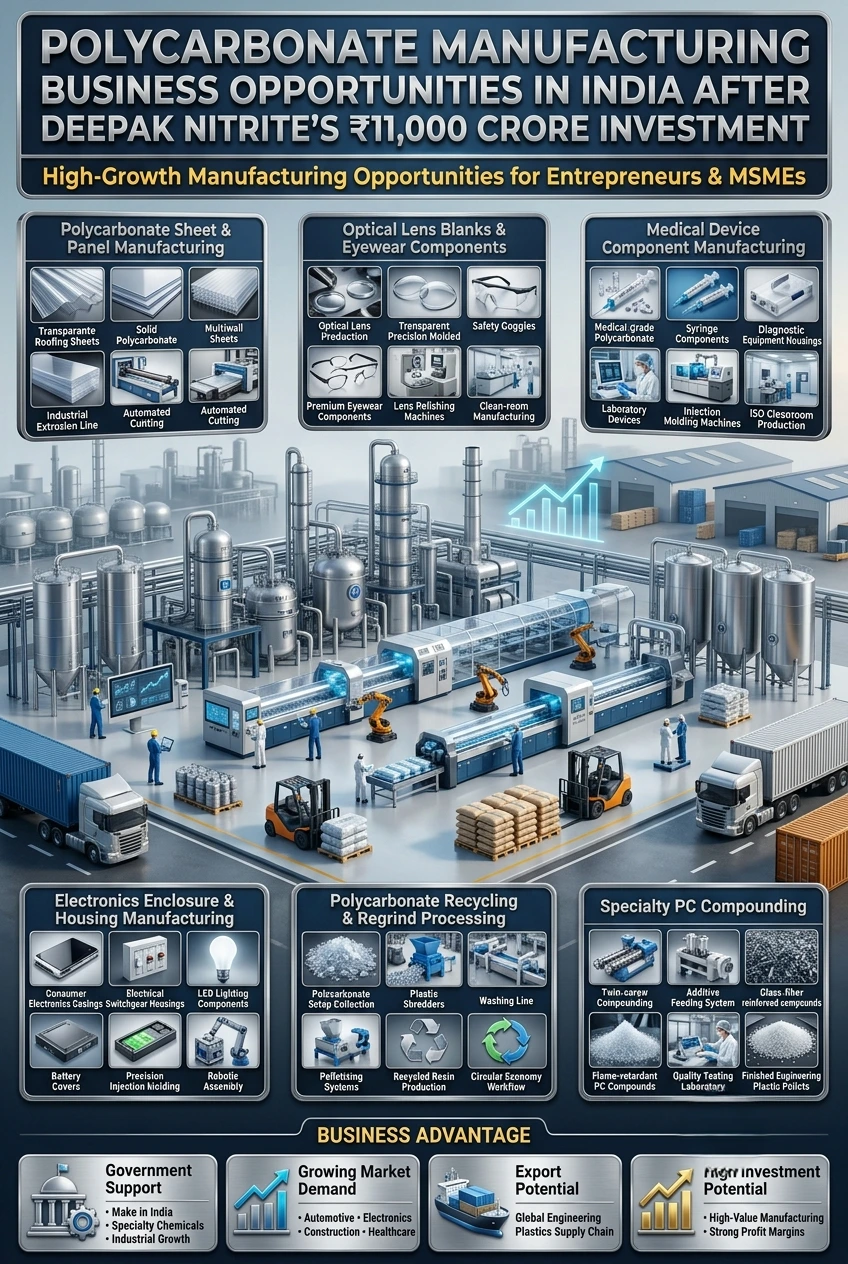
3. Medical Device Component Manufacturing
Applications: PC grade components for IV sets, blood oxygenators, syringe bodies and surgical instrument housings.
Market Demand: India’s market of medical devices has grown by 15%+ year-on-year and will be supported by PLI incentives and the hospital infrastructure.
Investment: ₹8-25 crore for cleanroom injection moulding (ISO 13485).
Target Customers: Medical Device OEMs, Hospitals, Government health procurement organizations, export markets.
Profit Potential: Medical-grade PC components can have margins ranging from 30 to 45%, as the quality standards are quite high and domestic competition is relatively low.
Key: Deepak Nitrite’s built-in PC system allows for uniform supply of medical grade resin, which is essential for this segment.
Related Article: 5 High-Growth Businesses to Build as India Fast-Tracks High-End Medical Device Manufacturing
4. Electronics Enclosure and Housing Manufacturing
Application: Consumer electronics, industrial controls and telecommunications equipment product housing made of PC and PC-ABS blends.
Market Demands: electronics in India are growing at a rapid pace with PLI – mobile phones, IT hardware, and consumer electronics are all using PC enclosures.
Multi Cavity Injection Moulding with surface finishing, investment range is ₹4–12 crore.
Target Customers: Electronics OEMs, EMS companies, industrial automation suppliers.
Profit Potential: 18-28% margins based on volume, contracts with electronics OEMs offer predictability.
A domestic PC can cut resin lead times from overseas suppliers from 6–8 weeks to 1–2 weeks, making it crucial for the rapidly changing electronics supply chain.
5. Polycarbonate Recycling and Regrind Processing
Product: Recycled PC pellets and regrind for second use such as automotive interior and non-critical housings.
Certified recycled PC is being demanded by automotive and electronics OEMs in their supply chains for circular economy requirements.
Investment: Shredder, washing line, and pelletiser has a cost of ₹2 – 6 crore.
Target Customers: Automotive Tier-1 Supplies, Electronics Manufacturers with Sustainability Requirements, European Exported Buyers.
Market Potential: Potential margins of 20-30% on recycled over virgin resin, increasing ESG related premium pricing.
With the onset of domestic PC resin production, post-industrial PC waste will also be available in India in substantial quantities for the first time, providing a sustainable feedstock for recycling facilities.(Polycarbonate Manufacturing Business)
6. Specialty PC Compounding
The product is a range of modified PC compounds for high performance applications that are flame, UV and glass fibre filled.
Moderate Demand: Automotive, aerospace and industrial applications call for PC grades that are not produced off-the-shelf by the basic resin producers.
Technical Requirements: A twin-screw compounding extruder line with an investment value of ₹6 – 18 crore.
Applications: Automotive OEMs, Electrical Equipment Manufacturers, Defence Suppliers, Infrastructure Developers.
Profit Potential: Specialty compounds sell at a 35–55% premium over a standard PC resin, while the technically differentiated products are less competitive.
Specialty material development is a key focus of Deepak Nitrite’s R&D centre (DRDC 2.0) at Vadodara, and there are plans for more PC specialty grades to come down the road for compounders to work with.
Import–Export Opportunity Analysis
India is currently importing polycarbonate resin worth of several thousand crores of rupees per year. The main sources are China, South Korea, Thailand and Germany. This import bill is a structural import bill.
Deepak Nitrite is meeting this requirement with domestic PC resin production in India by way of import substitution. The domestic sourcing will provide the downstream manufacturers with advantages of lower landed cost, no volatility of forex, faster lead time and better technical support from the near supplier.(Polycarbonate Manufacturing Business)
It is an equally good opportunity on the export front. India is an important market for the supply of polycarbonate-based components, especially in medical, optical and electronics industry, which is a thriving market in China plus 1 country such as Southeast Asia, Middle East, Africa etc. For the first time, Indian manufacturers having access to PC resin domestically will be cost competitive in these export markets.
Specialty polymers have been a key area of export growth identified over the years by the Chemicals and Petrochemicals Manufacturers Association (FICCI) and the domestic PC resin will further enhance India’s export capabilities in the field of technical plastics.
The other areas of trade include BPA (bisphenol-A) and phenolic derivatives, which will be the intermediates produced by Deepak Nitrite in their integrated chain. Purchasers in South Asia and South East Asia are currently buying these intermediates from China, and as their quality and reliability increases, there may be a shift to India.
Get Detailed Insights from This Book: The Complete Technology Book on Polymers with Processing & Applications
Indian MSME Success Stories in Related Sectors
Cosmo Films, Aurangabad
Cosmo Films has developed from a small specialty film manufacturer to a worldwide company producing technical films such as polypropylene and PC-based optical films. The results achieved by the company prove that Indian MSMEs can make a significant contribution to the value chain of materials by focusing on quality, R&D, and expanding into export markets. Today Cosmo Films has expanded its export to more than 80 countries.(Polycarbonate Manufacturing Business)
Wim Plast (Cello Group), Mumbai
Wim Plast (Cello Group) created a large-scale manufacturing company for plastics for consumer, institutional and industrial use. Their shift from commodity plastics to high-value technical polymer products shows how MSMEs can scale up by leveraging locally available raw materials. The company’s growth into the PC-compatible product market follows the flow of resin in the market.(Polycarbonate Manufacturing Business)
Nirlon Limited, Mumbai
Nirlon, as one of the pioneers in polymer manufacturing industry in India, is a good example of new polymer segment pioneers achieving long-term market positions. Deepak Nitrite’s entry of domestic supply on to PC’s offers a blueprint for MSMEs to follow regarding nylon and technical polymers.
About NPCS – Niir Project Consultancy Services
NPCS (Niir Project Consultancy Services) is one of India’s most established industrial consultancy and project report providers. For entrepreneurs and MSMEs looking to enter the polycarbonate and advanced materials sector, NPCS offers:
- Detailed Project Reports (DPR) for polycarbonate sheet, lens, medical device component, and compounding projects.
- Comprehensive Feasibility Studies covering capital requirements, raw material sourcing, market potential, and return on investment.
- Market Research Reports on specialty polymers, technical plastics, and advanced material segments.
- Technology Consultancy covering process selection, equipment specification, and vendor identification.
- Project Implementation Support from concept to commissioning, including liaison with government agencies.
NPCS project reports are useful for many people who want to go into manufacturing businesses. They’re utilized by MSME entrepreneurs, lenders (banks and financial institutions) and government bodies in project assessment (new business ventures). So, any entrepreneurial mind hoping to participate in polycarbonate chain can do an NPCS study.
Choose the right startup backed by real market demand
Industry Data Snapshot
| Parameter | Details |
| Industry | Polycarbonate Resin & Advanced Materials |
| Market Driver | Deepak Nitrite’s ₹11,000 crore integrated PC resin facility at Dahej, Gujarat (commissioning 2028) |
| Investment Range | ₹2 crore (recycling) to ₹25 crore (medical devices) for downstream MSME units |
| MSME Opportunity | PC sheets, optical lenses, medical components, electronics housings, specialty compounding, recycling |
| Export Potential | Southeast Asia, Middle East, Africa, and China+1 markets for PC-based components and intermediates |
| Government Support | PLI Scheme, MSME Credit Guarantee, Startup India, Make in India, Gujarat PCPIR incentives |
| Risk Level | Medium — raw material supply secured domestically post-2028; technology and quality compliance remain key risks |
| Growth Outlook | Strong — driven by electronics PLI, medical device expansion, infrastructure growth, and China+1 sourcing trends |
Frequently Asked Questions
1. When will domestic polycarbonate resin from Deepak Nitrite be available?
Indian Chemical News reports that Deepak Nitrite expects to commission its fully integrated polycarbonate facility in Dahej, Gujarat, in 2028. Entrepreneurs aiming to enter the PC downstream business can do so until 2028, when new capacity will come online and financing will be secured.
2. What is the minimum viable investment to enter PC downstream manufacturing?
Entry points vary by product segment. A polycarbonate recycling and regrind unit can be established for ₹2–6 crore. A PC sheet extrusion line requires ₹3–8 crore. Medical-grade injection moulding operations require ₹8–25 crore due to cleanroom and certification requirements.
3. Can MSMEs benefit even before the PC facility is commissioned in 2028?
Yes. MSMEs can begin building downstream capabilities, certifications, and customer relationships now using imported PC resin. Once domestic supply commences, they will have established market positions and can immediately benefit from improved raw material economics.
4. Which government scheme is most relevant for a new PC sheet manufacturing unit?
The Credit Guarantee Fund Trust (CGTMSE) of the MSME ministry facilitates the facility of collateral free credit of Rs. 5 crores to eligible manufacturing units and investment in plant and machinery. Through Technological Upgradation Fund Scheme (TUFS) and Startup India will be helpful in getting the income tax exemption for a newly incorporated firm.
5. Is there export demand for Indian polycarbonate products?
Great export opportunity especially within the growing Southeast Asia, Middle East and Africa markets. We see significant desire from the Global OEMs for supply bases outside of China. The OEMs will seek manufacturers with access to key raw materials at a competitive price as well as companies that can obtain relevant quality certifications. India with its potential is very well placed to address this trend for high quality components, optronics and technical enclosures.
6. What certifications are required to supply PC components to the medical device sector?
Medical-grade PC component manufacturing requires ISO 13485 certification for quality management systems. For specific device categories, CDSCO registration in India is mandatory. Export-oriented units may additionally require CE marking (for Europe) or FDA registration (for the United States). These certifications take 12–24 months to obtain and should be initiated well in advance of production launch.
Conclusion: The Window to Act Is Open
India’s polycarbonate sector is undergoing its most significant structural transformation in decades. The Deepak Nitrite investment, which Indian Chemical News detailed in an exclusive interview, signals that domestic PC resin supply—previously a critical gap—will resolve at scale by 2028. This single development unlocks an entire ecosystem of downstream manufacturing, processing, and trade opportunities that did not exist at competitive economics before.
For entrepreneurs, the opportunity lies in establishing downstream manufacturing positions now, before the raw material supply is fully available. For MSMEs, the priority should be product development, customer acquisition, and certification in the segments — medical, optical, electronics, construction — where polycarbonate delivers irreplaceable performance. Investors, the polycarbonate downstream value chain in India is entering a period of structural tailwind that may last a decade.(Polycarbonate Manufacturing Business)
The combination of domestic feedstock security, government policy support, China+1 diversification trends, and rising domestic consumption across multiple end-use sectors creates a convergence of opportunity that is rare in Indian manufacturing. Founders who recognise this opportunity and act decisively in 2025–2026 can lead India’s polycarbonate industry well into the next decade.
Get your feasibility study, project report, and market intelligence in place today. The next phase of India’s advanced materials story is being written now.