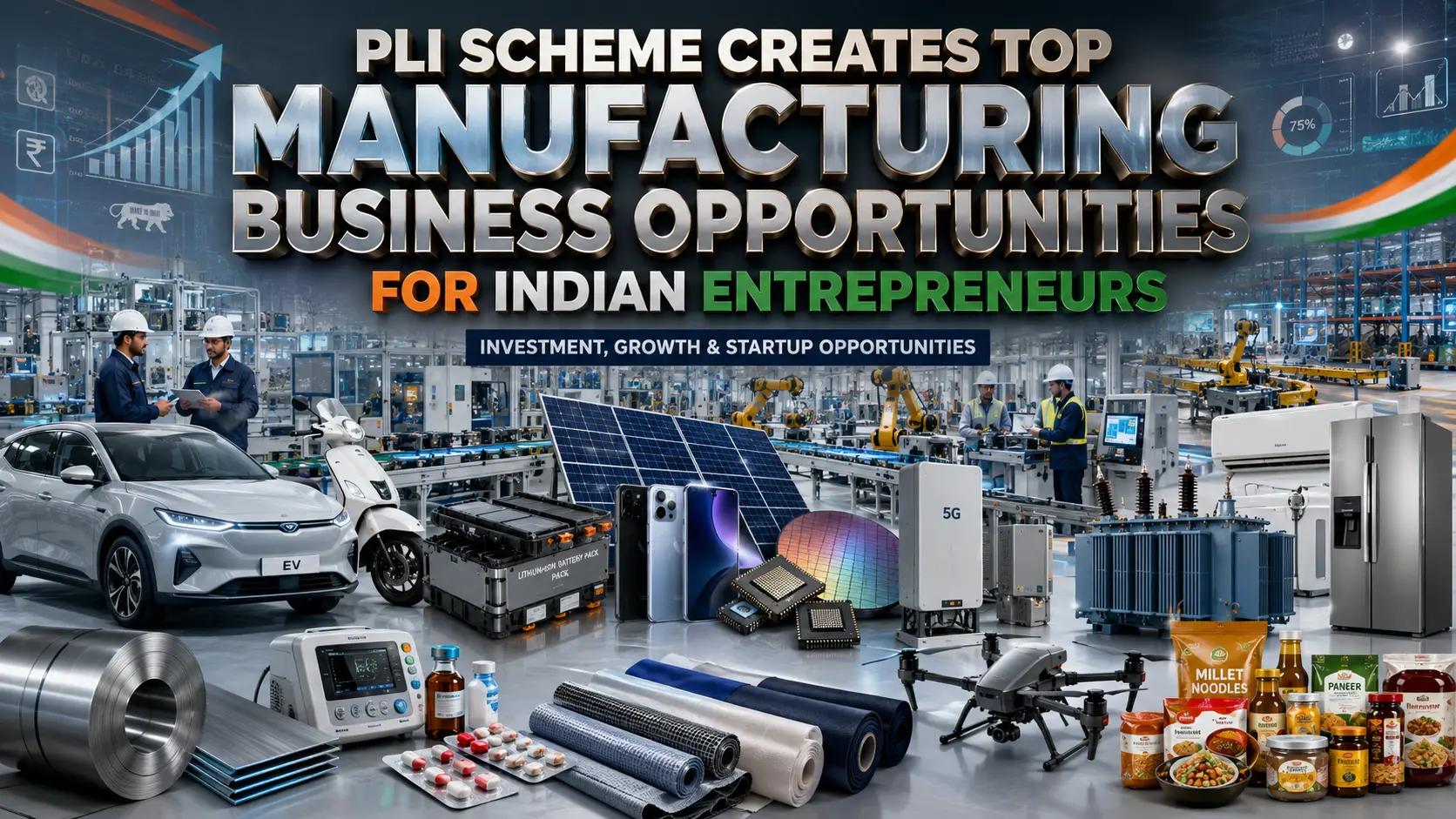

PLI Scheme Manufacturing Business
India has taken another giant step towards its manufacturing aspirations. According to the Economic Times dated 21st July 2026, the government’s Production Linked Incentive (PLI) schemes have been able to secure actual investment of Rs 2.40 lakh crore and created direct and indirect jobs of over 14.15 lakh till March 2026. These are not estimates. This is the capital that is already invested, already working, and already going to the market!
For every entrepreneur, MSME founder or Startup builder, this is a market call that can’t be ignored while observing the industrial landscape of India. A parallel system of component suppliers, ancillary manufacturers, contract processors and B2B service providers is quickly emerging alongside the billions pledged by big corporations.
PLI sectors helped India’s exports to the tune of more than Rs 15.2 lakh crore since inception, according to the Economic Times Manufacturing. PLI sectors helped India’s exports to the tune of more than Rs 15.2 lakh crore since inception, confirms Economic Times Manufacturing. It is fast becoming a value-chain partner worldwide. This article unpacks the implications for manufacturing entrepreneurs, which industries are doing well and where the big white spaces for new businesses lie today.
Related Article: PLI Scheme: Is It Really for MSMEs or Only for Big Companies?
What Recent Economic Times Reporting Means for Manufacturers
Based on a Lok Sabha reply given by Union Minister of State for Commerce and Industry, Jitin Prasada to an e-question in the Parliament, the above report by the Economic Times of 21 July, 2026 has been published.It is not a media forecast. Official government information in confirmation.
Key data points confirmed in the ET report:
- Real PLI investments made till March 31, 2026: Rs 2.40 lakh crore
- Total employment generated: 14.15 lakh (direct + indirect)
- Total exports achieved since inception: Rs 15.2 lakh crore
- Largest investment segment: High-efficiency solar PV modules – Rs 64,873 crore
- Pharmaceuticals: Rs 45,158 crore | Automobiles: Rs 44,326 crore | Specialty Steel: Rs 23,896 crore
- Lowest investment sector: Drones and drone components – Rs 595 crore (massive gap = massive opportunity)
What does this imply for a manufacturer’s founder? It means that there are assets being invested already for the purpose of anchoring. Now global and Indian companies, known as large PLI beneficiaries, are in need of domestic suppliers, component makers, contract manufacturers and logistics companies. The tier-two and tier-three suppliers are not very developed around the PLI sectors. This is the exact place where savvy founders can enter, grow rapidly, and secure long-term B2B deals.
Why This Manufacturing Sector Is Growing — And Why It Will Not Stop
PLI is not a “one-shot” government initiative. Structural reform is a multi-year, multi-sector reform to make India competitive in manufacturing in the international market. The information clearly demonstrates that the policy is having an impact. This growth path will be sustainable for these reasons:
1 Global Supply Chain Realignment
Global businesses have had to diversify their production away from dependency on a single geography, in response to COVID-19. India, for its part, has a huge pool of skilled labor, a solid infrastructure and PLI incentives making it the preferred alternate hub. The manufacturers of electronics, pharma MNCs, and auto OEMs are all growing Indian presence.
2 Export-Linked Incentive Design
Production and export performance are rewarded in PLI schemes. The scaling up of exports — Rs 15.2 lakh crore — requires domestic inputs, packaging, logistics, and testing infrastructure. There are 15 to 30 supplier needs downstream for each large exporter. The holes are market opportunities for founders.
3 Government Policy Continuity
The policy continuity for PLI by the Indian government has been indicated. Make in India and industrialization continues to be a national priority till 2030. Regulatory mechanisms, incentives disbursement and export promotion structures are in place and are growing.(PLI Scheme Manufacturing Business)
Government Policies and Incentives Founders Must Know
Complementary government support programs provide a web of support to the PLI ecosystem. Today’s manufacturers have a whole new set of policy tools to draw on:
1 Production Linked Incentive (PLI) Scheme
There are cash incentives ranging from 4% to 20% of incremental sales over a base year across 14 identified sectors offered by PLI. Ancillary and component suppliers to PLI beneficiaries will be beneficiaries of the success of PLI, even if they aren’t direct beneficiaries of PLI access.
2 MSME Ministry Support
The ministry of MSME offers credit guarantee schemes, technology upgradation support, and cluster development schemes catered to small manufacturers in high growth sectors. Founders should consider using the credit guarantee by CGTMSE and MSME Champions portal for sector specific support.
3 Startup India Seed Fund Scheme
As confirmed in the same Lok Sabha reply quoted in Economic Times, under Startup India Seed Fund Scheme, 219 operational incubators have received Rs 945 crore out of which Rs 650 crore has already been disbursed. These incubators provide access to funding for manufacturing startups with prototypes and market traction.(PLI Scheme Manufacturing Business)
4 DPIIT Recognition and Tax Benefits
The top 3,000 startups listed by DPIIT are exempt from paying income tax for 3 years, compliance easing, self-certification for labour and environment laws, and expedient patent application process. Start-ups that enter into sectors linked to PLI are good options for recognition by DPIIT.
Manufacturing Business Ideas Emerging Directly from PLI Sector Growth
Each sector with a high level of PLI investment presents a downstream supply chain opportunity. Let’s take a look at some business ideas that spring to mind with this new milestone:
Idea 1: Precision Metal Component Manufacturing for Automotive PLI Beneficiaries
The auto PLI scheme invests Rs 44,326 crore and OEMs and tier-1 suppliers are on a growth trajectory. Precision-machined components such as brackets, housings, hubs, shafts are too scarce domestically. This is an opportunity for a founder who has access to CNC or VMC equipment or sheet metal work. The investment required is from Rs 80 lakh to Rs 3 crore and will vary based on the machine mix.
Idea 2: Pharmaceutical API and Intermediate Manufacturing
Currently, the investments in Pharma PLI are at Rs 45,158 crore and the government is actively encouraging domestic API production to lessen the import dependency. Small scale API synthesis units and pharma intermediates producers can be contracting manufacturers to the big pharma PLI beneficiaries. This demands regulatory compliance (CDSCO, GMP) and margins are high and demand is captive.
Get Detailed Project Report (DPR): Active Pharmaceutical Ingredient (API) Products, Bulk API Manufacturing
Idea 3: Solar Panel Sub-Component Manufacturing
The solar PV module sector drew the highest PLI investment at Rs 64,873 crore. Yet most module-level inputs — aluminium frames, junction boxes, EVA film, back-sheets, and mounting structures — are still imported or sourced from a handful of domestic players. A manufacturer entering frame fabrication or junction box production with BIS certification can immediately target large PLI module manufacturers as anchor clients.(PLI Scheme Manufacturing Business)
Explore This Book: Solar PV Power and Solar Products Handbook
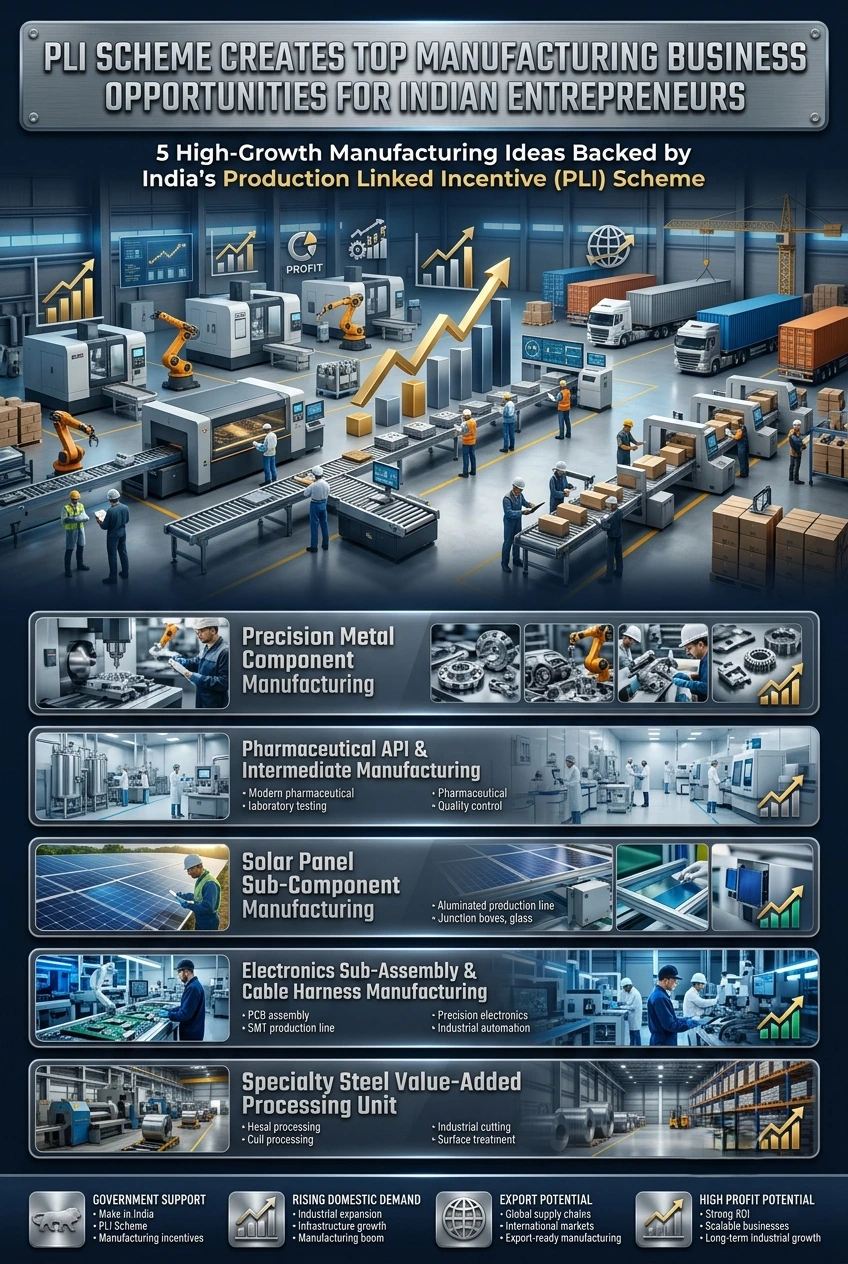
Idea 4: Electronics Sub-Assembly and Cable Harness Manufacturing
Large-scale electronics manufacturing received Rs 20,580 crore in PLI investments. Global electronics brands assembling in India — from consumer devices to IT hardware — require a continuous supply of PCB assemblies, cable harnesses, plastic enclosures, and mechanical parts. A structured contract manufacturing unit targeting electronics OEMs in PLI zones can achieve steady, contractual B2B revenue. Industry data confirms a significant domestic supply deficit in these inputs.
Idea 5: Specialty Steel Value-Added Processing Unit
Specialty steel PLI investments touched Rs 23,896 crore. Downstream opportunities include cold-rolled steel processing, steel service centres supplying cut-to-length and slit coils, and precision steel tubular manufacturing for auto and industrial applications. The Invest India portal has flagged downstream specialty steel processing as an underpenetrated segment with strong B2B demand from PLI beneficiaries.(PLI Scheme Manufacturing Business)
Get Detailed Insights from This Book: Steel and Iron Handbook
Import-Export Opportunity Analysis
PLI-driven manufacturing creates a dual opportunity: import substitution at home and export competitiveness abroad. The confirmed Rs 15.2 lakh crore in PLI-enabled exports proves the model works.
- Electronics: India’s smartphone exports crossed Rs 2 lakh crore in FY26. Sub-assembly and component exporters are benefiting from this ramp-up.
- Pharmaceuticals: India remains the world’s largest generic drug exporter. API manufacturers feeding the pharma PLI ecosystem are accessing global supply chains.
- Auto Components: Auto component exports are on a strong uptrend. Precision component makers with export-quality certification (IATF 16949) are entering global supply chains.
- Specialty Steel: Growing export demand from Southeast Asia and Africa for value-added steel products.
Export-oriented startups may obtain an IEC (Importer Exporter Code) from the Directorate General of Foreign Trade (DGFT) and consider sector-wise export promotion councils for marketing-related assistance.
Indian MSME Success Stories in PLI-Linked Manufacturing
Motherson Sumi Wiring India
A classic example of how a focused auto component maker scaled globally. Starting with wire harness manufacturing for domestic OEMs, Motherson scaled into a multi-billion-dollar global Tier-1 supplier. The PLI auto scheme is creating the next generation of such companies.
Dixon Technologies
Dixon entered electronics contract manufacturing when the sector was largely import-dependent. Today, under the electronics PLI scheme, Dixon is one of India’s largest EMS companies, supplying to global brands and winning export contracts. Founders in electronics sub-assembly can study the Dixon playbook.(PLI Scheme Manufacturing Business)
Granules India
Granules India was founded as one of the top API manufacturers from Hyderabad and became into one of the global generic supplier companies. The pharma PLI environment today mirrors the early conditions Granules navigated — strong domestic demand, global supply chain gaps, and regulatory maturity as the key differentiator.
Choose the right startup backed by real market demand
About NPCS — Niir Project Consultancy Services
NPCS (Niir Project Consultancy Services) is one of India’s most respected industrial consultancy and feasibility report providers, with over two decades of experience across manufacturing sectors including chemicals, food processing, pharma, agro-based industries, paper, plastics, textiles, and engineering goods.
For entrepreneurs and MSMEs looking to enter PLI-linked manufacturing sectors, NPCS provides:
- Detailed project reports and feasibility studies for manufacturing ventures
- Market analysis and demand forecasting for targeted sectors
- Plant and machinery guidance, sourcing support, and technology tie-up facilitation
- Licensing, compliance, and regulatory roadmap support
- Investment analysis and ROI modelling for new manufacturing units
NPCS helps founders move from idea to investment-ready project with structured, banker-grade feasibility documentation that supports loan applications, investor pitches, and government scheme applications.
PLI Sector Investment and Manufacturing Opportunity Matrix
| PLI Sector | Investment (Rs Cr) | Jobs Created | Startup Opportunity |
| High-Efficiency Solar PV Modules | 64,873 | 2.1 lakh+ | Component manufacturing, mounting systems |
| Pharmaceuticals | 45,158 | 1.8 lakh+ | API, contract formulation, nutraceuticals |
| Automobiles and Auto Components | 44,326 | 2.5 lakh+ | EV parts, precision casting, tooling |
| Specialty Steel | 23,896 | 90,000+ | Value-added steel processing, downstream units |
| Large-Scale Electronics | 20,580 | 1.5 lakh+ | PCB assembly, cable harness, enclosures |
| Telecom and Networking | 14,200 | 60,000+ | Antenna parts, connectors, sub-assemblies |
| Food Processing | 10,900 | 1.2 lakh+ | Frozen foods, retort packs, cold-chain infra |
Source: Lok Sabha Reply, Ministry of Commerce and Industry, July 21, 2026 | Compiled by NPCS Research
FAQ – Founder-Focused Questions on PLI Manufacturing Opportunities
Q1. Can an MSME or startup directly apply for PLI scheme benefits?
Direct PLI scheme eligibility requires minimum investment thresholds that most early-stage startups cannot meet. MSMEs can also get leverage of PLI scheme by acting as suppliers to a major PLI applicant or manufacturer for either component or raw material under their scheme applications. The PLI document specifies 176 MSMEs as beneficiaries under component manufacturing schemes like those for bulk drug, medical device manufacturing schemes and drone/food processing schemes. The startups founders may try the route of a component or material supply chain for the larger player to win at an indirect bid; also connecting with MSME ministry can help in getting more details about a sectorial opening.
Q2. Which PLI sector offers the lowest entry barrier for a new manufacturing startup?
Drone components and electronics sub-assembly currently have the lowest investment concentration in PLI data, indicating under penetration and open supply chain slots. Food Processing Sector- another entry with less capital input, easier regulation, huge market.
Q3. How much capital does a PLI-linked manufacturing venture typically need?
How much does one invest. It all depends on the sector. Sub-assembly for electronics and cable harness units can be established anywhere between Rs 50 lakh and Rs 2 crore. For manufacturing a Pharma API (active Pharmaceutical Ingredient) plant, investment can range between Rs 5 crore and Rs 25 crore depending on complexities of synthesis whereas precision machines in the Auto component sector cost Rs 1 crore to Rs 5 crore, according to an NPCS Detailed project report (DPR).
Q4. What government funding support is available for manufacturing startups in 2026?
Entrepreneurs also can leverage upon the Startup India Seed fund scheme 2016 with the aid of 219 registered incubators or opt for equipment funding thru SIDBI SPEED Scheme, avail collateral unfastened credit as much as Rs five crore thru CGTMSE Credit guarantee, and Avail Ministry of Micro, Small and Medium Business thru Cluster development subsidy. Such Entrepreneurs could also reap tax deductions & get exemption from self-certification via acquiring identification from DPIT.
Q5. How do I find anchor B2B clients in PLI-beneficiary companies?
Data bases are maintained by Industry Associations like CII, FICCI and specific bodies such as ELCINA (electronics), ACMA (auto parts), Pharma Export Promotion Council and so on. By participating in specific industry fairs such as Auto Expo, Electronica India, PHARMINTECH, etc., a founder can directly meet procurement heads from PLI beneficiary firms.
Q6. Is it the right time to enter PLI-linked manufacturing, or is the opportunity already crowded?
The Economic Times data confirms Rs 2.40 lakh crore in investments — but this has largely flowed to large enterprises setting up production capacity. The tier-2 and tier-3 supplier ecosystem — where a founder can realistically enter — is still forming. Entering now means building supplier relationships and quality certifications before the market matures, which is the ideal timing window for a first-mover advantage.
Conclusion: The PLI Signal Is Clear — The Supplier Ecosystem Is Wide Open
The Economic Times report published on July 21, 2026, is not just a government data release. It is a market signal of exceptional clarity. Rs 2.40 lakh crore in actual investments. Rs 15.2 lakh crore in exports. 14.15 lakh jobs created. These are the foundations on which India’s next wave of manufacturing businesses will be built.
The large PLI beneficiaries — the Foxconns, the Sun Pharmas, the Tata Electronics — cannot scale without thousands of domestic suppliers, component makers, contract processors, and value-added service providers. That ecosystem is currently underserved. That is the white space.
For a manufacturing founder in 2026, the strategic advice is simple: identify one PLI sector where your skills, capital, and network align; build quality systems that meet the anchor buyer’s specifications; and enter as a B2B supplier before the sector matures. The government policy, the investment capital, and the export demand are already in place.(PLI Scheme Manufacturing Business)
The timing window is now. Founders who move in 2026 will sign contracts, build certifications, and establish supply chain relationships before late entrants flood the space. Economic Times has validated the opportunity. NPCS can help you build the project report to act on it.