Introduction: IV Fluid Manufacturing in India
India’s pharmaceutical manufacturing industry is expanding rapidly with the support of the growing healthcare infrastructure, rising hospitalization rates, and rising demand for injectable therapies. Among the most important medical consumables used in hospitals and clinics are intravenous (IV) fluids such as Sterile Water for Injection (S.W.F.I.), Dextrose Saline and Normal Saline. These products are essential to the treatment of modern medicine and are used on a daily basis in vast quantities.
Unlike many pharmaceutical products that are subject to the vagaries of market fluctuations, IV fluids are a stable volume-driven industry underpinned by constant institutional demand. Hospitals need reliable supplies to guarantee continuous patient treatment – so IV fluid manufacturing is an interesting and sustainable business opportunity. For entrepreneurs and pharmaceutical manufacturers in India, this is a sector with growth potential in the long term with a sound public health impact.
Read More: Aloevera Gel and Powder – Manufacturing Plant, Detailed Project Report, Profile, Business Plan, Industry Trends, Market Research, Survey, Manufacturing Process, Machinery, Raw Materials, Feasibility Study, Investment Opportunities, Cost and Revenue
Understanding Important IV Fluid Products
Sterile Water for Injection (SWFI)
Sterile Water for Injection is a highly purified and sterile water used mostly for preparing injectable medications. Although it does not contain active pharmaceutical ingredients, SWFI is a vital ingredient in medical treatments, especially in reconstituting powdered drugs like antibiotics and vaccines.
Hospitals depend on SWFI for:
- Reconstitution of medicines for injection
- Preparation of emergency drugs
- Flushing and dilution procedures for IV line
- Surgical and critical care applications
Manufacturing SWFI requires the use of advanced water purification systems and stringent aseptic processing. Water undergoes multiple purification processes through reverse osmosis and distillation before storage in sterile tanks. The filling process occurs within cleanroom environments which maintain strict controls to preserve sterility and protect patient safety.
The packaging costs together with utility expenses and quality assessment costs and regulatory compliance expenses represent the primary drivers of operational expenses because the raw materials remain inexpensive to obtain. Manufacturers who focus on efficiency while pursuing long term institutional contracts will receive continuous income.
Read More: Manufacturing Business IV Fluid (FFS Technology)
Dextrose Saline
Dextrose Saline is a sterile IV solution that is a combination of glucose and sodium chloride. It is widely used for hydration therapy, electrolyte balance and energy support in those who cannot take food orally. Hospitals use this fluid so often; in general wards, pediatric care, and post-operative recovery.
Key medical uses include:
- Treatment of dehydration
- Post-surgical recovery support
- Paediatric fluid therapy
- Management of hypoglycaemia
- Maintenance fluid therapy
The manufacturing process starts with pharmaceutical grade purified water. Controlled amount of dextrose and sodium chloride dissolved under strict monitoring conditions in stainless steel mixing vats. The solution is filtered, packed in sterile containers, and sterilized using proven procedures such as autoclaving.
Consistency in formulation is critical as incorrect concentrations may influence the patient safety and stability of products. As healthcare services are being extended to smaller cities and rural parts of India, the demand of Dextrose Saline is still expanding steadily. Regional manufacturing plants benefit from reduced shipping expenses and quicker shipment times which enable them to supply hospitals.
Normal Saline (Sodium Chloride 0.9%)
Normal Saline stands as the most frequently used intravenous fluid across the globe. The solution maintains isotonicity because it contains sodium chloride at a precise level that matches the body’s normal fluid equilibrium. Hospitals use Normal Saline every day to conduct various medical procedures which makes Normal Saline the backbone of IV Therapy.
Common applications include:
- Hydration and replacement of fluids
- IV Flushing, Medication Dilation
- Cleaning of wounds and surgical irrigation
- Emergency and shock treatment
The formulation presents a simple design yet needs precise measurement and sterile handling and strict quality control during its production process. Purified water cannot be used with less than pharmaceutical standards and sodium chloride concentration must be precise to assure safety and effectiveness.
Normal Saline manufacturing is a mainly high volume business. Profitability relies on efficient production systems, improved packaging techniques and effective distribution networks. Because of its constant demand, it is one of the most reliable segments in pharmaceutical manufacturing.
Read More: DEXTROSE SALINE – Manufacturing Plant, Detailed Project Report, Profile, Business Plan, Industry Trends, Market Research, Survey, Manufacturing Process, Machinery, Raw Materials, Feasibility Study, Investment Opportunities, Cost and Revenue, Plant Layout
Manufacturing Process Overview
While each IV fluid has specific formulation requirements, the general manufacturing process takes similar steps:
1.Water Purification: Good quality water is generated with the help of reverse osmosis, deionization and distillation systems to meet pharmaceutical standards.
2.Solution Preparation: Ingredients like sodium chloride and dextrose are dissolved in stainless steel mixing tanks in controlled conditions.
3.Filtration: The prepared solution undergoes microfiltration to effectively eliminate particulates and microbial contaminants.
4.Aseptic Filling: Cleanroom environments use automated filling systems to transfer solutions into sterile bottles and bags.
5.Sterilization: Manufacturers use validated processes such as autoclave to perform final product sterilization.
6.Quality Testing: The company conducts comprehensive testing to assess sterility and chemical composition and product stability before releasing products to the market.
Modern technologies such as Blow-Fill-Seal (BFS) systems help decrease contamination risks while increasing operational efficiency.
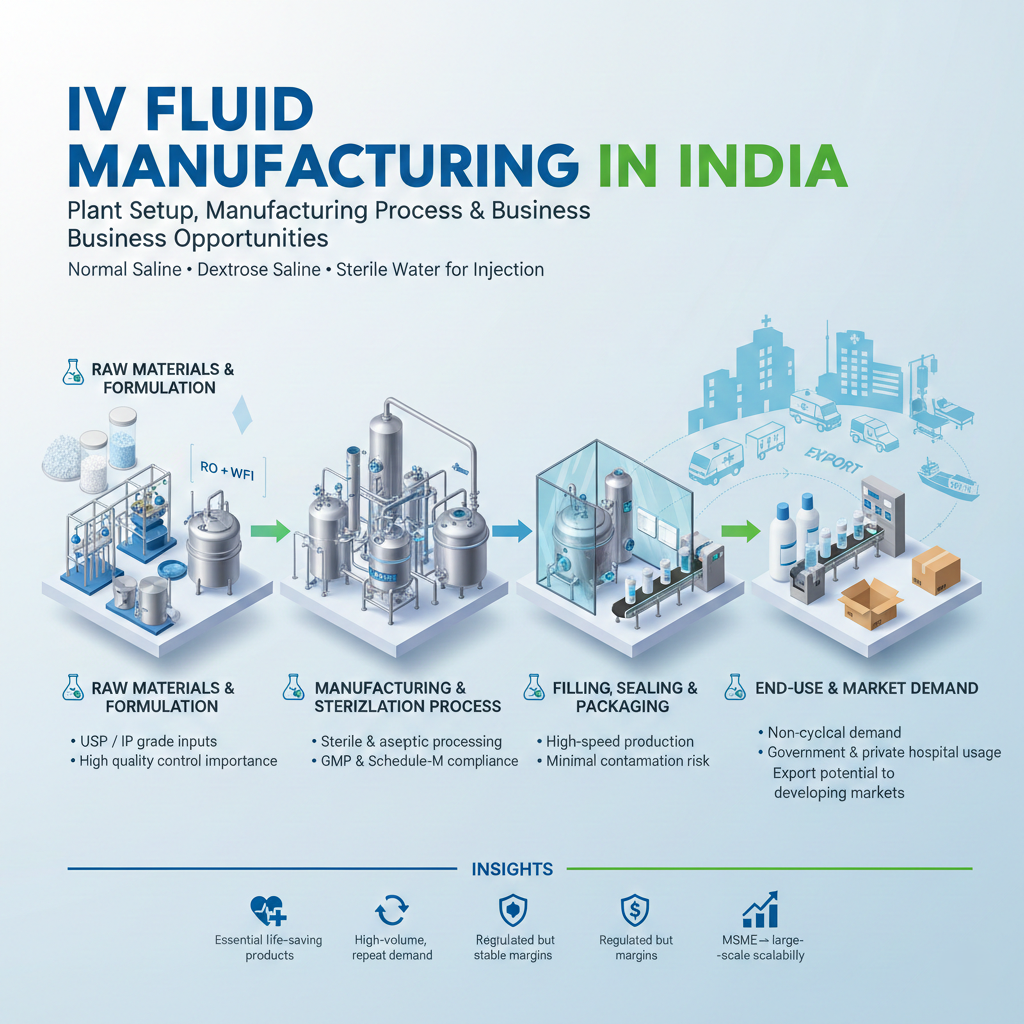
Market Demands and Growth in India
The Indian healthcare sector expands because of growing population demands and improved insurance access and enhanced medical facility development. Government healthcare programs and the expansion of private hospitals are also contributing towards increasing consumption of IV fluids.
Major driving forces of growth are:
- Increasing number of surgical procedures and admissions to hospital
- Growth in injectables medicines and biologics
- Expansion of critical care and emergency services
- Development of healthcare facilities in tier-2 and tier-3 cities
- Increasing awareness of modern medical treatments
Because IV fluids are necessary components for almost every department in the hospitals, demand remains constant regardless of economic cycles.
Read More: Launching a Profitable IV Fluid Manufacturing Venture with BFS Technology
Regulatory Requirements and Compliance
Establishing an IV fluid manufacturing plant in India needs to be followed by strict adherence to the pharmaceutical regulations. Manufacturers need to obtain licenses from appropriate authorities while following Good Manufacturing Practices (GMP) regulations. Essential requirements consist of the following element:
- Sterile production environments and cleanroom facilities
- Verified manufacturing processes
- QA, or Quality assurance and documentation systems
- An example of this is, “Regular inspections and regulatory approvals”.
Organizations need to meet compliance standards for their legal operations because compliance builds trust with hospitals and institutional buyers.
Read More: Launching a Profitable IV Fluid Manufacturing Venture with BFS Technology
Business Opportunities and Potential Profit
IV fluid manufacturing is a scale-based business in which profits are made based on the efficiency of production and supply agreements, not high margins per unit. Many new manufacturers have launched their initial production with Normal Saline because of its high demand and relatively straightforward formulation. Companies will establish Dextrose Saline and SWFI product lines as their operations grow through business expansion.
Opportunities include:
- Supplying government hospitals and health care programs
- Working with private hospital chains as partners
- Contract manufacturing for pharmaceutical companies
- Exporting to new healthcare markets
The transportation of IV fluids becomes challenging because their large size results in heavy hauling expenses which creates an advantage for organizations that possess strong logistics systems and regional distribution capacity.(IV Fluid Manufacturing in India)
Conclusion
The three products which include Sterile Water for Injection and Dextrose Saline and Normal Saline serve as critical components necessary for contemporary healthcare delivery. The pharmaceutical industry in India experiences exciting growth prospects because institutional customers and ongoing demand for IV fluids, which manufacturers can produce through scalable production systems, exist in the market.(IV Fluid Manufacturing in India)
Businesses become successful and sustainable when entrepreneurs invest their resources into building high-quality infrastructure while following regulatory standards and establishing effective production systems. The demand for quality IV fluid manufacturers will increase because people in India gain better access to healthcare services, which makes this industry both profitable and beneficial to society.
FAQs
- Is making IV fluid a profitable business in India?
Yes, profitability is not based on high margins per unit on days, but on production scale, compliance, and long-term hospital supply contracts.
- Which is the highest demand IV fluid in hospital?
Normal Saline often has the highest volume demand as it is used in such a wide range of medical treatments.
- What are the major challenges in Sterile Water for Injection manufacturing?
Maintaining the sterility, meeting the strict regulatory standards, ensuring advanced aseptic processing.
- What is the difference between Dextrose Saline & Normal Saline?
Dextrose Saline contains glucose for energy support while Normal Saline is mainly used for hydration and electrolyte balance.
- What are the drivers of growth for IV fluids industry?
Hospital expansion, more surgeries, expansion of injectable medicines and better access to healthcare come across India.
- Can small manufacturers get into this industry?
Yes, but it will require strong compliance systems, investment in infrastructure and reliable distribution networks for success.