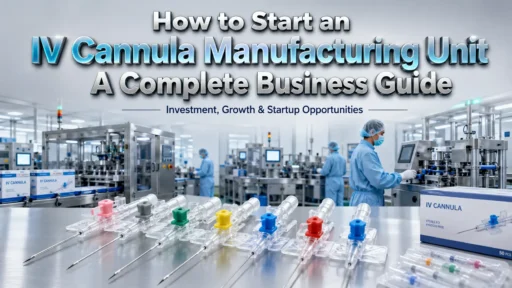


IV cannula manufacturing is a regular top priority opportunity for established industrial consultants when assessing business ideas in the health care manufacturing sector. The healthcare sector is growing faster in India than in any other sector. Hospitals, clinics and emergency care centres require millions of IV cannulas per month and local production is still far behind. This gap is a business opportunity for the entrepreneur who has a clear vision and has moderate capital for him and for the society.
An IV cannula (intravenous catheter) is a small hollow plastic tube that a healthcare provider inserts into a patient’s vein to deliver fluids, medicines, or blood. It is considered a single use medical device and is replaced with each admission to the hospital. This kind of consumption pattern results in an ongoing and increasing demand curve. In addition, the cost advantage of the Indian manufacturers enables them to assert their presence in the export markets of Africa, Southeast Asia and Middle East.
Why IV Cannula Manufacturing Is a Smart Industry to Enter
India is emerging as one of the world’s fastest-growing medical device markets. Experts estimate that the country’s medical device industry will likely reach a whopping ₹3 lakh crore in the coming years, with disposable and single-use devices making up a significant share. IV cannulas are an obvious example of such a high consumption. The combined use of tens of millions of units a year by government hospitals, private nursing homes, and diagnostic centres, plus the surprisingly high import dependency.
Besides, the pandemic COVID-19 revealed the vulnerability of India to supply chain disruptions of medical consumables. Meanwhile, the central and state governments have been proactively promoting domestic production. The tailwind in the policy has created a structural advantage for new manufacturers in the sense that the market is there, the government is supporting them and there is not much competition from organised Indian players in the field. It is an old opportunity that has not yet been given to the well-funded MSMEs.
Get Detailed Insights from This Book: Handbook on Medical and Surgical Disposable Products
Export Opportunity: Global Demand for Affordable Medical Devices
Indian IV cannula manufacturers are already exporting to more than 60 countries. Imported drugs are a key growth area in African health care systems, which are heavily dependent on them. Likewise, the Indian manufacturers’ efforts at establishing a credible reputation for quality products have made Indian medical devices preferable to Chinese ones, especially among the countries of Southeast Asia, which also look favourably on the competitively priced medical devices. Now, the global IV cannula market is expanding at a CAGR of more than 8%, and Indian exporters are poised to take a bigger bite out of this market.
Government Policies and Incentives That Support This Business
The Government of India has placed a significant emphasis on medical device manufacturing through policy. There are several support mechanisms available to help entrepreneurs to reduce capital burden and speed their IV cannula unit entry into the market.
The Production Linked Incentive (PLI) Scheme for Medical Devices is being introduced by the Department of Pharmaceuticals (DoP) for financial incentives on incremental sales to eligible manufacturers. This scheme has a direct impact on the producers of disposable medical devices like cannulas. The Ministry of MSME provides credit-linked capital subsidies under the CLCSS scheme, which offers up to 15% subsidy for medical devices small-scale manufacturers are interested in – very relevant in this context.
Medical Devices are identified as a priority sector of the Make in India initiative. Founders of Startups and MSMEs can avail tax exemption and other benefits under Startup India (DPIIT) for first three years. Besides, the National Medical Devices Policy provides a roadmap to positioning India as a global medical device hub including provisions for involving MSMEs in the medical device manufacturing clusters in India.
The Credit Guarantee Fund Trust for Micro and Small Enterprises (CGTMSE) has been created to provide working capital to eligible MSMEs and create a mechanism for collateral free loan disbursements worth of up to ₹2 crore for the first-generation entrepreneurs who are short of any tangible assets to pledge.(IV Cannula Manufacturing Business in India)
Business Ideas Within IV Cannula Manufacturing: Specific Project Models for Startups
1. Small-Scale IV Cannula Assembly Unit (MSME Segment)
It’s the most convenient starting point for first time entrepreneurs. This small-scale assembly unit procures pre-manufactured needle hubs, PTFE catheters, and connector components to assemble, sterilise and package the finished cannulas under a registered brand or contract manufacturing. The investment in this model is typically the acquisition of the machinery, clean room space, initial raw material stock, and cost of compliance with the regulations, ranging from ₹ 50 lakh to ₹ 80 lakh. The medical device manufacturing environment is clean room, which meets Class 10,000 (ISO 7) standards. The revenue at the 70-80 per cent capacity utilisation is more than comfortable to sustain more than ₹1.5 crores per annum. The model is particularly suitable for states where a mature supplier base for medical plastics and components already exists, such as Gujarat, Maharashtra and Tamil Nadu.
2. Full-Scale Integrated IV Cannula Manufacturing Plant
The vertically integrated plant produces all sub-components: the catheter hub, the steel needle, flash-back chamber and the protective cap itself, and then assembles and sterilises the finished product. This model requires a higher investment, which is usually around ₹2 crore to ₹5 crore based on the capacity and automation level, but it offers better margins and complete quality control. It also places the unit in the right position to export directly as the buyers in export markets are often looking for a GMP certified unit with in-house traceability.
If they choose this route, they will have to acquire a manufacturing licence under the Drugs and Cosmetics Act (Form 27-D), comply with ISO 13485 standards and invest in an ETO (ethylene oxide) steriliser or hire a third-party steriliser that is certified to do so. The business logic is obvious: the more you invest, the more you make, the more powerful the moat, the more the long-term.(IV Cannula Manufacturing Business in India)
Get Detailed Project Report (DPR): IV Cannula Manufacturing Plant Report
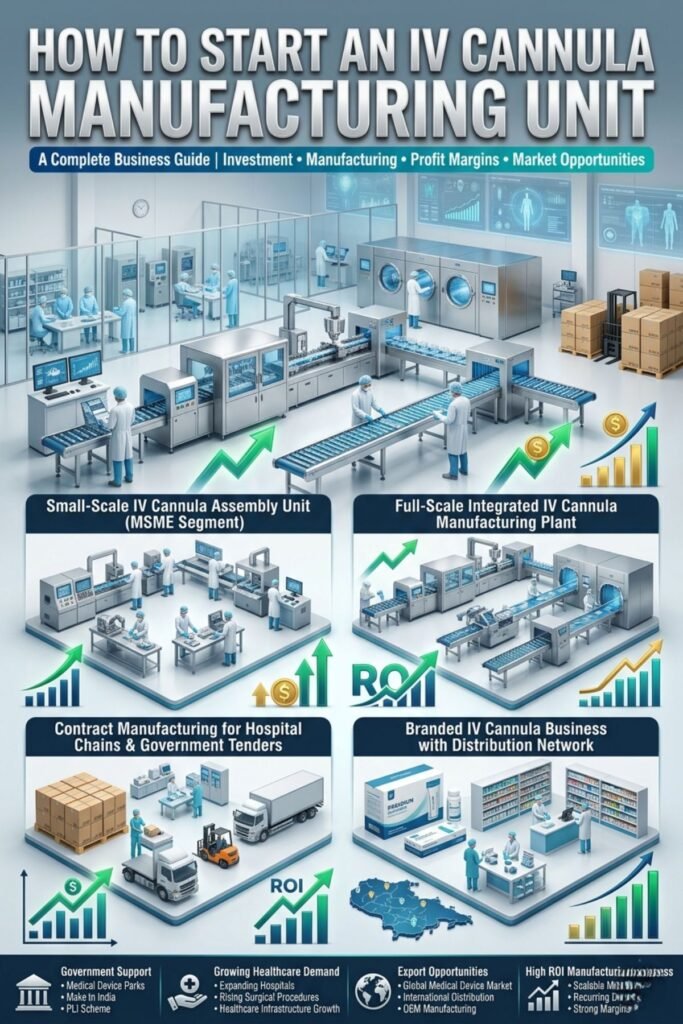
3. Contract Manufacturing for Hospital Chains and Government Tenders
The Central Medical Services Society (CMSS) and the government procurement agencies such as state health ministers and departments, along with a number of hospital chains, have been conducting big tenders for IV cannulas every year. These tenders are open for bidding to a Manufacturing Unit certified under Schedule M of Drugs and Cosmetics Rules without any need of Marketing Infrastructure. The margins on government contracts are less than retail, but the volume predictability and guaranteed payments make it a low risk business model. For entrepreneurs with factory setup and less experience in selling may find that government tenders are best option for them in early years. The important key to success lies in the batch quality and documentation discipline, that is, to avoid disqualification at surprise inspection.
4. Branded IV Cannula Business with Distribution Network
Some entrepreneurs are not only manufacturing for others but also establish their own registered brand and sell through medical wholesale, C&F agents and hospital pharmacies. This model is more capital intensive as it involves branding, packaging and distributor margins, but it creates brand equity and realises better returns from each unit. A branded IV cannula in the price range of ₹8 – ₹18 per unit (based on gauge size) will give much better margins as compared to supplying it through contract. Winning brands in this category ensure consistent packaging, use colour coding by gauge size, and include compliance markings that hospital pharmacists prefer. It is suitable for entrepreneurs with distribution partnership in the medical device or pharmaceutical industry.(IV Cannula Manufacturing Business in India)
Import–Export Opportunity Analysis for IV Cannula Manufacturers
India imports significant amount of high quality IV cannulas from Germany, the USA, and China — mainly from the private hospitals, catering to the premium segment. This is a market opportunity for higher quality domestic producers and it is a policy issue the government is working on. By obtaining the ISO 13485 certification and CE marking (for export to Europe), new Indian manufacturers can address the opportunity of import substitution as well as export.
Indian medical device manufacturers export more than 50% of their products to Africa, with IV cannula being one of the top three exports. In sub-Saharan Africa countries have little manufacturing capacity for medical consumables and are heavily dependent on imported medical supplies in hospitals. Indian manufacturers can provide price advantage over European manufacturers by providing the product quality comparable to that of European manufacturers at 30-50% lower price. At the same time, the markets are expanding at a fast pace in Southeast Asia with Bangladesh, Vietnam and the Philippines showing their receptivity to competitively priced Indian cannulas with hospital infrastructure development. Starting from the moment, WHO-GMP certification will enable start-ups to access both venues at the same time.
Build a profitable business with the right idea
Indian MSME Success Stories in Medical Device Manufacturing
Hindustan Syringes & Medical Devices Ltd. (HMD)
HMD is one of the oldest and most trusted medical device manufacturers in India, with Rajiv Nath as its founder, it produces more than 3 billion units of syringes, needles, and IV cannulas every year. The key takeaway point of the HMD story for the new entrepreneurs is that the company continuously aimed for quality certification such as ISO, CE and WHO-GMP, which played a key role in its export to more than 100 countries. Early investment in automation, rather than the labour-intensive processes, was the key to Rajiv Nath’s price competitiveness. For new MSME entrepreneurs, remember that quality certification is not a burden, it is a market access mechanism that builds over time.
Poly Medicure Ltd.
Originally a small MSME, Poly Medicure, founded by Minda family from Faridabad, Haryana, has developed into a publicly listed medical device manufacturer exporting to more than 100 countries. The company’s success in the IV cannula and IV sets came from its early efforts to establish a disciplined R&D arm as well as investing in clean room infrastructure that was of international standard. Their journey is proof that Indian MSME manufacturers can confidently play in the global arena, not at the expense of compromising on quality, but by leveraging the cost-effectiveness of Indian industry and rigor of international compliance. The Poly Medicure story is proof for the new entrants to the value of integrated manufacturing as a pathway for wealth creation over the long term.(IV Cannula Manufacturing Business in India)
Romsons Group
Founded by B.D. Gupta, the Romsons Group of Companies, headquartered in Delhi, is a typical case of an MSME which consistently developed a wide medical device portfolio of IV cannula, infusion sets, and catheters, while also steadily moving towards export market growth. They have taken a pragmatic approach of channeling government procurement contracts to early-stage growth, followed by using the growing funds and trust earned to invest in export infrastructure that can build a company’s credibility and reputation. The story’s moral shows that when governments reduce spending volume, they improve the quality of public healthcare systems, which eventually offsets the costs of premium private and export-oriented healthcare.
Related Article: Start a Medical Products Manufacturing Business in India: IV Fluids, Dialysis, Implants & More
How NPCS Can Help You Plan Your IV Cannula Manufacturing Project
Furthermore, Niir Project Consultancy Services (NPCS) conducts a Market Survey cum Detailed Techno-Economic Feasibility Report (DPR) as a professional study to establish a new industry or manufacturing business in a specific sector. If you are thinking of establishing an IV cannula manufacturing plant, our reports feature detailed manufacturing processes, clean room layout design, market research and demand analysis, process flow diagrams, product mix and capacity planning, machinery and raw material specifications, and complete financials of the project, including profitability analysis. We want to help you assess feasibility, profitability and scalability in the long term before you put any capital in. A robust DPR is beneficial to any new business or industrialist wishing to diversify into medical devices, as it minimizes risk and enhances investors’ confidence.(IV Cannula Manufacturing Business in India)
IV Cannula Manufacturing Unit: Key Project Parameters at a Glance
| Parameter | Indicative Estimate / Details |
| Project Category | Class II Medical Device (IV Cannula) |
| Minimum Investment (Assembly Unit) | ₹50 – ₹80 Lakhs |
| Investment (Integrated Plant) | ₹2 – ₹5 Crores |
| Clean Room Standard | ISO 7 (Class 10,000) |
| Regulatory Licence Required | Form 27-D, Drugs & Cosmetics Act |
| Key Certifications | ISO 13485, CE Mark, WHO-GMP |
| Key Raw Materials | PTFE Catheters, Steel Needles, ABS/PP Hubs, ETO Gas |
| Estimated Revenue (Small Unit, 75% Utilisation) | ₹1.5 – ₹2.5 Crores/Year |
| Estimated Net Margin | 18 – 28% (Branded Route) |
| Top Export Markets | Africa, Southeast Asia, Middle East, Latin America |
| Government Incentive Schemes | PLI Scheme, CLCSS, CGTMSE, Startup India |
FAQs
Q1. What are the necessary licenses & approval to set up IV cannula manufacturing unit in India?
A: You need a drug manufacturing license under Form 27-D issued by the State drug controller’s office. Apart from this your unit must conform to schedule M GMP standards of medical sterile devices. An ISO 13485 certification is not mandatory as per Indian laws for sales within India but most hospital purchase orders and almost all export clients will ask for it. CDSCO registration for the device is must before placing any device on sale.
Q2. What would be the approximate investment needed to set up an IV cannula manufacturing unit?
A: An investment of ₹50–80 lakh can establish a small-scale unit focused solely on assembly. This would cover the costs of machinery, clean room fabrication, initial raw material purchase, regulatory compliance etc. We can set up an integrated manufacturing facility with in-house component production at an investment of ₹2–5 crore, depending on capacity, automation level, and sterilization requirements.
Q3. Are IV cannulas a good investment for MSMEs?
A: IV cannula manufacturing yields healthy profit margins when scaled adequately with the right certifications. For the Branded sales route, profit margins are in the range of 18-28% net margin. Government tenders on the other hand are likely to yield lesser margins (10-15%) but provide good volume and purchase guarantees. The Export-oriented units generally do better, providing returns in terms of forex earnings and additionally benefits from Government Export incentive schemes like RoDTEP.
Q4. What are the raw materials for IV cannulas?
A: The materials used to produce IV cannulas are the catheter tube made of PTFE, introducer needle made of medical grade stainless steel, the connector and hub usually made of ABS or polypropylene, and Lubricant in the form of silicone oil. The sterilisation of the product is carried out using either ETO (Ethylene oxide) or Gamma radiation for sterile medical devices. Except for the PTFE material required to produce the catheters, most other raw materials are available in the Indian market. High grade PTFE is either sourced from Japan or USA.
Q5. How to get into Government contracts/tenders for IV cannulas?
A: Government agencies such as the Government e-Marketplace (GeM), state medical supply corporations, the Central Medical Services Society (CMSS), and state-level agencies like TNMSC place contracts to purchase IV cannulas. In order to enter into Government tenders, one needs to obtain a drug manufacturing license and possess the necessary technical capabilities and specifications (usually based on BIS standards or similar quality metrics). To procure a government contract the surest way is to be registered in GeM and maintain its pre-qualification status actively.
Q6. What are the certifications required for export for IV cannulas?
A: For the purpose of export, an ISO 13485 certification (quality management system for medical devices) and Certificate of Free Sale (CFS) from CDSCO is essential for most of the countries. European markets require CE marking as stipulated by EU Medical Device Regulation (MDR) and a large number of countries in Africa and Asia require a WHO-GMP certificate. Initiate the export certification process concurrently with the domestic certification to reduce the time required to commence exports.
Concluding: A Medically Essential Business Opportunity that is Commercially Viable
IV cannula manufacturing is at the crossroads of two significant forces in India: a swift growth in healthcare infrastructure, and a steadfast initiative towards the production of medical devices locally. Entrepreneurs who take this business seriously, investing in proper quality certifications, getting GMP certification and establishing strategic distribution connections are going to get a financial as well as a long-term return on their investment. Single use device consumption pattern leads to predictable demand. The policy framework is conducive. There is a significant opportunity to export.(IV Cannula Manufacturing Business in India)
That is not to say capital alone will assure success in this business. Diligent quality control, knowledge of regulatory requirements, and a solid go-to market plan are crucial. Entrepreneurs who prepare a proper feasibility study before “opening up the wallet” are much more apt to steer clear of the common mistakes and ensure long-term profitability. All of the business concepts proposed-ranging from basic assembly operations up to integrated, export-oriented operations-present accessible options that cover a range of budgets and investment tolerances. The opportunity is present and now, the demand is present as well.


Dear Sir
we intend to startup IV cannula production lines.
please advice a comprehensive study and machinery requirements with sources of raw materiel required. as understood, you may be able to provide complete feasiblity study and costing.
setup will be in Lahore, Pakistan
Please advice