Alcoholic beverages is one of the fastest growing profitable manufacturing industries in India. Indian Made Foreign Liquor (IMFL) is one of the high-growth business opportunities in all the categories due to the rising demand of Indian spirits in foreign countries, premium drinking habits and an increase in urban consumption.
The modern day IMFL industry expands to other than conventional liquor sales. People are looking for better whisky, craft gin, aged rum, vodka and Indian single malts. This shift in consumption has given tremendous opportunities to the entrepreneurs to develop successful manufacturing brands in India.
UnivDatos Market Research Report states that the Indian alcoholic beverage market was valued at billions of dollars and will grow strongly in the next few years owing to urbanization, increasing standard of living and lifestyle changes.
What is IMFL?
Alcoholic beverages produced by Indian manufacturing companies, based on international liquor categories such as whisky, rum, gin, vodka and brandy are known as Indian Made Foreign Liquor (IMFL). They make use of the local or imported ingredients, and are marketed under Indian or global brands.
Major IMFL Categories:
- Whisky
- Rum
- Vodka
- Brandy
- Gin
- Craft Spirits
Of these, whisky is the biggest market in India and premium gin and Indian single malt whisky is gaining momentum among urban consumers.
Explore This Book: Handbook of Beverage Processing Alcoholic & Non-Alcoholic Drinks
Why the IMFL Industry is Growing Fast
There is a strong premiumisation trend in the IMFL sector. Consumers will spend more for good liquor and also better packaging, and the drinking occasion. Today’s consumer is not looking for cheap liquor but rather for good craft and quality spirits.
The India’s Premium and Luxury Spirits Market is projected to surge in the coming years, as evidenced by the growth in demand for high-end alcoholic beverages, as per the Monika Alcobev Industry Report 2025.
Key Reasons Behind Industry Growth:
- Rising middle-class population
- Urban lifestyle changes
- Premium drinking culture
- Increasing hospitality sector demand
- Export opportunities for Indian brands
- Growth of craft spirits and premium whisky
This is particularly useful for start-ups, because they can make more money on a higher-margin product even with relatively small production runs.
Best IMFL Business Ideas in India
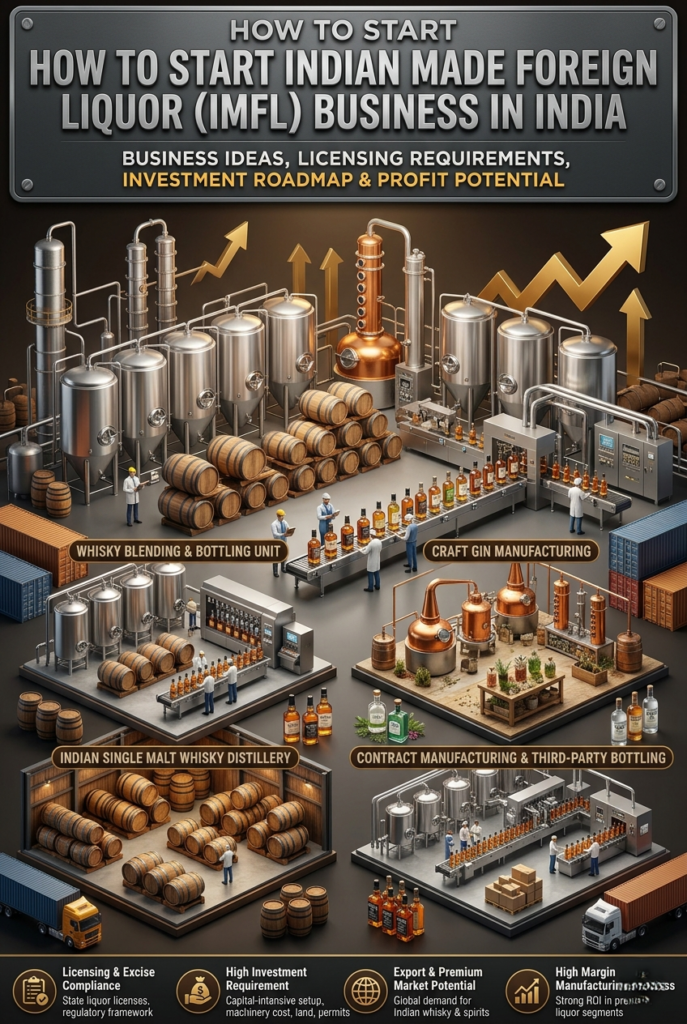
Whisky Blending and Bottling Unit
A whisky blending and bottling unit is considered one of the easiest entry models for new entrepreneurs. In this configuration, the Extra Neutral Alcohol (ENA) comes from licensed distilleries, is mixed with flavours and treated water and then bottled.
Benefits of This Model:
- Lower investment requirement
- Easier licensing process
- Faster market entry
- Scalable business structure
This model enables the entrepreneur to concentrate on branding and distribution, rather than on building up large distillation facilities.
Craft Gin Manufacturing
The premium alcohol segment of craft gin is one of the fastest-growing segments in the Indian liquor industry. Unique flavours and quality botanical combinations are appealing to consumers.
Indian botanicals like:
- Cardamom
- Lemongrass
- Coriander
- Black pepper
- Citrus peels
They are popular ingredients in contemporary craft gin of India.
Greater Than Gin by Nao Spirits is one of the biggest success stories in this category and has helped create a craft gin movement in India and earned it international recognition as well.
Related Article: The Rise of Herbal Beverages: Crafting Traditional Indian Liquors
Indian Single Malt Whisky Distillery
In the past 10 years Indian single malt whisky has gained recognition worldwide. Various Indian distilleries are now competing with international ones in world-class distilling competitions.
One of the biggest is the Amrut Distilleries’ International Success, in which Indian whisky has achieved global acclaim with various gold medals in International Spirit Competitions.
Major Requirements for Single Malt Production:
- Copper pot stills
- Malted barley sourcing
- Barrel ageing warehouses
- Quality control systems
This will be a little more expensive to get into and more time consuming to age, but the profit potential is very high.
Contract Manufacturing and Third-Party Bottling
There are several alcohol entrepreneurs today that are starting alcohol brands without owning their factories. This is a model in which the production is sent to the licensed distilleries and the entrepreneur is responsible for the marketing and distribution processes.
Advantages:
- Lower capital investment
- Reduced operational risk
- Faster business launch
- Easier scalability
Especially this model is followed by startup companies in the premium liquor market.
Get Detailed Project Report (DPR): IMFL Manufacturing Plant Detailed Project Report
Government Schemes and MSME Support
Most of the entrepreneurs are not aware that Manufacturing businesses can get support from MSME related support schemes as per the structure of their business and investment.
The CGTMSE Official Portal contains details regarding the various MSME credit guarantee schemes and collateral free loans that can be used for manufacturing businesses.
In addition, entrepreneurs can consider:
- MSME financing support
- Mudra loans
- Stand-Up India Scheme
- Export promotion incentives
In addition to this support, the Ministry of Food Processing Industries (MOFPI) also runs policy support and industrial development programmers for the food and beverage manufacturing industries.
Licenses Required for IMFL Business in India
Alcohol laws are regulated by the state governments, which is why the liquor industry is so regulated. Excise rules, pricing and distribution vary between states.
Essential Licenses Include:
- State Excise Manufacturing License
- FSSAI Registration
- Factory License
- GST Registration
- This comes from the Pollution Control Board NOC.
- Fire Safety Clearance
- Import Export Code (IEC)
State selection for manufacturing is of utmost importance due to the difference in the structures of excise in India.
Investment Required to Start an IMFL Business
The amount of investment is dependent on the kind of business model and the scale of production that the entrepreneur selects.
Estimated Investment:
- Small blending & bottling unit: INR 2-5 Crore
- Small scale plant: INR 2–10 Crore
- Production of distilled spirits: INR 6–16 Crore
- Food and beverages demand surge in the coming years: INR 15 Crore+
Further investments needed for:
- Branding
- Packaging
- Distribution
- Working capital
- Licensing fees
Export Opportunities for Indian IMFL Brands
Indian spirits are now becoming popular worldwide. Indian spirits are proving to be excellent exports to countries such as UAE, Singapore, UK, Australia, and African countries.
Business Standard Report on APEDA Export Targets says the government is keen on seeing a significant boost in alcoholic beverage exports from India in the coming years.
Major Export Markets:
- UAE
- Singapore
- United Kingdom
- Australia
- USA
- Africa
The export potentials of Indian single malt whisky and high-quality craft spirits are particularly high.
Stop guessing—choose the right business with confidence
Challenges in the IMFL Industry
The IMFL business, highly profitable, has operational and regulatory challenges, too.
Major Challenges:
- Complex excise laws
- High taxation
- Strong market competition
- Distribution barriers
- Regulatory compliance costs
Quality, branding, compliance and long-term strategy are all key factors that typically help entrepreneurs succeed in this business.
How NPCS Helps Entrepreneurs Start an IMFL Business
NPCS (Niir Project Consultancy Services) provides detailed consultancy and project planning which helps the entrepreneurs to set up a profitable manufacturing unit.
NPCS provides:
- Detailed Project Reports (DPR)
- Market Survey Reports
- Techno-Economic Feasibility Reports
- Machinery Selection Guidance
- Financial Analysis
- Profitability Forecasting
- Plant Setup Planning
- Licensing Guidance
They provide valuable consultancy services for setting up a business:
- Whisky blending units
- Craft gin projects
- Rum manufacturing plants
- Single malt distilleries
- Contract bottling businesses
NPCS project reports are also valuable for:
- Bank loan approvals
- Investor funding
- MSME financing
- Business planning
- Expansion strategies
Conclusion
Indian Made Foreign Liquor (IMFL) industry is one of the most lucrative and future-oriented manufacturing industries in India. Growing demand for premiums, exports, urbanisation and changing consumer habits offer good opportunities for entrepreneurs.
There are numerous opportunities for businesses in the sector, ranging from blending units to craft gin companies to high-quality whisky distilleries, and they offer a wide range of opportunities to scale up and achieve good long-term profits. But, for success, one must have a strong plan, regulatory compliance, quality production and strategic branding.(Indian Made Foreign Liquor (IMFL))
Businessmen who make a wise entry into the alco-beverage industry with a proper feasibility study and professional advice can make a highly successful business in the ever-developing alco-beverage industry in India.
Frequently asked questions (FAQs)
How much is the minimum investment to establish an IMFL business?
For a small blending and bottling unit, the investment will range from INR 2 crore to INR 5 crore.
Which part of the IMFL is the most profitable?
The highest margins are normally premium craft spirits, Indian single malt whisky and craft gin.
Do manufacturers of liquor need an excise licence?
Yes, the production has to have state excise approval first.
What about starting an alcohol brand without a manufacturing plant?
Indeed, there are numerous contract manufacturing and third-party bottling models used by many entrepreneurs.
Are there any consultancy services provided by NPCS for IMFL businesses?
Yes, NPCS Official Website delivers project reports and consultancy services to the manufacturing businesses of the IMFL.
What is the profit in exporting Indian liquor?
Yes, India premium spirits are seeing increased demand in the UAE, UK, Singapore & Australia etc. international markets.