
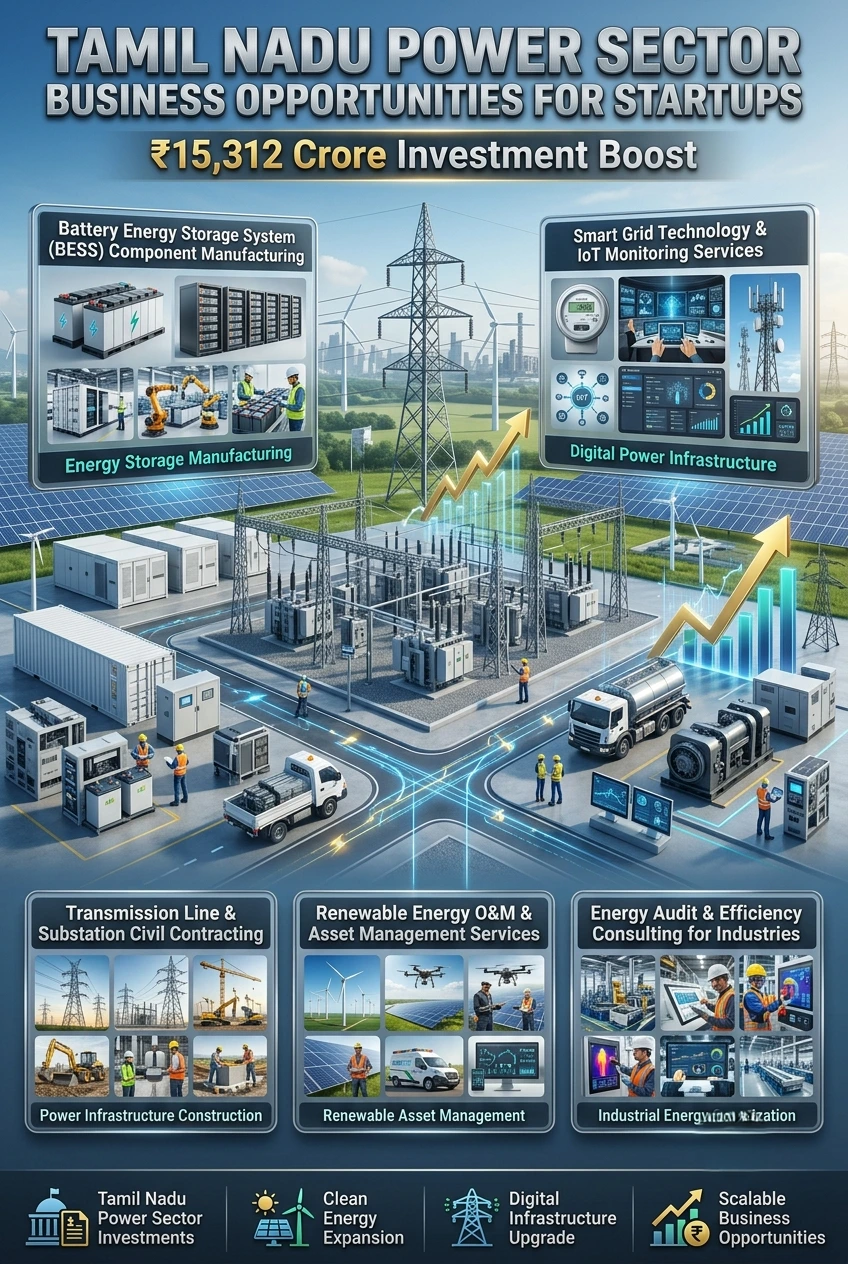
Recently, The Economic Times featured a news item of particular importance that every entrepreneur, MSME owner, and startup founder in India should be aware of. Tamil Nadu has unveiled a comprehensive power sector overhaul initiative, with a budget of ₹15,312 crore, which is one of the most ambitious infrastructure schemes for the power sector in the State to come in years. This isn’t simply a government budget statement. It’s a strong market indicator that there’s a huge business opportunity wave to be tapped into in grid technology, renewable energy integration, energy storage, and smart infrastructure services.
Tamil Nadu is poised to become India’s top wind state and a rapidly emerging solar state and is now developing the infrastructure backbone to enable the next decade of clean energy investment in the state. The investment will focus on three key areas: grid modernisation, Battery Energy Storage Systems (BESS), integration with renewable energy and digital automation of distribution networks, where private entrepreneurs and MSMEs can make a significant impact, said Economic Times Energy.
As a founder, you don’t have to worry about this! How quickly can you get your startup ready for this metamorphosis?
What Recent Economic Times Reporting Means for Founders
The Economic Times recently pointed out that the power reform in Tamil Nadu, which costed ₹15,312 crore, has been laid out with four fundamental pillars such as transmission and distribution network strengthening, integration of renewable power, deployment of Battery Energy Storage Systems (BESS), and digital grid management.
In the business world, what does this imply? It implies that in the next three years, Tamil Nadu will have hundreds of procurements for equipment, engineering, construction, software and O&M contracts. The investment will be made by large developers and public utilities, who will be outsourcing huge chunks of work that have a special interest to them to private MSMEs and startups.
This is the typical infrastructure multiplier phenomenon! For every ₹100 crore invested in grid infrastructure, it sparks a private downstream industry worth of roughly ₹40–60 crore for manufacturing, services and technology. The downstream opportunity for private players may be higher than ₹6,000–9,000 crore in total addressable market (4–5 years’ time horizon) at ₹15,312 crore.
Economic Times market reporting has always revealed that Indian MSMEs that get in early at state level infrastructure cycles create disproportionate value as compared to the latecomers. The power reform opportunity for Tamil Nadu is Now.
View Full Project Details: Business Opportunities in Tamil Nadu – A Practical Guide
Why Tamil Nadu’s Power Sector Is a High-Growth Commercial Arena
Tamil Nadu isn’t playing on a low platform. The state has been the wind energy powerhouse of India for decades now and has become one of the top solar markets in the past five years. It is already one of the three largest states in India with respect of installed Renewable Energy potential and its size is increasing at a tremendous pace.
The size of the reform programme indicates the critical need for reform. The distribution network is also ageing in several districts of Tamil Nadu; transmission constraints are impacting how much renewable power can be brought upon to the grid and the surge in solar development has created challenges for grid stability that need solutions in the form of storage. To solve these problems, we need more than government capital, we need a lively and active system of private service providers.
The state also recently came out with the Tamil Nadu Electricity Grid Code 2026 which superseded the previous version of 2005 and conforms to the national grid code standards, indicating a long-term commitment towards modernizing and strengthening the power system for incorporating renewable energy. The continuous policy thrust positions Tamil Nadu’s power sector among the most business-friendly markets in the country with long investment gestation periods.
To this is also the fact that Tamil Nadu is actively wooing global giants — Hitachi Energy India recently inked a MoU to invest ₹1,000 crore in the state and set up its Global Technology and Innovation Centre, while bringing manufacturing capabilities for the state. When tech giants venture into a market for a long time, it gives a positive validation of the market’s commercial depth for local MSMEs as well.
Government Policies and Incentives Supporting Energy Entrepreneurs
Startups and MSMEs don’t work in isolation in the power sector. The policy framework actively facilitates CE entrepreneurs in multiple ways in India. For small manufacturers looking to get into BESS components or grid equipment, the Ministry of MSME has a credit guarantee scheme and technology upgradation fund.
The tax incentives, regulatory relaxations and access to government procurement via the GeM portal are directly applicable for energy tech startups with access to supply public utilities to Tamil Nadu, which the Startup India platform offers to DPIIT-recognised startups.
The production linked incentive (PLI) schemes by DPIIT for advanced battery storage systems and renewable energy industry at the National level provide direct financial incentives to manufacturers who are interested in investing in this segment.
Clean energy manufacturing was actively pursued by the government of Tamil Nadu via Invest India, through its own industrial policies, both foreign and domestic. The state’s industrial infrastructure, particularly in Chennai, Coimbatore, Hosur and Tiruchirappalli, makes it a natural place to have energy technology manufacturing start-ups.
5 Business Ideas Emerging Directly from Tamil Nadu’s Power Reform
1. Battery Energy Storage System (BESS) Component Manufacturing
The implementation of BESS is one of the cornerstones of the reform in Tamil Nadu. The state must have systems in place to store excess solar and wind energy for use when it is most needed — which will grow in size in the next five years or more. The market offers Indian manufacturers long-term demand for BESS enclosures, thermal management systems, battery management units, and DC-AC inverter assemblies. Other ancillary items such as cell holders, busbars and cooling systems are niches for MSMEs.
Get Detailed Insights from This Book: Lithium-Ion and Lead-Acid Battery Manufacturing Handbook
2. Smart Grid Technology and IoT Monitoring Services
The reform in Tamil Nadu specifically focuses on the digital monitoring, automation and intelligent grid control. This provides an opportunity for startups to sell energy monitoring devices, integrate with the SCADA system, provide smart meter data analytics services and provide distribution automation. Smart grid technology contracts are unlike the large infrastructure contracts and are modular in nature, thus making it accessible to well-funded startups and technology MSMEs.(Tamil Nadu Power Sector Business Opportunities)
3. Transmission Line and Substation Civil Contracting
The grid expansion programme will include the construction and development of hundreds of substations and transmission lines throughout the state. Construction of substations, erection of towers, laying of cables and earthing systems are typical MSME works in civil and electrical contracting. The electrical contractors having TANGEDCO empanelment and licensed electrical supervisor in Tamil Nadu can stake their claim for the huge volumes of work in the substations of this period 2026–2030.
Get Detailed Project Report (DPR): Transmission Tower & Telecommunication Tower Manufacturing Guide
4. Renewable Energy O&M and Asset Management Services
With the growth of installed renewable energy capacities in Tamil Nadu such as solar, wind, and hybrid, the demand for operations and maintenance services will grow accordingly. Companies specializing in the provision of preventive maintenance, drone-based inspection, performance analytics and inverter servicing for utility-scale solar and wind power generation projects are in demand. This is a recurring revenue model and has a long-term contract duration – perfect for entrepreneurs who seek stable cash flow businesses.
Read the Complete Book Here: Solar PV Power and Solar Products Handbook
5. Energy Audit and Efficiency Consulting for Industries
Technical loss reduction is expected to come under a spotlight when Tamil Nadu tries to modernise its distribution network. Industrial consumers in Tamil Nadu, particularly those in textiles, auto components, and chemical products, face increasing pressure to optimize energy use. There will be a demand for energy audit services, power quality services, and demand side management services providers as both utilities and industries will look to cut down on energy waste and energy costs.
Related Article: Tamil Nadu’s EV Boom: 5 Profitable Business Opportunities Founders Can Seize Right Now
Import–Export Opportunity Analysis
The power sector reform in Tamil Nadu also gives rise to a lot of import-export opportunities. Specified BESS components, such as lithium iron phosphate cells, advanced inverter modules and grid-scale control systems, will be in greater demand on imports. Indian MSMEs can develop commercial business by setting up Import Trading / Value Added Assembly activities of these imports. Exporters and importers in energy sector can avail incentives, EPCG licence and advance authorisation frameworks from the Directorate General of Foreign Trade.
Also on the export side, Indian manufacturers of solar inverters, power transformers, switchgear, distribution equipment are now becoming more competitive all over the world. Domestic investments in infrastructure in Tamil Nadu will create manufacturing scale to help exporters be competitive — particularly in Southeast Asian, African and Middle Eastern markets where investments are also picking up in grid modernisation.(Tamil Nadu Power Sector Business Opportunities)
The exports of energy technology from India have been on the rise in the previous three years. For those who establish domestic market credibility in the reform cycle, export markets will be much easier to gain access to — with Tamil Nadu’s infrastructure development as a portfolio reference.
Indian MSME Success Stories in Energy Infrastructure
There are many inspiring MSME success stories from India’s energy sector that highlight the industry’s growth potential. One such company started as a small solar module manufacturer and has expanded rapidly. It recently announced the construction of a solar PV module manufacturing plant at Gangaikondan, Tamil Nadu. The automated facility will cover around 6 lakh square feet. It is expected to create more than 1,500 jobs. The plant will manufacture high-efficiency solar modules with efficiencies of up to 23.69% using advanced N-Type TOPCon technology.
Similarly, Roofsol Energy, a commercial and industrial solar IPP, secured ₹260 crore in funding from an infrastructure finance company. The investment will help expand its portfolio and highlights how targeted energy businesses can attract significant institutional funding in the current market.
In all these examples, Indian businessmen have found a niche in the energy infrastructure supply chain, a niche they perceived to be technically feasible, and developed a genuine competence in the niche; and then they attracted capital, attracted customers, and attracted growth. Its next wave of opportunities comes from the ₹15,312 crore Tamil Nadu reform.
About NPCS – Niir Project Consultancy Services
NPCS (Niir Project Consultancy Services) provides entrepreneurs with industry standard feasibility reports, project profiles and techno-economic analysis for various energy, manufacturing and clean technology industries to convert the market opportunity described in this article into a viable business plan.(Tamil Nadu Power Sector Business Opportunities)
The NPCS reports include detailed capital cost estimates, machinery sourcing strategies, raw material planning, market demand analysis, financial projections, and regulatory compliance frameworks. These insights provide founders with a structured roadmap for preparing bank loan applications, investor presentations, and proposals for government schemes.
Energy storage and grid infrastructure are highly technical sectors. A well-prepared feasibility report can significantly improve the credibility of your project. It also increases your chances of securing funding from banks, investors, and financial institutions.
Discover business ideas that actually make money
Data Table: Tamil Nadu Power Sector Reform — Key Metrics
| Parameter | Details |
| Total Investment | ₹15,312 Crore |
| Number of New Projects | 231+ Power Projects |
| New Sector Employees | 15,058 (Recruitment Initiated) |
| Key Focus Areas | Grid Upgrade, BESS, Renewables, Digital Automation |
| Tamil Nadu Renewable Leadership | Top 3 State by Installed Capacity |
| Hitachi Energy MoU (Tamil Nadu) | ₹1,000 Crore Investment, ~1,000 High-Skill Jobs |
| Vikram Solar TN Plant | 6 Lakh Sq Ft, 1,500+ Professionals, TOPCon Modules |
| BESS Opportunity Signal | Gujarat WRPC Approves 750 MW/3,000 MWh BESS — National Trend |
| Downstream Private Market Opportunity (Est.) | ₹6,000–9,000 Crore over 4–5 Years |
| Key Government Schemes | MSME Credit Guarantee, Startup India, PLI for BESS |
FAQ: Founders Ask, Consultants Answer
Q1. Is there a minimum size requirement to be a part of Tamil Nadu’s power reform contracts?
No. Tamil Nadu has hundreds of projects under its infrastructure programme, such as transmission, distribution, BESS, and digital systems. There are several contracts in particular which are only available to registered MSMEs, such as O&M, civil works, component supplies, and energy auditing. The government procurement platforms like GeM also offer direct access to the DPIIT recognised startups.
Q2. What’s the lowest capital cost for a BESS component manufacturing facility?
Establishing a BESS or Battery Management Unit manufacturing facility in Tamil Nadu requires an investment of Rs. 1.5–5 crore. The exact investment depends on the production scale, automation level, and product specialization. MSME and SIDBI financing, along with credit guarantee schemes, can significantly reduce the promoter’s equity requirement.
Q3. How do I get empanelled as a vendor with TANGEDCO or TANTRANSCO?
Tamil Nadu Electricity Companies (generation, distribution) and transmission (TANGEDCO/TANTRANSCO) have their list of approved vendors for equipment and services. Normally, empanelment involves having valid registration with the Goods and Services Tax (GST), technical qualification certificates, past project references, and ISO certification in manufacturing. This is a structured process, and is competitive for MSMEs who possess a genuine technical capability.
Q4. Will the energy storage market in India be big enough to create a scalable business?
BESS market is not only growing in Tamil Nadu but across the country in India. The Gujarat Western Regional Power Committee in the state recently sanctioned 750 MW / 3,000 MWh BESS installation by Power Grid Corporation and other states are also approving such projects. The national pipeline makes any Tamil Nadu reform one of multiple commercial legs for an energy storage entrepreneur.
Q5. What are the energy tech startups certifications and licences required in Tamil Nadu?
Depending on your business, there are different requirements. Tamil Nadu Electrical Licensing Board issues license to electrical contractors. Equipments manufacturers may require BIS certification, MNRE approvals for solar products and CEA compliance for grid connected system. Smart grid technology providers have to meet TNERC technical standards. It is strongly recommended that you pay for professional advice from a qualified consultant prior to making any capital investment.
Q6. What are the options for sourcing energy products to be exported from Tamil Nadu?
Export Promotion Councils and Directorate General of Foreign Trade provide Market Intelligence, Buyer introduction and export incentives. Solar Inverters, Solar Transformers and Solar Switchgear are Tamil Nadu-manufactured products that have proved their export credentials. Building portfolio reference with the reforms in Tamilnadu will help in approaching the export market with a credible approach.
Conclusion: The Timing Window Is Open — For Now
Economic Times’ reporting on Tamil Nadu’s ₹15,312 crore power sector reform is not just infrastructure news. It is a commercial opportunity map for Indian entrepreneurs who know how to read market signals.
The state is investing in exactly the sectors — BESS, smart grid, transmission upgrades, renewable integration, digital automation — where India’s startup and MSME ecosystem has growing capability. Government investment, clear regulations under the Tamil Nadu Electricity Grid Code 2026, the entry of Hitachi Energy and Vikram Solar, and strong MSME support policies have created favourable conditions for new business opportunities.(Tamil Nadu Power Sector Business Opportunities)
History consistently shows that entrepreneurs who enter infrastructure opportunity windows early gain a significant advantage. They capture better margins, build stronger client relationships, and establish more durable business positions before mainstream competition intensifies. Tamil Nadu’s power reform is in its early implementation phase. That window will not stay open indefinitely.
The Economic Times has signalled the market shift. The government has committed the capital. The regulatory framework is in place. For India’s founders, the only remaining question is: what are you building?