

Aluminium Manufacturing Business Ideas
The manufacturing market in India changed significantly this week. Shyam Metalics and Energy Limited is set to start commercial production at its aluminium foil plant in Sambalpur, Odisha, with an investment of around ₹800 crore in two downstream aluminium plants, Economic Times reported. The company’s 60,000 TPA Aluminium Flat Rolled Products (FRP) plant is to be commercialized during September 2026.
It’s more than just a corporate expansion headline. For MSMEs, Startup entrepreneurs, and Industrial entrepreneurs, this is much more than a development; it’s a structural upgrade of the aluminium value chain that is creating real, near-term manufacturing opportunities along the value chain.
The involvement of a large, listed company with a market cap of ₹30,000 crore in this ₹800 crore downstream aluminium wager gives credibility to the entire value chain stakeholders, ranging from upstream suppliers to component manufacturers, packaging converters to niche product producers. Smart entrepreneurs must read this signal as early as possible. The opportunity to buy up any adjacent aluminium businesses is currently opening.
What Recent Economic Times Reporting Means
The Economic Times reportage on Shyam Metalics’ investment of ₹800 crore in Sambalpur is very strategic. The company has always been a steel and ferro-alloy based business and is making a deliberate shift to higher value-added aluminium products and this is a clear indicator of the economics of downstream aluminium.
Key facts from the Economic Times development:
- The 18,000 TPA aluminium foil plant in Sambalpur, Odisha is now functioning as a commercial plant.
- Launch of 60,000 TPA Aluminium FRP (Flat Rolled Products) plant by September 2026.
- Investment: Combined investment of ₹800 crore in the downstream Aluminium at a single location.
- Value added product mix is expected to increase the margin by 40 to 50 per cent.
- Medium-term revenue growth: 2x to 2.5x – Forecasts
- The products are foils 6-40 microns (pharma, packaging, industrial) and FRP 0.3-4.0 mm (construction, transport, industrial).
See original report in the Economic Times: Shyam Metalics sets up its aluminium foil plant in Odisha — Economic Times
The implication of MSME is direct. As major anchor companies begin downstream aluminium manufacturing facilities, they need to have a broad-based ecosystem: raw material processors, component suppliers, precision converter, quality testing laboratories, logistics providers and niche secondary manufacturers. The majority of these roles are exactly designed for MSME investment.
Get Detailed Insights from This Book: The Complete Technology Book on Aluminium and Aluminium Products
Why India’s Downstream Aluminium Sector is Growing
India is the world’s second largest producer of primary aluminium but has exported a lot of it in its semi or unprocessed state. This is changing over the past three years. Domestic market for value added aluminium products (foils, flat rolled, extrusions, sheets and tubes) has been expanding at the pace of 8-10% CAGR, promoted by construction, consumer packing, pharmaceuticals, automotive lightweighting and electronics.(Aluminium Manufacturing Business)
Economic Times has been monitoring the trend for a long time. The per capita aluminium consumption in India is around 3 kg per capita as compared to the global average of 11 kg per capita. This is a huge structural gap that’s a huge run. Shyam Metalics’ Odisha investment is a straight shot on this closure in the coming decade.
Key Demand Drivers
- One such application of aluminium foil is in the pharmaceutical industry, where it is widely employed in blister packs. The demand for high-grade pharma foils is witnessing a steady growth rate of 12% per annum with the growth rate of drug exports.
- In India, the demand for flexible aluminium based packaging will touch $6 billion by 2027 in FMCG & Food Packaging segment.
- In the construction sector, the use of Aluminium flat rolled products is vital to roofing, cladding and curtain walling and architectural applications.
- Automotive Lightweighting: India’s EV and car manufacturing industries are making efforts to substitute steel with aluminium parts.
- The government’s initiative to promote indigenisation of the defence industry is bringing new business opportunities to precision aluminium products.
Government Policies and Incentives
The policy environment is very supportive of new investments in aluminium production. These schemes are directly related to the government’s Production Linked Incentive (PLI) scheme, the Make in India initiative and dedicated MSME support schemes. If you’re an entrepreneur coming into this area, you can find organized financial and infrastructure assistance in several ministries.
- MSME Ministry Support: Collateral free loan under CGTMSE, technology-upgradation, and cluster development schemes to MSMEs in manufacturing sector.
- Startup India: — Registered startups get income tax exemption for 3 years, fast-track patent registration, and also access to the Fund of Funds for equity funding.
- Make in India / DPIIT: — Supports manufacturing startups for industrial licensing, facilitation & notifications of PLI scheme (for specific sectors).
- SIDBI: — Offers equity support, working capital and term loans for MSME for manufacturing projects in priority sectors such as metals and industrials.
- DGFT Export Support: — Advance Authorisation, EPCG scheme, and RoDTEP duty refund can be availed by Aluminium product exporters to boost export competitiveness.
5 Manufacturing Business Ideas Inspired by This ET Development
The coverage by the Economic Times in the commissioning of Shyam Metalics clearly maps out an opportunity. Here are five manufacturing companies and their story of how they benefit from — and are enabled by — this market development.
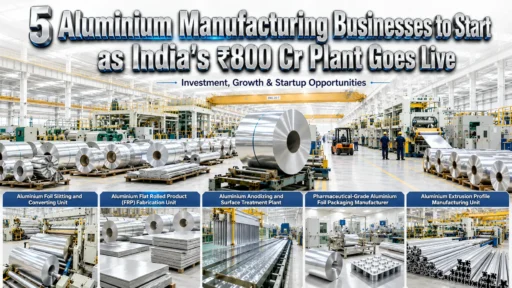
1. Aluminium Foil Slitting and Converting Unit
For large plants, such as Shyam Metalics’ 18,000 TPA (ton per annum) foil plant, jumbo rolls are produced. These rolls need to be slit and/or laminated down to the consumer and industrial size before they can be consumed by end-users. An MSME slitting and converting unit can be a perfect fit in this supply chain being able to process jumbo rolls into retail rolls, blister foil strips, or industrial-gauge sheets. Investment range: ₹40–80 lakh. The target companies include FMCG brands, pharma companies, and packaging converters. This business requires relatively low startup costs, and entrepreneurs can establish it within 6–9 months after completing the planning phase.(Aluminium Manufacturing Business)
Access Complete Business Plan: Aluminium Foil Manufacturing Guide
2. Aluminium Flat Rolled Product (FRP) Fabrication Unit
After Shyam Metalics makes its new 60,000 TPA FRP plant operational in September 2026, the company will provide a reliable domestic source of 0.3–4 mm aluminium sheets and coils. The finished products made by downstream fabricators, who cut, form, stamp or anodize these sheets into panels for roofs, door frames, enclosures, transport body panels, and signboards, will benefit from a more affordable and accessible supply chain of raw materials. Investment range: ₹60 lakh to ₹1.5 crore depending on the level of automation. Industries: construction contractors, transport OEMs and industrial equipment manufacturers.
Get Detailed Project Report (DPR): Aluminium Products and Manufacturing Projects
3. Aluminium Anodizing and Surface Treatment Plant
With the increased availability of aluminium flat rolled products, the demand for value added surface treatments such as anodizing, powder coating, brushing and mirror polishing will also increase. An anodizing and surface treatment plant is an industrial service company with a high profit. The colourful aluminium anodizing process makes the metal more corrosion resistant and more attractive, and provides a 25–40% premium over non-anodized metal. This company supplies architectural aluminium, furniture industry, electronics enclosure industry and consumer goods sectors. Material Cost: ₹80 lakh – ₹2 crore.(Aluminium Manufacturing Business)
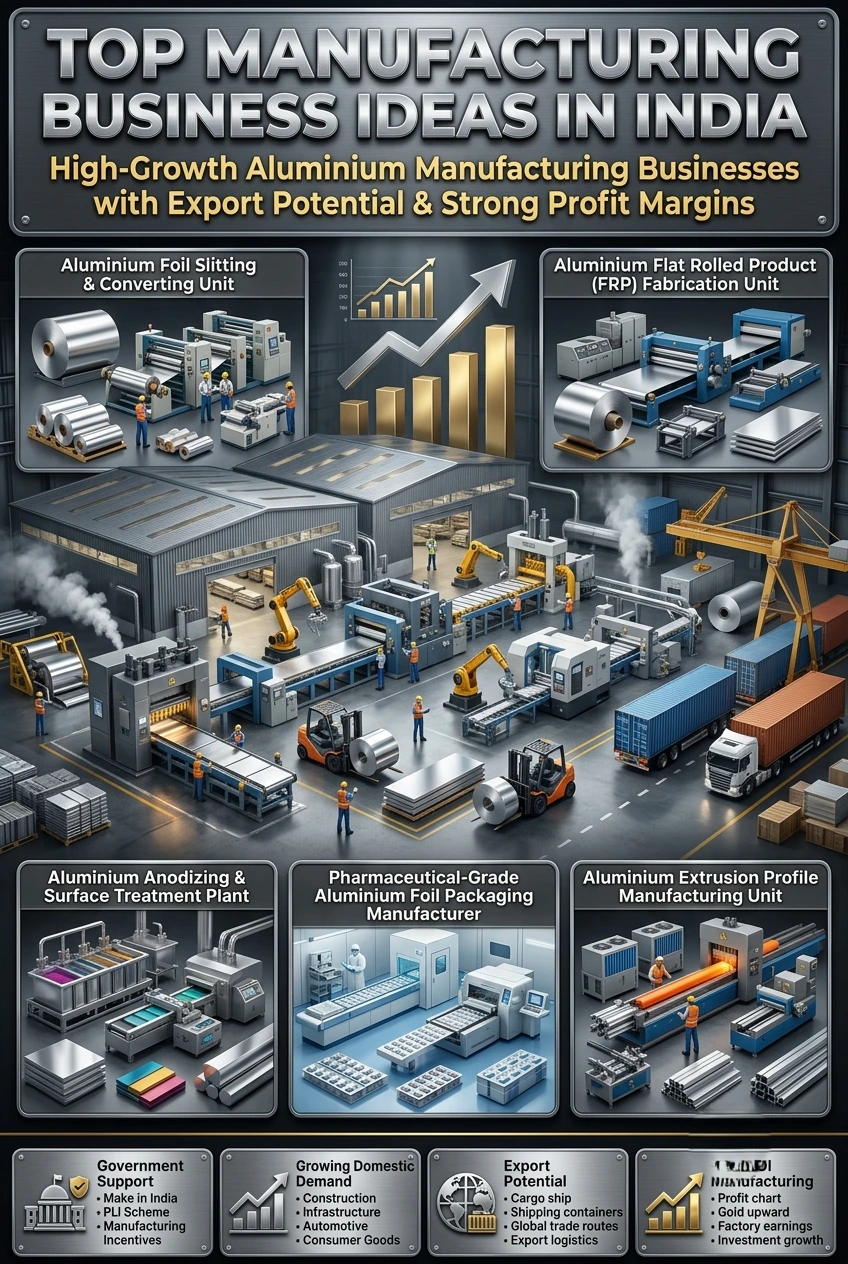
4. Pharmaceutical-Grade Aluminium Foil Packaging Manufacturer
The Indian pharmaceutical industry is a $50 billion business with a growing export demand. Blister packs (PVC-aluminium foil laminates) are regulated, precision-demanding and high value packs. A domestic foil supplier like Shyam Metalics in Odisha makes foiling and blister packing more feasible because pharmaceutical packaging uses aluminium foil. Manufacturers produce products such as push-through blister packs, cold-form foil laminates and ALU-ALU packs. Investment: ₹1–3 crore. Requirements for the licensing: Schedule M GMP compliance. Domestic pharma companies and regulated pharma exporters.
5. Aluminium Extrusion Profile Manufacturing Unit
Aluminium extrusion profiles are among the fastest growing sub-segments in India for window frames, door sections, mounting structure for solar panels, racking systems and aluminium channels in industries. With fast reckoning of the government’s ambitious rooftop solar installation targets and the demand from the real estate sector, the order flow remains intact. The components of an extrusion profile unit include a billet heating furnace, extrusion press, and profile dies. Investment: ₹1.5–4 crore for a 500–1000 TPA unit. This business can source billets from within India and is having the same downstream aluminium ecosystem as built by Shyam Metalics.(Aluminium Manufacturing Business)
Related Article: Aluminium Value-Added Manufacturing in India: A High-Growth Startup Opportunity
Import–Export Opportunity Analysis
India is presently importing substantial quantities of aluminium foils and flat rolled products (FRP) from China, South Korea and Japan with the main imports being high micron pharma grade foils and precision gauge flat rolled products (FRP). This import dependence is exactly what Shyam Metalics’ ₹800 crore investment is looking to cut down. The MSME manufacturers have a clear path towards export growth in the coming 3–5 years in this import substitution story.
The export of aluminium foils is on the rise in India. Indian exports of aluminium foils are increasing. The Middle East, Southeast Asia, and Africa are key markets where Indian manufacturers can compete with Chinese manufacturers on quality and cost, particularly after the 2024 realignment of anti-dumping duties. The exporters of MSMEs can avail the benefits of the Advance Authorisation Scheme and EPCG from DGFT to avail raw material import duties relief and finance capital equipment.(Aluminium Manufacturing Business)
The Confederation of Indian Industry (CII) expects India’s aluminium product exports to grow at a 15% CAGR in the coming years as global supply chains diversify beyond a single country. MSMEs that register for export and obtain quality certification will be ready to benefit from this growth wave.
Indian MSME Success Stories in Aluminium Manufacturing
In India, the aluminium MSME ecosystem already has some impressive success stories to show the scalability of the downstream manufacturing approach.
Gulf Catering Equipment Industries (Gujarat): An MSME that began as a small aluminium cookware manufacturer from Ahmedabad has expanded into pan-India catering equipment suppliers thanks to the consistent work done to deliver quality products and their recognition as a Startup India.
Jindal Aluminium (Karnataka): This is a simple case where an MSME-based extrusion business has grown into India’s largest Aluminium Extrusion unit because of market demand, and started off small in Bangalore.
They are a number of MSMEs in Baddi, Himachal Pradesh and Hyderabad with turnover ranging from ₹10 crore to 50 crore per year, who have created a business supply chain of aluminium blister foil lamination directly to the top-20 pharma companies. The examples prove that the opportunity for MSME in downstream aluminium manufacturing is valid.
About NPCS — Niir Project Consultancy Services
Feasibility analysis is the first step that is important to take for entrepreneurs wishing to pursue aluminium manufacturing. NPCS — Niir Project Consultancy Services is India’s most reputed project consultancy organization having 40 plus years of experience in generating bankable feasibility reports, detailed project reports (DPRs) and market research studies on manufacturing projects.
NPCS provides project reports of all kind in the manufacturing of Aluminium Foil, FRP Fabrication, Anodizing Plant, Extrusion Plant, and Pharma Packaging Projects. These reports contain investment analysis, procurement of raw materials, requirements for machines, licensing guide, eligibility for Government schemes, and financial projections. These reports are utilized for bank loan applications by the founders and MSMEs, investor presentations and strategic planning.(Aluminium Manufacturing Business)
For MSMEs looking to make an entry into the market, the current scenario where Economic Times is reporting large-scale investments in aluminium downstream, and government policies are strongly in favour of manufacturing MSMEs, an NPCS feasibility report gives a structured and data-backed entry strategy instead of the hit-and-trial method.
Discover business ideas that actually make money
Quick Reference: Aluminium Manufacturing Business Comparison
| Business Idea | Est. Investment | Margin Range | Key Markets | ET Signal Link |
| Foil Slitting & Converting | ₹40–80 Lakh | 12–18% | FMCG, Pharma | High (foil plant commissioned) |
| FRP Fabrication Unit | ₹60L–1.5 Cr | 15–22% | Construction, OEMs | Very High (FRP plant Sept 2026) |
| Anodizing & Surface Treatment | ₹80L–2 Cr | 25–40% | Architecture, Electronics | High (FRP demand driven) |
| Pharma Foil Packaging | ₹1–3 Crore | 20–28% | Pharma Exporters | High (domestic foil supply) |
| Extrusion Profile Unit | ₹1.5–4 Crore | 18–25% | Solar, Real Estate | Moderate–High (upstream ready) |
FAQ — Founder-Focused Questions
Q1. Will aluminium foil slitting be a profitable MSME business in India in 2026?
Yes – and much better now! As per Economic Times, Shyam Metalics is setting up a large domestic foil manufacturing plant in Odisha, which will now make it possible for MSME converters to avail the domestic supply of competitively priced jumbo foils instead of imported stock. The foils converting business needs comparatively low investment (₹40-80 lakh), has short turnaround time and has applications in the stable markets like FMCG and Pharma. It is one of the easiest ways for industrial entrepreneurs to enter the aluminium production industry.
Q2. What is the number of licences a unit in India requires for manufacturing aluminium?
Requirements are different for product and output capacity. Requirements are: Registration under the Factory Act (State Government), GST registration, Pollution Control Board (PCB) NOP (green or orange as per process) registration, MSME Udyam registration if applicable, BIS/ISI registration for registered products (Pharma foils). It is necessary that pharma foil packaging be Schedule M GMP compliant. The registration of startups under Startup India scheme in startupindia.gov.in can provide further tax and funding advantages.
Q3. How does a small manufacturer fare against Shyam Metalics and other big manufacturers?
Yes — and this is one of the many things many founders get wrong. Standard grade products are manufactured in industrial scale by large manufacturers such as Shyam Metalics. The MSME opportunity is in downstream conversion, customization, niche specifications and last mile services that are not economically possible to be provided by large plants. A slitting unit, anodizing plant or precision fabrication unit cannot replace Shyam Metalics, but it can coexist with the company and even serve customers who require processed products from the large plant.
Q4. What government funding is available for starting an aluminium manufacturing unit?
There are a few options for the business to avail. For collateral free loan: CGTMSE of msme.gov.in provides Collateral Free Loans Up to 5 coursed: It provide Term Loans & Working Capital forms Mes. Technology Upgradation Fund (TUF): Scheme is provided for investment in plant and machinery. State govt schemes – The State Govt Industrial Development Corporation provides land allotment, infrastructure support and capital subsidy in the industrial estate( this scheme might be useful since in Odisha the State Govt now has an aluminium downstream development policy).
Q5. Is aluminium foil manufacturing export-viable for Indian MSMEs?
Indeed, India’s pharma foil demand has risen as API and formulation exports have grown. The Middle East, Southeast Asia, and Africa are actively seeking quality aluminium foils and FRP products from India. Several countries have imposed anti-dumping tariffs on certain Chinese aluminium products. This has given Indian manufacturers a competitive window of opportunity. Through DGFT’s Advance Authorisation and EPCG schemes, Indian manufacturers can reduce raw material costs. They can also import capital equipment at subsidised duties.
Q6. How does this Economic Times development affect aluminium raw material pricing for MSMEs?
The upside over the medium term. Higher local downstream capacity – as is occurring with the commissioning of Shyam Metalics – has the effect of attenuating imported price volatility via a lesser intensity of competition over supply. MSMEs that procure aluminium foil jumbo rolls or FRP coils will now have a local option available, thus they will not be entirely beholden to international LME prices, international freight costs, etc. There will still be price volatility, but their structure supply will be less influenced by imports.
Conclusion: The Window Is Open — Act Early
Economic Times‘s coverage of Shyam Metalics’ ₹800 crore aluminium commissioning in Odisha is not a standalone business headline. It is a structural market signal — confirmation that India’s downstream aluminium ecosystem is entering a new phase of domestic value creation.
For MSME founders and manufacturing entrepreneurs, the logic is straightforward. Large anchor investments create supply chain ecosystems. Shyam Metalics’ foil and FRP plants in Sambalpur will require converters, fabricators, surface treatment providers, logistics specialists, and precision niche manufacturers. These roles are sized exactly for MSME-scale investment — ₹40 lakh to ₹4 crore — and carry genuine margin potential of 15–40%.
The timing is particularly important. Early movers who establish manufacturing capability and supply relationships before the FRP plant’s September 2026 launch will capture preferential supplier positions. Waiting means competing against a larger pool of established players. Economic Times is telling you where the market is moving. The opportunity to act on that signal is now.(Aluminium Manufacturing Business)
Start with a clear feasibility study and build your licensing pathway. Explore government scheme eligibility through msme.gov.in and startupindia.gov.in. Get your DGFT export registration in place. India’s downstream aluminium manufacturing story is just beginning. This week’s Economic Times development confirms that you are reading the right signal at exactly the right time.