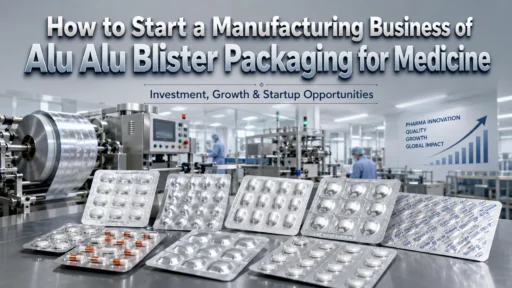
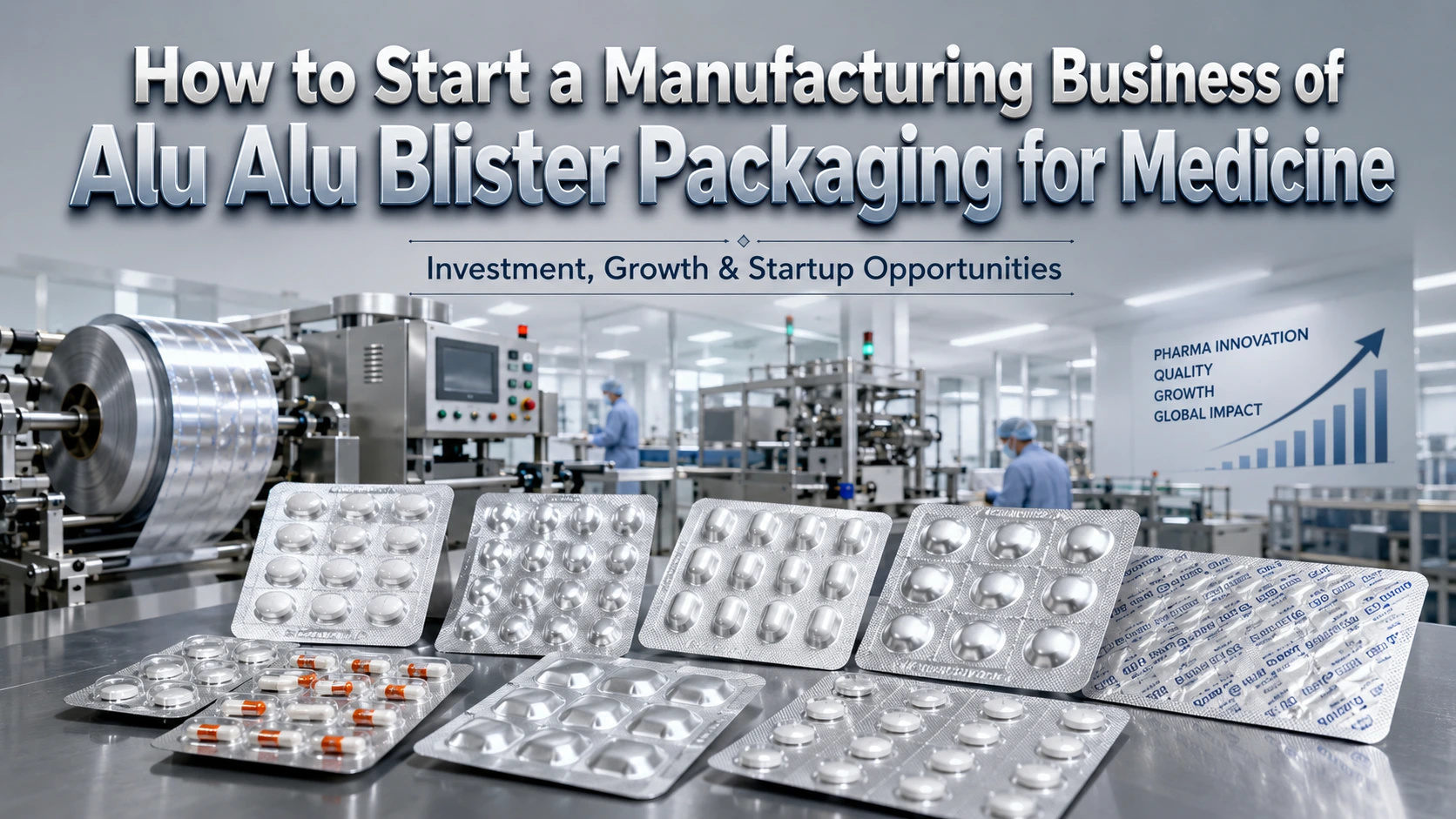

Alu Alu Blister Packaging Manufacturing Business in India
A Pharma Packaging Business Idea Worth Serious Attention
Pharmaceutical industry in India is among the most dynamic and export-oriented industries globally. Packaging is an integral part of this ecosystem, not only as a protective element, but a regulatory compliance, patient safety and product shelf life determinant. Alu Alu blister packaging for medicine is one of the most important packaging formats of the present times, and is a high growth potential market with high margins. Entrepreneurs with an active interest in the identification of business ideas in a pharma-adjacent manufacturing space should seriously consider this segment for analytical consideration.
Alu Alu blister packaging is unlike the conventional PVC blister packaging as it has aluminium foil on both sides, the lid and base so making it completely moisture-proof, light-resistant and chemically inert. For sensitive and hygroscopic products like anti-retroviral, antibiotics and specialty generics, these properties are essential. The increasing complexity of drug molecules coming into Indian market is creating systematic demand for this packaging format. The opportunity is ripe, the structure of the investment is in place and the policy regime is looking favourable, for a first-generation entrepreneur or MSME investor.
Get Detailed Insights from This Book: Drugs & Pharmaceutical Technology Handbook
Why the Alu Alu Blister Packaging Sector Is Growing Fast
About 60,000 branded formulations are made in India. Moreover, Many of these are in increasing numbers needing moisture barrier packaging. In fact, No one else at this price provides as good as Alu Alu blister packs. Moreover, regulatory authorities such as the Central Drugs Standard Control Organisation (CDSCO), the USFDA, and the EMA now demand more stringent packaging requirements for sensitive categories of drugs. Consequently, This has spurred greater uptake on export and domestic grade production lines.
The Indian pharmaceutical packaging market will grow at a CAGR of more than 10% during 2016–2020, with flexible and blister packaging emerging as the fastest-growing segments. In the meantime, exports of Indian pharmaceuticals account for over ₹2 lakh crore per year, and a significant share of the business goes to regulated markets that require compliant packaging. Exports from these markets always mention Alu Alu format packs to high sensitivity molecules, as per Pharmaceuticals Export Promotion Council of India (Pharmexcil).
Further, the cost function is getting better. The price of aluminium has steadied to a point where even mid-market, generic manufacturers can now afford to use Alu Alu packs, which they used to use PVC packs. Alu Alu blister pack makers at the small and mid-scale now have a big market to call their own thanks to this commercial inflection point.
Government Policies and Incentives Supporting This Business
The Government of India has developed several frameworks that directly affect Alu Alu blister manufacturers. The Department of Pharmaceuticals plans, executes, and monitors the Production Linked Incentive (PLI) Scheme for Pharmaceuticals, while API manufacturers and their ancillary packaging partners benefit indirectly from increased order inflows driven by PLI-supported growth in pharmaceutical production volumes.
The Credit Guarantee Fund Trust for Micro and Small Enterprises (CGTMSE) extended by the Ministry of MSME directly supports the packaging units through collateral free loans. The MSME-Champion Scheme and the ZED Certification Programme also help to further lower the cost of quality compliance — an important criterion for suppliers of packaging materials in the pharmaceutical industry.
Packaging in the pharma industry falls under the priority manufacturing sub-sector under Make in India. The Growth Capital schemes under SIDBI can also be availed by entrepreneurs for financing their plant and machines. In Gujarat, Himachal Pradesh, Uttarakhand and Telangana, the states with the highest concentration of pharma industries, provide capital subsidy of 15–25% for new manufacturing units with a project cost of less than ₹5 crore.
Get Detailed Project Report (DPR): Pharmaceutical Drugs & Bulk Drug Intermediates
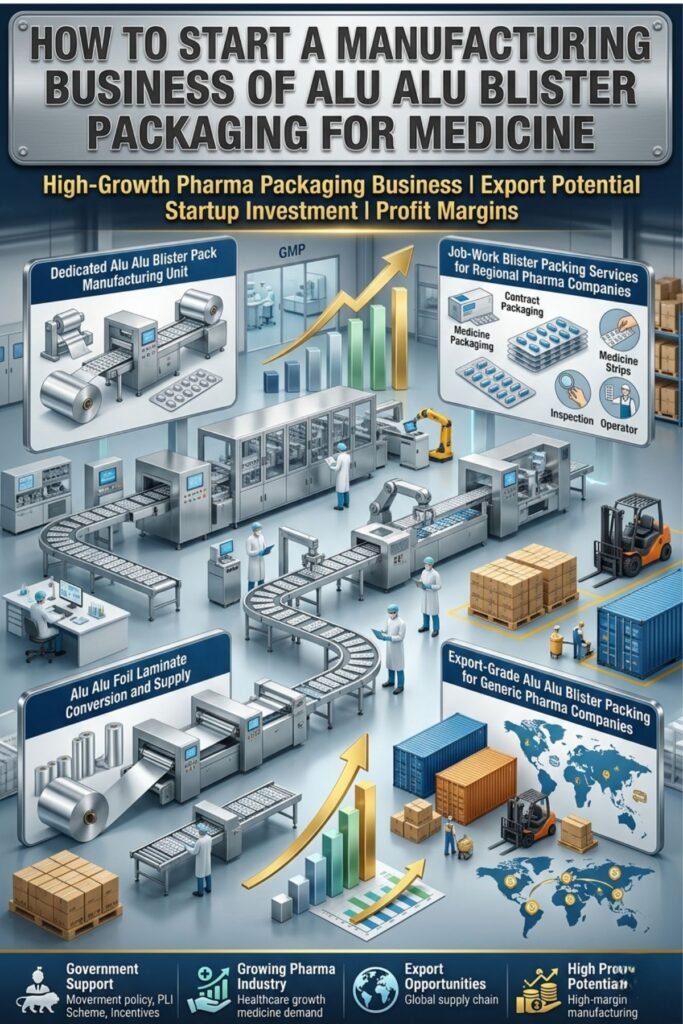
Business Ideas for Startups in Alu Alu Blister Packaging
1. Dedicated Alu Alu Blister Pack Manufacturing Unit
The easiest way in is to establish an Alu Alu blister pack manufacturing unit. This includes the purchase of cold-form aluminium foil (usually 45-micron in a OPA/AL/PVC or OPA/AL/PVDC laminate), the use of a thermoform or cold-form machine to form blister pockets from the foil and sealing with heat and pressure of the top lidding foil. A small to medium size unit can handle 10–15 pharmaceutical clients at once with two or three blister lines. Long-term supply contract is the main business rationale; pharma companies do not want to deal with a bunch of different packaging vendors and want a consistent quality and chain of custody. The investment amount in a 2-shift operational unit of startup is ₹60 lakh to ₹1.2 crore with the EBITDA margin of 18-25% at a 70% capacity utilisation.
2. Job-Work Blister Packing Services for Regional Pharma Companies
Outsourcing blister packing to a third party is an attractive solution for many small and mid-sized pharmaceutical manufacturers especially those with specialty, niche or low volume molecules. Thus, the job-work model for packing Alu Alu is an extremely attractive and promising business opportunity. The entrepreneur provides the packaging line, skilled operators, and quality systems, while the pharma company supplies the tablets/capsules and packaging materials. This model helps lower raw material procurement risk, streamlines working capital management and speeds up the revenue cycle. Within 6–8 months, job-work units located close to the different kinds of pharma clusters in Baddi (Himachal Pradesh), Hyderabad, Ahmedabad and Sikkim can secure a reliable order book. Less investment required, around ₹30-55 lakh for a lean operation, as the client provides the foil materials.
3. Alu Alu Foil Laminate Conversion and Supply
Instead of having to form the blisters, a business person can concentrate on converting and supplying cold-form aluminium laminate rolls, the most important raw material in Alu Alu blister packs. This will involve the need for lamination line, slitting machines and quality testing facilities for moisture-vapour transmission rate (MVTR) and peel strength. The end customers are integrated pharma companies having in-house packaging and blister pack manufacturers. The company is a materials-processing firm with a high percentage of repeat business. Further, import substitution is an attractive opportunity – India is already importing some percentage of speciality pharma laminates from Europe and Japan. A laminate convertor for the domestic market that will deliver a consistent MVTR of less than 0.05 g/m²/day can secure long-term contracts. The initial investment for a lamination and slitting unit is from ₹80 lakh to ₹1.5 crore.
Turn your budget into a successful business plan
4. Export-Grade Alu Alu Blister Packing for Generic Pharma Companies
India is known as the pharmacy of the world and a large number of countries are importing generic medicines from India. For drugs that are temperature sensitive and hygroscopic, most regulated markets such as the US, UK, Europe, Africa, and Southeast Asia, demand stringent packaging requirements. Hence, pharma manufacturers who are looking to export are keen to find packaging vendors who can provide export grade Alu Alu blister packs, along with proper material traceability and documentation. Investment in the clean room standards, quality management systems (GMP compliant) and testing laboratories is greater in an export grade packaging unit, but the price is far superior — usually 30-45% more than in the domestic marketplace. This is a good business idea if the entrepreneur establishes strong relationships with export-oriented generic manufacturers in the pharma SEZs of Andhra Pradesh, Gujarat, and Maharashtra.
Import–Export Opportunity Analysis
The import of blister packaging material is a prominent opportunity for import substitution in India. The country cannot manufacture these materials because it lacks sufficient production capacity and quality uniformity. As a result, manufacturers import them from other countries, particularly Germany, Japan, and China. According to data from Directorate General of Foreign Trade (DGFT), the specialty pharma packaging foils have a significant market share in the pharma-allied imports and this can be taken up by domestic converters, if they have the right technical set-up.
The potential on the export side is even greater. The generic drug exports from India need compliant packaging, and packaging vendors with USFDA/EMA/WHO-GMP compliant facilities can be the preferred vendors of the domestic pharma exporters. Also, direct export to the pharmaceutical companies in Africa and South-East Asian is an emerging avenue, a region with a strong Indian presence in the pharma sector. The Government’s efforts on pharma diplomacy and India-Africa health partnership further facilitates institutional procurement avenues for the packaging suppliers.
Indian MSME Success Stories in Pharma Packaging
Bilcare Limited, Pune
Mohan Barge of Pune started Bilcare Limited in the much smaller business of producing blister films for pharmaceuticals and expanded it to become a worldwide pharmaceutical packaging firm with business operations on various continents. The vision of Barge was a very simple one—it was the realization that a market boom in India’s pharma exports would generate an out-of-proportional demand for precision packaging. He invested in cold-form laminate technology early in its development—long before it became mainstream—and built a clientele that included 20 of India’s top pharmaceutical exporters. The general rule for new entrepreneurs is: the earlier into specialisation the better, well before the market matures, as late entries are hard to catch up.
Uflex Limited, Noida
Uflex Limited, headed by Ashok Chaturvedi, is India’s biggest manufacturer of flexible packaging and has a decent pharma packaging arm which includes Alu Alu solutions. In order to grow Uflex, Chaturvedi adopted a vertical approach by having all the raw materials, production and printing under one roof. As a result, Uflex’s success is a lesson in integration: It’s a strategy that can only be emulated at a smaller scale by startups that control a bigger share of the value chain. Partial integration is a viable method for small manufacturers, such as the combination of laminate conversion and blister forming for example.
Huhtamaki India, Mumbai
Huhtamaki India’s packaging division caters to a multitude of pharma customers in India. Furthermore, Their presence in India with base in Maharashtra and Gujarat reflects the ability to implement global packaging standards for domestic and export pharma clients quite efficiently. Moreover, The company’s success in pharma packaging highlights the significance of winning institutional contracts with certifications such as GMP, ISO 15378 (pharma packaging) and FSSC. Therefore, For the MSME entrepreneurs, the initial investment in certifications is not an expense, it is a means of entering the market.
Related Article: Best Pharmacy Franchise Option in India Under 10 Lakhs
How NPCS Can Help You Start This Business
Niir Project Consultancy Services (NPCS) offers professional consultation and preparation of Market Survey cum Detailed Techno-Economic Feasibility Reports (DPRs) for establishing a new industry. We present the detailed manufacturing processes, process flow diagram, product mix and capacity planning, machinery specifications, raw material sourcing and complete financials of the projects related with Alu Alu blister packaging in our reports with profitability analysis. Our goal is to conduct a thorough feasibility and profitability analysis of the business idea and assess its potential to scale into a bankable industrial project before investing any capital.
Key Project Data: Alu Alu Blister Pack Manufacturing Unit (Indicative)
| Parameter | Indicative Details |
| Plant & Machinery Investment | ₹40–80 Lakh (2–3 blister lines) |
| Civil & Utilities Setup | ₹10–20 Lakh |
| Working Capital Requirement | ₹15–25 Lakh |
| Total Project Cost (Small Unit) | ₹65 Lakh – ₹1.25 Crore |
| Annual Installed Capacity | 12–18 Lakh blister strips/year |
| Average Realisation per Strip | ₹2.50 – ₹4.50 |
| Estimated Annual Revenue | ₹1.8 Crore – ₹3.5 Crore |
| Net Profit Margin (Post Stabilisation) | 18–25% |
| Payback Period | 3–4 years |
| Key Raw Material | Cold-form Al laminate (OPA/AL/PVC/PVDC) |
| Key Machinery | Cold-form blister machine, Heat sealer, Slitter |
| Regulatory Compliance Needed | CDSCO, GMP, ISO 15378 (for pharma supply) |
Frequently Asked Questions (FAQs)
Q1. What is Alu Alu blister packaging and why is it different from standard blister packs?
Unlike traditional packs which have PVC on the base, Alu Alu blister packs have cold formed aluminium laminate in both base and lid. Which makes Alu Alu packs completely moisture-proof, light-proof, chemically inert – a crucial requirement for hygroscopic drugs (antibiotics, effervescent tablets and moisture-sensitive APIs). In regulated markets, this is often a requirement for sensitive formulations by regulatory authorities.
Q2. What would be the minimum investment required in order to start an Alu Alu manufacturing unit for blisters?
A job-work based lean unit can be established for an investment of ₹ 30 to 55 lakh. This involves a separate production unit with 2–3 blister lines, quality testing, and basic infrastructure, which cost between ₹65 lakh and ₹1.25 crore. It varies based on capacity, location, level of automation, and compliance infrastructure.
Q3. Which schemes are there to support such a manufacturing startup?
There are several schemes which are applicable directly. The CGTMSE offered collateral free loans upto ₹2 crore for MSMEs under the Ministry. Pharma-cluster states offer state level capital subsidies of 15 to 25%. The Growth Capital scheme offered by SIDBI, raw material assistance from NSIC and ZED certification support also apply. The entrepreneurs should visit the MSME-DFO/DDC of the state to avail state benefits.
Q4. In India who are the main customers of Alu Alu blister packs?
Key customers include small and mid-sized pharmaceutical companies manufacturing tablets and capsules, contract manufacturing organisations (CMOs) and exporters in the pharma business. The new packaging manufacturers’ target customers include companies based in pharma clusters like Baddi, Hyderabad, Ahmedabad, Surat, and Sikkim.
Q5. Is export of Alu Alu blister packs a viable revenue stream for a startup?
Exporting directly in blister pack form is commercially feasible, though in a near-term more accessible route for startups is to supply Indian pharma exporters who in turn would require export quality packing to be compliant with USFDA and WHO-GMP. This provides an export-equivalent pricing for, as well as circumvents the logistics of exporting to overseas markets. The above mechanism is also encouraged by both Pharmexcil and DPIIT via respective export promotion schemes.
Q6. What certifications does an Alu Alu blister pack manufacturer need?
To supply to regulated pharma companies, at least GMP as per Schedule M of the drugs and cosmetics Act is essential. For export quality/regulated market supply, ideally ISO 15378 (the standard for primary pharmaceutical packaging material) should be adhered to. Depending on whether the unit is classified as manufacturer or converter, a CDSCO license might be necessary. It would be appropriate to check the current licensing guidelines with the Central Drugs Standard Control Organisation (CDSCO).
Conclusion: A Structured, Scalable, and Policy-Supported Opportunity
It needs to be stated that the Alu Alu blister packaging venture isn’t a gambit. It is a sound, demand-driven, policy-assisted manufacturing prospect that aligns itself with India’s export dreams as well as developing regulatory practices governing drug safety. Space that is already vast, has been documented as being on an upward trend, and is adequately capitalizable by serious MSME investors.
But to be successful in this business one must ensure he is right technically, have the quality compliance setup in place and a customer-acquiring strategy, particularly in existing pharma clusters. The ones who are willing to acquire the certifications in the early stages, stay close to the pharma manufacturers and maintain working capital discipline can consider this as one of the profitable industrial business ideas of the decade. A technically sound and realistically assessed feasibility report, supported by authentic market intelligence, provides the safest initial step for investors before committing their money.
References & Useful Links
Ministry of MSME, Government of India
CDSCO – Central Drugs Standard Control Organisation
DPIIT – Department for Promotion of Industry and Internal Trade
DGFT – Directorate General of Foreign Trade
Make in India – Manufacturing Sector