

Copper Manufacturing Business
India has been experiencing stress on copper and its industrial engine operates on copper. The alarm was sounded by a major industry body just recently in Economic Times that India needs to add 500,000 tonnes of refined copper capacity every five years, to maintain the growth with the escalating demand. It’s not some prophetic prediction. That is a structural opening that is occurring in real time.
This is the signal from the market that is a decade long opportunity for the founders, MSMEs and industrial entrepreneurs. If a critical raw material is not available for industry (and the government is being urged to intervene), windows open quickly. Early movers reap the greatest benefit.
Demand for copper in India has increased by 9.3 per cent to 1,878 kilo tonnes only in FY25. It’s a fight for a limited resource in the fields of infrastructure, renewable energy, consumer durable goods, and construction. India keeps falling short of its demand by increasing every quarter. That’s where your possible business comes in.
What Recent Economic Times Reporting Means
Recently, industry bodies had urged the government to give a push for domestic copper capacity in the country, as reported by the Economic Times. It is more than a commodity story as the report comes from ET Manufacturing.
The International Copper Association India (ICA India) flagged that the demand for copper will expand in India by no less than 9 per cent till 2026 in line with the overall GDP growth in India. Construction of buildings grew by 11 per cent on an annual basis. There was an increase of 17 per cent in infrastructure. The renewable energy industry experienced the largest ever increase in capacity. All these sectors operate on copper.
An Economic Times development that founders and MSMEs cannot have wished for more: an upward trend in demand, limited supply, government interest and evident import reliance. This is what has historically resulted in good business cases for domestic processing, downstream manufacturing, and value-added copper product businesses.
The signal is clear and distinct. Copper isn’t a small cap. It is at the core of India’s growth story, and the supply side has lagged.
Get Detailed Project Report (DPR): Copper and Copper Products and Projects
Why the Copper Industry Is Growing in India
Infrastructure Push
The National Infrastructure Pipeline (NIP) has already pledged trillions of rupees in India for smart cities, metro systems, roads and ports. Copper wiring, cables, busbars and connectors are needed for every kilometre of this infrastructure. Saw the fastest growth of demand in the infrastructure segment, rising 17 per cent YoY in FY25.(Copper Manufacturing Business)
Renewable Energy Expansion
Copper is used in solar parks, wind farms and grid storage facilities and is these systems’ core requirement. Copper is copper-intensive by design: it is the core requirement in solar parks, wind farms and grid storage systems. Utility-scale solar projects use tonnes of copper for panels, inverters, transformers, and transmission lines. The demand for copper in the clean energy will continue to grow as India strives to reach its clean energy targets.
Consumer Durables Surge
Copper is used in many big household items, such as air conditioners, refrigerators, washing machines and fans. The growth in middle class incomes and development of the domestic manufacturing sector under the PLI scheme is driving the growth of production of consumer durables at double digit rates and so is the demand for copper.
Electronics and Telecom
Several new and emerging applications, such as data centres, 5G tower rollout, and semiconductor manufacturing facilities, are driving demand for copper. The amount of copper used in each 5G base station is about three times that of its 4G counterpart. The development of digital infrastructure in India is quietly emerging as one of the biggest new drivers of the metal.
Government Policies and Incentives to Know
There are several value chain support programmes available for the entrepreneurs entering the copper value chain. The Ministry of MSME provides two types of funding namely, the credit linked capital subsidy schemes and technology upgrade funds particularly for the metal processing MSMEs.
From tax exemptions to expedient patent processes and a tax-free access to the Fund of Funds scheme run by SIDBI, startup India offers a host of benefits to startups working in the critical materials processing sector.(Copper Manufacturing Business)
Make in India programme actively promotes the manufacturing of industrial metals and the downstream copper products in the country. There are a number of sectors, including electronics, consumer durables and telecom equipment, that offer PLI related incentives.
Entrepreneurs should also keep an eye on the proposed Production Linked Incentive (PLI) scheme for the non-ferrous metals industry, which industry groups are lobbying the government to introduce and which The Economic Times reported.
Get Detailed Insights from This Book: The Complete Book on Ferrous, Non-Ferrous Metals with Casting and Forging Technology
6 Business Ideas for Startups and MSMEs in the Copper Sector
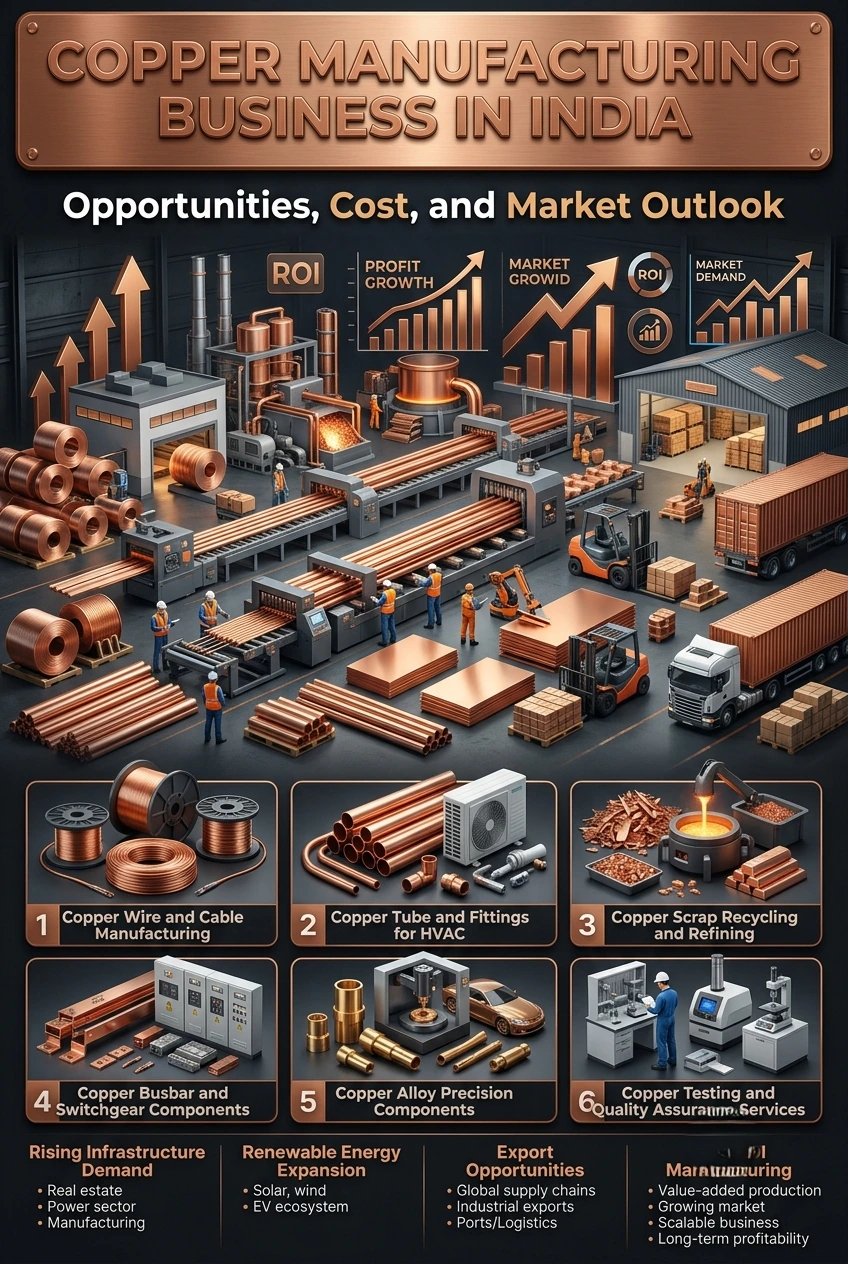
1. Copper Wire and Cable Manufacturing
Demand for winding wire, building wire and power cables are at an all-time high. The range of the machinery used in small scale copper wire drawing units is ₹50 to 150 lakhs. The segment is geared towards the electrical, construction and consumer durables markets, which are all witnessing significant growth.
2. Copper Tube and Fittings for HVAC
The penetration of air conditioners in India is still less than 10 per cent. The copper tube demand for refrigeration and HVAC systems will increase along with this increasing number. In the copper tube production category, there are opportunities for MSMEs in this category that are focused and less competitive.
3. Copper Scrap Recycling and Refining
Electrical dismantling, electrical demolition and end-of-life equipment generate huge amount of copper scrap in India. A copper scrap collection, processing and refining operation can be viable at smaller capital levels and large manufacturers can benefit from the supply of secondary copper feedstocks.
Related Article: Copper Wire Recycling Plant Business in India: Investment ₹37 Lakh, Profit 20%, Complete Setup Guide
4. Copper Busbar and Switchgear Components
Copper busbars are used in power distribution switchgear, transformers and control panels. The power landscape is growing at a healthy pace and data centres are on the rise, making this a high demand B2B segment with assured institutional customers such as power utilities and EPC contractors.
5. Copper Alloy Precision Components
Copper alloy parts, such as bearings, bushings, connectors and heat sinks are used in automotive, aerospace and defence manufacturing. With the defence manufacturing push of PLI, precision machined copper alloy parts command high value as well as export.
6. Copper Testing and Quality Assurance Services
With the growth of domestic production, the testing, certification, and quality assurance services provided by third parties will increase. NABL-accredited testing lab for copper and cable manufacturers is a business of capital efficient model with recurring revenues with institutional demand.
Import-Export Opportunity Analysis
As the country faces a structural shortfall in copper, trading enterprises have seen an opportunity to buy copper in India at a lower price than overseas. Traders who are capable of obtaining refined copper cathodes and concentrates from trusted sources in the world, especially in Chile, Peru and Zambia and deliver them effectively to local sellers can develop solid trading margins. Before venturing in this segment, take a close look at the DGFT guidelines for copper imports.
The value-added products of copper such as wires and cables, tubes and precision products fetch much higher realisations on the export side. As discussed, finished copper products are competitive in the Southeast Asian and African markets due to the labour cost edge and the quality of the manufacturing processes in India.(Copper Manufacturing Business)
Entrepreneurs interested in the export business should contact the Engineering Export Promotion Council (EEPC) and use government export promotion schemes to cover eligible export promotion costs.
Indian MSME Success Stories in the Copper Sector
Some Indian MSMEs have created substantial business by cleverly following the demand cycles of copper. Firms in the city of Jamnagar, Gujarat, which was the centre of making brass and copper fittings in India, have grown from being a city of local plumbing fitting companies to a city of export businesses serving Europe and the Middle East. Their mantra: domestic first, quality second and export third.
The Coimbatore small scale winding wire manufacturers who are supplying to the motor manufacturers have turned into mid-scale manufacturers by upgrading their capacity based on the surge in demand of electric motors in the industrial automation era and the improvement of conductivity grade.
However, the processing of copper scrap in the Narela industrial area of Delhi has resulted in a viable recycling enterprise that provides secondary copper to the downstream wire processors at a competitive margin with that of primary copper processing.
The common denominator of all these tales: they foresaw a demand segment early on, remained focused and invested in quality to gain both domestic and export customers.
How NPCS Can Help You Enter the Copper Business
Niir PROJECT CONSULTANCY SERVICES (NPCS) is the most trusted name in providing industrial feasibility reports in India for a period of more than three decades to help entrepreneurs, MSMEs and investors to plan their projects in the industrial sector.
NPCS offers detailed project reports for the copper industry for entrepreneurs who want to enter the copper industry for copper wire drawing, copper tube manufacturing, busbar fabrication, and copper alloy casting business, which includes plant layout, selection of machines, raw material procurement, cost of production, financial projections, and analysis of the payback period.(Copper Manufacturing Business
NPCS reports offer practical value because entrepreneurs can submit them to banks, NBFCs, and government agencies when applying for loans or seeking project approvals. They contain the information required for these applications. NPCS reports provide the necessary information that banks, NBFCs, and government agencies accept for loan applications and project approvals, making them valuable for entrepreneurs and businesses. A project report by NPCS offers the technical and financial backbone to take a copper sector entry from idea to bankable.
Build a profitable business with the right idea
Copper Sector at a Glance — Key Data Points
| Parameter | FY25 Data | Implication for Business |
| India Copper Demand | 1,878 KT | Large and growing addressable market |
| Year-on-Year Demand Growth | 9.3% | Consistent expansion supports investment |
| Infrastructure Copper Growth | +17% YoY | Strong B2B demand from govt projects |
| Building Construction Growth | +11% YoY | Wiring, fittings, and plumbing demand |
| New Capacity Needed | 500,000 T / 5 years | Clear supply gap = business entry point |
| Expected 2026 Demand Growth | ~9%+ | Demand momentum continues |
| Key End Sectors | Infra, Renewables, Durables, Telecom | Diverse demand reduces risk |
| Primary Import Sources | Chile, Peru, Zambia | Import trading opportunity exists |
FAQ — Founder-Focused Questions on the Copper Business Opportunity
Q1. Can a first-time entrepreneur in a small capital make a business of copper production?
Yes, especially downstream. Copper wire drawing, Copper fitting fabrication and Scrap wire recycling can be started from the scale of ₹30 to ₹150 lakh, depending on the capacity. These doorways enable newbies to discover the value chain without staking significant capital.
Q2. What are the various sources of Government assistance available to the MSMEs in copper industry?
The Credit Guarantee Fund Trust for Micro and Small Enterprises (CGTMSE) offers micro and small-scale loans without any collateral, with a maximum loan amount of ₹2 crore. Plant Modernisation is supported by the Technology Upgradation Fund (TUF) scheme. Shared infrastructure benefits too are provided by MSMEs on the industrial areas. Furthermore, copper-linked businesses that are eligible are eligible for Startup India benefits.
Q3. Where can I get raw copper copper when it can’t be found locally?
In India, most of the downstream copper manufacturers buy refined copper cathodes either from registered importer or directly from the international suppliers and follow the LME (London Metal Exchange) linked price mechanism. The ability to develop a sound import sourcing relationship is essential in this business. Direct imports require DGFT registration and IEC (Import/Export Code).
Q4. What is the highest margin potential product of copper?
Well-run precision copper alloy components, for automotive, defence and industrial use, usually have the highest margins, from 15 to 25 per cent of EBITDA. Copper cables and wires are more commoditised, but have higher volume potential. The biggest strategic opportunity is to upscale from raw processing to finished certified product manufacturing.
Q5. Does there exist an opportunity of export for copper products produced in India?
There is considerable export potential especially in copper wire, cables and fittings. Labour cost advantage and rising manufacturing quality makes India competitive in markets throughout Southeast Asia, East Africa and the Middle East. The Engineering Export Promotion Council (EEPC) is very active in providing Market Development Assistance to Copper Product Exporters.
Q6. How long does it take to set up a copper wire drawing unit?
The time required for the commissioning of a small-scale copper wire drawing plant for project planning to the trial production process is about 6-9 months. Timelines: procurement of plants and machines (3-4 months), civil construction (2-3 months), the trial runs and stabilisation (1-2 months). NPCS project reports include detailed implementation schedules.
Conclusion: The Window Is Open — Move While the Demand Signal Is Clear
The Economic Times’ recent spotlight on India’s copper capacity gap is more than a news item. It is a market signal. When an industry body formally urges the government to support capacity expansion, institutional attention follows — and with it, policy support, financing availability, and investor interest.
India’s copper demand is not a cyclical blip. Infrastructure commitments spanning decades, an irreversible clean energy transition, and a consumer market that still has low penetration of copper-intensive durables are driving this growth. The supply deficit is structural, not temporary.(Copper Manufacturing Business)
For founders and MSMEs who move now, this is the kind of market condition that creates durable businesses. The demand is there. The policy intent is aligning. The competitive field in downstream copper manufacturing is still relatively uncrowded. What is needed is informed action — a clear project plan, access to the right government schemes, and the conviction to enter early.
Economic Times has identified the signal. The market has confirmed the gap. The question for every entrepreneur reading this is simple: are you going to act on it? Start by exploring the MSME Ministry’s scheme portal and Startup India’s benefits framework to understand what support is available for your copper sector venture today.