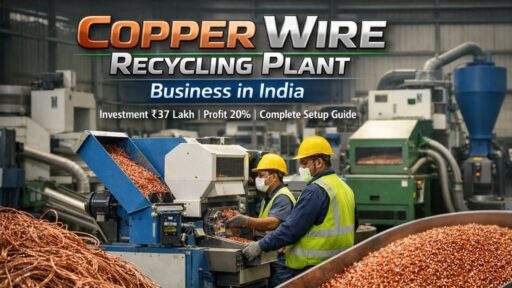


Introduction: Copper Recycling Business India
Copper recycling is coming out as one of the most viable manufacturing opportunities in India. Due to the rapid development of industry, the growth of infrastructure and the increase in demand of electrical equipment, the consumption of copper is growing annually. Meanwhile, construction sites, factories and electrical systems produce large quantities of copper scrap.
Copper is one of the materials that can be recycled many times without compromising its quality. This makes it a great resource to manufacturers and a lucrative business among entrepreneurs. When properly operated recycling plant can result in high quality copper granules that find extensive application in cables, motors, transformers, and electronic equipment.
India still imports a large percentage of its copper demand, which creates a good opportunity for local recycling industries. This industry has consistent demand, low-risk, and long-term development prospects to first-time entrepreneurs and MSME investors.
Market Demand and Industry Growth in India
There are various industrial developments that are driving the growth in the demand of copper in India. The build-up of renewable energy development, production of electric vehicles and electric power distribution systems has greatly led to the rise in the demand of copper wires and electrical products.(Copper Recycling Business India)
The industries that contribute a lot to demand are:
- Electrical cable manufacturing
- Electric vehicle production
- Construction and infrastructure
- Renewable energy projects
- Electronics manufacturing
With the expansion of these industries, there will be an increase in the demand of the recycled copper. This trend is likely to be the most beneficial to organized recycling plants capable of providing consistent-quality material.
Get Detailed Insights from This Book: Manufacture of Electrical Cables, Wire and Wire Products Handbook
Investment Required to Start a Copper Recycling Plant
The machine’s production capacity, quality, and working capital determine the overall investment. A small-scale unit will be appropriate to new entrepreneurs who desire to begin with moderate investment and continue to grow operations.
Typical investment range:
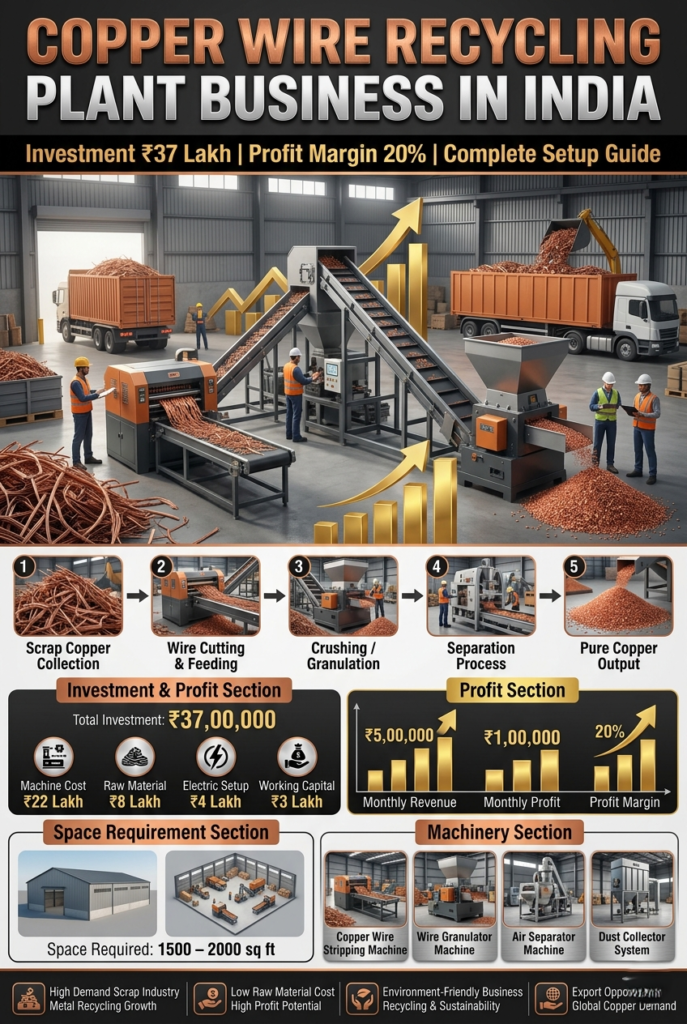
- Small-scale unit (5–8 MT/month): ₹37 lakh to ₹55 lakh
- Medium-scale unit (15–20 MT/month): ₹90 lakh to ₹1.3 crore
The typical cost of such investment includes:
- Purchase and installation of machinery.
- Rent of factories or sheds preparation.
- Raw materials working capital.
- Electricity and utility installation.
- Initial operating expenses
Renting an industrial she’d rather than buying a piece of land can greatly save on the costs of starting a business and it can enable you to establish a business within a short period.
Machinery Required for Copper Wire Recycling
Efficiency of the machinery used is important in the performance and profitability of the business. Recycling machines of the modern world can quickly recycle copper scrap without compromising on the purity.
Key machines required in a copper recycling plant:
- Copper wire granulator
- Air table separator
- Magnetic separator
- Wire stripping machine
- Baling or briquetting machine:
Other machines like conveyors, weighing machines and dust collection systems are used to enhance productivity and safety at work. Investment in good machinery minimizes downtime and guarantees uniform production output.
Get Detailed Project Report (DPR): Copper Wire Manufacturing Business Plan and Feasibility
Space and Infrastructure Requirement
When it comes to a small copper recycling unit, an area of approximately 2,000 to 2,500 square feet will suffice to be covered. This area is enough to accommodate machinery installation, storage of raw materials and finished products. Large facilities with more storage capacity are needed in medium-scale units.
The selection of the appropriate location is significant in terms of efficiency of operations and compliance with regulations. The industrial areas are generally preferable as it has a reliable electricity supply, access to transport, and simpler licensing processes.
Raw Material Supply and Procurement Strategy.
The most important aspect in the success of this business is the availability of copper scrap. Production cannot go on unhindered without a steady stream of raw material. Thus, entrepreneurs ought to consider establishing good supplier relationships prior to inception.(Copper Recycling Business India)
Some typical sources of copper scrap are:
- Scrap dealers and recycling markets.
- Wire manufacturing companies Cable and wire manufacturing companies
- Construction and demolition projects.
- Government scrap auctions
- Repair workshops of industrial machinery.
The establishment of permanent supplier contracts enables businesses to maintain fixed expenses while their operations continue without any interruptions.
Licences Required to Start a Copper Recycling Business
The operation of a copper recycling plant requires multiple regulatory approval processes to achieve safe and legal functioning. The licences serve as a certification that environmental and industrial standards have been met.
Important licences and registrations include:
- Udyam Registration (MSME registration)
- GST Registration
- Factory Licence
- Pollution Control Board NOC.
- Fire Safety Certificate
The most time-consuming process among these is often the Pollution Control Board approval. Entrepreneurs ought to seek this licence as soon as they are planning to avoid procrastination.
Find high-return business ideas based on your budget & ROI
Find high-return business ideas based on your budget & ROI
Government Schemes Supporting Recycling Businesses
Indian government offers financial support to small manufacturing companies in different schemes to facilitate entrepreneurship and industrial development. Such programs assist in minimizing the cost of venturing into a new business.
Major government schemes available:
- PMEGP Scheme – offers capital subsidy.
- CGTMSE Scheme – provides loan guarantee with no collateral.
- MUDRA Loan – helps finance small businesses.
- State subsidies on MSMEs.
Such schemes can greatly reduce the startup expenses and cash flow can be enhanced at the initial stages of the business.
Profit Margin and Financial Performance.
Recycling of copper is a manufacturing business that is said to be financially appealing due to the gap between scrap value of purchase and processed copper value of sale. The business can also bring about a steady flow of revenues and predictable profit margins when effectively managed.(Copper Recycling Business India)
A recycling facility with a small recycling capacity is capable of producing a number of tonnes of copper per month. The refined copper grains are marketed to the industry at fair market values and they yield a constant stream of revenue. Most organized units have net profit margins of between sixteen to twenty two percent after taking into consideration operating costs like electricity, labour, and maintenance.
The average payback period of the initial investment is two to three years which can be said to be good with regards to a manufacturing enterprise.
Why a Detailed Project Report Is Important
Entrepreneurs prepare a comprehensive project report before investing in machinery or seeking bank funding of the project. This report gives a clear picture regarding the business concept, financial forecast, and operational needs. This report is very important to banks in the process of assessing loan applications.
A professional project report typically contains:
- Investment and cost analysis of project.
- Machinery specifications
- Production capacity planning
- Profit and loss forecasts.
- Market demand assessment
- Risk analysis and compliances.
NIIR Project Consultancy Services is one of the established organizations which prepare industrial project reports in India. This organization deals with feasibility studies and business planning of manufacturing industries. Entrepreneurs in need of bank loans and government subsidies have made extensive use of their reports.
Collaborating with an established consultancy would aid in making sure the business plan is feasible, properly organized and in line with the market environment.
Related Article: How to Start a Copper Wire Recycling Business in India (Investment, Profit & Market Guide)
Future Growth Potential of Copper Recycling in India
Increasing industrial demand and environmental awareness promise a good future of copper recycling in India. With the implementation of sustainable practices in the industries, recycling will be crucial in waste minimization and conservation of the natural resources.
Several long-term trends are likely to stimulate growth in this sector:
- Increased production of electric vehicles.
- Development of renewable energy projects
- Expansion of smart city infrastructure.
- Increase in demand of electronic devices.
- Focus more on environmental sustainability.
The current trends are expected to Favor businesspersons who have set up effective operations and supply chains nowadays.
Frequently Asked Question (FAQ)
How much money would you need to establish a copper recycling plant in India?
An average small-scale unit to recycle copper would need an investment of 37 lakh to 55 lakh depending on the capacity of the machineries and working capital.
Would copper recycling be a lucrative venture in India?
Yes, copper recycling is usually profitable, because of high demand and stable prices. The net profit margin of most of the organized units is between 16 and 22.
What is the time lag to start the business?
The entire installation process takes approximately five to seven months, comprising of licences, installation of machinery and trial production.
Is it possible to borrow a bank loan over this business?
Yes, banks and other financial institutions offer loans to manufacturing businesses on MSME schemes. An elaborate reporting of the project is normally mandatory to obtain finance.
Who will make a project report on the recycling of copper?
Organizations like NIIR Project Consultancy Services can prepare professional project reports and are specialized in industrial feasibility studies and business planning.