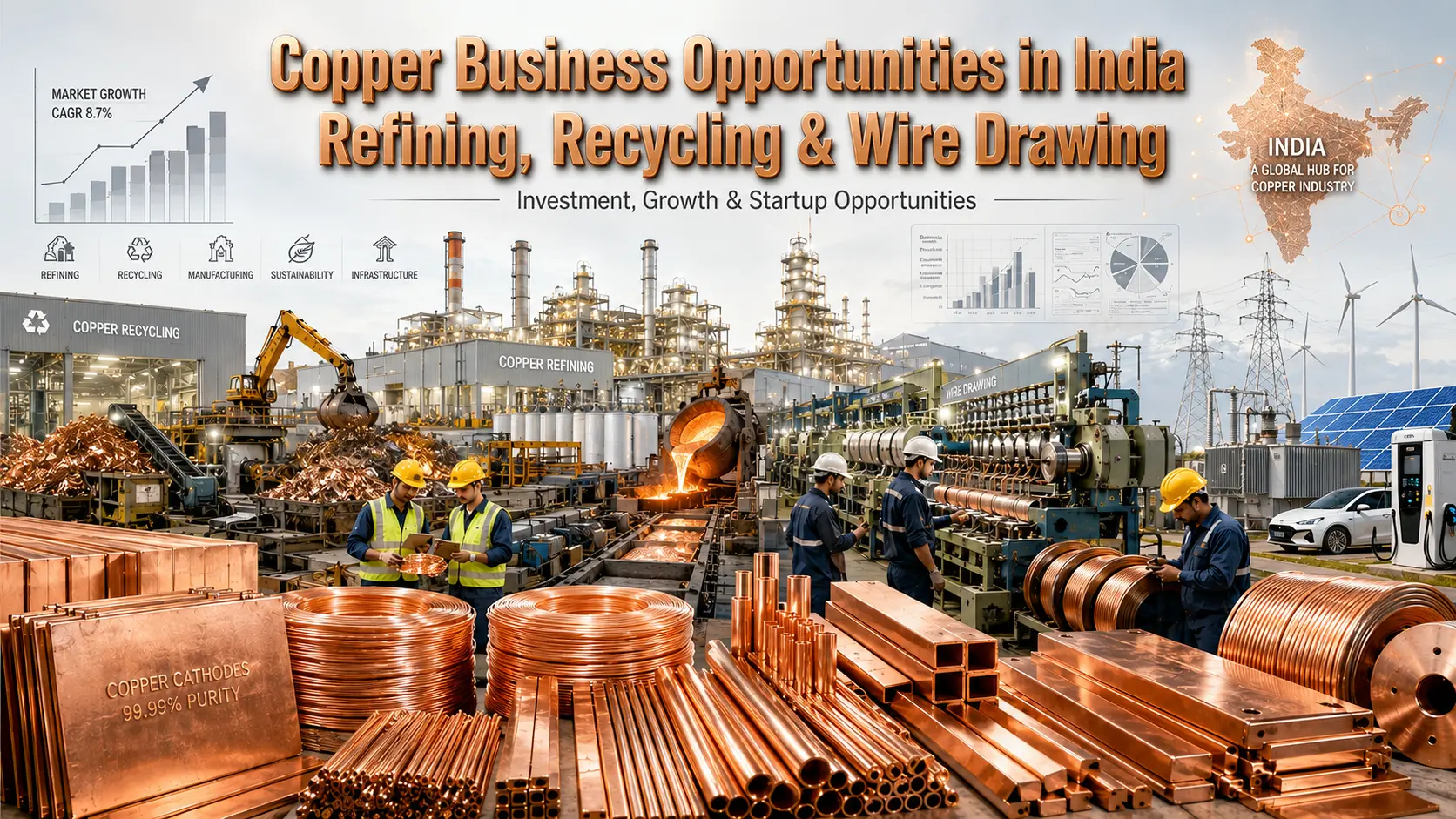

Copper Business Opportunities
A Supply Crisis Hiding in Plain Sight
A subtle but strong message has been sent by Economic Times Manufacturing’s fresh market signal across industrial corridors in India. The International Copper Association India (ICA India) estimates that India will require an extra 500,000 tonnes of refined copper capacity every five years to meet its own demand. This isn’t a prediction for the far distant future. It’s a structural problem that is playing out now, and it’s growing as new power lines are erected, new metro tunnels are bored and new solar panels are installed on India’s infrastructure.
In FY25, India’s copper demand increased by 9.3% YOY to 1,878 kilo tonnes. The building and construction industry grew by 11% and infrastructure by 17%. Throw in the clean energy transition, the consumer durables boom and the defence electronics push and you have a demand machine that’s in no hurry to slow down. But domestic refining capacity is only moving forward marginally. The near-term additions from Hindustan Copper and Hindalco will add about 100,000 tonnes which is a small fraction of the requirement of the market.(Copper Business Opportunities)
This is exactly what founders, MSMEs and industrial investors want: A supply-demand imbalance that generates lasting, long-term business opportunities. Whether or not there is a gap is not the question. It has, and continues to expand. Who will go first?
Get Detailed Project Report (DPR): Copper and Copper Products and Projects
What Recent Economic Times Reporting Means for Entrepreneurs
The Economic Times report that quotes ICA India Managing Director Mayur Karmarkar isn’t just a sector update. Market signals and immediate business implications. Karmarkar’s words “supply will have to chase demand” are a true reflection of the fact that copper ecosystem in India is structurally under-invested. If a reputable industry association speaks as explicitly, MSMEs and founders need to take it as a green light to investigate value chain gaps.
In this regards, three takeaways stand out from these economic times development:
- The 500,000 tonnes/5-year marker provides a clear and measurable investment goal for secondary refining, downstream processing, and copper recycling companies.
- The decision to restart Hindustan Copper’s secondary smelter and Hindalco’s new secondary smelter will give another boost to the secondary and recycled copper processing, thus giving official and corporate recognition to the secondary and recycled copper processing.
- When demand is increasing at about 9% annually, the window of opportunity for the early movers is now! A quarter’s late isn’t a quarter’s too late.
Economic Times has been consistently tracking copper’s rise as a critical industrial metal. This development will be having a policy tailwind, which is very few sectors get to enjoy simultaneously, as the alignment of ICA India’s warning with India’s infrastructure aspirations, PM Gati Shakti, National Infrastructure Pipeline, Green Energy Mission etc. are all looking at infrastructure.(Copper Business Opportunities)
Why India’s Copper Industry Is Growing Faster Than Most Sectors
The Infrastructure Multiplier Effect
Each rupee spent on infrastructure translates to demand for copper in various categories. Copper is used in metro rail for traction motors, signalling and overhead equipment. Copper wiring is required in smart cities for broadband, sensors and power grid. The country’s highways use copper for traffic control and lighting. This multiplier has been recorded by Economic Times many times and the ICA India data now shows that it is now converting into a 17% annual increase in infrastructure copper offtake.
Clean Energy is a Copper-Intensive Transition
Copper is used at 2x to 4x more in solar panels, wind turbines, EV charging stations and battery storage systems than in traditional buildings. India has set a target of 500 GW of renewable energy by 2030. About 4,000 to 5,000 tonnes of copper is needed to produce a gigawatt of solar power. Arithmetic is simple and harsh for unprepared supply chains.(Copper Business Opportunities)
Consumer Durables and Defence Electronics
Copper windings and connections are used in air conditioners, refrigerators, washing machines and power tools. India’s middle class is expected to grow by many times till 2030, and so will the demand for consumer durables. The Atmanirbhar Bharat programme has introduced an additional strategic demand track, which domestic industry is only just catering to.
Government Policies and Incentives Supporting Copper Industry Growth
Indian government shouldn’t have taken the chance to miss the copper opportunity. Copper sector investment is facilitated by multiple policies both directly and indirectly. These can be accessed by the entrepreneurs from Ministry of MSME and Startup India portal.
- Specialty steel and metal production linked incentive (PLI) schemes provide incentives for adjacent copper processing and fabrication units.
- The National Mineral Policy 2019 has opened the door for secondary processing and recycling of non-ferrous metals such as copper, thereby decreasing the dependence on imports.
- Loans available under MSME credit guarantee schemes through CGTMSE are available without collateral for manufacturing units including metal processing units.
- Provide regulatory fast tracking and infrastructure support for critical materials aligned industrial units through Make in India and PM Gati Shakti.
- The copper product manufacturers interested in exporting to the Southeast Asian and African markets are supported by export promotion frameworks by DGFT and the export promotion councils.
The investment facilitation portal of DPIIT is a good place to begin for entrepreneurs who want to register for manufacturing incentive schemes. Change in industrial policy, and licensing of metal processing units are also available on Invest India.
Explore This Book: The Complete Book on Ferrous, Non-Ferrous Metals with Casting and Forging Technology
6 High-Potential Business Ideas Emerging From This Copper Supply Gap
1. Secondary Copper Smelting and Refining Unit
The most immediate answer to the warning by ICA India. The establishment of a secondary copper smelter (scrap, spent wiring, end-of-life copper products) helps to solve the problem of supply shortages and fits into the agenda of the circular economy. This model is being validated at scale by Hindalco and Hindustan Copper. MSMEs can start smaller regional secondary refining units to cater to the local demand of electrical contractors, transformer makers and cable makers.(Copper Business Opportunities)
2. Copper Scrap Collection and Pre-Processing
India produces a great amount of copper scrap from construction demolition waste, electrical installations, and end-of-life industrial machinery. A logical solution to a real logistical problem is a structured scrap aggregation, sorting and pre-processing facility that will supply the refiners and fabricators. Material recovery rates drive margins in this segment, and businesses can easily adapt the model to local franchise or depot networks.
3. Copper Wire Drawing and Conductor Manufacturing
After refining, the wire drawing process takes copper cathode or copper rod and produces copper wires of various specific thicknesses used for making power cables, winding wire, and wire used for telecom. The grid expansion and rollout of EVs in India and the charging infrastructure in the residential sector presents a high volume, consistent off-take market. Medium to high entry costs and well-established technology and government approvals of customers like power utilities and infrastructure contractors.
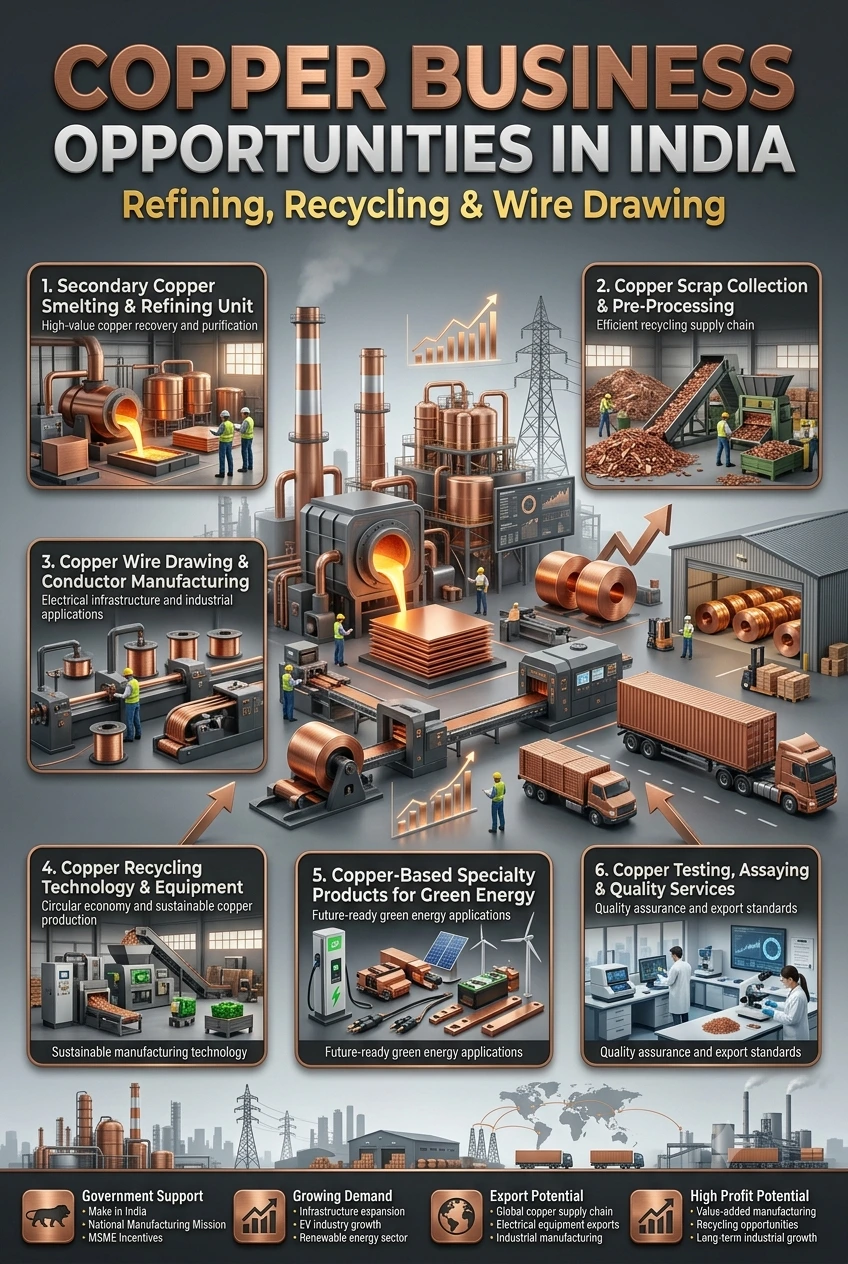
4. Copper Recycling Technology and Equipment
With the scale of copper recycling in India, a requirement for specialized shredding, granulating, and electrolytic refining machines is increasing. A capital-efficient way to participate in the copper boom without taking on commodity-price risk is to provide equipment to smaller recyclers.(Copper Business Opportunities)
Related Article: Copper Wire Recycling Plant Business in India: Investment ₹37 Lakh, Profit 20%, Complete Setup Guide
5. Copper-Based Specialty Products for Green Energy
Specialty products such as solar inverter busbar, copper bonded rods for earthing in wind farms, and flexible copper connectors for EV battery packs are premium products with higher prices. These are not commodity copper plays. They need precision engineering and compliance certification, which protect the margins of well-capitalised MSMEs.
6. Copper Testing, Assaying, and Quality Services
With the expansion of the copper supply chain in India, there will be a growing demand for independent testing including purity assay, conductivity testing, RoHS testing. A third-party testing and certification lab for copper traders, fabricators and electronics manufacturers is capable of creating a scalable, asset-light revenue stream. The opportunity for the government procurement through BIS alignment and NABL accreditation.
Import-Export Opportunity Analysis
The trade deficit of copper in India is a challenge and opportunity. The average price of refined copper imported into the country is USD 9,164 per tonne. Replacing one tonne of domestic refining capacity saves one tonne of foreign exchange, and makes the supply chain more resilient. Processed copper items such as wire rods, precision tubes and copper alloy parts have higher unit realisation for exporters as compared to raw cathode.(Copper Business Opportunities
In addition, markets in South East Asia, the Middle East and East Africa are also emerging as potential markets for the Indian copper products, due to the infrastructure development programs currently underway in these areas. The DGFT portal provides exporters with export licensing, duty drawback schemes, and advance authorisation facilities to help them manage their working capital and input cost recovery.
- Regional trade agreements provide low tariff access for copper wire and cable exports to SAARC countries.
- Solar farms offer high export opportunities for copper earthing products in markets with stricter ground resistance standards in Southeast Asia and Middle East.
- Recycled copper products are steadily becoming more compliant with the global sustainability procurement standards that is beneficial to Indian exporters who sell to European B2B buyers.
- India’s free trade agreements with UAE and potential FTAs with the European Union provide formal avenues to export value-added copper products.
Indian MSME Success Stories in the Copper Sector
Sterlite Industries → Lessons in Scale and Compliance
Sterlite Technologies (now independent from Vedanta’s copper business, after its closure in Tuticorin) emerged from the MSME fold to become a world-class fibre and copper conductor business. Its journey reflects two points – that copper processing in bulk is possible from Indian soil and that compliance to the environment is a no no. New players who have compliance built-in from the beginning do not face the risk of regulatory issues that hampered Sterlite’s main copper business.(Copper Business Opportunities)
KEI Industries — Wire Drawing to Nationwide Reach
Founded as a small wire drawing facility, KEI Industries has grown into one of the biggest cable companies in India catering to power transmission and distribution, railways and infrastructure developers. Its growth is exactly like what copper wire and conductor MSMEs are experiencing these days — a huge customer base availed by the government, and long-term pipelines for procurement.
Precision Wires India — Winding Wire Specialisation
There are very few narrow areas within the copper industry where Precision Wires India had been able to carve a niche and make it a profitable business for the company, but the one thing that made this a possible venture was the emphasis on quality consistency and catering to the needs of the OEMs for motor, transformer and generator industry.
Businesses can replicate this model in neighboring specialty areas such as EV motor windings, inverter-class winding wire, and high-frequency transformer conductors.(Copper Business Opportunities)
Discover business ideas that actually make money
How NPCS (Niir Project Consultancy Services) Can Help You Enter the Copper Sector
Businesses, MSMEs and industrial investors looking at the copper sector must be able to rely on accurate feasibility information to ensure a good investment and not a bad one. Niir Project Consultancy Services (NPCS) offers detailed project reports, techno-economic feasibility studies and market intelligence on copper processing, wire drawing, copper recycling, specialty copper product manufacturing, amongst others.
NPCS produces the following reports: plant layout, machinery procurement, raw material procurement, regulatory approvals, financial modelling (NPV, IRR, payback period), and market demand analysis. Entrepreneurs have been relying on NPCS feasibility reports for preparing Bank loan applications, investor decks, Government scheme applications, etc. as the foundation of their applications. It’s not a luxury in a sector like copper, where capital intensity is real and market timing is important. It is a requirement.
From secondary copper refining, to wire-drawing, to specialty copper product, NPCS can give you both the technical and financial foundation to go from interest to investment, confidently.
India Copper Market: Key Data Snapshot (FY25–FY30)
| Indicator | Figure / Detail |
| India copper demand FY25 | 1,878 KT (9.3% YoY growth) |
| India copper demand FY24 | 1,718 KT |
| Additional refining capacity needed (every 5 years) | 500,000 tonnes |
| New capacity from Hindustan Copper + Hindalco (near-term) | ~100,000 tonnes |
| Gap between new capacity and 5-year need | ~400,000 tonnes |
| Demand forecast by FY2030 (conventional sectors) | ~3.24 million tonnes |
| Building & construction sector growth (FY25) | 11% YoY |
| Infrastructure sector growth (FY25) | 17% YoY |
| Global copper demand projected by 2050 | ~50 million tonnes |
| Adani Kutch Copper plant capacity | 0.5 million tonnes (phase 1) |
| India’s average copper import price (2024) | USD 9,164/tonne |
Frequently Asked Questions (FAQs) for Founders and MSMEs
Q1. Is copper refining viable for MSMEs or only for large corporates?
It is possible to get into the secondary copper refining business from scratch on a smaller MSME level, and the costs could be anywhere between 5 crore and 25 crore to set up a working unit of secondary refining or a wire rod plant. Primary smelting of ore concentrate would need a higher amount of capital and would be appropriate for bigger groups. MSMEs should be encouraged to get into secondary manufacturing, fabrication, and specialty products.
Q2. What government licences and approvals are needed to start a copper processing unit?
Key approvals include Factory Act registration, PCB (Pollution Control Board) consent for manufacturing operations, GST registration, and — for export-oriented units — IEC (Import Export Code) from DGFT. Metal recycling and secondary refining units may also require hazardous waste handling authorisation under the Hazardous Waste Management Rules. Starting with compliance from day one avoids the regulatory disruptions that have affected larger players.
Q3. What is the typical payback period for a copper wire drawing unit?
Industry benchmarks show that a moderate-capacity (500–1000 TPA) copper wire drawing plant can achieve a payback period of 4 to 6 years under typical operating scenarios, provided copper input costs remain stable and the plant sells its output to electrical contractors, transformer manufacturers, and the cable industry. Margin protection by way of value addition in specialty gauges and meeting certifications ensures better return.
Q4. How does the ICA India 500,000-tonne demand figure affect pricing outlook for copper?
This scale of a structural supply gap of 500,000t per five years vs incremental capacity addition of 100,000t in the near term will necessitate a strong domestic premium over global benchmarks. Import parity price will provide the base-case floor. Domestic players who secure capacity before the supply gap widens will continue to enjoy strong premiums and off-take from infrastructure sector buyers seeking supply certainty.
Q5. Can a copper sector business access PLI scheme benefits?
Within the existing policy regime, copper refining is not an eligible stand-alone product under PLI. Though manufacturers of copper components used in PLI-eligible sectors (electronics, EVs, and renewables) may have preferential access through anchor-buyer arrangements. However, the CGTMSE scheme of the MSME Ministry remains the best funding route for smaller copper enterprises. SIDBI finance schemes also provide strong financial support.
Q6. Is there an export opportunity for Indian copper products right now?
Yes, Indian copper wire rods, earthing products, and specialty copper components are increasingly competitive in Southeast Asian and Middle Eastern markets. In Southeast Asia, processed and compliant certified Indian copper components earn higher returns than raw copper cathode exports. DGFTs advance authorisation enables concessional duty for import of copper inputs to copper component manufacturers with an exporter orientation.
Conclusion: The Copper Opportunity Window is Open — But Not Indefinitely
Economic Times’ coverage of ICA India’s structural demand alert is a rare moment of market transparency. Industry associations say India needs 500,000 tonnes of additional copper refining capacity every five years. However, current additions meet only 20% of that demand. This gap creates a major investment opportunity. Every entrepreneur, MSME owner, and industrial investor tracking India’s materials economy should bookmark The Economic Times report.
The timing is as strong as the opportunity itself. Infrastructure spending is at a historic high. Renewable energy installation is accelerating. EV adoption is inflecting upward. Consumer durables penetration is deepening into Tier 2 and Tier 3 cities. Every one of these trends is copper-intensive. The supply side is lagging — and that lag is where businesses are built.(Copper Business Opportunities)
Entrepreneurs who begin feasibility work now — engaging with Make in India frameworks, assessing MSME credit access through SIDBI schemes, and commissioning project reports for copper processing or specialty fabrication units — will be operational when the supply pinch tightens further. Those who wait for the market to become obvious will find it crowded and the economics compressed.
The copper gap is not a problem for India’s planners to solve alone. It is an opportunity for founders to fill — one refining unit, one recycling facility, one specialty product line at a time. The market has signalled. The policy framework is supportive. The question now is simply: who acts first?