

Floral Foam Manufacturing Business
Quick Reference: Market Intelligence Summary
Market Focus: Floral Foam (Wet & Dry) Manufacturing — India, 2023–2033
Global Market Projection: USD 9.44 Billion by 2033 at 5.36% CAGR; Asia-Pacific is the fastest-growing region with 800 million+ units consumed
India Demand Trigger: India conducts over 10 million weddings annually; floriculture market valued at INR 323.8 Billion; hospitality and retail florist demand growing at double-digit CAGR
Supply Concentration Risk: One organised domestic manufacturer (Smithers-Oasis India, Raigad). Residual Indian market demand is served by Chinese imports — China controls 83% of global floral foam export volume
Startup Entry Window: No second organised domestic player exists. A greenfield MSME unit of 500–2,000 MT annual capacity, costing ₹2.5–6 crore, directly targets the import-substitution opportunity with strong repeat-purchase demand
Key Government Schemes: CGTMSE (collateral-free loans up to ₹5 cr), PMEGP (up to ₹50 lakh subsidy), DPIIT Startup India, Make in India, Aatmanirbhar Bharat
Get Detailed Project Report (DPR): Floral Foam Manufacturing Plant Report
Executive Overview: The India Floral Foam Opportunity
In fact, floral foam is used in all flower arrangements that adorn Indian wedding mandap, five-star hotel lobby, a hospital reception counter or a florist’s window display, and you won’t even notice it. This specialised material is known as a porous and water-retentive phenol formaldehyde block and is the invisible lifeline of India’s multi-billion-dollar floriculture and events industry. Yet, despite the country’s massive and increasing needs for floral decoration, the local production of floral foam is extremely limited.
India is the second largest producer of flowers with floriculture accounting for more than 285,000 hectares and having a market value of INR 323.8 Billion, growing at a steady CAGR of 10.5%. Weddings account for more than 10 million florist decorations annually, the hospitality industry, corporate events, retail florists and a growing residential décor market are other major consumers of flower decoration. Floriculture exports grew from Rs. 0.25 crores in 2008 to Rs. 10.66 crores in 2010, according to the India Brand Equity Foundation (IBEF). 1,600 crores in FY21 to Rs. The total export in FY25 is 2,000 crores with fresh and dried cut flowers accounting for 72%.
The domestic production of the floral foam is confined in a single multinational manufacturing plant amidst this huge demand. So, India imports floral foam which makes up only 17% of the total volumes, and Chinese imports are filling this gap (inadequately, as well). The market size and growth, cultural stability, and lack of domestic supply, are the structural fault lines supporting the investment thesis.
This report also breaks down the India floral foam market by product segments (wet foam and dry foam), application segments (commercial and residential), geography (domestic demand and import export), competitive landscape (domestic players), and opportunity for the first-generation entrepreneurs and MSMEs in the manufacturing of phenolic foam.
Product Segmentation: Wet Foam and Dry Foam — Two Markets, One Opportunity
The Science and Commerce of Wet Floral Foam
Wet floral foam is the category that founded the world’s floral foam industry. Wet foam was commercially used for the first time in 1954 by Smithers-Oasis with the invention of water absorbing phenolic foam, which is designed to have one extremely reliable function: absorb water in large quantities and release it gradually to ensure adequate water supply to cut flower stems. The commercial viability of cut flowers with a quality wet foam block can be extended to 5-10 days after watering, which is equivalent to the whole event lifecycle without support.
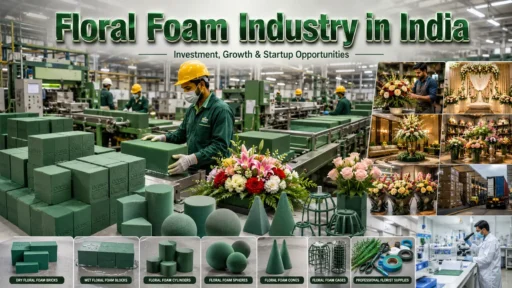
The manufacturing chemistry of a wet foam is the catalysed polymerisation of phenol and formaldehyde to create a network of phenolic resin. Surfactants are added to control the cell structure and water-retaining properties. This foam is a highly porous open cell foam that has interconnected cells with a capillary action to draw water and gives it off slowly through evaporation and direct stem uptake. The foam is produced in the standard brick size (23 x 11 x 8 cm is the international standard) but also in spheres, cones, cylinders, rings and custom 3D shapes for event decorating applications.(Floral Foam Manufacturing Business)
Wet foam is the major part of total floral foam use in India. The commercial florist and event decoration market, which includes the country’s 10 million-plus weddings each year, the hospitality market and the corporate events market, is the main buyer base. The product is non-re-use and disposable, so each new arrangement is a ‘repeat purchase’ – a new foam substrate is required.
Dry Floral Foam: India’s Growing Secondary Market
The product logic behind the use of dry floral foam – or dry floral foam brick or florist’s dry foam brick – is quite different. Unlike wet foam, which must be soaked before use, dry foam can be used as-received for the artificial flowers, silk flower arrangements, preserved and dried botanicals. It offers support with no water needs and it is lightweight and easy to cut, making it perfect for retail displays, home décor and gifting items.
India’s dry foam market has been a small portion of the wet foam market till now, as people prefer to use flowers in their ceremonies and artificial flower decorations are still relatively new in traditional settings. But, three macro changes are making the buying of dry foam more popular in India. First, the market for artificial flowers is becoming mainstream and is expanding at 8.6% CAGR to reach USD 185.9 million by 2020. Secondly, with the proliferation of internet flower delivery websites and retail florist chains, there is a need for more durable flower arrangements that don’t spoil. Third, the sustainability movement is creating an aesthetic for dried flowers that demands that the base substrate be dry foam.
Wet Foam vs Dry Foam: Comparative Market Positioning
| Parameter | Wet Foam | Dry Foam |
| Primary Use | Fresh/live flower arrangements | Artificial, silk, dried flower arrangements |
| Water Requirement | Must be soaked before use | Used dry, no water needed |
| Key Buyers | Professional florists, event decorators, hotels | Retail décor shops, home users, gifting brands |
| Market Share (India) | Dominant (~70–75%) | Growing (~25–30%) |
| Purchase Cycle | Per-event disposal — very high frequency | Longer life, moderate reuse |
| Growth Driver | Wedding & hospitality boom | Urban décor, artificial flowers, e-commerce |
| Price Sensitivity | Moderate (commercial buyers) | Higher (retail/residential buyers) |
| Manufacturing Process | Phenolic foam with water-retention additives | Phenolic foam without hydrophilic treatment |
Application Analysis: Commercial vs Residential — Where the Real Volumes Are
Commercial Segment: The Revenue Engine
The commercial segment is the major contributor of the volume and value of the floral foam industry. Commercial buyers include professional florists in standalone shops and boutiques in cities and tier-2 cities; event management companies working on weddings, corporate functions, product launches and social events; hotel chains, from luxury five-star to mid-market business hotels, which have regular floral programmes; banquet halls and marriage venues that need regular foam supply throughout the wedding season; funeral service providers in urban markets where floral arrangements are a standard practice; and floral decoration contractors, who supply to temples, religious institutions, and community event organisers.(Floral Foam Manufacturing Business)
The structural and practically perpetual demand base for the commercial segment is provided by the Indian wedding industry.The Indian wedding industry is the source of a structural and virtually permanent demand base. According to the India Brand Equity Foundation (IBEF), the Indian wedding services market will reach USD 103.93 billion in 2024 and grow at a CAGR of 14.3% until 2030. The per event floral budget has grown significantly since the beginning of the year, as the number of weddings per year has almost doubled and the cost of an average wedding has increased by 36% since the start of the COVID-19 pandemic. Industry surveys show that decoration expenditure, including floral, makes up about 14% of total wedding spend, and is a consistent and increasing draw on floral foam procurement.
Hotels and hospitality represent a complementary demand channel with distinct characteristics: unlike wedding-driven demand which is seasonal and spike-oriented, hotel floral programmes generate daily, year-round procurement. India’s hospitality sector has expanded rapidly post-COVID, with the hotel industry recording occupancy recovery and new property openings. Every new hotel property, resort, or convention centre that opens in India represents a new institutional floral foam buyer.
Get Detailed Insights from This Book: Our Books
Residential Segment: The Emerging Frontier
Historically, the size of the residential segment (individual consumers buying floral foam for their own home flower arrangements, interior décor projects, and personal gifting) was insignificant in the India market. Traditionally, floral arrangements were reserved for professional flowerists and not the home person. But several parallel developments are now creating this that is a commercially viable secondary market.
Thanks to the fast expansion of the online flower delivery industry, a new class of flower product consumers has emerged, people who regularly interact with flowers in a domestic setting. With the rise of Instagram and Pinterest, as well as an increase in the amount of home activities during the pandemic, the DIY home décor culture has made flower arranging a common pastime for city dwellers. The gifting industry, which is expanding faster than the trend rate, now includes floral foam-based product formats such as pre-arranged flower boxes and dried flower displays that businesses sell to consumers for personal use and gifting needs.(Floral Foam Manufacturing Business)
The availability of floral foam in supermarkets, craft stores, online marketplace (Amazon, Flipkart, Meesho) and garden centre is on the rise both because of increased demand and because it is fostering more awareness. With this retail distribution build out, a new consumer audience is getting exposed to floral foam.
Regional Analysis: Mapping India’s Floral Foam Demand Geography
Floral foam demand in India follows three key variables: the volume and scale of weddings and social events; the density and maturity of the professional floriculture and florist ecosystem; and the growth of hospitality and commercial event infrastructure across different regions. Each of India’s major regions presents a distinct demand profile.
| Region | Demand Profile | Key Demand Drivers | Supply Access |
| West India (Maharashtra, Gujarat) | Highest organised demand; best served | Large weddings, Mumbai hospitality, Smithers-Oasis plant in Raigad | Domestic supply + organised distribution |
| North India (UP, Delhi-NCR, Rajasthan, Punjab) | Largest volume market; underpenetrated | Highest wedding frequency; lavish décor culture; Rajasthan destination weddings | Primarily China imports + distributers |
| South India (Tamil Nadu, Karnataka, Telangana) | Strong floriculture base; dual demand | Bengaluru event industry; TN floriculture; growing hospitality clusters | Mixed: some domestic, significant imports |
| East India (West Bengal, Odisha, Bihar) | Underserved emerging market | Durga Puja floral demand; urban wedding growth; Kolkata retail florists | Almost entirely imports/unorganised |
| Central India (MP, Chhattisgarh, Jharkhand) | Low-penetration frontier market | Growing tier-2 city weddings; MP floriculture sector | Negligible organised supply; opportunity zone |
The North India market — encompassing Uttar Pradesh, Delhi-NCR, Rajasthan, Punjab, and Haryana — represents the single largest untapped opportunity zone for a new domestic floral foam manufacturer. Wedding volumes in this belt are the highest in the country, with large-format, multi-day celebrations that are among the most floral-decoration-intensive in the world. Yet this market is served almost entirely through import channels and informal distribution. A manufacturing unit established in Noida, Lucknow, or Jaipur industrial areas would command natural geographic and logistics advantage over both Chinese imports and the Maharashtra-based Smithers-Oasis facility.
COVID-19 Impact and Post-Pandemic Market Reset
The Pandemic’s Double Disruption
The COVID-19 pandemic affected the Indian floral foam market from both sides — demand declined sharply due to reduced purchases, while supply chains faced major disruptions. On the other hand, the Government of India’s ban on social functionings has effectively put India’s wedding and events calendar on hold for most of the past 2 years. Authorities banned large gatherings, such as corporate events, public gatherings, and hotel banquets. They also restricted weddings to 20–50 people, depending on state requirements. The demand of the commercial florist segment — which accounted for the highest proportion of floral foam use — dropped near completely.(Floral Foam Manufacturing Business)
On the other hand, during early 2020, the disruptions in Chinese manufacturing and logistics operations led to the immediate scarcity of floral foam imports in the Indian markets. The congestion of ports, shortage of shipping containers and the extraordinary surge in freight rates further complicated the picture for Indian importers. The rising cost of importing foam from China and unreliable deliveries would normally motivate local production, but the damaged demand situation also prevented manufacturers from expanding locally.
The Extraordinary Recovery
The events and floriculture market is one of the most interesting demand recovery periods it has seen after the easing of the pandemic. A huge deferred marriage queue coupled with an unprecedented surge in the desire to celebrate and return to normals led to a surge of high-value marriage events that happened in the backdrop of the economy recovering from the pandemic and the middle class in the urban India’s aspirations for marriage.
The statistics back it up. In 2020, the India wedding services market reached a value of USD 18.58 billion during the pandemic low, and experts project it will grow to USD 32.98 billion by the end of 2025, more than doubling its value since the pandemic began. The average expenses of weddings increased from INR 20 lakhs before the pandemic to INR 28.5 lakhs and the number of average functions increased from 3.2 to 4.2 per wedding. The amount of money spent on floral decorations increased slightly, and floral arrangements became a hallmark of the celebration style after the pandemic.(Floral Foam Manufacturing Business)
In the case of floral foam, the recovery amounted to significant demand increases over pre-COVID levels, but domestic production capacity had not increased to match. The structural supply gap that existed long before the pandemic widened during the disruption years because companies reduced new investments, creating a larger mismatch between demand and supply during the recovery years.
Structural Changes the Pandemic Accelerated
The COVID-19 period also saw a few structural changes in the Indian floral foam market, which will have long-term implications for entrepreneurs and investors:
- Permanent demand was seen as a positive for the residential décor and online flower delivery lines as home aesthetics became important during the lockdowns.
- Procurement manager awareness of supply chain risks increased significantly, leading to a commercial benefit for the reliability of domestic supply as against Chinese imports.
- The eco-friendly wedding trend — weddings with a lower impact, less waste — was on the rise, and this will be an opportunity for the future for biodegradable foam alternatives.
- Digital discovery of floral foam products (Amazon, Flipkart, B2B platforms) grew and it has become simpler for new manufacturers to establish distribution channels without relying on traditional trade channels.
Import–Export Trade Analysis: India’s Paradoxical Position
India as Global Exporter — Through One Company
The Indian floral foam market is paradoxical. In export shipment volume, India’s Smithers-Oasis India Pvt. Ltd. is the single largest exporter of floral foam in the world, surpassing Malaysia, Latin America and China, in the number of export shipments to global destinations, recorded. The facility at Taloja MIDC, Raigad serves as strategic link between the company and its clients in the United States, Russia and the Philippines.
This export achievement, however, is a result of the export strategy of the parent company and not on the service delivered to the domestic market. Smithers-Oasis mainly directs its production in India towards its international subsidiaries and distributors, while it considers India’s domestic market a secondary commercial objective. The Taloja plant is actually an international manufacturing plant, albeit in India and not specifically for India.(Floral Foam Manufacturing Business)
Your investment deserves the right opportunity
India as Import-Dependent on China for Mid-Market Supply
The bulk of India’s florists and event decorators (by number) — the domestic mid-market and mass-market segments — procure their foams from imported sources, mostly from China. China has 83% of the world’s export volume of floral foam and the trading intermediaries who sell floral foam to buyer segments in tier-2 and tier-3 Indian cities prefer Chinese foam over any other due to its affordability to the price-sensitive buyers.
Per data from the Agricultural and Processed Food Products Export Development Authority (APEDA) and the Ministry of Commerce & Industry, India’s import bill for specialty chemical foam products — including phenolic foam variants — reflects a consistent outflow of foreign exchange that could be captured by domestic manufacturing. The currency risk embedded in this import dependency (INR/USD fluctuations directly affect landed cost of Chinese foam), combined with the supply chain concentration risk demonstrated during COVID-19, creates a clear commercial argument for domestic production.
Export Opportunity for New Domestic Manufacturers
For new Indian manufacturers looking to break into the floral foam market, the Middle East, Southeast Asia and some parts of Europe are ready markets that are actively seeking alternatives to Chinese products. India’s actual manufacturing capabilities in this category (as evidenced by its global export performance through Smithers-Oasis) coupled with the low labour cost and availability of raw materials such as petrochemicals provides a strong export position for domestic manufacturers. The key enablers will be ensuring the packaging is of ISO quality standards, having the right BIS packaging certification and creating export ready packaging.
Demand–Supply Gap Assessment: Quantifying the Manufacturing Opportunity
A detailed study of the demand-supply dynamics of floral foam market in India is an eye opener of a structurally significant shortfall that is both significant and persistent from a commercial perspective. This imbalance will not correct itself; the lack of organised domestic competition has caused this structural issue in the market.(Floral Foam Manufacturing Business)
Demand Estimation Framework
The bottom-up approach can be used to estimate the consumption of floral foam in India, across the key application categories. The base consumption of foam bricks is already in the order of several hundred million per year with the wedding segment, with 10 million+ weddings per year consuming each wedding multiple foam blocks for décor applications. When she adds to that the hotel and hospitality channel, the retail florist network, corporate event decoration, religious and institutional decoration and the emerging residential segment, the tonnages addressed domestically are quite substantial, and far greater than the capacity of the single domestic florist manufacturer.
More than 800 million foam units were consumed in Asia-Pacific, combined — including India — in a recent year. If we estimate India’s domestic consumption conservatively at 1.5–2% of the Asia-Pacific total, we can expect it to exceed 12–16 million units per annum. This corresponds to the weight of several thousand metric tonnes of product at standard brick weight.
Supply Gap Quantification
| Supply Component | Status | Market Share Est. |
| Smithers-Oasis India (Raigad) | Active — premium tier | ~30–35% of organised market |
| Other domestic manufacturers | None identified as organised | ~0% |
| Chinese imports (mid-market) | Active — dominant in tier-2/3 | ~45–55% of actual consumption |
| Other imports (SE Asia, Malaysia) | Minor presence | ~5–10% |
| Unmet / informal demand | Significant residual gap | ~10–15% of potential market |
Investment Thesis: The supply gap analysis supports a clear investment thesis: a new MSME manufacturer targeting 750–1,500 MT annual capacity can capture a defined slice of import-displaced demand with immediate commercial traction, without needing to compete directly with Smithers-Oasis India’s premium brand positioning. The addressable market for a mid-tier domestic supplier — priced competitively vs Chinese imports with service advantages of domestic supply — is commercially viable and financeable under Ministry of MSME support schemes.
Competitive Landscape: India’s Organised Floral Foam Players
Smithers-Oasis India Pvt. Ltd. — The Sole Organised Manufacturer
Smithers-Oasis India Pvt. Ltd., located at Plot 10, MIDC Industrial Area, Taloja, Raigad, Maharashtra, is India’s largest organised domestic manufacturer of Floral Foam. The Taloja manufacturing plant produces the full Smithers-Oasis Company (USA) OASIS® product line of Premium, Nova, Ideal and customised designer shapes such as alphabets, 3D shapes and specialty sizes for event decoration. The parent company operates in 122 countries with manufacturing facilities in 22 countries around the world to provide the most advanced phenolic foam technology in the world to the Indian manufacturing environment.
Smithers-Oasis India exports to the United States, Russia and Philippines and is — according to export shipment data — the biggest floral foam exporter in the world. The Indian market prices it high under its OASIS® brand, and luxury wedding decorators, 5-star hotels, and professional florist chains prefer it. But high-end positioning and export demand have created a significant gap in the mid-market, and this is where the startup opportunity lies.(Floral Foam Manufacturing Business)
Ashish Brass Collections and Raika Stores — Distributor-Tier Players
In addition to Smithers-Oasis India, there are a handful of other active players in India’s floral foam export data, namely Ashish Brass Collections (2% export share) and Raika Stores (1% export share). The following are distributor-type companies that sell floral foam in addition to other items such as floral accessories and supplies, not phenolic foam manufacturers. Their presence is an indicator of ongoing commercial activity but is not a sign of organised manufacturing competition for a new entry.
The Unorganised Import Channel
What will be the biggest challenge that a new domestic manufacturer will face is not another Indian manufacturer, it is the existing network of traders who import foam from China and sell it at wholesale prices in Mumbai, Delhi, Surat, and Chennai. These traders are buying and selling with low margins, buy in large quantities and selling based on price. Competing against this channel involves not only cost parity, but also services – lead time, local presence, quality documentation, and intangible value of a local supplier with no currency risk.(Floral Foam Manufacturing Business)
Related Article: How to Start a Floral Foam Manufacturing Business: Smart Business Ideas for Ambitious Entrepreneurs
Manufacturing Feasibility: Raw Materials, Process, and Plant Economics
Key Raw Materials
Well established raw materials used for producing phenolic floral foam are available in the well-established petrochemical supply chain in India:
- Phenol is available domestically from Hindustan Organic Chemicals and is imported. One of the basic components of phenol formaldehyde resin.
- Formaldehyde (37% solution / Formalin): Available in wide range from chemical industries in India. Should be treated with suitable HSE measures.
- Surfactants: regulate the structure of foam cells and water retention properties. Can be supplied by specialty chemical suppliers.
- Blowing Agents: These are used to generate the foam structure in the polymerisation process. A variety of models offered by specialty importers.
- As a polymerisation catalyst, they start and control the polymerisation reaction (acid catalyst). Standard industrial chemicals.
- Colourants / Dyes: Wet foam – the standard dark green colour; Dry foam – white/grey. Water-based dyes available domestically.
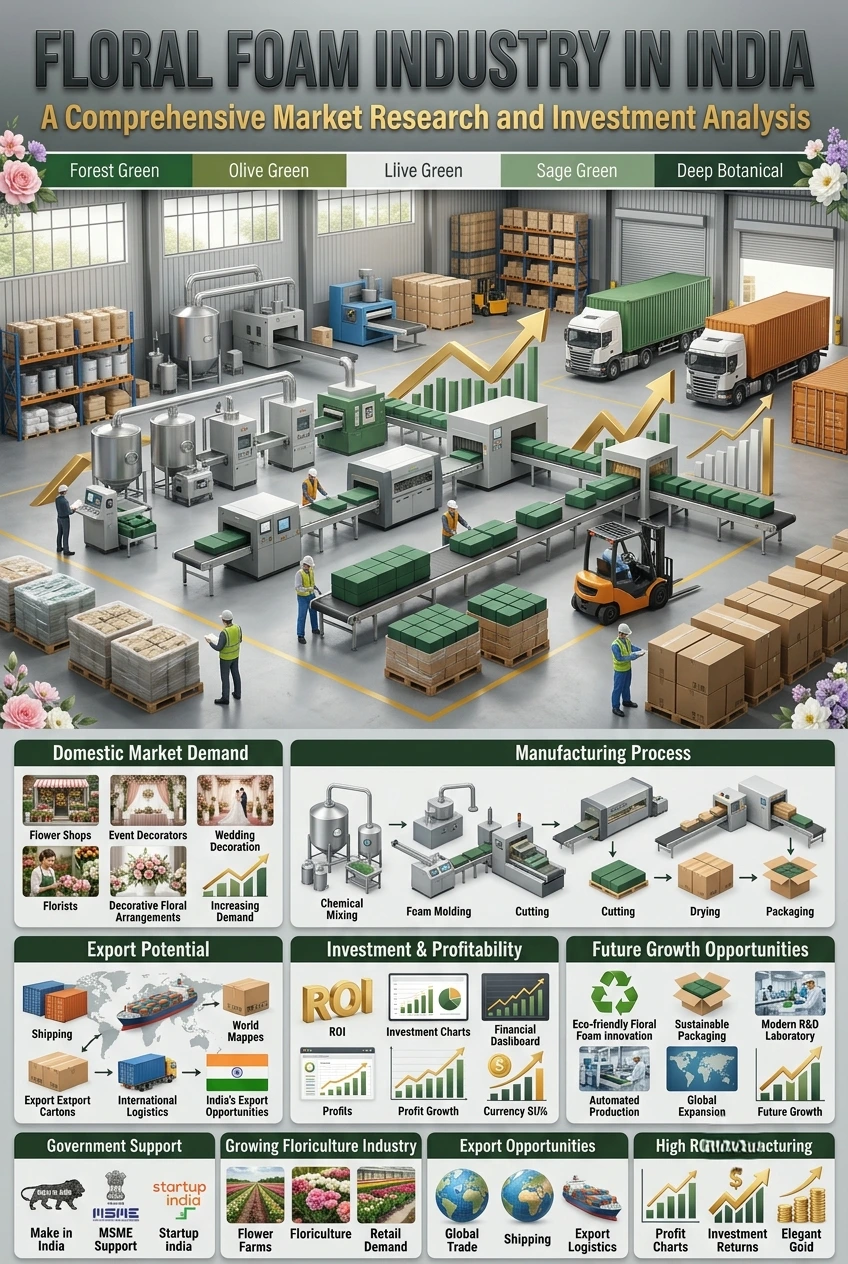
Manufacturing Process Summary
| Stage | Process Description | Key Equipment |
| 1. Resin Preparation | Phenol and formaldehyde reacted under controlled temp and catalyst in a reactor vessel to form phenolic resin | Jacketed reactor with agitator, temperature control system |
| 2. Foam Compound Mixing | Resin blended with surfactants, blowing agent, and colourant under controlled conditions | High-shear mixing vessel, dosing pumps |
| 3. Foaming & Moulding | Mixture poured into mould trays; exothermic reaction causes foam expansion to fill mould shape | Foam mould trays, pouring station, ventilation system |
| 4. Curing | Foamed blocks cured at controlled temperature to achieve target density, cell structure, and water retention | Curing oven or curing room with temperature control |
| 5. Cutting & Shaping | Cured blocks cut to standard brick dimensions or custom shapes using mechanical or automated cutting equipment | Band saws, hot-wire cutters, CNC cutting machines (premium) |
| 6. QC Testing | Water absorption, density, compression strength, and pH tested per quality protocol | Laboratory: balance, absorption test rig, compression tester |
| 7. Packaging | Finished bricks wrapped in plastic film or packed in cartons for distribution | Flow wrap machine, carton erector, labelling equipment |
Project Economics at a Glance
| Parameter | Small Scale (500 MT/yr) | Medium Scale (1,500 MT/yr) |
| Land Required | 0.5 Acre | 1–1.5 Acres |
| Plant & Machinery | ₹1.5 – ₹2 Crore | ₹3 – ₹4.5 Crore |
| Civil & Utilities | ₹30 – ₹50 Lakh | ₹60 Lakh – ₹1 Crore |
| Working Capital | ₹40 – ₹60 Lakh | ₹70 – ₹100 Lakh |
| Total Project Cost | ₹2.5 – ₹3.5 Crore | ₹4.5 – ₹6.5 Crore |
| Revenue Potential (est.) | ₹3 – ₹5 Crore/yr | ₹9 – ₹14 Crore/yr |
| Estimated Payback Period | 4 – 5 Years | 3.5 – 5 Years |
| CGTMSE Eligibility | Yes (up to ₹5 Cr collateral-free) | Partial (above ₹5 Cr requires collateral) |
Government Policy Environment: A Tailwind for Domestic Floral Foam Producers
Entrepreneurs looking forward to entering the floral foam manufacturing business can benefit from the supportive environment that both central and state governments provide. Multiple cross-cutting policy mechanisms can directly support a new phenolic foam business.
Floriculture as a Sunrise Industry
Invest India reports that the Government of India has officially recognized floriculture as a sunrise industry and given it 100% export orientation unit status. This designation indicates the policy intent to develop the floriculture value chain in India, encompassing processing, packaging and ancillary inputs such as floral foam with institutional support and infrastructure development. With the active promotion and facilitation from the National Horticulture Mission and APEDA, the export clusters of flowers directly boost the downstream market for local produced floral foams.(Floral Foam Manufacturing Business
MSME Financing and Support Schemes
The Ministry of MSME’s CGTMSE scheme provides collateral-free credit guarantees to banks extending loans up to ₹5 crore to micro and small enterprises — directly addressing the financing barrier for first-generation entrepreneurs without fixed assets. Under PMEGP, manufacturing projects can receive project cost funding up to ₹50 lakhs with 15–35% subsidy (higher for SC/ST, women, and NER applicants). Ministry of MSME launched Udyam Registration portal. Through the portal, the MSMEs can get formal registration and enjoy benefits like Priority Sector Lending, Interest rate subsidies, Government procurement preference.
Make in India and Import Substitution
The Make in India initiative has moved to its second phase with a list of 27 sectors like chemicals and specialty polymers. This generates policy support and institutional awareness for local foam manufacturers. This, combined with the Aatmanirbhar Bharat policy push, which aims to cut import dependency (especially from China), is an easy narrative and policy to take up with state industrial development corporations to obtain land and infrastructure for local foam players.(Floral Foam Manufacturing Business
Startup India Recognition
This program from DPIIT provides a comprehensive suite of benefits such as income tax exemptions for 3 years under section 80-IAC for DPIIT-recognized startups, self-certification compliances under 6 labor laws and 3 environmental laws, and quick patent examinations with 80% rebate on filing fee. A first-generation entrepreneur who plans to set up a floral foam manufacturing plant and register it as a startup can significantly reduce regulatory and tax-related friction during the early years of operation.
Niir Project Consultancy Services (NPCS): Your Project Partner
For entrepreneurs, investors, and MSME operators evaluating the floral foam manufacturing opportunity, Niir Project Consultancy Services (NPCS) provides the industrial intelligence and financial modelling needed to convert market interest into a bankable project.
NPCS has prepared Market Survey cum Detailed Techno-Economic Feasibility Reports (DPRs) for floral foam (phenolic foam) manufacturing projects, covering the full spectrum of pre-investment analysis requirements. Entrepreneurs use our reports to secure bank financing, negotiate with equipment suppliers, engage state industrial authorities, and make informed decisions about capacity and product mix.(Floral Foam Manufacturing Business)
NPCS DPR Contents — Floral Foam Manufacturing
- Market survey: India floral foam market sizing, historical demand trends, import-export analysis, competitive landscape assessment
- Manufacturing process: step-by-step phenolic foam production technology with process flow diagrams (PFD/BFD) and material balance
- Raw material sourcing: domestic and import sources for phenol, formaldehyde, surfactants, blowing agents, and catalysts; pricing benchmarks
- Plant and machinery: equipment list with specifications, Indian and international suppliers, installation and commissioning requirements
- Infrastructure requirements: land, civil works, utilities, effluent treatment, safety systems
- Manpower plan: skilled and unskilled workforce requirements, salary structure, training needs
- Financial projections: capital cost, revenue model, gross margin analysis, break-even at capacity, IRR, NPV, payback period, sensitivity analysis
- Regulatory compliance: BIS, pollution control, factory act, FSSAI (if food-grade foam), GST classification guidance
To commission a customised floral foam DPR or to discuss your project parameters, visit www.niir.org or contact the NPCS consulting team directly.
Frequently Asked Questions (FAQ)
Q1. Why is floral foam consumption in India expected to grow faster than the global average?
India’s floral foam market is growing because of a unique combination of structural factors that mature markets lack: a rapidly expanding wedding industry (currently valued at USD 104 billion and growing at a 14.3% CAGR), a floriculture sector increasing by 10.5% annually, urbanisation boosting hospitality infrastructure, and a growing residential décor market. “Those established markets, such as North America and Europe, face a slower pace of growth given that they already have very high floral foam penetration per capita. India is still very early to mid-stage in adoption, resulting in a much higher inherent growth rate.
Q2. What makes phenolic foam the preferred material for floral foam vs alternatives?
Phenol-formaldehyde (phenolic) foam: Phenolic foam meets the unique demands of professional floristry because of its exceptional properties. It retains water more than 40 times its own weight, provides strong stem support, maintains its shape without swelling in water, and allows florists to cut and shape it into various forms without crumbling. Once saturated, it keeps flowers hydrated for 5 to 10 days. While researchers have developed and tested alternatives like polyurethane foam, these materials cannot match phenolic foam’s water-holding capacit. Newer bio and eco-friendly options exist but are more costly.
Q3. What is the minimum viable investment for a floral foam manufacturing unit in India?
It is possible to set up a minimum viable unit of producing 500 MT/year within an investment of around 2.5-3.5 crore, inclusive of cost of land (leased/bought in MIDC/industrial zone), plant and machinery, civil construction works, working capital, and pre-operative expenses. Units of this scale can be availingCGTMSE’s collateral-free finance up to 5 crores, and also the PMEGP manufacturing subsidy up to 50 lakhs. NPCS can prepare a tailor-made financial modeling for any specific capacity at any desired location.
Q4. How does a new manufacturer compete with Chinese imports on price?
A domestic manufacturer can compete on total cost of ownership rather than just product price. Chinese foam carries additional costs: import duties (applied to phenolic foam imports), shipping freight, port handling charges, insurance, currency conversion costs, and a 4–8-week lead time that requires importers to maintain higher safety stock. A domestic manufacturer that offers 1–2 week delivery times, avoids currency exposure, maintains a solid quality dossier, and accommodates smaller MOQs can match Chinese landed costs or charge a slight premium while still delivering better value.
Q5. Are there any environmental compliance requirements for floral foam manufacturing?
Phenol and formaldehyde are the primary raw materials used in phenolic foam manufacturing. Their usage requires proper environmental management practices. The industry must obtain Consent to Establish and Consent to Operate from the State Pollution Control Board. It may fall under the red or orange category based on the scale of operation. Industries must properly treat wash water and process effluents before disposal. Since phenol and formaldehyde are hazardous substances, they require safe handling and storage as per the Environment Protection Act and Hazardous Waste Management Rules.
Q6. What export markets are realistic for a new Indian floral foam manufacturer?
The most immediate export markets for Indian suppliers are likely to be the Middle East, including the UAE, Saudi Arabia, and Kuwait, due to their growing wedding and hospitality sectors and existing sourcing links with India. South East Asian markets such as Indonesia, Vietnam, and Thailand also offer potential, with developing floriculture and event sectors but strong price sensitivity due to Chinese competition. East African countries like Kenya and Ethiopia are emerging markets with increasing hospitality investments. Europe could be a premium opportunity for suppliers that meet EU standards and certification requirements while offering an alternative to Chinese sourcing.
Q7. How does NPCS support entrepreneurs in the floral foam manufacturing sector?
NPCS also prepare elaborate Market Survey cum Techno-Economic Feasibility Report (DPRs) such as market size estimation, manufacturing technology, raw material planning, plant and machinery requirements, legal aspects, as well as financial requirements etc., to the banks, state industrial bodies, new entrepreneurs to raise finances, as well as in making investment decisions. NPCS also provides individual project consulting for customised capacity, location, and product mix parameters.
Q8. Is biodegradable floral foam a near-term threat to the conventional phenolic foam market in India?
Not in the near term. Biodegradable floral foam — such as Smithers-Oasis’s OASIS® Renewal™ launched in 2025 — is a premium product targeting sustainability-certified commercial buyers in Europe and high-end hospitality in North America. In India, the price sensitivity of the dominant mid-market buyer segment and the limited regulatory or consumer pressure on foam biodegradability means that conventional phenolic foam will remain the commercial mainstream through at least 2028–2030. Biodegradable foam represents a medium-term strategic opportunity for entrepreneurs who can position for the eco-premium segment — but it is not a substitute for the near-term phenolic foam market opportunity.(Floral Foam Manufacturing Business)
References and Authoritative Citations
This article draws on data and analysis from the following authoritative sources:
- India Brand Equity Foundation (IBEF) — Floriculture Sector Export & Rural Prosperity Case Study: https://www.ibef.org/research/case-study/india-s-floriculture-sector-blooming-with-export-potential-and-rural-prosperity
- IBEF — Economic Impact of India’s Wedding Industry (CAIT Data & Market Analysis): https://www.ibef.org/blogs/examining-the-economic-impact-of-india-s-wedding-industry
- Invest India (Government of India) — Indian Floriculture: The Sunrise Sector: https://www.investindia.gov.in/blogs/indian-floriculture-sunrise-sector
- APEDA — Agricultural & Processed Food Products Export Development Authority (Floriculture Export Statistics): https://apeda.gov.in
- Ministry of MSME, Government of India — MSME Schemes: CGTMSE, PMEGP, Udyam Registration: https://msme.gov.in
- Press Information Bureau, Government of India — Make in India Initiative & Startup India Programme Details: https://www.pib.gov.in/Pressreleaseshare.aspx?PRID=1738170