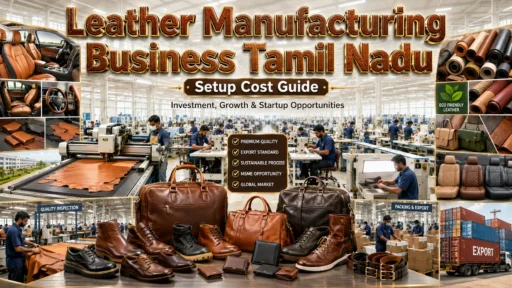


Leather Manufacturing Business Tamil Nadu: Export Opportunity Guide
Tamil Nadu tans and processes the maximum leather followed by Vellore, Ambur and Ranipet, which together contributes huge amount of leather export shipment to India. That concentration is due to decades of tannery infrastructure, experience and relationships with buyer brands from Europe and North America in the footwear and accessory sector, which a new entrant can’t catch up on easily but can access directly. Leather industries that are established by the Tamil Nadu entrepreneurs today do not have to invest in building tanning facilities, as the common effluent treatment plants and finished leather supply chain already exist in the state. The opportunity is further down the line in finished footwear, leather goods and component manufacturing for brands that are actively looking to source from a second or third qualified India source as they look to diversify away from China.
Why Tamil Nadu’s Leather Cluster Is a Genuine Opening
Begin by diversifying your buying. The footwear and leather industry has been diversifying sourcing from China over the last few years and Tamil Nadu’s existing export infrastructure, quality certification experience and managerial skills make it a natural destination for the diversification. The opening is for capacity and not buyers. The Ambur-Vanampadi-Ranipet belt is already exporting to known customers in Europe and America. A large part of this cluster is located in estates that have been created by the State Industries Promotion Corporation of Tamil Nadu, the state’s industrial infrastructure body.
This trend is supported by the Government. The industrial policy of Tamil Nadu provides for paying capital subsidy to the leather and footwear units under the MSME promotion scheme, in addition to the central schemes of the Ministry of Micro, Small and Medium Enterprises that specifically target the leather and footwear sector as it is labour-intensive and export-oriented.
Finished footwear or leather goods manufacturing startup entry capex begins around six to ten crore rupees, for a mid-scale operation with two hundred to three hundred workers, and slightly more for component manufacturing for automotive/industrial leather applications, due to strict specification requirements. It generally takes 6 to 10 months to secure a license from the Tamil Nadu Pollution Control Board (TNPCB) for the existing tannery clusters for operation and for their units to join that cluster, provided the effluent treatment is shared. The Federation of Indian Chambers of Commerce and Industry provides cluster level output and export data as a helping hand in finalizing a capacity plan.
Get Detailed Insights from This Book: Leather Processing & Tanning Technology Handbook
Business Selection Logic
The leather industry offers a wide range of possible margin structures, and these depend largely on how well a unit integrates into the overall value chain. Established players in the raw tanning/finished leather supply market control the eight to twelve per cent share. A branded export buyer pays for brand quality certification and design ability, however, and finished footwear and leather goods are eighteen to twenty-five percent.
Scalability is usually buyer-relationship-based and not a straight ramp up in production. When a founder begins with a single order of export from one brand, they typically start with a few orders and perform well in terms of quality and delivery time through a number of production cycles, and they then increase their capacity when that buyer agrees to a longer-term sourcing agreement.
Risk focuses on raw material price fluctuations because finished leather prices reflect domestic (hide availability) and international (leather commodity cycles) market price movements and on buyer concentration if a new unit relies on one or two export orders for much of its initial revenues.
Product and Project Opportunities Worth Evaluating
Export-Grade Leather Footwear
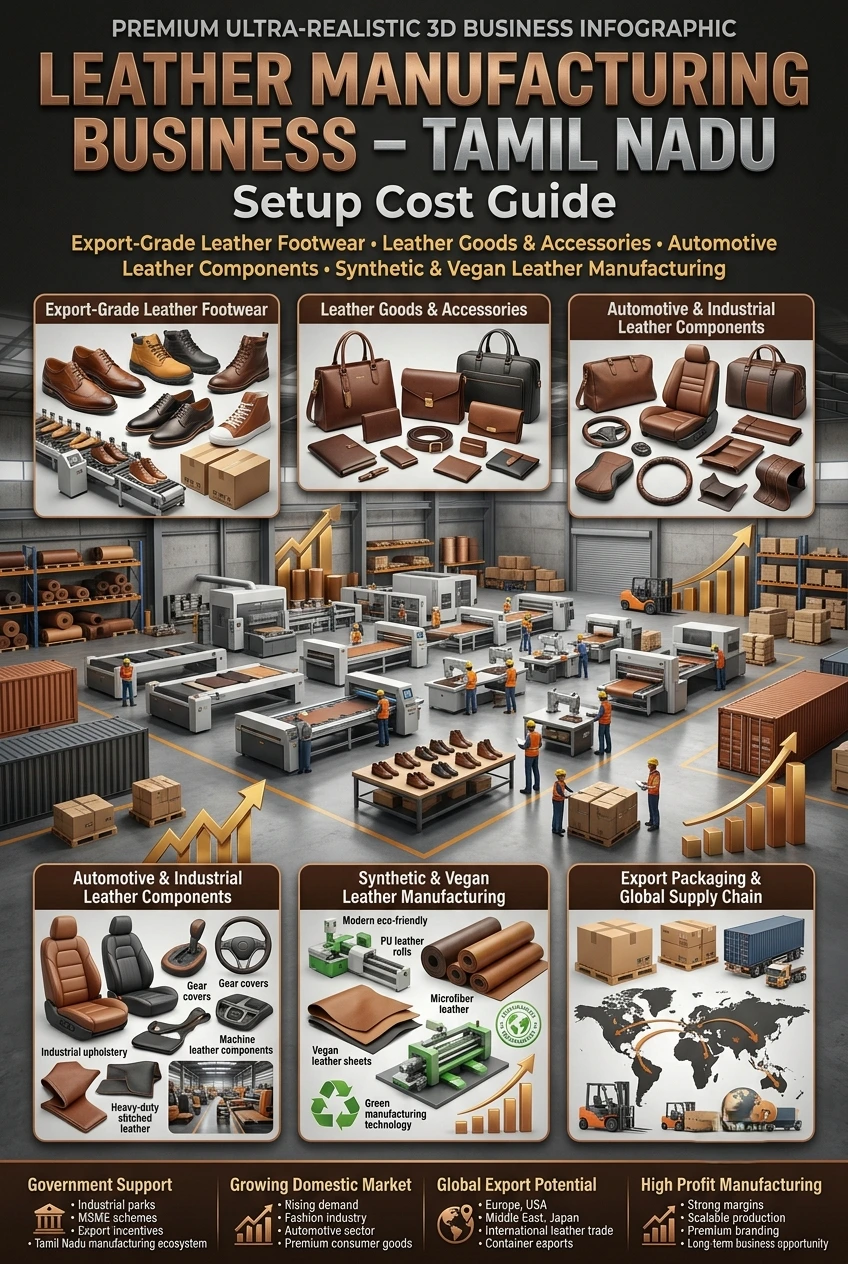
Leather footwear for European and North American companies remains the biggest business opportunity in the leather cluster in Tamil Nadu and the diversification of buyers from China has truly created an opportunity for new leather businesses to gain orders. A mid-scale unit with capex of Rs. 7 to 10 crores address footwear brands in the direct sourcing via buying agents in Chennai. Once the company completes quality certifications, it follows standards that include sample approval and factory audits. The process takes six to nine months and helps achieve margins of twenty to twenty-six percent, but it represents the first meaningful order.
Leather Goods and Accessories (Bags, Belts, Wallets)
The leather goods industry, including manufacturing of bags, belts and other small leather goods, requires less specialized machinery than footwear, so it offers an easier way for a manufacturer who lacks experience in leather production to enter the business. Capex has a mid-scale unit with a cost of Rs 4 to 7 crore, which caters to both foreign buyers and the ever-expanding branded leather goods market in India. The margins are between eighteen and twenty-four per cent, and the domestic market provides a cushion of demand that the footwear manufacturing industry in a purulent export business does not enjoy when demand slows down in the global market.
Turn your budget into a successful business plan
Automotive and Industrial Leather Components
In addition to export buyers, leather seat covers, upholstery parts and industrial leather parts meet the demand of the Tamil Nadu based automotive manufacturing base, thereby providing two demand channels within the state. A specific team of dedicated people with 10 crore rupees of capex directly targeting auto OEMs and Tier-1 suppliers. The margins are between 20 to 28 percent, depending on the specification requirements and captive contracts of automotive supplies after quality qualification.
Synthetic and Vegan Leather Manufacturing
The category of true alternatives to leather has increased over the years, particularly synthetic and plant-based leather, which have won the allegiance of cost-conscious buyers and brands that make a sustainability claim. The unit — which will cost five to eight crore rupees — will focus on fashion and accessory brands as well as automotive interior buyers looking for cheaper options to leather. The margins are about 22% to 28%, as the product is relatively new in India, it will have significantly less domestic competition as compared to the regular leather manufacturing.
Indian Entrepreneurs Who Built This
Starting with a single Ambur tannery, Rafeeque Ahmed has grown Farida Group into one of the biggest integrated leather and footwear exporting units in India, moving ahead from raw tanning to leather manufacturing of finished footwear with a view to garner higher value than tanning alone. The early rather than purely a tanning supplier to other exporters, it’s that backward-to-forward integration lesson that is worth studying.
The broader Ambur-Vaniyambadi cluster itself illustrates a different lesson: decades of shared infrastructure investment, including common effluent treatment plants that individual small units could never afford alone, created an industrial base that lowered entry barriers for hundreds of smaller manufacturers who followed the early movers. A founder entering Tamil Nadu’s leather sector today benefits directly from that shared infrastructure the cluster’s original builders funded collectively, which remains one of the more instructive examples of cluster-based industrial development anywhere in Indian manufacturing.
Get Detailed Project Report (DPR): Comprehensive Guide to Leather Tanning and Leather Products
Import-Export Opportunity Analysis
Tamil Nadu already exports a substantial share of India’s leather and footwear output, but domestic demand for branded leather goods has grown steadily as well, creating a dual-channel opportunity most export-focused units underexploit. Meanwhile, India as a whole still imports certain specialty tanning chemicals and finishing agents from Europe, an adjacent opportunity for a founder with chemical processing capability.
For a new entrant, the clearest opening is capturing export orders that global brands are actively redirecting away from Chinese suppliers. Chennai’s port access and the Ambur cluster’s established buying-agent relationships mean a new manufacturer does not need to build export market access from scratch. Export registration and shipment documentation run through the Directorate General of Foreign Trade, and a founder needs to qualify quickly enough to capture orders brands are already looking to place with a diversified Indian supplier base.
Government Reference and Feasibility Planning
Utility and processing chemical inputs for leather finishing connect back to India’s broader petrochemical base more than most founders realize, since several tanning and finishing chemicals derive from petroleum-based feedstock. The Annual Report 2024-25 of Ministry of Petroleum and Natural Gas, Government of India — accessible at mopng.gov.in — documents the scale of domestic refining and petrochemical capacity that keeps these processing chemical inputs available without full import dependency, a connection worth tracing even in a labour-intensive sector like leather manufacturing.
Founders serious about entering this cluster typically commission a Market Survey cum Detailed Techno-Economic Feasibility Report before finalizing machinery and buyer strategy. Niir Project Consultancy Services prepares these specifically for entrepreneurs entering industrial and export-oriented manufacturing, covering process flow, machinery and raw material specification, capacity planning, and full project financials — replacing assumption with a number a buyer or a bank can actually evaluate. The Confederation of Indian Industry and Invest India both publish sector notes on leather manufacturing worth cross-referencing before finalizing a project report.
Conclusion
A leather manufacturing business Tamil Nadu entrepreneurs build today enters a cluster with decades of infrastructure already in place, which cuts both capex and timeline risk considerably compared to building a leather manufacturing base anywhere else in India from scratch.
The decision hierarchy is straightforward. Locate within or near the Ambur-Vaniyambadi-Ranipet belt to access shared effluent treatment and an established skilled labour pool rather than attempting a standalone site elsewhere. Choose finished footwear or leather goods over raw tanning wherever capital allows, since the margin difference between the two runs ten percentage points or more. Budget six to nine months for buyer qualification as a fixed part of the timeline, because brands do not speed up their approval processes even when factories are built quickly.
Global buyer diversification away from China has created a genuine window for Tamil Nadu’s leather cluster to add capacity, and that window will not stay fully open indefinitely as other manufacturing hubs compete for the same diversified sourcing. For a founder who can move on buyer qualification with real production discipline, a leather manufacturing business Tamil Nadu offers one of India’s most established, lowest-friction manufacturing entry points today.
Related Article: Leather Goods Manufacturing Business
Capex vs Margin Overview by Product
Source: Industry estimates; NPCS sector analysis
| Product | Capex Range | Gross Margin | Target Buyer |
| Export-Grade Leather Footwear | ₹7-10 Cr | 20-26% | European/North American footwear brands |
| Leather Goods & Accessories | ₹4-7 Cr | 18-24% | Export buyers + domestic branded market |
| Automotive Leather Components | ₹6-9 Cr | 20-28% | Auto OEMs & Tier-1 suppliers |
| Synthetic/Vegan Leather | ₹5-8 Cr | 22-28% | Fashion brands + auto interiors |
Frequently Asked Questions
From a founder’s perspective — practical, decision-oriented questions:
What capex is needed for a leather manufacturing business Tamil Nadu buyers will qualify?
A mid-scale footwear or leather goods unit can start near four to ten crore rupees depending on product category. Locating within an existing cluster with shared effluent treatment lowers this considerably compared to a standalone site.
How long does export buyer qualification take?
Six to nine months typically, covering sample approval, factory audits, and production trial runs. Brands rarely commit to volume orders before this process completes, so budget it as a fixed cost of entry rather than a delay.
Is raw tanning or finished product manufacturing the better entry point?
Finished footwear and leather goods offer considerably better margin, eighteen to twenty-six percent versus eight to twelve percent for raw tanning, and require less specialized chemical processing infrastructure for a first-time entrant.
What is the biggest risk in this sector?
Buyer concentration in the early years. A new unit often depends on one or two export orders for the bulk of initial revenue, so diversifying across multiple brand relationships as quickly as possible reduces that exposure.
Can a founder enter without prior leather industry experience?
Yes, particularly through leather goods or synthetic leather manufacturing, which need less specialized tanning knowledge than footwear. Partnering with an experienced production manager from the existing cluster meaningfully shortens the learning curve.