India is on the verge of approving a $1.2 billion (approximately ₹10,000 crore) Production-Linked Incentive (PLI) scheme for construction and infrastructure equipment manufacturing. On August 21, 2026, Reuters reported this development, which was one of the largest industrial policy moves of the year, according to two sources from within the government.
The seven-year initiative seeks to lure $1.8 billion in new investment for high-dollar equipment such as tunnel boring machines (TBMs), elevator systems in high-rise structures and firefighting equipment. The main goal is simple: to decrease India’s risky reliance on China for vital infrastructure equipment and create an independent supply chain.
This is not a government initiative. This is a tectonic change in the industrial policy of India and it is opening a rare and time-bound opportunity for entrepreneurs, MSMEs, manufacturers, investors and startup founders to tap into a market of tens of billionrons that will exist over the next 10 years.
Read the original Reuters article: India set to approve $1.2 billion incentive plan to make building equipment
What Reuters’ Reporting Means for India’s Industrial Landscape
Reuters reported this story on August 21, 2026, estimating India’s construction and infrastructure equipment industry at ₹1 trillion (~$10.5 billion) and noting its fast growth. The government designed the scheme after carefully considering the requirements manufacturers must meet to make domestic production commercially viable and eliminate the country’s existing dependence on imports.
This is an opportunity, defined by three key facts from Reuters’ reporting:
- Seven years, providing a long-time horizon of incentive for manufacturers.
- Sectors include TBMs, firefighting equipment and high-rise elevators, all of which are virtually all imported.
- Some of the companies that are likely to benefit are state-owned BEML, Larsen & Toubro, and Johnson Lifts, but hundreds of component suppliers could be in play.
For entrepreneurs, MSMEs, manufacturers and investors, it translates to: The government is investing serious money into a business dominated by imports in the past. The window for setting up domestic manufacturing capability — and the supply chain — is open now.
The founders who act in the next 12–18 months will be ready to scale up with the scheme, get an edge on being an early mover and even be able to provide to big players such as L&T, BEML, Metro Rail corporations in India.
Related Article: Top Construction Manufacturing Business Ideas in India – High Profit & Growing Industry
Why India’s Construction Equipment Industry Is Booming Right Now
The amount of government investments in the infrastructure in India has touched a new high. The Union Budget 2024-25 had budgeted ₹11.11 lakh crore for capital expenditure, which is a record. This is being directed towards metro rail, expressways, bullet trains, airports, smart cities and industrial corridors.
Whether building an underground metro line, a high-rise building, a commercial complex, or anything in between, large equipment projects, such as tunnelling, require high-value equipment — things like tunnel boring machines, hydraulic lifts, firefighting systems, and specialised cranes and excavators for highway construction.
Up to now, most of this equipment has come from China, Germany, Japan and South Korea. China’s decision to limit the export of TBMs to India, which dropped from $18 million to only $500,000, has shown how vulnerable this dependence is.
The PLI scheme alters the dynamics. The government provides incentives that tie in with local manufacturing over a 7 year period, which makes local manufacturing economically viable for the first time. This is the sort of demand signal that a policy can create and change a fledgling manufacturing sector.
Government Policies and Incentives Supporting This Sector
The proposed $1.2 billion PLI scheme for construction equipment is part of a broader ecosystem of government support. Here are the key policies and portals entrepreneurs should know:
- PLI Scheme (Construction Equipment) — DPIIT
- Ministry of Heavy Industries — Scheme Guidelines: https://heavyindustries.gov.in
- MSME Ministry — Credit & Technology Schemes: https://msme.gov.in
- Make in India — Sector Opportunities: https://www.makeinindia.com/sector/capital-goods
- National Infrastructure Pipeline (NIP) — Ministry of Finance: https://indiainvestmentgrid.gov.in
- Invest India — Investment Facilitation: https://www.investindia.gov.in
- SIDBI — Financing for MSMEs: https://www.sidbi.in
- NSIC — National Small Industries Corporation: https://www.nsic.co.in
Beyond the PLI scheme, the government’s Atmanirbhar Bharat policy, public procurement preference for domestically manufactured goods, and RoDTEP export incentives further strengthen the business case for manufacturers entering this space.
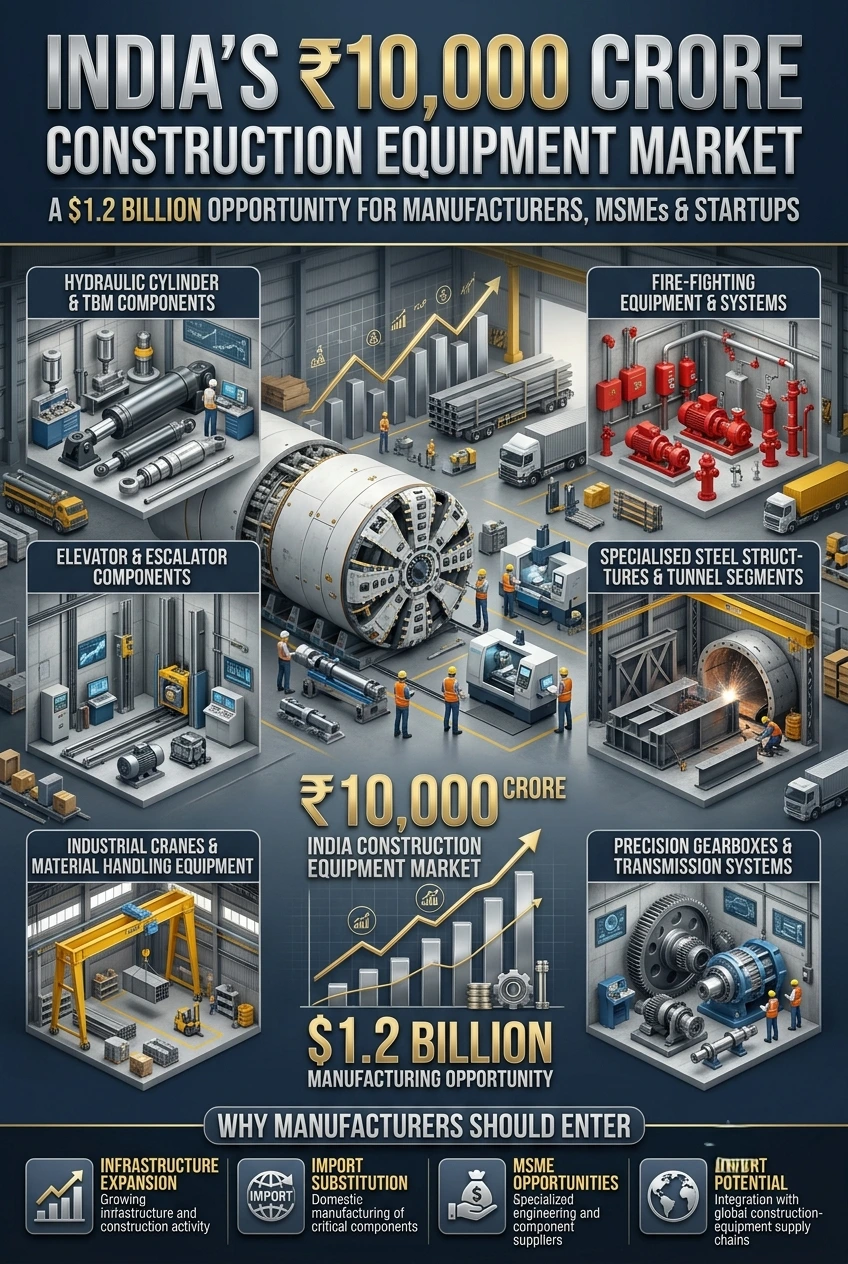
6 Manufacturing Business Ideas Directly Inspired by This News
The $1.2 billion incentive plan, Reuters reports, creates specific and practical manufacturing opportunities. The following business ideas all directly link to the equipment types and supply chain gaps identified in this policy.
1. Hydraulic Cylinder and Component Manufacturing for TBMs
TBMs are large, complicated, and contain hundreds of parts that have to perform with high precision. These are primarily imported as a product at this time. The new scheme of PLI will require TBM manufacturers such as BEML and L&T to have steady domestic suppliers. Long-term supply contracts can be made with these players to a precision engineering unit producing hydraulic cylinders, seals, pistons and actuators for TBMs.
Why now: The initiative focuses on value addition to completely imported machines, to push the direct purchase of the component manufacturers.
2. Fire-Fighting Equipment and Systems Manufacturing
Specifically included as a covered category in the PLI scheme are ‘firefighting systems.
Why now: Firefighting equipment will be explicitly mentioned in the government’s scheme, making this a policy guaranteed growth segment.
3. Elevator and Escalator Component Manufacturing
India’s elevator market is expanding at a rate of 12-15% per year, driven by the smart city initiatives, commercial real estate, and residential high-rises. Elevators in high-rise buildings are included in the scheme. The majority of elevator assembly is done by world-class manufacturers (Otis, KONE, Schindler, Johnson Lifts), and their supply chains are based in the area for motors, guide rails, counterweights, traction machines and control panels. It makes a lot of sense to establish a component manufacturing facility for these OEMs.
Why now: Johnson Lifts announced it is a potential PLI beneficiary, thus generating an anchor buyer’s demand for supply chain.
4. Specialised Steel Structures and Tunnel Segment Manufacturing
Tunnel boring machine segments concrete in segments as they go. The precision moulding, high strength concrete mixes and steel reinforcement rings are needed for these segments. A capital efficient business to feed into the TBM supply chain is the setting up of a tunnel segment precast manufacturing business in close proximity to metro or highway projects.
Why now: Metro Rail expansion in 27+ cities and the bullet train project are driving multi-decade demand for tunnel segments in India.
View Full Project Details: Steel and Iron Industry Projects
5. Industrial Crane and Material Handling Equipment Manufacturing
For large scale infrastructures, cranes, hoists, winches and material handling systems are needed. India is largely dependent on imports for this equipment. Infrastructure and industrial/warehousing units for manufacturing industrial cranes, gantry systems, and overhead hoists can operate in a single facility.
Why now: PLI has a wider category of infrastructure equipment, which enables a policy-back environment for this segment.
6. Precision Gear Boxes and Transmission Systems for Heavy Equipment
Whether it’s a TBM, crane or excavator, all heavy construction equipment depends on precision gearboxes and planetary drives. A significant amount of these is imported from Germany, Italy and China. The precision gear business serves OEMs in construction equipment, and is a high value, technically differentiated business with high IP value and high integration level.
Why now: The scheme is to boost local value-added for currently all imported machines, with component manufacturing as the top priority, as Reuters reported.
Import–Export Opportunity Analysis
India’s import bill for infrastructure equipment is in the thousands of crores every year. The PLI programme specifically aims to turn this reliance on imports into manufacturing capacity – and eventually export capacity.
Import Substitution Opportunities
TBM’s: Imports fell from $18 million (FY23) to $500,000 (FY25) as exporting restrictions left a need for domestic production. Currently India imports from the U.S., Germany and Japan for firefighting systems. The market value of only the fire sprinklers is hundreds of crores per year. Despite having a huge domestic market for elevators, the components are imported.
Export Markets to Target
Get Detailed Insights from This Book: The Complete Book on Construction Materials
Trade Policy Tailwinds
Indian manufacturers enjoy preferential market access from Free Trade Agreements with UAE, Australia and negotiations with the EU and UK. This, coupled with the cost support provided by the PLI scheme, makes exports a cost-effective growth path from day one.
Indian MSME Success Stories in Capital Goods and Construction Equipment
1. Precision Camshafts Limited (PCL) — Aurangabad
PCL, a small foundry has expanded to become India’s largest provider of camshafts to automotive and industrial OEMs, based in Pune. The journey of these Indian MSMEs shows how proper investment and technological support can help Indian MSMEs become global giants in precision component manufacturing, with direct applications in construction equipment components.
2. Action Construction Equipment (ACE) — Faridabad, Haryana
ACE started as a small company based in Haryana, and has expanded to become one of the largest crane and construction equipment manufacturers in India, quoted on the NSE. The commercial viability of domestic construction equipment manufacturing is reflected in its Q1 FY27 results, which show a 22.28% increase in net profit. ACEs story is an example of how Indian manufacturers can compete with imports when they concentrate on product development and market penetration.
3. Greaves Cotton — Mumbai
With its history of engine production, Greaves Cotton has carved out a successful transition into the industrial equipment, power solutions and construction-related business sectors. The diversification model they have put forth is a blueprint of how current MSMEs and mid-sized manufacturers can access PLI schemes to get into new and high-growth equipment segments with manageable investments.
Smart entrepreneurs start here—find your perfect venture
About Niir Project Consultancy Services (NPCS)
Niir Project Consultancy Services (NPCS) is an Industrial Consultancy and Project Report issuing organization based in India, which is among the best industrial consultancy and project report providers in India. NPCS can provide entrepreneurs who wish to join the construction equipment manufacturing industry with:
- Detailed Project Reports (DPRs) of the manufacturing unit for machinery, project layout, costing and ROI calculation.
- Market Research Reports — sector specific demand analysis, competitor landscape, and pricing intelligence.
- Market Research — research on the demand for goods and services in a particular area.
- Technology Consultancy: procurement of technology, machines, raw materials and foreign technology partners.
- PLI Scheme Navigation Support: supporting entrepreneurs to understand eligibility, application processes and compliance.
From manufacturing hydraulic parts to designing fire-fighting systems, elevator components to tunnel parts, NPCS offers a complete knowledge and documentation base that can take you from concept to a bankable project.
Industry Data Snapshot
| Parameter | Details |
| Industry | Construction & Infrastructure Equipment Manufacturing |
| PLI Scheme Value | $1.2 Billion (₹~10,000 Crore) over 7 years |
| Projected Investment Attraction | $1.8 Billion in fresh domestic investment |
| Market Size | ₹1 Trillion (~$10.5 Billion) — expanding rapidly |
| Market Driver | India’s record ₹11.11 lakh crore capital expenditure budget + China import restrictions |
| Key Equipment Covered | Tunnel Boring Machines, Firefighting Systems, Elevators, Cranes, Infrastructure Machinery |
| MSME Opportunity | Component manufacturing, precision engineering, sub-assembly units for OEMs |
| Export Potential | Bangladesh, Sri Lanka, UAE, Africa, Southeast Asia — infrastructure boom markets |
| Government Support | PLI scheme, Make in India, MSME credit schemes, RoDTEP export incentives |
| Risk Level | Moderate — long gestation period, technical complexity; mitigated by PLI support |
| Growth Outlook | Strong — 7-year incentive horizon aligned with India’s infrastructure decade |
Conclusion: India’s Infrastructure Decade Begins — Are You In?
The report of India’s $1.2 billion construction equipment PLI scheme by Reuters on 21 August 2026 isn’t merely a news report. It’s a kickoff for one of the greatest manufacturing prospects of this decade.
India is investing an unprecedented ₹11 lakh crore per year in infrastructure. It is making strenuous efforts to break its reliance on Chinese machinery. Providing seven years production linked incentives to willing manufacturers. It is a vacuum in a supply chain, with no one at scale filling it with TBM components, firefighting systems, elevator assemblies, precision gear boxes and tunnel segments.
The window is now open. Those who will enter the market in the next 12-18 months will win supply deals, OEM relationships, and market position that will multiply over the next 10+ years.