Why Industry Consultants Matter in India’s Fruits and Vegetables Sector
India is one of the largest producers of fruits and vegetables, accounting for about 10% of the global production of fruits and 15% of the global production of vegetables. However, even with this outstanding agricultural foundation, little fresh produce is processed — typically very little of what farmers produce makes it to value-added processing facilities. This is not only a supply chain challenge; it’s a business opportunity. For entrepreneurs who wish to join the fruits and vegetables business or expand their business, it is no longer a choice, but a must to get professional guidance from experienced fruits and vegetables consultants in India.
The set up of a fruits and vegetables processing plant is certainly more complicated than most first time investors think. Food Safety and Standards Authority of India (FSSAI) and Agricultural & Processed Food Products Export Development Authority (APEDDA) have strict regulations concerning documentation. Cold chain logistics, hygienic processing requirements and equipment choices will all be taken into consideration when designing the plant, be it a mango pulp, tomato paste, dehydrated vegetables, fruit juices or frozen vegetables plant, such as frozen peas. Further, the financial viability, land acquisition, utility requirements and GST structuring all require expert handling. This is where the leading fruits and vegetables industry consultants in India come in handy.
Read the Complete Book Here: Handbook on Fruits, Vegetables & Food Processing with Canning & Preservation
The Ministry of Food Processing Industries (MoFPI) through schemes like the Pradhan Mantri Kisan SAMPADA Yojana (PMKSY) and the Production Linked Incentive (PLI) Scheme has done much to encourage investment in this sector. Accordingly, the fruits and vegetables processing market in India is experiencing a wave of entrepreneurship at both the Micro Small and Medium Enterprise (MSME) level, as well as large integrated fruit pulp processing plants geared towards exporting to the Middle East, Europe and Southeast Asia. In all of these, the right consulting partner can make or break the success of a project whether it’s funded, built and profitable, or goes no further than feasibility.
What Fruits and Vegetables Plant and Process Consultants Actually Do
A lot of business owners think of a consultant as a “report writer.The majority of business owners consider a consultant to be a “report writer. In fact, the plant consultant for fruits and vegetables is involved in many roles and hats — acting like an engineer, a market analyst, a regulatory paths finder and a project coordinator. Knowing what these consultants actually offer when selecting firms to work with can assist entrepreneurs in making the correct choice.
Feasibility Studies and Techno-Economic Analysis
Every investor, before investing capitals should have a clear understanding of the viability of the project. The feasibility consultants for the fruits and vegetables industry analyze raw material availability, market demand for certain categories, product mix, installed capacity (MT/day or TPD), processing technologies options, location of the plant and financial projections. They also assess key factors like yields (e.g., the amount of raw tomatoes needed to process into tomato paste), directly related to cost economics. The bottom-line question that any investor will ask themselves is, “Is this project good for my money and will it pay off in a reasonable amount of time?”. A well-crafted, TEFS really gives the investor the answer to that question.
Detailed Project Reports (DPR) for Financing and Approvals
The basic document for bank financing, approval of government schemes and institutional investment is a Detailed Project Report. In the case of fruits and vegetables processing projects, it includes the manufacturing flow, specifications and sourcing of plant and machinery, raw material details and land available, market research, demand-supply projections, product mix and capacity planning, utility requirements and complete financials of the project like capital expenditure, working capital, profitability, payback period etc. Project loans will not be sanctioned by banks and NBFC lenders if the DPR is not credible. Boutique management consulting firms in India that specialize in food technology will be best suited to prepare these reports, because they have a certain engineering knowledge along with financial modeling expertise.
Process Engineering and Plant Layout Design
In addition to documentation, the consultants who work in process plants are also responsible for designing the actual manufacturing flow. In the case of a fruit pulp unit, the washing lines, pulping machines, pasteurizers, aseptic filling machines and cold storage specifications are specified. It means either choosing between tray drying, freeze drying or spray drying to set up a vegetable dehydration plant for the specific product and its intended market. Plant layout design helps in ensuring efficient movement of material, adherence to food safety and Factories Act requirements for occupational safety. Process engineering consultants with hands-on food technology experience normally provides these engineering services.
EPC Support and Project Implementation
Some individual consultancies are more than just advisors, they provide Engineering, Procurement and Construction (EPC) services – they take care of the selection of vendors, obtaining the machinery, overseeing the civil construction, installing equipment, and commissioning. Fruits and vegetables EPC consultants in India are hired to be the project’s technical representative on the ground, ensuring that the project is constructed according to the blueprints, budget and timeframe. This integrated support is particularly useful for the first-generation entrepreneurs, who do not have internal technical team to run the plant independently.
Why India Has Become a Hotspot for Fruits and Vegetables Consulting
India is one of the fastest growing markets for fruits and vegetables industry consulting, driven by several factors. Once investors understand these drivers, they will value the importance of professional consulting support in this field.
First, there are strong incentives that have been created by government policy. The MoFPI can be found at Under PMKSY, mofpi.gov.in has approved 41 Mega Food Parks and sanctioned hundreds of cold chain projects, allowing for infrastructure to combat post-harvest losses. Financial incentives provided by PLI Scheme for the food processing industry encourage investment on large scale. Further, the PM Formalisation of Micro Food Processing Enterprises (PMFME) Scheme is supporting thousands of MSMEs in the fruits and vegetables sector to be formalised, upgraded and secured institutional finance.
Second, there is new interest in the projects due to the import substitution/export potential. With APEDA — the apex export promotion body available at our ease, the export of fruits and vegetables has been on a healthy growth path in India. apeda.gov.in, is playing an important role in facilitating market access for more than 100 countries. There is a high demand for products such as mango pulp, tomato paste, frozen vegetables, dehydrated onions and fruit concentrates internationally and demand for these products is increasing. The businessmen who are planning to start their business in these segments require consultants who know the food technology requirement as well as export compliance aspects under APEDA.
View Full Project Details: Complete Guide to Fruit & Vegetable Processing
Third, rising domestic consumption of processed foods is creating scale opportunities that did not exist a decade ago. Urbanization, changing dietary preferences, growing modern retail penetration, and the expansion of food service chains are all driving demand for processed fruits and vegetables. This has attracted not just MSME entrepreneurs but also large agribusiness companies and NRI investors looking to build vertically integrated food businesses in India.
For all these investors, India’s boutique management consulting firms in the food technology space have emerged as critical enablers. The Invest India portal and the IBEF Food Processing Sector page both confirm the strong investor interest and the depth of opportunity in this sector.
How to Evaluate and Shortlist the Best Fruits and Vegetables Industry Consultants in India
There are dozens of food processing consulting firms and individual consultants and it’s hard for founders to distinguish real from superficial. These are the factors that will help you choose and shortlist the best industry consultants for the fruit and vegetable industry in India.
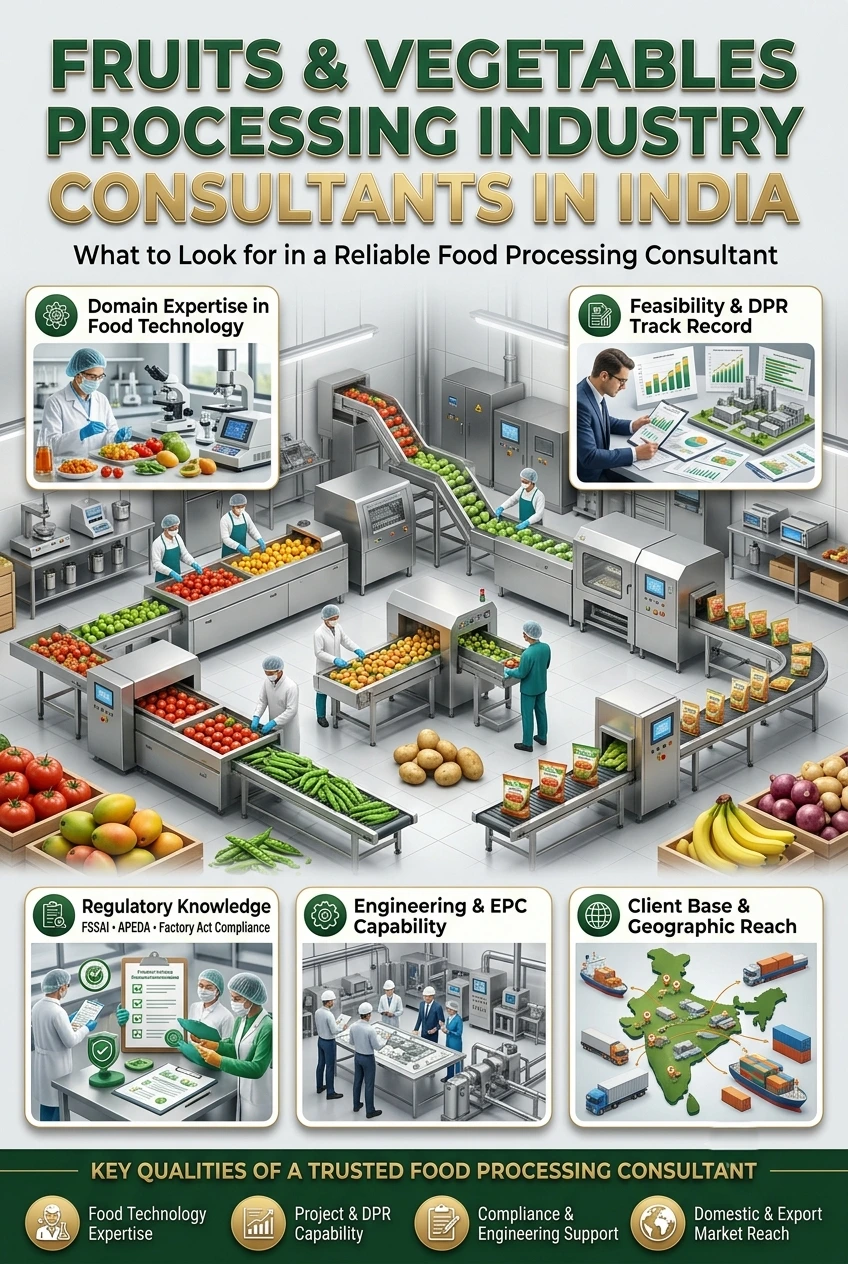
1. Domain Expertise in Food Technology
The first filter is a domain depth filter. The fruits and vegetables processing industry includes a multitude of different segments such as pulping, juicing, canning, dehydration, freezing, pickling, and ready to eat. There are different food technology needs for each. The consultant you select should be able to talk through the product you are looking to produce, the yields, the equipment available, the quality parameters and processing challenges. Before shortlisting, request case studies or sample DPRs from their fruit & veg project portfolio.
2. Feasibility and DPR Track Record
A worthy consultant would have established an easily verifiable history of crafting bankable Detailed Project Reports, which have been able to secure loans from banks, NBFCs or government scheme approvals. Ask for references or examples of projects they submitted their DPRs for which they were funded. The top engineering consultants in the Food sector also possess an understanding of the intricacies of the MSME scheme documentation, PMKSY applications, and PLI submission requirements, which are all sector-specific.
3. Regulatory Knowledge — FSSAI, APEDA, and Factory Act Compliance
FSSAI requires licensing for plants that process fruits and vegetables for domestic sale. FSSAI regulations also apply to plants that process food products made from fruits and vegetables for domestic sale. APEDA registration and conformity with quality and traceability requirements is compulsory for the export-oriented plant. The
All India Food Processors’ Association (AIFPA), the oldest industry body in this area is closely working with FSSAI, BIS and QCI on the regulatory issues. Experienced process plant consultants will take you through the licensing process with FSSAI, layout approvals with FSSAI, requirements of the food safety management system with FSSAI, and Pollution Control Board consents in the State under Environment Protection Act. They will also guide you through the Factory Act guidelines on worker safety and fire safety. Uninformed consultants can slow your project down months.
4. Engineering and EPC Capability
However, for bigger projects, such as a fruit pulp factory of 10 TPD or more, mere advisory consulting will not suffice. You require process engineering consultants that can convert the feasibility design into a real plant drawing, equipment specifications and timelines. Added value of EPC consultants is to handle vendors, procurement schedules and installation quality. When looking for potential companies to collaborate with, directly question whether they provide turnkey EPC support or just advisory and report writing services.
5. Client Base and Geographic Reach
Practical knowledge of regional differences in land costs, utility tariffs, labour markets and raw material supply chains is available from established consultancies working with a portfolio of clients in different states. The demand and supply scenario for raw material varies from one unit to another depending on the type of units—whether mango pulp unit in Maharashtra, tomato processing unit in Karnataka or onion dehydration unit in Rajasthan. The consultants, who are top fruits and vegetables industry experts in Delhi and all over India, will be familiar with such local nuances, and will take into account the project economics in a realistic manner.
Role of NPCS in Fruits and Vegetables Project Consultancy
India’s established industrial consultancy firms are all engaged in a wide range of industrial consulting services. Niir Project Consultancy Services (NPCS) is one such firm headquartered in Delhi and available at niir.org is one of the most experienced names in fruits and vegetables project consultancy. NPCS has been since 1994, helping food processing entrepreneurs to prepare Detailed Project Reports and techno-economic feasibility studies for more than 30 years. They have the experience of delivering successful projects in 85 countries, 150,000+ projects and a consulting team with sectoral knowledge across India’s manufacturing landscape.
In the case of the fruits and vegetables segment, NPCS prepares detailed DPRs representing the manufacturing process and technology selection, machinery and raw material details along with the supplier references, market research and market demand analysis of the target product, process flow diagrams, product mix and capacity planning, utility and infrastructure requirements, project financials (capital expenditure, profitability analysis, payback period and break-even calculations). This sort of detail is just what bank appraisal teams and government scheme assessment committees need.
If you are a budding entrepreneur and you have a number of ideas for projects in this space, you can check out NPCS’s catalogue of fruits and vegetables project profiles at: NPCS Fruit & Vegetable Project Profiles. This catalogue is a guide for founders to determine capacity and product to match their investment budget and market access.
Related Article: Indian Processed Food Market: Demand, Trends & Growth Opportunities
One of the most significant advantages of NPCS for first-time entrepreneurs is the blend of market knowledge and engineering details. The reports prepared by NPCS are not generic reports but project specific reports that take into account local availability of raw materials, prevailing machinery market rates in India, realistic capacity utilisation assumptions and government incentives applicable. NPCS’s DPR gives an investor the assurance to approach institutional lenders with confidence when planning to set up a fruits and vegetables processing unit, be it a dehydration unit with an investment of ₹30 lakh or an integrated pulp and juice plant of ₹5 crore.
Best Fruits and Vegetables Industry Consultants in Delhi and the National Landscape
Delhi and the NCR are the main centres of the industrial consulting industry in India. Delhi has a concentration of Government Ministries (MoFPI, APEDA, headquarters), policy institutions and financial bodies, making it a logical location for consulting firms advising on fruits and vegetables projects. While many of the top engineering consultants, EPC consultants, and boutique management consulting firms in India have their main offices in Maharashtra, Gujarat, Rajasthan, Punjab, Uttar Pradesh, Karnataka and Andhra Pradesh, many of them do have their principal offices in Delhi.
However, the consulting landscape extends well beyond Delhi. Ahmedabad-based firms have strong expertise in vegetable processing, particularly for products like dehydrated garlic and onion that are Gujarat’s export specialties. Chennai and Hyderabad-based consultancies have deep experience in mango and banana-based processing. Pune-based firms are well-positioned for grape and wine-adjacent fruit processing. The rise of remote consulting, combined with the ability to conduct plant feasibility assessments and market research digitally, has further expanded the reach of smaller boutique management consulting firms in India — making it possible for a Delhi-based firm to serve an entrepreneur in Nashik or Bangalore with the same effectiveness as a local advisor.
For the IBEF and Invest India data consistently highlight that Maharashtra, Uttar Pradesh, Andhra Pradesh, and Punjab are among the most active states for fruits and vegetables processing investment. Consultants with project experience in these states — whether for cold storage, primary processing, or value-added manufacturing — bring irreplaceable on-ground knowledge that generic advisory firms simply cannot replicate.
Build a profitable business with the right idea
Consulting Service Types: Comparison of Scope, Deliverables, and Best-Fit Clients
| Consulting Service Type | Core Focus | Key Deliverables | Best-Fit Client |
| Feasibility Study | Project viability assessment | Market analysis, cost-benefit report, investment summary | Early-stage investor exploring project options |
| Detailed Project Report (DPR) | Bankable project documentation | Process flow, machinery list, financial model, profitability analysis | Entrepreneurs seeking bank loans or govt scheme funding |
| Process Engineering Consulting | Plant design and process optimization | Layout drawings, equipment specs, utility design | Investors setting up a new processing unit |
| Regulatory Compliance Advisory | FSSAI/APEDA licensing and approvals | License applications, food safety plans, compliance checklist | Units targeting domestic sale or export |
| EPC Consulting | Full project delivery management | Vendor sourcing, procurement, construction oversight, commissioning | Large-scale investors needing turnkey execution |
| Market Research Reports | Demand and competition analysis | Market sizing, competitor mapping, pricing intelligence | Diversifying companies assessing new product lines |
| MSME Scheme Advisory | Government incentive navigation | PMKSY/PMFME/PLI applications and documentation | Small-scale entrepreneurs seeking subsidies |
Conclusion: Practical Next Steps for Fruits and Vegetables Entrepreneurs
India’s fruits and vegetables processing sector sits at a genuine inflection point. Currently, Government policy, rising domestic demand, export opportunity, and improving infrastructure are all aligning in favour of serious investors. However, the technical complexity of food processing — combined with the regulatory landscape under FSSAI and APEDA, the competitive market dynamics, and the capital intensity of plant setup — means that going it alone is rarely advisable.
Therefore, The first practical step for any entrepreneur is to engage a credible fruits and vegetables industry consultant in India early in the process — ideally before committing to a product or location. A well-prepared feasibility study will validate your idea, size your investment correctly, and give you a roadmap for regulatory approvals and financing. Furthermore, From there, a bankable DPR will open doors with lenders, scheme authorities, and institutional investors.
Similarly, Whether you are a first-time founder evaluating a mango pulp plant in Maharashtra, an MSME operator looking to upgrade your dehydration unit with government scheme support, or an NRI investor planning an integrated cold chain and processing facility, the right consulting partner will compress your learning curve dramatically and improve your chances of project success.
Additionally, For entrepreneurs looking to explore a wide range of fruit and vegetable processing project ideas — from value-added juices and concentrates to dehydrated vegetables and frozen products — the Ministry of Food Processing Industries (MoFPI), APEDA, and established consultancy platforms like NPCS (niir.org) are valuable starting points. Finally, India’s fruits and vegetables industry is ready to grow — with the right advisory support, your project can be part of that growth story.