Compostable biodegradable disposable cups and plates based on sugarcane bagasse are among the most interesting business concepts that are growing in India’s green manufacturing industry for their unique blend of environmental significance, policy support, and market demand. Every year India produces millions of tonnes of single use plastic waste. Governments are increasingly being pushed to take action at all levels. For those ready to take the leap, the bagasse tableware market isn’t just an opportunity—it’s a revolution that rewards action-takers.
After crushing sugarcane stalks for extraction of juice, there is a dry fibrous residue called bagasse. It has been used by sugar mills for decades as a low-value fuel for boilers. The same material today is the basis of a business worth ₹10,000 crore, which operates worldwide in the tableware industry. India is the second-largest sugar producer in the world and has vast reserves of raw materials that replenish over time. This provides a definite cost benefit to the domestic manufacturers.
Why the Compostable Tableware Industry Is Growing Fast
Consumer demand is changing and changing rapidly. Among the people in urban India, there is growing awareness about plastic pollution, and their corporate buyers, event management companies, and quick service restaurants are proactively looking for eco-friendly packaging and tableware. Sustainable products are no longer considered high-end luxuries by modern-day consumers. They’re expecting them as the standard.
Moreover, there is a regulatory vacuum in the country as a result of the Government’s ban on single-use plastics, which bagasse table ware fills. Hotels, airlines, food delivery systems and institutional canteens are now making a point of replacing plastic disposables. This substitution effect, i.e. the bagasse tableware comes into a well-developed market for table service, reduces the cost of market development for a new competitor.
There’s another dimension of export demand. Regulators in Europe, the U.S., Japan, and Australia have imposed strict regulations on non-compostable food-contact materials. Indian manufacturers benefit from low-cost bagasse and competitive labour, enabling them to effectively cater to these markets. The global trade in compostable packaging has increased significantly in recent years and bagasse packaging is one of the fastest-growing categories.
Get Detailed Insights from This Book: Handbook on Biodegradable Plastics (Eco Friendly Plastics)
Government Policies and Incentives Supporting This Business
This is a strong indication of the congruence between Indian policy and this sector. Entrepreneurs that know about the schemes that are available will be able to alleviate their capital burden and have more viable projects from the first day.
MSME Credit Guarantee Scheme (CGTMSE): The Ministry of MSME provides for collateral-free loans up to ₹2 crore under the Credit Guarantee Fund Trust for Micro and Small Enterprises. For first-generation entrepreneurs, who have no property collateral, this scheme is a game-changer. Bagasse tableware units are considered as micro or small manufacturing enterprises.
PLI Scheme and Packaging Support: The DPIIT under Make in India has identified sustainable packaging as a priority sector. The Production Linked Incentive framework offers financial benefits to manufacturing units meeting output thresholds. Entrepreneurs who scale operations within the PLI targets stand to receive meaningful cash incentives over the scheme’s tenure.
Startup India Recognition: Every registered start-up under Startup India programme will get three-year income tax holiday, faster patent process and relaxed government procurement norms. A bagasse tableware startup, meeting the recognition standards of DPIIT, will have a very favourable financial picture, when combined with MSME incentives.
State-Level Incentives: The Sugar producing states such as Uttar Pradesh, Maharashtra, Karnataka, and Tamil Nadu have come up with specific packages for agro-residue processing industries. They normally involve capital subsidy, power tariff concessions and stamp duty exemptions, all of which have a significant positive impact on the unit economics for bagasse manufacturers.
Specific Business Ideas for Startups and MSMEs
1. Small-Scale Bagasse Tableware Manufacturing Unit
The smallest manufacturing plant for the manufacture of plates, bowls, cups and trays from bagasse pulp is the most direct and capital-efficient venture into this field. It is a process that comprises the steps of pulping of dry bagasse, shaping of the dry bagasse under pressure and heat in hydraulic moulding machines, drying, trimming and stacking. The 4 to 6 moulding machines of a unit can mould 50,000 to 80,000 pieces in one shift. The initial investment required for a small unit (land lease, equipment, working capital, regulatory issues etc.) is between ₹40 lakh and ₹75 lakh, depending on the state and scale. When supplying at full capacity, directly to the food service distributors/institutional buyers, the revenue can be up to ₹1.2 crore to ₹1.8 crore per annum. Product mix is key – round plates plus clamshell boxes give the highest volume, while branded custom-moulded products are the premium margins.
2. Export-Oriented Bagasse Packaging Unit
For entrepreneurs with access to export infrastructure, or with a working relationship with export houses, it may be prudent to think from the beginning of getting their unit ready for export markets. The unit design used for exporting is basically the same as that used in domestic production, but quality control, certification and packaging standards are widely different. There are certifications like BPI (Biodegradable Products Institute), DIN CERTCO and EN 13432 composting standards which are required by export markets. The certifications generally cost Rs.3 lakh to Rs.8 lakh, to participate in which once one gets access to buyers in Europe and North America willing to pay premiums ranging between Rs.20,000 and Rs.40,000 for domestic buyers. APEDA offers export facilitation support and market development assistance to export exports of agro-processed products including bagasse-based products.
Access Complete Business Plan: Bio-based Polymers and Eco-Friendly Packaging
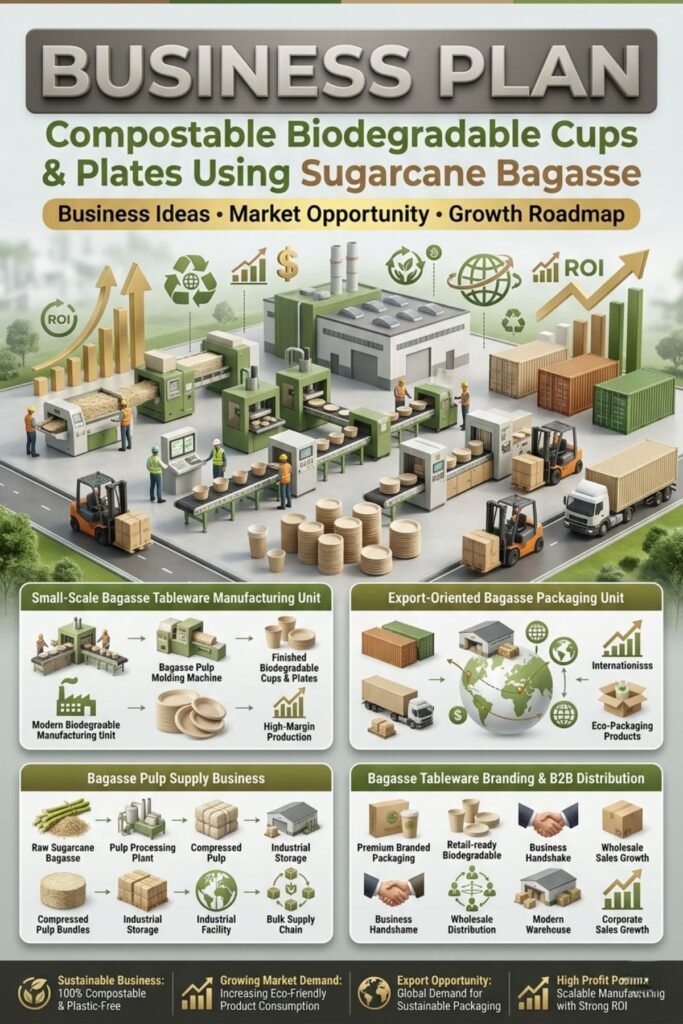
3. Bagasse Pulp Supply Business
An entrepreneur can start a business by providing pre-mixed bagasse pulp to various tableware manufacturing companies, instead of directly into the finished goods manufacturing. In this model, sugar mills supply raw bagasse at low cost, and sometimes even at zero cost. The system then cleans and processes it into a uniform slurry. After that, it delivers the slurry in bulk or packaged form to downstream manufacturing companies. This business has less capital needed, more stable off-take agreements and predictable margins. It also helps to establish the entrepreneur as an integral part of the chain providing tableware, which is becoming more and more relevant as the tableware industry expands. The cost of the pulp processing equipment for a medium scale operation is around ₹20 lakhs to ₹35 lakhs.(Sugarcane Bagasse Disposable Plates Business)
4. Bagasse Tableware Branding and B2B Distribution
The opportunity of “white labelling” or contract manufacturing is a capital-light, but high-margin one. An entrepreneur can partner with the existing bagasse manufacturers for the production, create a brand for sustainable tableware and concentrate solely on sales, marketing and B2B distribution. There are four top volume sales channels looking for dependable suppliers of branded eco-friendly tableware, such as corporate gifting, event management companies, food delivery services and institutional canteens. The amount of working capital required to set up this model is relatively small, ranging between ₹10 lakh and ₹20 lakh, and the margins of branded premium products are usually in the range of 25% to 40%. The barriers to entry are low, but quality of supply and brand credibility have to be built with persistence and a good relation management.
Import–Export Opportunity Analysis
India’s trade in bagasse tableware is truly beneficial to the world. The country is blessed with raw material, manufacturing cost base and a growing community of technically savvy MSME manufacturers. It has a lack of well-structured developments of export channels and regular product certifications.
The Single-Use Plastics Directive in the EU and the like in the UK, Canada and Australia has changed the way things are bought and sold. Long-term supply deals with Asian manufacturers are in demand by importers in these countries. Displacing Chinese suppliers on quality grounds is achievable for Indian exporters who invest in EN 13432 and ISO 14855 certification, ensure uniformity of product quality and provide competitive prices – something that is already happening in several categories of FMCG and food services.(Sugarcane Bagasse Disposable Plates Business)
There is not much risk to domestic manufacturers on the import side. Competitive bagasse product comes from China and Vietnam, but the import duties, logistics, and the advantage of ‘Made in India’ and ‘sustainably sourced’ brands do mitigate the risk to some extent. Moreover, domestic demand is increasing rapidly, allowing the Indian manufacturers to increase production before starting to launch an aggressive export push. The Federation of Indian Export Organisations (FIEO) offers market intelligence, buyer connect programmes and export documentation support that are specifically relevant to this sector.
Build a profitable business with the right idea
Indian MSME Leaders in This Sector
Yash Pakka Limited – Ayush Thapar
Yash Pakka (previously known as Yash Papers), which was based in the city of Ayodhya, Uttar Pradesh, took a radical shift and started manufacturing 100% compostable food packaging material for bagasse. The company was led by Ayush Thapar, who invested in the development of special pulp and moulding technology, and created an export quality product line. They’ve decided to focus on international food chains and QSR brands, not on the commoditised ones in their own country, leading to steady profits. The main takeaway: Specialise and certify for premium pricing and changed unit economics.
Ecoware – Raj Malhan
Ecoware of Delhi has created one of the most popular and well-known brands of sustainable tableware in India. The company was placed early into the corporate gifting & institution food service sector by Raj Malhan. Ecoware introduced a range of quality moulded bagasse products, branded them and direct-sold them to airlines, hospitals and large corporates, and created repeat-order relationships. Their strategy shows that sustainable packaging builds long-term profitable brand equity, while commodity supply does not. New entrepreneurs should study Ecoware’s channel focus as an example. This will help them enter the domestic market effectively.(Sugarcane Bagasse Disposable Plates Business)
GreenLine Bioplastics and Agro Products
A MSME based in Maharashtra that grew from a small bagasse plate production company to a multi-product company with domestic distributors and export markets in five years. They achieved success due to strong quality control. They also adopted food-grade certifications early. In addition, a strategic partnership with an agri-cooperative ensured a steady supply of bagasse. This example shows that supply chain security is a critical competitive advantage in this business. It is not manufacturing itself.
How NPCS Can Help You Evaluate This Business Opportunity
Firstly, Niir Project Consultancy Services (NPCS) prepares comprehensive Market Survey and Techno-Economic Feasibility Reports (DPRs) for entrepreneurs, investors, and MSME planners who want to identify new industrial projects. Our report covers all manufacturing processes in the bagasse compostable tableware industry. These include bagasse raw material procurement, pulp preparation, moulding, drying, trimming, and quality inspection. Detailed market research and demand analysis based on the current consumption pattern and data of export trade. Our reports include process flow diagrams, product mix recommendations, capacity planning suggestions, machinery specifications, raw material specifications, complete project financials, profitability analysis, and calculations of payback period and IRR.
We want entrepreneurs to make investment decisions with all the facts and not just on an assumption. We can offer you the analytical basis you need to take an informed decision when considering a bagasse tableware unit, a pulp supply business or an exportable packaging manufacturing plant.(Sugarcane Bagasse Disposable Plates Business)
Related Article: Biodegradable Packaging Manufacturing: India’s ₹10,000 Crore Sunrise Opportunity Post-Plastic Ban
Key Project Parameters – Bagasse Compostable Tableware Unit (Indicative)
| Parameter | Indicative Range / Value |
| Raw Material | Sugarcane Bagasse (agro-residue from sugar mills) |
| Unit Scale | Small: 4–6 moulding machines; Medium: 10–14 machines |
| Production Capacity (Per Shift) | 50,000 – 1,20,000 pieces |
| Land & Building (Lease) | ₹3 lakh – ₹8 lakh/year depending on state |
| Plant & Machinery Investment | ₹25 lakh – ₹55 lakh (small to medium scale) |
| Total Project Cost (Small Unit) | ₹40 lakh – ₹75 lakh |
| Working Capital Requirement | ₹8 lakh – ₹15 lakh per month |
| Annual Revenue (Full Capacity) | ₹1.2 crore – ₹2.5 crore |
| Gross Margin (Indicative) | 22% – 35% |
| Payback Period | 3 – 5 years |
| Key Certifications for Export | BPI, EN 13432, ISO 14855, Food Safety (FSSAI) |
| Key Buyer Segments | QSRs, Airlines, Institutions, Event Cos., Export Markets |
Note: Above figures are indicative project estimates for planning purposes. Actual costs vary by location, machinery sourcing, and market conditions.
FAQs
Q1. How much investment is required to set up a small bagasse tableware unit?
A small unit with 4-6 molding machines would typically require a total project investment of INR 40 Lakhs – 75 Lakhs, comprising of machinery, building fit-out and initial working capital. Scheduled Banks can provide collateral-free loans for a large part of this investment, supported by CGTMSE (Credit Guarantee Fund Trust for Micro and Small Enterprises) under the Ministry of MSME’s Credit Guarantee Scheme.
Q2. What is the raw material and how will it be sourced?
Sugarcane bagasse is the primary raw material. It is the dry residue that remains after extracting juice from sugarcane pulp. Sugar mills across India produce sugarcane bagasse in thousands of tonnes and supply it at very low prices; they even provide it free to units located nearby. If the manufacturing unit is located within 50–100 km of any sugar mill, it will greatly reduce logistics costs and supply issues. To further secure supply, the company can sign a long-term contract with the cooperative society or individual sugar mills.
Q3. What certifications are essential for exports of bagasse tableware?
EN 13432 certification confirms industrial compostability and is almost mandatory for selling products in the EU market, while BPI certification is the preferred standard among buyers in North America. Food-grade safety standards have to be met in every market. Exporters can quickly recover the INR 3–8 lakh investment in these certifications because certified export-grade products fetch 20–40% higher prices in international markets.
Q4. Is the Indian market size sufficient, or exporters have to rely solely on exports?
The domestic Indian market size is huge and rapidly growing. The food service industry, institutional catering sector, airlines, and events sector consume billions of units of disposable tableware every year and the ongoing ban on single-use plastic products in many segments in India would eventually eliminate the major competitors across sectors. Moreover, the working capital cycle in the domestic market is faster than in the international market. Several companies in India today are running businesses of INR 1 Cr + with just the domestic supply chain and they have not yet ventured into export sales.
Q5. Which machinery would be required and how is it available?
The machinery required includes bagasse pulp making machines, hydraulic heat-press molding machines, trimming machines, and packaging lines. Domestic machinery manufacturing is prevalent and established among reliable vendors located in Gujarat, Maharashtra, and Punjab. Buying locally reduces investment costs, installation time and after sales servicing is easier. Export-focused manufacturers sometimes purchase Chinese or Taiwanese moulding machines for higher precision, but Indian manufacturers now also produce machines with decent accuracy and output.
Q6. Which are the relevant Government bodies assisting this sector?
Various agencies give active support to entrepreneurs. Ministry of MSME ensures credit guarantees and skills development; DPIIT takes care of registration under Startup India and the PLI mechanism; the Ministry of Environment, Forest and Climate Change (MoEFCC) issues the regulations governing the plastic ban which creates market for the ventures; APEDA extends support to agro-based exports while NABARD offers refinance to banks that offer finance to agro-processing MSMEs.
Conclusion: A Structural Opportunity That Rewards Early Action
The sugarcane bagasse-based industry of compostable biodegradable tableware is not speculative or niche opportunity. It’s a direct result of a regulatory requirement, structural change in consumer preference, and a growing demand base all over the world, coming together at once.
The fact that India has a sustainable competitive edge in this area is true and solid: There is ample agro-residue supply, low manufacturing costs, a large domestic food service market, and good policy alignment. The most successful entrepreneurs will be those who act now, before late players fill this area and drive profit margins down.(Sugarcane Bagasse Disposable Plates Business)
The first step in considering this business is conducting a careful feasibility study, which involves considering realistic costs, determining the appropriate product line and choosing the appropriate market channel. The TEFR is not a routine paper chase; it’s a document that can make the difference between a well-funded, well-planned project and an undercapitalised shot in the dark. It’s a promising sector – and in such a competitive sector, preparation itself is a competitive advantage.(Sugarcane Bagasse Disposable Plates Business)