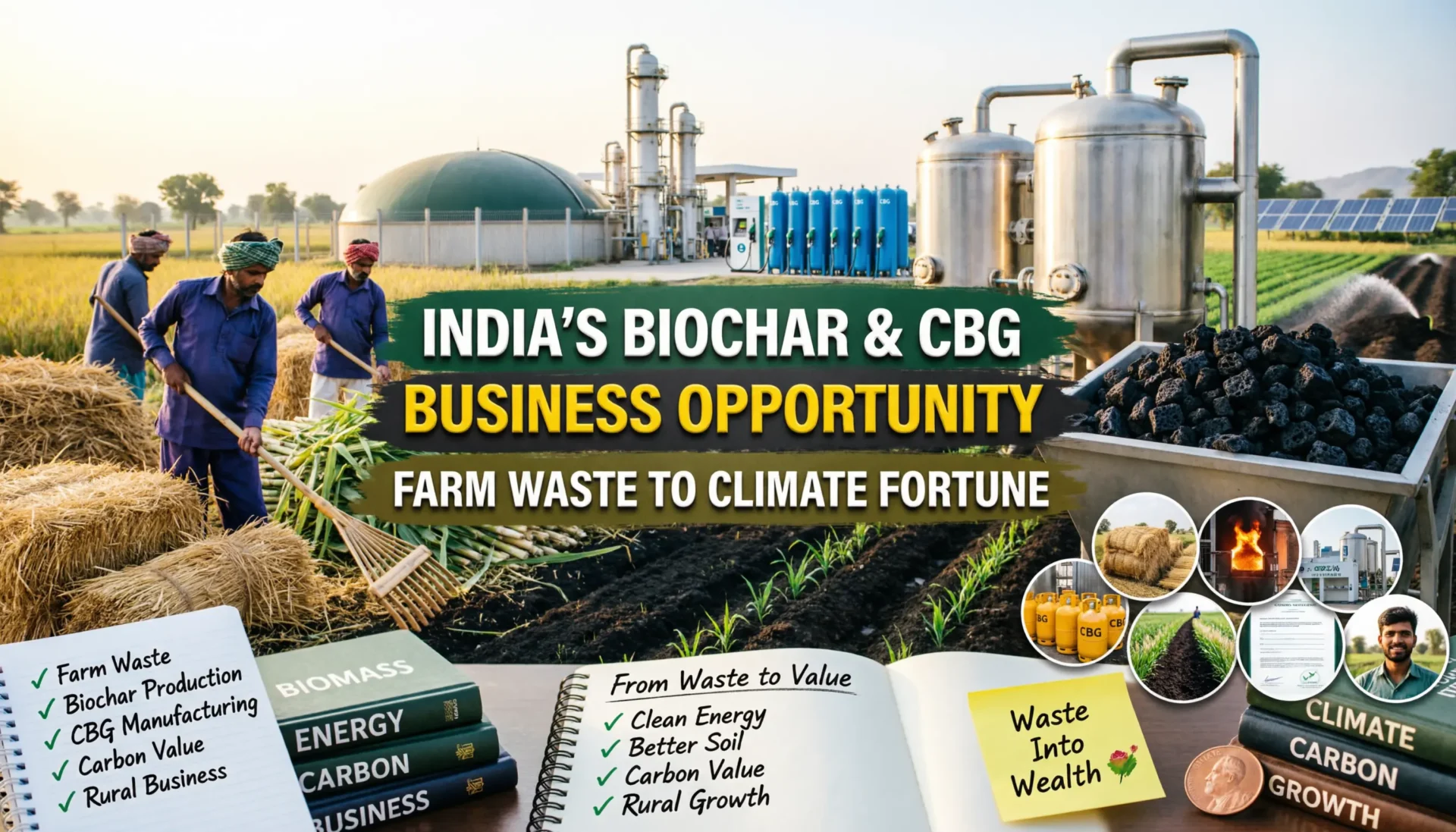

October is the time when Indian farmers burn a goldmine. All of these are wasted as they are burned in the cities, polluting them and destroying a carbon source that should be in use.All of these are incinerated, polluting cities and wasting a carbon source that should be utilized. Smart entrepreneurs have turned this equation around today. Serious capital, government interest and export interest are driving business ideas based on biochar production and Compressed Biogas (CBG) manufacturing. This is one of the most opportune areas for MSME entrepreneurs and first-generation industrialists in the clean energy and agri-processing economy in India.
Biochar is a charcoal that producers make from biomass through a high-temperature, low oxygen thermal process called pyrolysis. Purified natural gas, on the other hand, is not compressed but producers create it through anaerobic digestion of organic waste, and they compress it to natural gas standards, which is known as CBG. The two technologies solve the double challenge that India faces of agricultural waste management and clean energy transition. Most significantly, both now have good commercial viability for new manufacturing businesses.
Why the Biochar and CBG Sector Is Growing Fast
In India, more than 500 million tonnes of crop residue farmers produce every year. Much of this biomass is burned in the field or left to decay, releasing methane (CH₄), carbon dioxide (CO₂) and particulate matter. State and Central governments have been stepping up their actions against stubble burning. This policy pressure, together with the valuation of carbon credits in the world, has made biomass conversion a business opportunity.
From a market standpoint, biochar globally commands growing demand — especially in soil amendment, carbon sequestration, and water filtration applications. India’s own agricultural economy, with its massive fertiliser dependency, is an immediate buyer. Additionally, the SATAT (Sustainable Alternative Towards Affordable Transportation) scheme launched by the Ministry of Petroleum has opened procurement channels for CBG producers, assuring offtake at fixed prices from oil marketing companies (OMCs). This price visibility makes CBG manufacturing a lower-risk business compared to typical industrial ventures.
Additionally, carbon credits under the nascent carbon market in India and voluntary carbon markets abroad are creating a new income stream for the biochar producers, apart from selling their biochar. The business model of this product is a dual revenue one, where the sale of biochar and carbon credits can make this one of the most lucrative clean-tech manufacturing businesses in existence today.
Government Policies and Incentives Supporting Entrepreneurs
Government of India has designed a multi-layered support mechanism for the biochar and CBG producers. The National Bioenergy Programme — Waste to Energy sub-scheme of MNRE provides Central Financial Assistance (CFA) for biomass-based energy projects such as pyrolysis and gasification unit etc. Small and medium enterprises entering bio-energy production is covered under the programme with CFA rates mentioned for biogas/BioCNG plants.
All registered operators of CBG plants in India are centralised on the GOBARdhan (Galvanizing Organic Bio-Agro Resources Dhan) Unified Portal. Multiple government schemes such as SATAT offtake agreements with OMCs are applicable to Registered CBG plants. The scheme called GOBARdhan National Circular Bioenergy Scheme has an outlay of over ₹23,000 crore to increase the domestic production of CBG several times by 2035-36.
Collateral-free loans are available to MSME entrepreneurs under the scheme called Credit Guarantee Fund Trust for Micro and Small Enterprises (CGTMSE), a joint initiative of the Ministry of MSME and SIDBI. CGTMSE offers guarantee coverage to bank loans availed by MSEs to provide working capital and term loans to the first-generation entrepreneurs without any collateral.
Haryana Renewable Energy Development Agency (HAREDA) Bio Energy Programme is actively promoting entrepreneurship in biomass and biogas technology in Haryana which has a high density of paddy and agro-industrial wastes. HAREDA is the nodal body for implementation of MNRE schemes in the state with direct access to entrepreneurs for CFA subsidy and green energy certificates.
Punjab Pollution Control Board (PPCB) Notifications and Orders on Agri Residue Management are the compliance guidelines for biomass processing unit for the entrepreneurs of Punjab. The Punjab Government gives fiscal incentives and exemptions on tax and land lease to industries for establishing paddy straw biomass processing or palletisation plants, which will directly benefit CBG and biochar entrepreneurs.
Manufacturing Business Ideas in Biochar and CBG for Indian Startups
1. Agricultural Biochar Production Unit
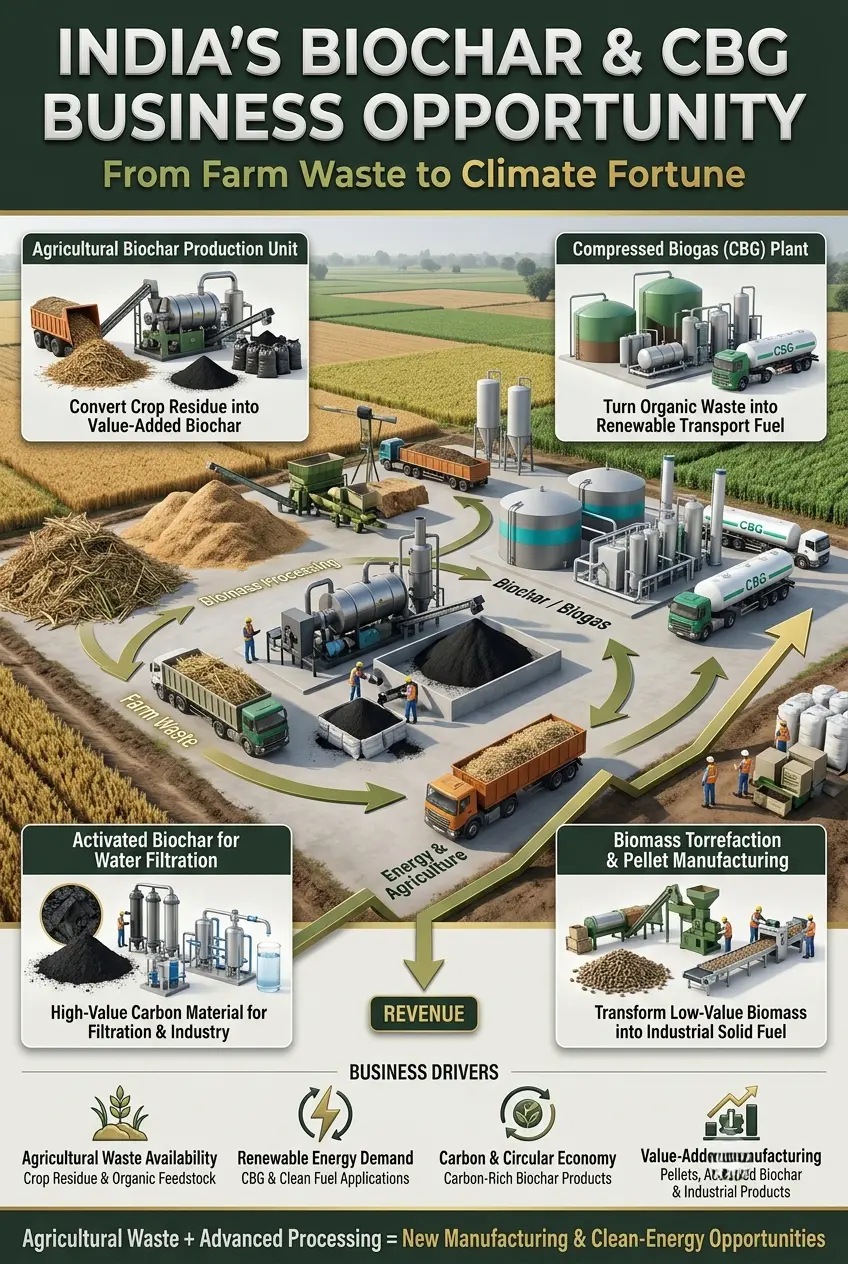
One of the most promising business opportunities in this field is the establishment of a biochar production plant for agriculture, with slow or fast pyrolysis technology. The raw material base, such as paddy straw, rice husk, sugarcane trash and groundnut shells are plentiful in the farm belts of India at practically no cost. The biomass processing rate of a unit of 5-10 tonnes/day can yield around 1.5-3 tonnes of daily output of biochar.
The final product is sold to the fertiliser companies, organic farming input dealers, and soil conditioner manufacturers. In addition to direct products income, each tonne of biochar produced and used in soil can be certified according to international standards like Puro. earth and Verra. This is because the same production unit can have two markets and sell its products in India and sell its carbon credits out of the country, thus enhancing the unit economics of the new entrepreneur.
2. Compressed Biogas (CBG) Plant from Organic Waste
The CBG manufacturing plant produces raw biogas by treating wet organic waste such as cattle dung, food processing waste, municipal solid waste, and press mud from sugar mills through anaerobic digestion. This biogas is then purified and compressed to obtain the CBG with Bureau of Indian Standards (BIS) approved IS 16087:2017 standard (Biogas/ Biomethane). The commercial potential of this business is that the government has ensured CBG procurements from the OMCs under SATAT scheme, so the plant owners can easily predict their revenue. The capital cost of a plant of capacity 2000 kg/day is about ₹ 8-12 crore, considering the land acquisition and logistic of the feedstock. The fermented slurry produced has a high nutrient level (N, micronutrients), and plants sell it as bio-manure, which gives another revenue stream for plants with zero waste and enhances profitability.
3. Activated Biochar for Water Filtration and Industrial Use
In addition to its agricultural use, manufacturers can chemically or physically treat biochar to make activated carbon, which is also a higher-value product used in water treatment, air filtration, pharmaceutical production and food processing. Activated biochar will fetch a handsome premium over regular agricultural biochar. A biochar start-up that focuses on activation capability in the biochar plant can directly supply the industrial biochar directly to the industrial buyer, the biochar directly to the municipal water company, and the biochar directly to the pollution control boards. This high-quality segment is currently relying mainly on imports and a few big manufacturers. In cases where the MSME has access to agro-biomass in states such as Andhra Pradesh, Karnataka or West Bengal, it gives them an opportunity for a high return manufacturing line of 1–3 tonne/day activated biochar which is ready for export.
4. Biomass Torrefaction and Pellet Manufacturing
Torrefied biomass pellets are located between raw biomass and biochar in the thermal conversion chain. The torrefaction process uses mild thermal treatment at 200–300°C to yield a dry, hydrophobic, energy-dense pellet that can serve as a coal alternative in power plants and industrial boilers. An entrepreneur can start a torrefaction line while making biochar, to mix their product output. One of the most direct incentives are given in the form of Central Financial Assistance under the MNRE Biomass Programme in the National Bioenergy Programme to Biomass Briquette and Pellet manufacturing plants.
Import–Export Opportunity Analysis for Biochar and CBG Businesses
Potential of export of biochar in India is significant and yet remains largely untapped. Verified biochar is actively sought after by EU markets for agricultural soil amendment and carbon credit generation, such as in Germany, Netherlands and the UK. Indian manufacturer certified by European Biochar Certificate (EBC) can directly approach the importers in the European countries. Indian Biochar can be competitively priced in these premium markets, considering the cost competitiveness of Indian biomass feedstock and lower operational costs. Biochar income from the carbon credit projects on Puro. Earth or Gold Standard constitute an additional revenue stream from the same production batch.
For imports, the technology of pyrolysis reactors from Germany and Japan generally provides better throughput and process control than most of the reactors available in the country. For larger scale reactors (more than 20 TPDs) entrepreneurs can consider importing reactor systems for production of consistent products as this would lead to a successful outcome on the carbon credit verification. Another investment in feedstock logistics management ensures consistent quality input, which also directly influences output quality and export eligibility.
CBG’s import-export is more home-grown. CBG demand from industrial consumers, city gas distribution networks (CGDNs), and refineries, however, will be rising much faster in India as it aims to achieve net-zero by 2070. Those entrepreneurs who join early and create a track record under the SATAT and GOBARdhan will be in a good position when the CGD network expands into Tier 2 and Tier 3 cities.
Indian MSME Leaders Making It Work in Bioenergy
Nexus Power: Building a Carbon-Negative Biochar Brand
Nexus Power, a company from Maharashtra is one of the emerging examples of commercially structured biochar producers for the domestic agri-markets and carbon registries in India. With a background in agricultural input distribution, the promoters realised early that product revenues plus monetisation of carbon credits completely alters the unit economics. Their move towards EBC certification for export premium was a sign of the vertical thinking of successful MSME operators in the soil application products segment, along with having a direct-to-farmer distribution model. The “take home” from this lesson is that biochar is not a manufacturing game — it’s a carbon asset management game.
Vayu Energy: Scaling CBG Under SATAT
A team of agri-entrepreneurs from Uttar Pradesh, was promoting Vayu Energy, who established one of the first commercial scale CBG plants using press mud from sugarcane mills as feedstock. Their success has been based on their proximity to sugar mills – which saves them cost of feedstock and transportation – and on the SATAT procurement by HPCL – secured revenue. The founders’ wisdom is now useful: that maintaining the feedstock within 20 km of the plant has a tremendous impact on the economic viability of the plant. This case highlights an important point that the most important variable cost in a CBG business is the transport of the feedstock, and its solution is the most critical decision before finalising plant location for new entrepreneurs.
Pyrochar Solutions: The Premium Activated Carbon Path
This is an opportunity that smaller firms like Pyrochar Solutions of Bangalore, took up the cudgels before the bigger guys. They contracted for long-term supply from municipal water companies in Karnataka and Andhra Pradesh, allowing them to expand their plants.They entered into long-term supply contracts with municipal water companies in Karnataka and Andhra Pradesh, thus making the capital investment for plant expansion a sound investment. Their model, which is creating business relationships with institutional buyers before expanding production, is an example of a low-risk growth trajectory for MSME entrepreneurs entering into the business of technical material manufacturing. Due to their engineering background, the promoters were able to design optimized activation recipes for different applications in industry which other commodity biochar producers would not be able to easily replicate.
How NPCS Can Help You Start Your Biochar or CBG Business
At Niir Project Consultancy Services (NPCS), we are experts at delivering professional consulting services for preparing detailed techno-economic feasibility reports (DPRs) for setting up new industries or businesses. We provide comprehensive information on manufacturing processes, market research and market demand analysis, process flow diagrams, product mix, capacity planning, machinery details, raw material information, complete project financials including profitability analysis in our reports. Our goal is to aid entrepreneurs to assess feasibility, profitability, and long-term scalability prior to investment.
NPCS has released an extensive printed reference book on Biogas and CBG manufacturing which includes in detail the technology, market analysis, investment parameters and manufacturing processes of biogas & CBG. The printed book: Biogas and Compressed Biogas (CBG) Production Handbook (from Waste & Renewable Resources) covers the subject in detail.
For a detailed techno-economic Project Report on setting up a CBG or biochar manufacturing business in this sector — including plant economics, machinery lists, financial projections, and applicable government incentives — the NPCS Project Report: Compressed Bio Gas (CBG) Production from Cow Dung, Napier Grass, Municipal Waste, and Agricultural Residues.
Conclusion
India’s farm waste is no longer a problem — it is a raw material waiting for the right entrepreneur. Biochar manufacturing and CBG production represent a unique convergence: environmental necessity, government support, global market demand, and domestically abundant feedstock all pointing in the same direction. The window of entry advantage is still open. Early movers who build credible production operations, secure carbon certifications, and establish institutional buyer relationships will hold competitive advantages that compound with time. For serious business builders with access to agricultural biomass or organic waste streams, this is one of the most strategically compelling manufacturing business ideas available in India today.
Your Investment Deserves the Right Opportunity
Every serious investment begins with choosing the right sector and the right business model. With hundreds of industrial opportunities available across India’s manufacturing and clean-energy landscape, making the most informed choice is critical. Niir’s Startup Selector tool helps entrepreneurs, MSMEs, and investors identify the most suitable business opportunities based on their investment capacity, location, and interests — so your capital is directed toward a venture with the strongest fit and potential.