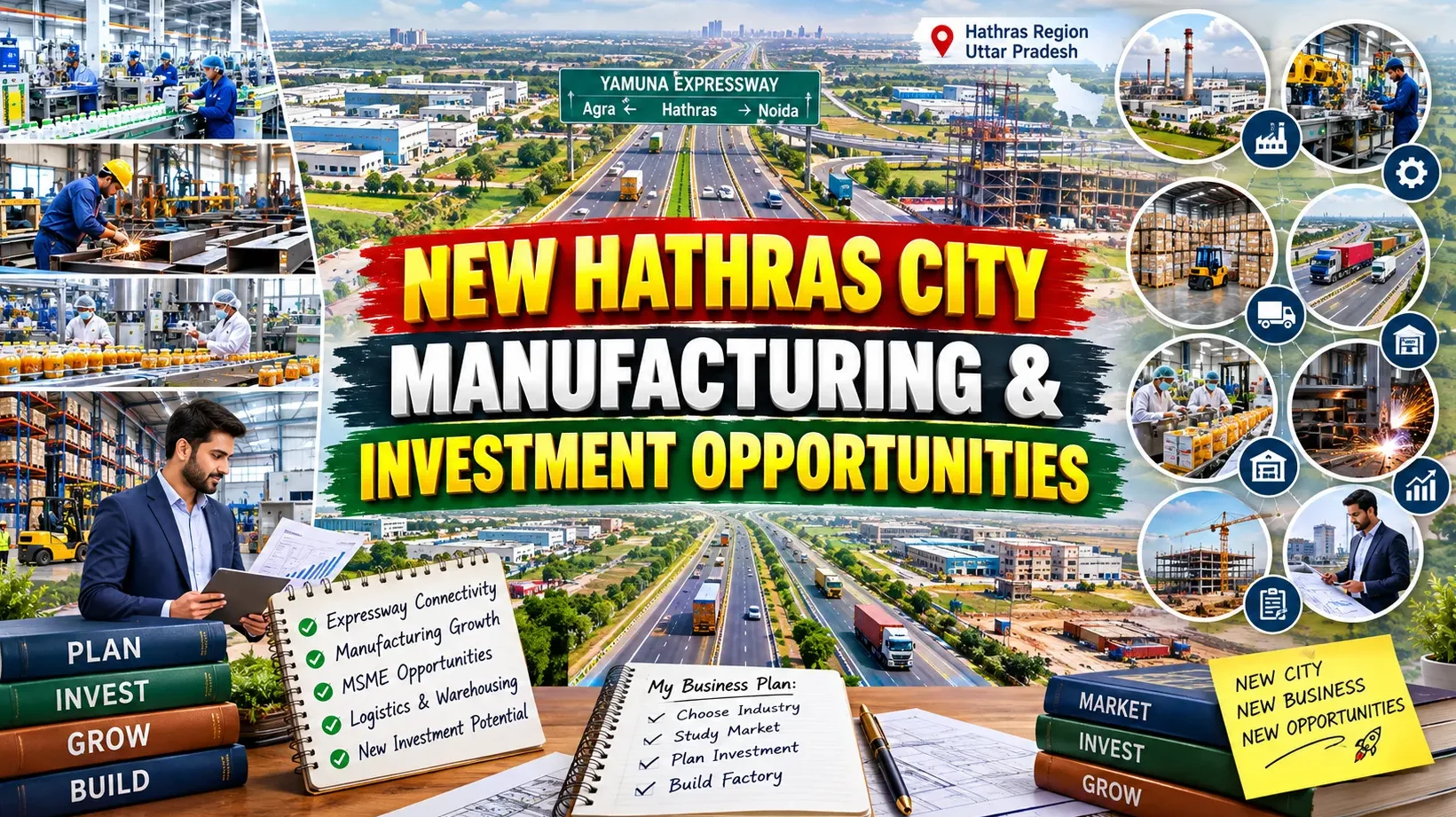

The city development project is quietly changing the industrial landscape of Uttar Pradesh. Under the Master Plan 2031 Phase-II of the Uttar Pradesh government, the Yamuna Expressway Industrial Development Authority (YEIDA) has officially decided to build a new Urban Centre in Hathras district, which has immense commercial value for manufacturers, MSMEs, investors, and startup founders from all over the country.
With more than 10,000 registered MSMEs and cottage industries already present in the town, it is expected that its journey will further place it as the next major hub of industries along the Yamuna Expressway corridor, which is 165 km long. The opportunity map for industry and commerce is large with the planned city being built across around 4000 hectares in 358 villages in Sadar, Sadabad and Sasni tehsils, with the Noida International Airport (Jewar) on a growth catalyst within reach. The right time to draw a map and work this corridor is right now, for entrepreneurs and businesses looking at expansion or greenfield entry.
What This Development Means for Indian Businesses
Proposed New Hathras Urban Centre is not just a real estate initiative. It is an organized industrial-urban development supported by the planning authority of the UP government that involves the interconnection of industrial zones, residences, IT parks, institutional facilities, commercial clusters, green infrastructure and smart civic utilities.
YEIDA has been instructed to engage a consultant to come up with a Detailed Project Report (DPR) that will provide the master plan for urban and industrial architecture in the city. This DPR is likely to provide a blueprint for future industrial areas, residential zones, commercial areas, logistics areas, institutional areas, and ancillary infrastructure, quite different from what an unplanned industrial area would typically have.
To entrepreneurs, the meaning is obvious. Infrastructure is guaranteed in areas planned by YEIDA – roads, power, drainage, water supply – compared to areas that are not planned where utilities are often spotty and expensive. YEIDA’s extensive experience in developing sectors in the vicinity of the Yamuna Expressway, such as Multi-Modal Logistics Park, Electronics Manufacturing Cluster (EMC 2.0), Global Film City, and Semiconductor Park, clearly shows the authority’s capability to create investment-grade industrial geography.
The location of Hathras also adds to the possibilities. The district is surrounded by the Noida International Airport (Jewar) on one side and the National Highway (NH-93) Agra-Aligarh on the other side, and has rail connectivity through Hathras junction, while this area is also flanked by major industrial commercial cities Aligarh to the north-east and Mathura and Agra to the south-west. This geography is the true competitive advantage for logistics-intensive enterprises such as processed food, packaged goods, light engineering and export manufacturing.
Why This Industrial Corridor Could See Stronger Growth
There are several reasons that are making the Yamuna Expressway-Hathras highway of the roadways segment commercially relevant in the medium term.
Airport-led Industrialisation: Large international airports have historically attracted investments in the field of industry and logistics from a radius of 50 to 80 km. Hathras is in the economic circle of the Noida International Airport. Meanwhile, companies in the region can greatly reduce the cost of transporting the most time-sensitive goods, such as processed food, specialty chemicals, handicraft exports, and pharmaceutical logistics, due to the ease of access to air cargo and expressways.
UP Government’s Planned Urbanisation Strategy: The Uttar Pradesh government has approved four urban centres under Master Plan 2031 Phase-II across Aligarh, Mathura, Hathras, and Agra. This is not a standalone announcement but a deliberate, multi-node industrial urbanisation strategy that mirrors the development model used to build Noida and Greater Noida. For investors and manufacturers, planned multi-node development signals long-term infrastructure commitment rather than a one-off policy gesture.
Existing MSME Base Ready for Scaling: Hathras already carries over 10,293 registered MSME and cottage units across industries including glass and ceramic bead manufacturing, piled dhurries, brass lamps, readymade garments, hing (asafoetida) processing, and chemical production. The planned city formalises and upgrades this existing industrial base rather than building from zero — which typically means faster market formation for suppliers, service providers, and ancillary manufacturers who enter early.
Supply-Chain Localisation Demand: National policy directions toward supply-chain resilience and import substitution are driving domestic manufacturing interest across sectors. A newly planned industrial corridor with YEIDA-standard infrastructure and proximity to both Delhi-NCR demand and export gateways is exactly the kind of setting that attracts FDI, joint ventures, and anchor investments — which in turn generate secondary MSME opportunities.
Government Policies and Incentives
Entrepreneurs evaluating entry into the New Hathras corridor have access to a substantial umbrella of government support. At the central level, the Ministry of MSME‘s schemes — including the Credit Guarantee Fund Trust for Micro and Small Enterprises (CGTMSE) and the MSME Development Programme — provide collateral-free credit and technology support to qualifying businesses.
The Udyam Registration Portal enables MSMEs to formally register and access benefits including priority sector lending, technology upgradation subsidies, and cluster development support under various central government programmes.
The Startup India Initiative — administered through the Department for Promotion of Industry and Internal Trade (DPIIT) — offers recognised startups benefits including income tax exemptions, faster patent processing, and access to funds-of-funds. Startups establishing manufacturing units in planned urban corridors like New Hathras can leverage these incentives in combination with state-level support.
At the state level, the Invest Uttar Pradesh portal consolidates the UP government’s industrial investment facilitation, including land allotment through industrial authorities, capital subsidy programmes, and single-window clearances for manufacturing investors. The UP government’s ODOP (One District One Product) scheme formally designates readymade garments and cotton durries as priority products for Hathras — ensuring these sectors receive focused marketing, raw material support, and export promotion.
Turn your budget into a successful business plan
The Yamuna Expressway Industrial Development Authority (YEIDA) itself is the primary land allotment and industrial facilitation body for the corridor, managing industrial plot allotments, residential scheme launches, and infrastructure development mandates.
Export-oriented businesses can access support through the Agricultural and Processed Food Products Export Development Authority (APEDA), especially relevant for hing processors, spice manufacturers, and food product exporters. The Export Promotion Council for Handicrafts (EPCH) provides direct support to glass bead exporters, brass craft makers, and textile artisans through trade fair participation, buyer-seller meets, and product development programmes.
The National Small Industries Corporation (NSIC) supports MSMEs through raw material assistance, technology business incubators, and marketing support — all particularly relevant for cottage industries transitioning to scale in Hathras. The DC-MSME (Development Commissioner, MSME) also provides cluster development support, design intervention, and Common Facility Centre (CFC) development funding for artisanal manufacturing clusters like those in Hathras.
Manufacturing Business Opportunities Emerging From This Development
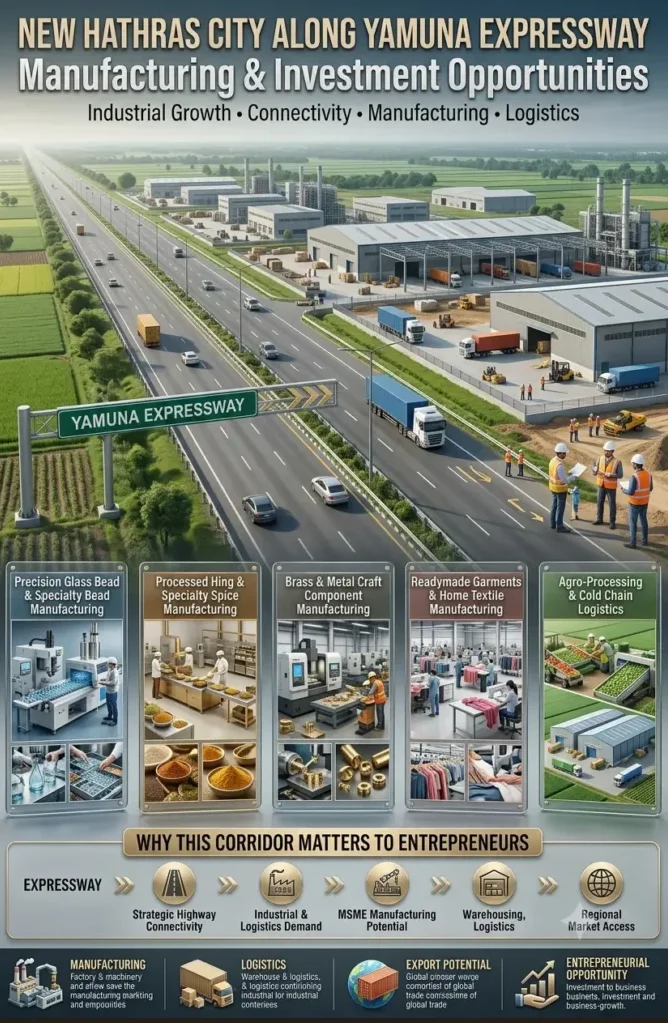
Precision Glass Bead and Specialty Bead Manufacturing
Historically, the Purdil Nagar area of Hathras has been a source of glass beads for local and export markets. But production is still mostly small scale and manual. The availability of a planned industrial zone with stable power, modern infrastructure and expressway connectivity sets the stage for the upgrade to precision glass bead production – such as borosilicate beads for use as traffic road-marking, high-reflectivity beads for safety wear and specialty glass beads for scientific and laboratory uses. In India, with growing highway network, road-marking beads alone make up for an appreciable opportunity of import-substitution. MSMEs with small capital investment of their automated glass bead production line can focus on both road construction contractors within the country and in the export market in the Southeast Asian and African regions.
Processed Hing (Asafoetida) and Specialty Spice Manufacturing
Hathras is one of India’s most concentrated locations for processing of hings with 200-250 hing processing units. Hing mostly comes from Afghanistan and Iran, and manufacturers process it here. The planned urban corridor creates a value-added hing manufacturing opportunity by providing better power, cleaner production spaces, access to cold chain logistics, and proximity to Jewar Airport for air cargo. It will also enable manufacturers to produce encapsulated hings for pharmaceutical applications, standardised compound hings for FMCG supply chains, and organic certified hings for premium export markets. The investment in hygienic and standardised processing units for food safety certification (FSSAI/ISO 22000) makes manufacturers ready for organised retail supply chain and export.
Handbook on Spices
Brass and Metal Craft Component Manufacturing
The traditional base of the city of Hathras is the manufacture of handicrafts, especially of brass and the making of metal parts. The opportunity widens to manufacturing precision brass components for electrical, plumbing, automotive and sanitaryware industries where Aligarh (a major hardware hub) and Agra already have an industrial demand. MSMEs can provide the manufacturing ecosystem that is developing along the Yamuna Expressway, by moving from artisanal production to semi-automated brass die casting, CNC machining, and precision turning. The entry investment is moderate and there is a well-established raw material supply chain in western UP and Rajasthan.
Readymade Garments and Home Textile Manufacturing
In UP government, readymade garments are already included as one of the ODOP categories in Hathras area. The planned urban centre will provide the industrial zone development, improved transportation and labour and logistic access which will create opportunities to grow garment manufacturing from the cottage to organised export production. The production of cotton dhurries, home textiles and institutional garments is an untapped opportunity. Jewar Airport is near, which gives a considerable boost to export logistics. MSMEs who can implement a quality control system and ensure the compliance (OEKO-TEX, GOTS) to the buyer can address home textile importers to Europe and garment buyers in the US market.
Agro-Processing and Cold Chain Logistics
The agricultural potential of the Hathras district is well endowed, yielding wheat, pulses, oilseeds, sugarcane and horticultural products. The planned urban corridor with integrated Yamuna Expressway is an ideal place for agro-processing units such as pulse milling, oil refining, wheat flour milling, dairy processing and export of pulses. The cold storage and temperature-controlled logistics sector is a sector of great potential in the region, and is still very underdeveloped, offering a direct avenue for the development of entrepreneurship for launching multi-commodity cold chain units. The close proximity to big consumer markets in Delhi-NCR, as well as to the Jewar Airport cargo terminal, further enhances the potential of agro-logistics projects.
Food Processing and Agriculture-Based Projects
Construction Materials and Prefab Component Manufacturing
A new planned city creates direct and ongoing demand for construction materials on a 5-10 year time frame to build it. The opportunities are in ready-mix concrete (RMC) plant, AAC blocks (autoclaved aerated concrete), precast structural elements, PVC conduits and plumbing material, architectural metal work. The technology is not particularly complex; local demand is fairly strong and predictable; and there is limited sensitivity to long-distance freight. This is a natural first-mover advantage for entrepreneurs who have their manufacturing units in or near the development zone and are able to supply the construction pipeline.
The Complete Book on Construction Materials
Import-Export and International Market Opportunity
Export Opportunity
The airport cargo access, along with the connectivity of expressways, and the plans of YEIDA for the logistics infrastructure, provide a viable export platform for the producers of the Hathras area. Records show that people exported glass beads to markets for decorative goods in the Middle East, Africa, and Southeast Asia. Processed hing and specialty spices target the South Asian diaspora and specialty foods market in the UK, USA, Canada, and Australia. Through the handicraft export channel, the handicraft items made of brass especially those with ceremonial, decorative and lighting application have found their markets in the Gulf and Southeast Asia. European Lifestyle brands and Fair-trade retailers are the sustainable export market for cotton dhurries and home textiles. Hathras manufacturers hold the product heritage and raw material availability, and with proper quality systems, can market their products in top-end export segments.
Import Substitution
India is importing considerable amounts of traffic safety beads and laboratory grade glass components from China and Europe respectively. The manufacturing capacity of domestic glass beads is still limited, making it a great import substitution product for entrepreneurs who have limited capital and technical knowledge. Likewise, India has a dependence on imported processed hing derivatives, with expansion of processing capacity directly mitigating this reliance. As city construction picks up, the construction material imports, especially the special additives of cement and industrial fasteners, are also the candidates for localised manufacturing.
Indian MSMEs and Startups in Related Industries
T.A. Glass Beads, Hathras is an established exporter of glass beads established in Purdil Nagar, Hathras since 2003 and deals with both domestic and international customers in the fields of Decorative, Imitation jewellery and Specialty glass beads. The unit proves that glass bead production is commercially viable from Hathras MSME level without any infrastructure support and with proper infrastructure upgrade it can support the capacity building and quality improvement. Entrepreneurs who are entering this sector will be able to learn from their experience in developing product range and navigating export markets.
Hathras-Based Hing Processing Clusters: With 200-250 hing processing units operating within the district, Hathras represents India’s most concentrated asafoetida processing geography. Units within this cluster supply hing under various brand names to FMCG companies, wholesale markets, and retail distributors nationally. The cluster model demonstrates that collective infrastructure — shared logistics, common raw material sourcing from importers — can make processing viable at small scale. New entrants focusing on value addition (encapsulated formats, standardised compound grades, organic processing) can differentiate from the commodity players operating in this cluster today.
Aligarh Hardware Manufacturers: Adjacent Aligarh district — part of the same YEIDA Phase-II development corridor — hosts one of India’s largest lock and hardware manufacturing ecosystems, with hundreds of MSMEs exporting to global markets. The Aligarh cluster demonstrates how a traditional manufacturing base can transition to organised export manufacturing with improved infrastructure and cluster support. Hathras’s brass and metal craft ecosystem is at an earlier transition stage but offers a comparable trajectory. Entrepreneurs entering Hathras can use the Aligarh model as a blueprint for building export-capable metal manufacturing businesses.
What Entrepreneurs Should Evaluate Before Investing
The New Hathras opportunity is not imminent but it is real. The DPR is still in preparation and the master plan will require some time to get it approved by the state and be issued as land allotment. These are a few parameters to consider when deciding if you are an entrepreneur that enters with the hope of this development:
Market Demand Verification: Determine the verifiable market demand of the proposed product/service either locally (construction, agro-processing, readymade garments) or internationally through existing export outlets (glass beads, hing, handicrafts). Don’t presume that demand will automatically follow from the city announcement planned.
Raw Material Availability: Verify proximity and reliability of raw material supply chains. Hing raw material is imported; glass requires silica and specific mineral inputs; brass requires metal sourcing networks. Supply chain mapping is an essential pre-investment step.
Technology and Machinery: Assess whether the level of automation chosen is appropriate for the planned scale. Entry-level glass bead and brass manufacturing can start at modest investment levels, but food processing and precision component manufacturing will require certified equipment and quality systems.
Regulatory Requirements: Food processing businesses require FSSAI licensing. Export-oriented manufacturers may need BIS certification, APEDA registration, or product-specific certifications (OEKO-TEX for textiles, ISO for engineering components). Early clarity on regulatory requirements prevents costly delays.
Working Capital and Cash Flow: Manufacturing businesses in emerging corridors typically have longer receivables cycles. Entrepreneurs should model working capital requirements over a 12-18 month ramp-up period and explore CGTMSE-backed credit lines to manage cash flow gaps.
Scalability and Risk Management: The strongest opportunities in a planned corridor are businesses that can scale progressively as infrastructure and demand grow. Prioritise models with variable cost structures and expansion optionality, and plan contingencies for infrastructure delivery delays.
How NPCS Can Help Entrepreneurs Evaluate the Opportunity
NPCS – Niir Project Consultancy Services is a specialist industrial consultancy offering entrepreneurs a structured approach to evaluating manufacturing opportunities in emerging industrial corridors such as New Hathras. NPCS prepares Detailed Project Reports (DPRs) and feasibility studies that cover market demand analysis, plant and machinery specifications, raw material sourcing, production process design, capital expenditure modelling, working capital assessment, break-even analysis, and financial projections.
For opportunities specifically connected to the Hathras corridor — glass bead manufacturing, hing and spice processing, brass component manufacturing, agro-processing, textile manufacturing, and construction material production — NPCS can provide technology consultancy, plant layout guidance, machinery supplier identification, and market research tailored to the specific scale and investment appetite of each entrepreneur. For those seeking to enter a planned industrial zone, a professionally prepared DPR is not just advisable — it often serves as a prerequisite for obtaining institutional financing and regulatory approvals.
Business Opportunity Snapshot
| Industry | Urban & Industrial Development, Manufacturing (MSME), Agro-Processing, Handicrafts, Construction Materials |
| Market Driver | YEIDA Master Plan 2031 Phase-II; Noida International Airport (Jewar); Yamuna Expressway Corridor Expansion |
| Key Development | New Hathras City planned across 4,000 hectares, 358 villages; DPR under preparation by YEIDA |
| MSME Opportunity | Glass beads, hing/spice processing, brass components, readymade garments, agro-processing, construction materials |
| Manufacturing Potential | High – existing MSME cluster of 10,000+ units; planned zone adds infrastructure advantage |
| Export Potential | Moderate to High – glass beads, hing, brass handicrafts, home textiles have established export channels |
| Import Substitution | Specialty glass beads (traffic safety); processed hing derivatives; construction specialty materials |
| Government Support | YEIDA land allotment, UP ODOP scheme, MSME Ministry schemes, Startup India, CGTMSE, APEDA, EPCH |
| Investment Consideration | Entry-level: INR 25-75 lakhs (cottage/MSME); Medium-scale: INR 1-5 crore; large-scale manufacturing higher |
| Risk Level | Moderate – DPR under preparation; infrastructure delivery timelines subject to government approvals |
| Growth Outlook | Positive over 5-10 year horizon; aligned with UP government’s industrial urbanisation strategy |
Conclusion
The announcement of the New Hathras urban centre under YEIDA’s Master Plan 2031 Phase-II represents one of the more commercially significant infrastructure development signals to emerge from Uttar Pradesh in recent years. Moreover, it is not a standalone real estate scheme — it is a planned industrial-urban corridor initiative that the government authority backs, aligns with airport-led growth from Jewar, and situates in a district that already carries one of the most concentrated MSME manufacturing bases in the Yamuna Expressway region.
As a result, for entrepreneurs, manufacturers, and investors, the development opens up opportunities across glass bead manufacturing, processed hing and specialty spices, brass component production, textile and garment manufacturing, agro-processing, and construction material supply. Furthermore, export potential is real, import substitution opportunities are specific and verifiable, and government support frameworks — from YEIDA land schemes to central MSME programmes — are already in place.
Importantly, this is an opportunity that rewards early, informed evaluation — not speculative entry. Therefore, entrepreneurs who invest now in proper market research, feasibility study preparation, technology assessment, and financial modelling will be best positioned to make sound investment decisions as the corridor develops. Ultimately, the recommended path is clear: Market Research → Feasibility Study → DPR Preparation → Investment Planning → Phased Market Entry.