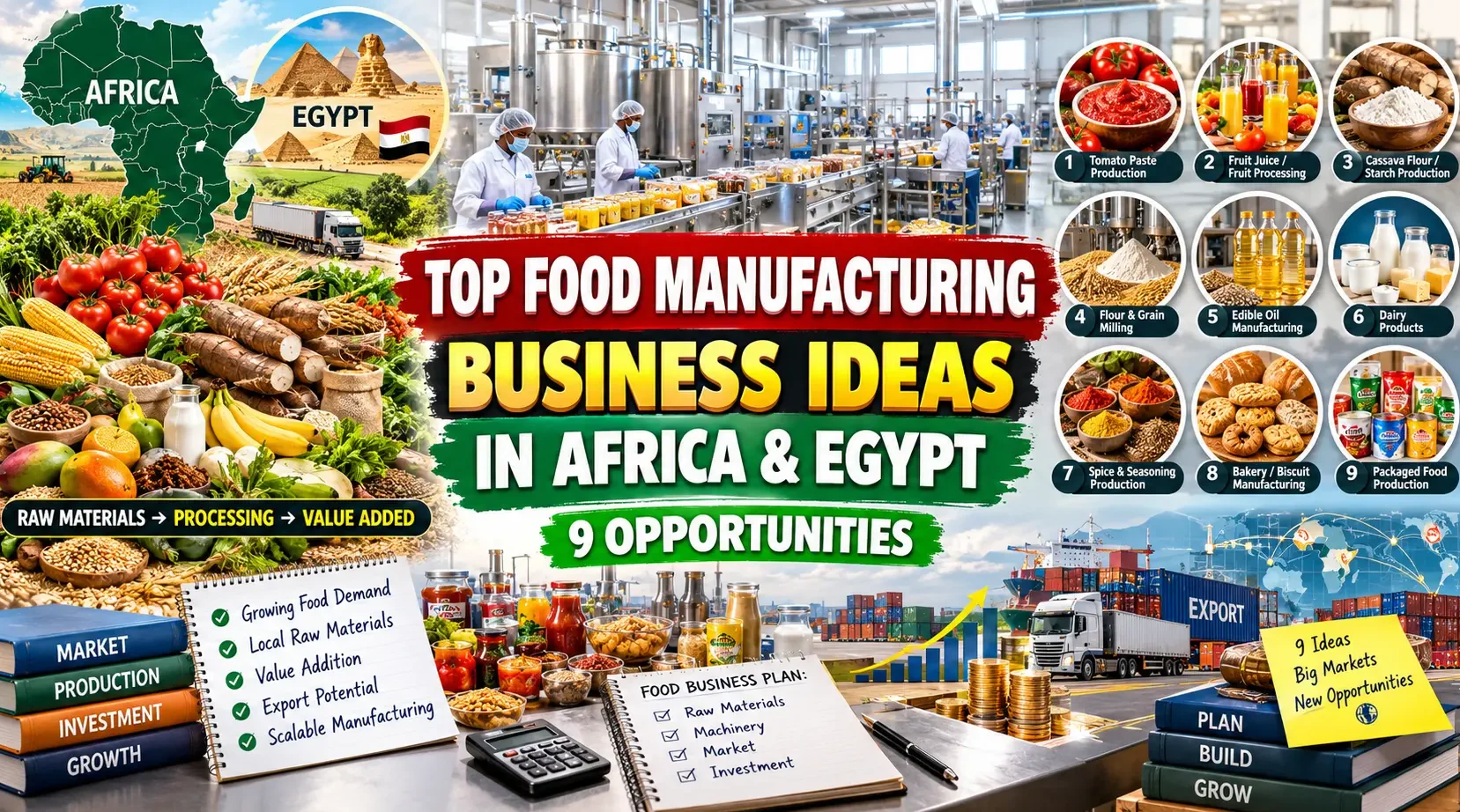

The Food Manufacturing Opportunity in Africa and Egypt
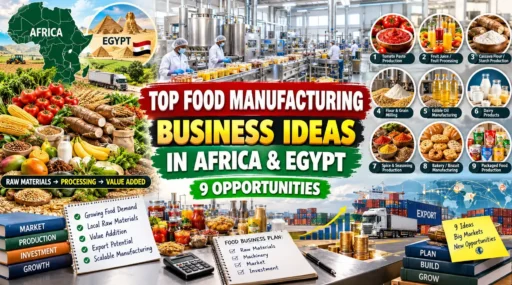
The food and beverage market in Africa is no longer a promising frontier to explore; it is a hot market that is attracting serious investment. Africa and Egypt may prove to be one of the most lucrative food manufacturing business ideas with solid ground in the modern era for those who are interested in the field. Rapid urbanization, youthfulness, increasing disposable income, and fast-growing trade between nations within the African Continental Free Trade Area (AfCFTA) have established the conditions for scalable and profitable manufacturing enterprises in various food categories.
The story is centered on Egypt. With its population of more than 100 million people, a vast industrial infrastructure, and access to global markets, Egypt is a strategic food production and trade hub, providing regulatory support and business environment to entrepreneurs. If you are a Startup founder looking to make your first venture into manufacturing or an investor wanting a diversified food business portfolio, now is the time to do it!
Why Food Manufacturing in Africa and Egypt Is a Smart Business Move
The food and agribusiness market in Africa is poised to grow to USD 1 trillion per year, as a result of both demographical growth and structural change. Furthermore, Africa has an unsurpassed natural basis for food production with over 60% of the world’s uncultivated arable land. However, the true scope of the business opportunity lies not in producing raw produce, but in transforming raw produce into packaged, branded, processed produce, which can generate higher margins and reach urban consumers.
In addition, Egypt’s industrial sector adds a lot to this story. Moreover, the nation has always been one of the leading producers of dates, citrus fruits, olive oil, sugar and rice, which expands into the domain of manufacturing. Furthermore, the Egyptian government’s industrialization, export promotion and support for MSMEs provides one of the most business-friendly environments in Africa for food entrepreneurs.
Moreover, the AfCFTA has facilitated preferential trade corridors between 54 African countries, which have lowered tariffs and made exporting easier. As a result, for Egypt-based food producers, that means they can sell to more than 1.3 billion people in Africa.
Government Policies, Incentives, and Regulatory Support for Food Businesses
The Egyptian government and international development institutions have put in place robust support programs for the food manufacturing sector in the region. Any entrepreneur knowing and making use of these programmes will have a great competitive advantage.
Egypt’s Industrial Development Authority (IDA) Support
The Industrial Development Authority (IDA) offers specialized services to manufacturing companies, such as the provision of industrial areas, acceleration of licensing procedures, and access to industrial infrastructure. Qualifying food manufacturers can benefit from Egypt’s Special Economic Zones (SEZs), including the Suez Canal Economic Zone, by enjoying lower corporate tax rates, customs exemptions, and infrastructure assistance. The Egypt IDA Industrial Zones Programme is available to offer comprehensive information on zones and incentives.
African Development Bank (AfDB) Agribusiness Support
The African Development Bank Feed Africa Strategy has an active portfolio of food processing and manufacturing projects in the Bank’s member countries. The business can receive grants, concessional loans, equity partnerships for businesses involved in value-added food production. Egypt based manufacturers with export orientation are often available for financing by the AfDB, via commercial partner banks.
AfCFTA Market Access Opportunities
Through the AfCFTA Secretariat Trade in Goods Protocol, over time, tariffs will be phased out for 90% of traded goods between member states. Egyptian food manufacturers benefit from this as an incentive to manufacture in large volumes and distribute them across Africa. The trading of processed grains, bottled beverages and packaged dairy products can offer the greatest gains to the industries.
World Bank Investment Climate Support
The World Bank Group (WBG) Investment Climate Report (ICR) for Egypt (2014) points out that the country is an investment-friendly economy, especially in its manufacturing sector. The process of establishing and expanding new food businesses has become simpler through regulatory streamlining, better customs documentation processes and continuing infrastructure investments.
Top Food Manufacturing Business Ideas for Africa and Egypt
The below business ideas are the most promising, profitable and sustainable food production ventures in Africa and Egypt. The local availability of raw material resources, domestic demand and export potential are strong factors in each segment.
1. Date Processing and Packaging
Egypt is one of the largest producers of dates; however, a significant portion of the date crop is being exported to consumers with minimal value additions. Entrepreneurs who venture into date processing and packaging can make a lot of profit when they clean, grade, pit-remove, and package dates into premium retailable forms such as date boxes, health snack packages, stuffed dates with nuts and date paste for the food ingredient industry. Egypt’s date exports are sold to more than 60 countries and the demand for premium date products in the Middle East, Europe and North Africa is increasing at a rapid pace.
A date processing unit with cold storage and grading machines, as well as modern packing lines, can be of service to both domestic retailers and international importers. According to the Food and Agriculture Organisation Date Statistics, Egypt has consistently remained in the top five countries of date production in the world. Processed and branded dates usually have margins between 3 and 5 times as high as selling raw fruit.
2. Olive Oil Extraction and Bottling
An important olive production area in Egypt is the northern coastlands around the Mediterranean belt. But the business of olive oil production is largely unstandardized, non-branded and unpatented; and, as such, is the space of an olive oil entrepreneur a relatively uncontested but high-value one. Placing a cold-press extraction unit, having bottling and labelling facilities with quality certification makes a business ready for handling premium domestic retailers, export to the Gulf markets and compete with the European imports. There is still a demand for extra virgin olive oil in North Africa and the Middle East, due to the growing health consciousness and food trends. This differentiator is the quality certification: EU organic certification or Egyptian food safety standards, which opens new export markets. Entrepreneurs can also be engaged in the hospitality industry, which is a large and regular consumer of good oils.
Olive Oil Manufacturing: Complete Business Guide
3. Packaged Grain, Flour, and Milling Products
Egyptian people and the entire African continent rely on grains, cereals and their derivatives as the core of their diet. Grain milling and flour packaging business is an industry with tremendous volume and regular demand. The consumption of fortified flour, multigrain flour mixes, chickpea flour, lentil flour and special cereal products is rising along with wheat flour. Egypt has a good supply of raw materials, particularly wheat, maize and legumes, as a result of its agricultural production. Local unorganised retailers in the cities can be replaced by a more hygienic and consistent quality milling unit with brand packed products. Further, school feeding programmes and government nutrition programmes in African countries are bulk purchasers and are stable, which can facilitate business planning and production scheduling.
Flour Milling Manufacturing Project Report
4. Dairy Processing and Cheese Manufacturing
Across Egypt and North Africa, people consider milk, yoghurt, cheese and cream products to be high-consumption staples. However, small informal farmers still carry out most of the production. With hygienic production, modern cold-chain logistics and branded retail packaging, an entrepreneur who enters the dairy processing and cheese manufacturing business immediately occupies the premium market position. Romy (local favourite) cheese, white brined and processed cheese spreads are popular cheese varieties. Modern dairy manufacturers are seeing a tailwind as the urban middle class increasingly prefers brands and quality-assurance of dairy products. The expansion of capacity to long shelf-life products such as UHT milk, cream cheese, labneh opens the door for businesses to expand geographically without investing heavily in refrigerated logistics. The FAO Dairy Market Report highlights one of the fastest-growing consumption areas for dairy products in the world – Africa.
5. Beverage Manufacturing — Juices, Energy Drinks, and Herbal Beverages
African and Egyptian beverage manufacturing covers natural fruit juices, carbonated beverages, energy drinks, herbal drinks and fortified drinks. Agriculture is rich in Egypt, it is found a large amount of citrus, guava, mango and pomegranate which gives the Egyptian manufacturers an advantage in the raw material for natural juices. Meanwhile, the energy drink and sports nutrition market is on the rise as younger Africans are increasingly embracing active, health-conscious lifestyles. An entrepreneur can identify more than one sub-segment at a time when he establishes a beverage plant with aseptic packaging line or glass bottle line. Distribution channels in cities around Africa are more accessible than ever and organised retail expansion provides an opportunity for increased shelf space for new brands. Sugar-free, natural and herbal drink variants have significant margins and positioning potential in urban markets.
Health Beverage Manufacturing Business in India: Cost, Profit and Market Demand
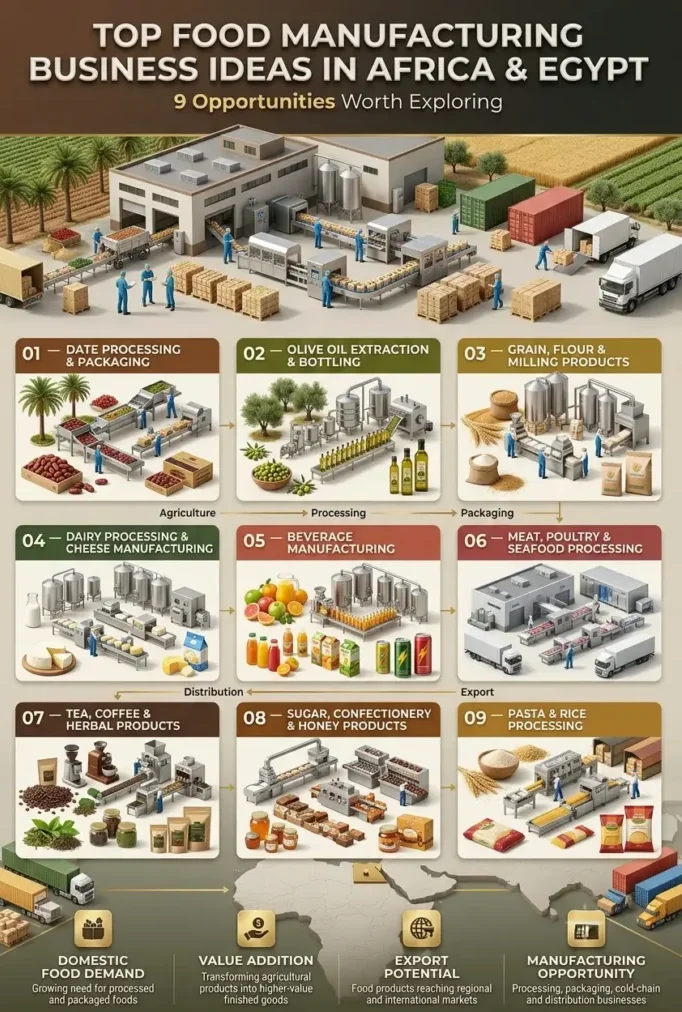
6. Meat, Poultry, and Seafood Processing
The processed and packaged meat, poultry and seafood market is a large and untapped manufacturing sector in Africa. Poultry is a significant industry in Egypt but value-added processing, such as marinated chicken cuts, ready to cook kebab mixes, portions of frozen seafood and canned fish is less developed than market demand. Quick-service restaurants, supermarket stores, hotels and caterers are among the establishments that may use processing businesses for regular supply or for foods that require hygienic handling. Halal certification is one of the most crucial factors that enable Egyptian domestic markets and export to Muslim countries in the Middle East and Africa. Cold chain and chilled product markets can launch as a niche business and gradually broaden to include frozen products that offer a longer shelf life and wider distribution area.
Read the Complete Meat & Poultry Preservation Book
7. Tea, Coffee, and Herbal Product Manufacturing
Coffee was invented in Africa and it is one of the most important coffee producers in the world. While not a major grower, Egypt is a large consumer and re-exporter of herbal infusions and specialty teas such as hibiscus (karkade), chamomile, anise and peppermint. Entrepreneurs who want to start a tea blending, herbal packaging, and instant coffee manufacturing business in Egypt will have the opportunity to import the raw herbs locally as well as from East Africa, blend them under retail brands, package them, and sell them locally and in the MENA region. There has been a huge surge in demand for functional herbal teas across the globe as a result of the global wellness movement. Private-label manufacturing for supermarket chains, hotel amenities and healthcare retail chains is an especially appealing enterprise model, as it offers a stream of steady sales and lower marketing expenses.
The Complete Book on Cultivation and Manufacture of Tea
8. Sugar, Confectionery, and Honey Products
Sugar production and confectionery making are traditional Egyptian businesses. There are several options available for the sugar industry entrepreneurs: sugar refining and packaging, traditional Egyptian sweets (such as basbousa, konafa fillings and halva), or modern confectionery formats like chocolate coated, hard candies and gummies. Another good enterprise in this category is the processing of honeys, especially those from the Egyptian apiaries where different varieties of flowering plants are raised. Raw honey, herbal infused honey, medical grade honey for the healthcare industry and branded honey for health-conscious consumers present good margins. The International Trade Centre Trade Map for Egypt Confectionery illustrates the stable export demand for sugar and confectionery products from Egypt throughout the world.
The Complete Book on Beekeeping and Honey Processing
9. Pasta and Rice Processing
In Egypt pasta and rice are daily mains and are widely eaten in North and sub-Saharan Africa. Pasta manufacturing and rice milling are reliable demand categories, have relatively simple production processes and have good retail channels. Durum wheat pasta, in particular, is a good price and quality product when compared with the European pasta imports. In the case of the rice business, the entrepreneurs, who have invested in modern whitening, sorting and branded packing equipment, can change the consumer preference from unbranded loose rice to standardised and convenient, packaged rice. Premium extensions add value to products like parboiled rice, quick cook rice and vegetable/pasta protein blends, without requiring significant capital investments, but they can help increase the per-unit revenue.
Pasta Manufacturing: A Tasty Opportunity for Smart Entrepreneurs
Import–Export Opportunity Analysis for Food Manufacturers
Egyptian food manufacturers have, perhaps, the greatest opportunity for growth today in the export market. Egypt, with its geographical location, and its trade relations with Libya, Sudan and the Red Sea route, is in the centre of two of the world’s fastest-growing consumer markets: Sub-Saharan Africa and the Gulf Cooperation Council (GCC).
The GCC market, especially Saudi Arabia, the United Arab Emirates and Qatar, is a significant market for the importation of processed foods and actively looking for suppliers that are certified halal and competitive. With its cost structure, local manufacturers enjoy a price advantage over European manufacturers. On the other hand, under the AfCFTA, lower tariffs on Egyptian products sent to countries in East Africa, West Africa and Central Africa make it an ideal route for packaged food exports.
Dates, olive oil, cheese, packaged rice, herbal teas, and confectionery are among Egypt’s strongest export categories. The Egyptian Export Council for Food Industries actively facilitates market access, buyer introductions, and trade fair participation for food manufacturers targeting export. On the import side, Egypt also presents opportunities for entrepreneurs who want to establish value-added processing of imported raw materials — cocoa processing, tropical fruit drying, or specialty coffee roasting — leveraging Egypt’s infrastructure and export connectivity.
The World Trade Organization Egypt Trade Profile confirms Egypt as one of Africa’s most active traders, with food and agricultural products forming a significant share of both export and import activity. For entrepreneurs, this means a mature trade ecosystem — with logistics, customs, and banking infrastructure — already in place to support a new manufacturing venture.
Food Manufacturing Success Stories: MSME and Growth Models to Learn From
Juhayna Food Industries — Egypt’s Dairy and Juice Champion
Juhayna Food Industries is an Egyptian food manufacturing success story. began as a small dairy business but has since developed into Egypt’s biggest and largest company listed on the stock market with a portfolio of milk, yoghurt, juice, and cream products, sold across the country. For new entrepreneurs, the key is the focus on backward integration in Juhayna: it went beyond simply farming dairies and cold storage facilities, it invested in its own farms, cold chain infrastructure, and distribution channels. The outcome was quality assurance, a reduced cost of inputs and better shelf appeal. The same principle can also apply at a smaller level to people looking to start a business in the dairy industry or the juice industry: have more control over the raw material source early on, invest in cold logistics before scaling up, and develop brand trust by ensuring uniformity of packaging and product quality.
Edita Food Industries — Egypt’s Packaged Snack Leader
The disciplined manufacturing quality and aggressive retail distribution of Edita Food Industries have changed the snack and confectionery landscape in Egypt. The firm, which made products such as HoHos, Twinkies (Egyptian market variant), and Tiger tails, did so by targeting a segment that big global giants neglected: cheap, uniform, branded packaged snacks that are readily available for Egyptian consumers. Manufacturing is based on the Edita’s model, which focuses on automation, international food safety standards (HACCP, ISO) and targeted product innovation according to local tastes. The take-home message is that, for new food entrepreneurs, it is possible to grow very quickly in Africa’s brand-conscious markets, by adapting international product formats to local preferences and price points.
BiscoMisr — Egypt’s Biscuit Manufacturing Giant
Another example of the power of scale and brand loyalty is BiscoMisr, an Egyptian food manufacturer. Previously, BiscoMisr was formerly a state-owned enterprise and has now become a competitive biscuit and wafer producer and manufacturer of several brands which are dominating Egyptian retail shelves. Moreover, with an efficiency plan, branding and a distribution scale plan, even a food category as basic as biscuits, crackers, wafers, can return a fantastic return. Therefore, starting a new business in the grain-based food manufacturing industry in Africa can be an inspiration to make food affordable, adopting new packaging technologies and slowly expanding the SKU list, as BiscoMisr does.
Discover business ideas that actually make money
How NPCS Supports Food Manufacturing Entrepreneurs
Entrepreneurs intending to establish a food manufacturing company in Africa or Egypt must go through a thorough feasibility study, financial modelling, and production process, regulatory considerations, as well as supply chain economics. It is here that the entrepreneurs get value added service from Niir Project Consultancy Services (NPCS) in a direct and measurable way.
For businesses looking to establish new manufacturing establishments in the food and agribusiness segments, NPCS generates professional Market Survey cum Detailed Techno-Economic Feasibility Reports (DPRs). The information in these reports includes all aspects of the project’s assessment: in-depth manufacturing steps, process flow diagrams, product range and capacity planning, machinery and raw materials procurement information, market research and market demand analysis, and comprehensive financial models of the project, including profitability analysis and payback calculation.
An NPCS feasibility report provides a solid analysis and basis for making sound investments decisions in a date processing unit, olive oil extraction plant, dairy processing plant or grain milling operation and also forms a solid business case for banks, investors and government. We want to help entrepreneurs determine if it’s feasible, profitable, and scalable before putting money into a business.
Food Manufacturing Business Ideas in Africa & Egypt — Market Snapshot
| Business Category | Key Products | Primary Market | Export Potential | Raw Material Availability |
| Date Processing | Premium dates, date paste, stuffed dates | Domestic + Middle East | Very High | Egypt — World Top 5 Producer |
| Olive Oil Extraction | Extra-virgin olive oil, blended oils | MENA + Europe | High | Northern Egypt — Mediterranean Belt |
| Grain Milling & Flour | Wheat flour, multigrain, specialty flours | Domestic + Africa | Medium-High | Egypt, Sudan — Strong Output |
| Dairy Processing | Cheese, yoghurt, UHT milk, labneh | Domestic + GCC | Medium | Egypt Dairy Belt |
| Beverage Manufacturing | Juices, energy drinks, herbal drinks | Domestic + MENA + Africa | Very High | Egypt — Citrus, Guava, Mango |
| Meat & Poultry Processing | Marinated cuts, frozen products, canned seafood | Domestic + GCC | High | Egypt Poultry Industry |
| Herbal Tea & Coffee | Herbal blends, karkade, instant coffee | Domestic + MENA + Europe | High | Egypt, Ethiopia, Kenya |
| Sugar & Confectionery | Branded sugar, traditional sweets, honey | Domestic + GCC + Africa | Medium | Egypt — Sugar Cane & Beet |
| Pasta & Rice Processing | Packaged pasta, parboiled rice, fortified variants | Domestic + Africa | Medium | Egypt — Strong Grain Base |
Conclusion: Act on the Africa Food Manufacturing Opportunity Today
The food manufacturing revolution on Africa is not in the future; instead, it is happening now. Moreover, Africa’s and Egypt’s food market is worth $1 trillion, the free trade framework is a continental one, and government incentives for industrial development, coupled with a large and growing consumer base, are the most conducive to a successful food manufacturing business ever.
For example, from date processing, olive oil production, dairy processing, to beverages and grain milling, the essential ingredient is to take action on solid market data and a well-prepared feasibility plan. Furthermore, building a quality infrastructure, certification, and branding system from the beginning, not as a side project, will give entrepreneurs the edge they need to seize local markets and the increasing demand for exports.
Geographically, Egypt lies at the centre of Africa’s food entrepreneurs and their strategy, while economically it is a relatively well-developed industrial region and plays a key role in AfCFTA. Therefore, those businesses that set up now will shape the African food manufacturing of tomorrow.
Finally, take a professional feasibility study to take the first steps towards a food manufacturing business in Africa or Egypt. In addition, NPCS’ detailed Techno-Economic Feasibility Report will provide you the financial clarity, process knowledge and market intelligence to have confidence in moving forward. Therefore, contact our Consulting team today to assess your project opportunity…