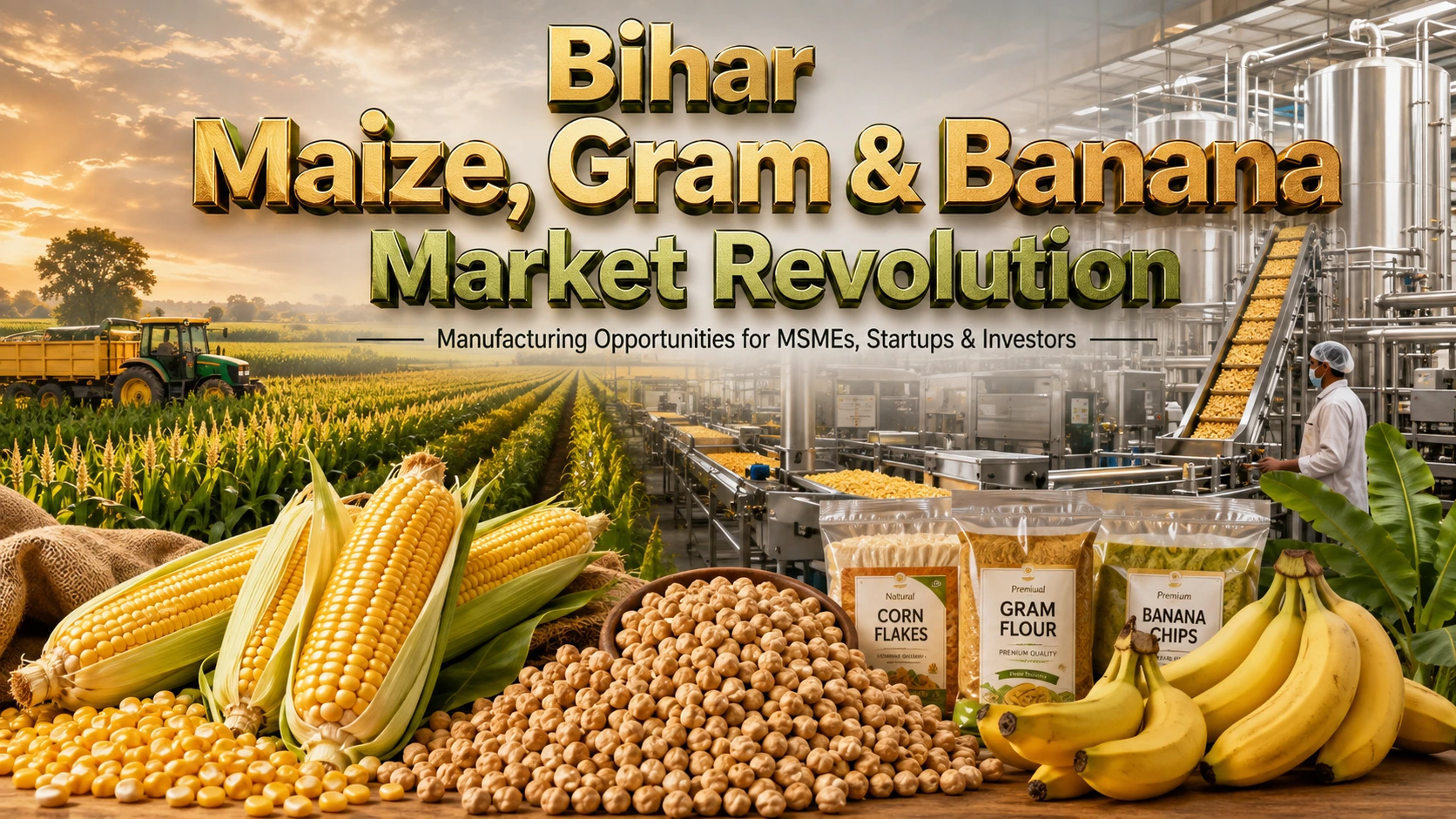

A recent report in Dainik Bhaskar, the Bihar’s most widely circulated Hindi newspaper, has brought to light a landmark initiative by the Government, to link up Bihar maize, gram (chickpea) and banana farmers to new markets with higher prices. It is a part of the state’s Direct Benefit Transfer (DBT) Agriculture framework specifically aimed to boost the income of farmers by up to 50 per cent. To those who know the story of agriculture in Bihar, it is not only a good news for farmers, it is a signal flare for the entrepreneurs and manufacturers and the investors too.
Bihar agriculture is at a turning point. It is the state that contributes around 10% of India’s total maize production and is among top maize producing states of India for production of banana and gram. But for decades, more than 90% of farm produce has been sold locally at distress prices to the traders and middlemen within the village itself, leaving the farmers and the processors no margin for the market linkages that would be provided by the formal market.
If the state government takes a positive step to develop new value chains for these three crops, then it does two things at once; establishing a price floor for farmers and a supply floor for processors and manufacturers. The business opportunity that arises is genuine, scalable and government sponsored. In this article, you’ll discover how to find the opportunity and what you can do about it right now.
What the Dainik Bhaskar Reporting Means for Business
As per news report of Dainik Bhaskar, Patna, the Bihar government is making serious efforts to establish institutional market linkages for maize, gram and Banana farmers in the state. The target set is for farmers to earn 50% more, which has specific policy support, such as increased mandis, DBT subsidy, new processing infrastructure support etc.
There’s a reason all business strategists should be paying close attention:
What Happened
The Bihar government has announced to develop new market outlets for three crops namely maize, gram and banana to shift the supply from distress selling to traders to the organized market channels like mandis, FPOs (Farmer Producer Organisations) and agro-processing linkages.
Why It Matters
The value chain doesn’t simply grow when new markets arise for raw agricultural commodities; it deepens as well. An increase of 50% in farmers’ income translates into 50% increase in their purchasing power in rural Bihar. It equates to increased raw material entering into formal supply chains. It means a green light for investment in processing infrastructure, and it means it’s coming from the government.
What Opportunities Emerge
- Entrepreneurs can start to develop processing units based on a now formalized supply chain.
- MSMEs can directly enter into contract with FPOs for assured quality raw material.
- Investors can go to a state that has shown 14.9% economic growth as compared to the national average of 12%.
- Exporters can use Bihar’s winter maize as a premium global commodity as it is already registered by the APEDA.
- Startups may develop market aggregation platforms, cold chain logistics platforms, and digital trade platforms.
The Bhaskar report is not a statement of news. It lies in the overarching agri modernization plan of Bihar, which involves cluster farming, providing support for cold chain infrastructure and providing incentives to agro-processing startups by the state government, as reported in various recent articles by Dainik Bhaskar.
Why the Agro-Processing Industry Is Growing Fast in Bihar
The statistics of the economy of Bihar speak for themselves. According to Bihar Economic Survey 2025-26, Bihar’s GSDP is pegged at Rs. The value of India’s postal services increased at 13.1% at constant prices to reach 9.91 lakh crore. Agriculture accounts for about 19.9% of GSDP, but the food processing industry remains underdeveloped. This industry generally adds two to three times the value of raw agricultural products and also faces a chronic problem.
This is where the opportunity lies. The very issues that are being mentioned in the Bhaskar report — lack of market linkages, middlemen-driven price suppression, lack of cold chain — are the very issues at which the Bihar government is directing all the efforts of state and central resources.
This growth is being reinforced by key drivers of demand, which include:
- Animal feed demand: The demand from the poultry and dairy industry accounts for more than 60% of the domestic maize production and is increasing at a rate of 8-10% annually.
- Maize Starch, Glucose syrup and bio-ethanol: Industrial demand for maize starch, glucose syrup and bio-ethanol are on the rise, due to growth in the food industry and energy transition.
- Derivatives of gram (besan): In all urban and semi-urban markets, the use of gram flour has been steadily increasing owing to health and traditional food preferences.
- Value addition of bananas for production of banana flour, banana chips, dried banana and extraction of fibres from banana pseudo stems are potentially high value products for export.
In 2025-26, India exported maize totaling 1.25 million MT with a value of Rs. according to APEDA. 3,357 crores. Foreign buyers are particularly drawn to Bihar’s winter yellow maize which is quoted at $220-245 per MT FOB.
Government Policies and Incentives You Should Know
The business case for investing in Bihar’s maize, gram, and banana processing ecosystem is strengthened enormously by overlapping government schemes. Below are the nine key frameworks:
- PM Formalization of Micro Food Processing Enterprises (PMFME): Offers 35% credit-linked subsidy up to Rs. 10 lakh per processing unit.
- DBT Agriculture Bihar: Direct subsidy transfer for farm inputs, seed, machinery, and market linkage support. Register at dbtagriculture.bihar.gov.in
- Bihar Industrial Investment Promotion Package (BIIPP) 2025: Extended through December 2026, offering capital subsidies and tax incentives for new manufacturing units.
- Bihar Startup Policy 2022-27: Interest-free seed loan up to Rs. 10 lakh for 10 years for eligible startups. See startup.bihar.gov.in
- National Food Security Mission (NFSM) — Pulses: Specifically supports gram/chickpea cultivation and processing linkages.
- Mission for Integrated Development of Horticulture (MIDH): Covers banana value chain development, cold storage, and processing. Access at midh.gov.in
- PM Kisan Samman Nidhi (PM-KISAN): Farmer direct income support boosting rural purchasing power — enabling demand for processed farm products. See pmkisan.gov.in
- National Horticulture Mission (NHM): Supports horticultural processing, packaging, and cold chain for banana — a key crop named in the Bhaskar report.
- APEDA — Agricultural and Processed Food Products Export Development Authority: Provides export promotion, registration, and market access support for processed maize, banana, and gram products.

6 Manufacturing Business Opportunities Directly Emerging from This News
The report of Bhaskar also highlighted new market linkages for maize, gram and bananas in Bihar directly opening up the following manufacturing opportunities. Both are good investment opportunities for any MSME and can provide several government subsidies.
1. Maize Starch and Glucose Syrup Manufacturing Plant
This is because new market linkages have now been in place and allowed the Maize Entrepreneurs to enter into a contract with FPOs or mandis to get raw maize regularly without the risk of the middlemen.
Maize starch is an industrial input in the pharmaceuticals, textiles, paper, adhesives, processed foods and fermentation industries. The Indian maize starch market is expanding, while processing capacity is significantly less than demand. The winter yellow maize – already known for being a premium export – is an ideal feedstock for Bihar.
Investment Range: Rs. 50 lakhs (small-scale) to 5 crores (industrial). Revenue potential: Rs. From 1.5 crore to 8 crore per annum depending on the scale. The target buyers are pharma companies, textile mills, glucose syrup distributors and snack food manufacturers.
Read the Complete Book Here: Handbook on Maize (Corn) Processing and Manufacture of Maize Products
2. Besan (Gram Flour) and Chickpea Dal Milling Unit
The reason why this is coming out of the news: Gram (chickpea) is one of three crops that the Bihar government is investing in new markets in particular. The besan mill is now located near the important gram producing areas in southern Bihar (Patna, Bhojpur, Aurangabad, Nalanda) where it can purchase quality raw material from formal market at the transparent price.
Besan is a year-round staple used in pakoras, namkeen, ladoos, batter mixes, and exported gram flour products. India’s annual besan production exceeds 5 million tonnes, with demand consistently outpacing organized supply. A fully automatic 50 TPD besan mill requires Rs. 1.5-2.5 crore investment and can generate Rs. 4-7 crore in annual revenue.
Product extension opportunity: Roasted gram (chana), sattu (a Bihar-specific high-protein flour with growing national demand), chana dal, and chickpea-based protein concentrate for export.
Access Complete Business Plan: Seed Processing Unit (Wheat & Chickpea) – Detailed Project Report
3. Banana Flour and Dried Banana Products Manufacturing
Why this comes in the news: Banana is the third identifiable crop mentioned in the Bhaskar report’s announcement on the expansion of the market. Bihar is already a leading banana producer state in India and has enormous production in Muzaffarpur, Vaishali and Samastipur districts.
Green bananas are a source of banana flour, a gluten free high resistant starch food that is in the process of being rapidly demanded on a global scale. Used in baking, baby food, sports nutrition and health food. Exports are to the EU, UK, Middle East and SE Asia. Other processing options for bananas include dried banana chips and banana powder, which are new products that can be dried with minimal investment.
Investment Range: Rs. 30 lakhs to Rs. 2 crores. The banana pseudo stem (trunk of the plant) is a further source of income: banana fibre has applications in textiles, paper and eco-packaging. Entrepreneurs can get two times the revenue in one banana cropping cycle.
Get Detailed Project Report (DPR): Banana Processing and Value-Added Products
4. Poultry and Aqua Feed Manufacturing Plant Using Maize
Significance of this coming out of news: More than 60% of maize consumption in India comes from animals. Bhaskar reports that the market formalization process increases the quantity of maize sourced through organised supply chains. This process, therefore, creates an opportunity to set up value-added feed manufacturing units that can access these new market channels.
The Bihar’s dairy and poultry industry is booming, milk production has increased by 4.2% and the state has become a hub for livestock. The cost of establishing a compound animal feed plant for maize, soya DOC and gram husk is Rs. 80 lakh to Rs. Increase value of poultry farms, dairy cooperatives, and aquaculture businesses to 3 crores and secure stable revenues through contracts.
Both sides of the Bhaskar report story are of direct benefit to this business, as it is buying from the newly market-linked farmers and selling to the burgeoning livestock industry in Bihar.
View Full Project Details: Poultry Feed Manufacturing Project Report
5. Maize-Based Snack Food and Breakfast Cereal Unit
What this means for the news: Maize supply chains are now starting to be formalized, which provides the raw material certainty to warrant investment in branded consumer products. Maize based snacks are those made from corn puffs, extruded snacks, popcorn and corn flakes and form a Rs. Strong rural and semi-urban consumption growth and a market of 15,000+ crores in India.
The cost of set up of a snack unit using maize extruder is Rs. 25-75 lakh (micro to small scale). The margin for a branded product is 3-5 times that of raw maize, if there is proper organisation in distributing the product. In addition to export market to Nepal, Bangladesh, Gulf countries, Bihar’s population of 13 crore is also a huge domestic market.
Related Article: Maize, Corn and By-Products Industry Consultants in India: A Complete Guide for Entrepreneurs
6. Cold Chain Infrastructure and Agricultural Warehousing Business
The lack of affordable cold storage and warehouses near production clusters – one of the major reasons for distress price selling of farmers in Bihar in the past – is one of the areas that need special attention. Without the parallel development of cold chain, the initiative to link the maize, gram and banana to new markets, described by the Bhaskar report, will be a failure.
This is an infrastructure business opportunity: controlled-atmosphere cold stores (for banana), Grain Silos & Warehouses (maize & gram), Refrigerated Transport (reefer trucks). 35% subsidy of cold chain infrastructure offered by MIDH. Negotiable warehouse receipt financing is provided by Warehouse Development and Regulatory Authority (WDRA).
Investment: Rs. The government is targeting Rs.1.5 crore out of a total of Rs.2 crore for the small modular cold store, 500 MT. Large scale multi-commodity facility of 15 crore. Revenue type: warehousing fee, income of pledges and facilitation, and logistics margin.
Get Detailed Project Report (DPR): Agriculture Storage and Warehousing with Cold Storage
Import-Export Opportunity Analysis
Export Markets
In 2025-26, maize exports grew to 1.25 million MT worth Rs. 3,357 crore – and Bihar’s winter yellow maize is a premium variety especially prized. Vietnam, Bangladesh, Malaysia, Nepal and the Gulf Cooperation Council (GCC) countries are key export markets. Bihar-origin maize can be certified, graded and exported with formalized supply chains with export price of $220-245 per MT (FOB) well above domestic commodity prices.
Banana Export Opportunity
India exports bananas to the Middle East, South East Asia, UK and EU. These exports mainly include fresh and dried bananas. The quality profile of bananas in Bihar is suitable for processed products. These include banana chips, banana flour and banana fiber. The global banana flour market is expanding at a CAGR of 7–9%. Non-GMO, naturally grown bananas from South Asia are a major factor. This differentiates them in premium markets.
Gram and Besan Export
India is one of the leading producers of gram/chickpea and has a steady demand from the UK, Canada, Australia and Middle East where Indian communities of the diaspora have been consuming pulse. Besan and roasted gram are well known exportable commodities. Registration of APEDA allows avail of various export support systems such as export incentive, market development assistance and facilitated buyer introduction.
Import Substitution Opportunity
Presently, India imports huge quantities of food grade maize starch and glucose syrup derivatives from the international manufacturers. This can replace a domestic Maize Starch Processing Cluster that Bihar can develop with government support to formalize the market, thereby benefiting India’s trade deficit and establishing a vertical integration approach.
Indian MSME Success Stories in Agro-Processing
1. Darbhanga Makhana Processors, Bihar:
The fact is that several makhana processing units in Darbhanga have grown from small village-level units into crore businesses through organized export linkages. This is what the Bihar government’s market linkage programme for maize, gram and banana plans to achieve. These units prove that crop formalization by the Bihar government is possible. They also show that MSME scale-up can be realized in 5 to 7 years if the programme is successful.
2. Sattu Enterprises, Patna Region:
Several small scale sattu (roasted gram flour) producers have developed a viable and lucrative business to cater to the urban health-conscious people of metro cities like Patna, providing high-value sattu drinks. These units purchase the raw commodity at local market, add value to it and sell the value-added product at 3-4 times the raw commodity price. The market expansion as reported by Bhaskar will help them to access their raw materials and reduce input costs.
3. Bihar-Based Banana Farmers Cooperatives:
In the state’s main banana belt towns of Muzaffarpur and Vaishali, farmer producer cooperatives have started to put together bananas for an organized trade, bypassing the traditional commission agents. Nowadays, some cooperatives are directly supplying to retail links in Patna and the export agents as well. These cooperatives are the obvious choice of government for any entrepreneur who is to expand the banana processing capability as they will be the ones who will procure the product.
About NPCS — Niir Project Consultancy Services
Niir Project Consultancy Services (NPCS) is one of India’s foremost industrial consultancy and feasibility study firms, with over 25 years of experience supporting entrepreneurs, MSMEs, and investors across agro-processing, food manufacturing, and industrial project development.
NPCS offers:
- Detailed Project Reports (DPRs) for bank financing and government subsidy applications
- Feasibility Studies covering technical, commercial, and financial viability
- Market Research on raw material sourcing, product demand, and competitive landscape
- Technology Consultancy including machinery selection, process layout, and vendor identification
- Pre-Investment Analysis for entrepreneurs evaluating entry into new sectors
For entrepreneurs looking to enter the maize starch, besan milling, banana flour, or animal feed sectors emerging from Bihar’s market linkage push, NPCS project reports provide a ready-to-use, bank-approved business template — significantly reducing the time and cost of project conceptualization.
Industry Data Summary
| Industry | Agro-processing: Maize starch, Gram flour (besan), Banana derivatives, Animal feed |
| Market Driver | Bihar government-backed new market linkage for maize, gram and banana (reported by Dainik Bhaskar); target: 50% farmer income increase |
| Crop Supply Base | Bihar: approx. 1.5 million MT maize annually; top 5 banana state; significant gram production in southern districts |
| MSME Opportunity | Rs. 25 lakh to Rs. 5 crore investment range; multiple product categories; government subsidy coverage 25-35% |
| Export Potential | Maize: Rs. 3,357 crore national export (2025-26); Bihar winter yellow maize at $220-245/MT; banana flour CAGR 7-9% |
| Government Support | PMFME (35% subsidy), BIIPP 2025, Bihar Startup Policy, MIDH, NFSM, APEDA export promotion |
| Risk Level | Medium — mitigated by formal supply chain establishment, government-backed market linkages, and strong domestic demand |
| Growth Outlook | Positive — Bihar GSDP growing at 13.1%; food processing gap vs. agricultural output creates significant headroom |
| Key Districts | Maize: Khagaria, Saharsa | Gram: Patna, Bhojpur, Nalanda | Banana: Muzaffarpur, Vaishali, Samastipur |
Conclusion: The Time to Act Is Now
The Dainik Bhaskar report on Bihar’s new market initiative for maize, gram, and banana is more than a headline. It is a policy timestamp — the moment Bihar’s agricultural commodities formally entered organized market infrastructure. For entrepreneurs, this is the signal that precedes the wave.
The business opportunity this unlocks is not speculative. Bihar produces 1.5 million MT of maize annually — 10% of India’s total. It ranks among the top producers of banana and gram. It has a state GSDP growing at 14.9% — above the national average. And it has a government that has specifically committed, through DBT Agriculture and allied schemes, to increasing farmer income by 50% through better market linkages.
The processing gap — the gulf between agricultural output and value-added manufacturing capacity — is the entrepreneurial opportunity. Every tonne of maize that enters a formalized market channel instead of being sold to a local trader represents raw material that a smart manufacturer can use. Gram farmer who now accesses organized pricing creates supply reliability for a besan mill. Every banana that reaches an institutional buyer rather than a commission agent’s warehouse creates the surplus that a banana flour manufacturer needs to plan production.
Founders who enter these markets now — with properly structured DPRs, the right government subsidy applications, and supply chain partnerships with the FPOs that Bihar’s new market framework is empowering — will have first-mover advantage in a government-backed market transformation.