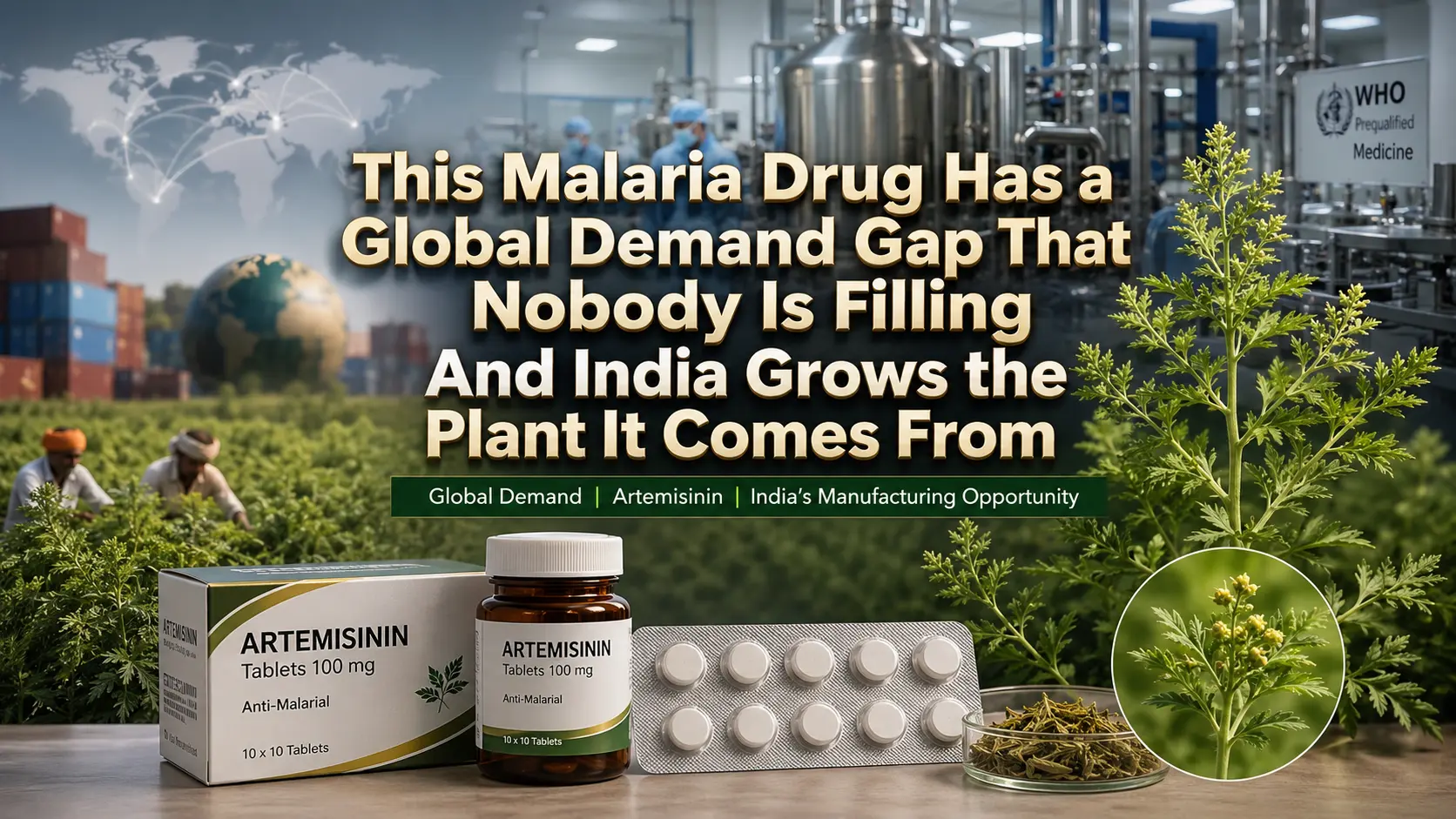

There are few business ideas in the pharmaceutical manufacturing industry that combine domestic under-supply with global urgency like artemisinin does. This sesquiterpene lactone endoperoxide forms the core of an essential malaria treatment: the World Health Organization recommends Artemisinin-based Combination Therapies (ACTs) as the front-line treatment for Plasmodium falciparum malaria, the deadliest strain.
India is at a crucial juncture. The nation has the farming foundation and manufacturing facilities to turn into a primary participant in the manufacturing of artemisinin and its downstream derivatives globally. With the farming basis and manufacturing infrastructure, the nation could be a major player in the manufacture of artemisinin and downstream derivatives globally. However, production is divided and still reliant on imports. It’s one of the most promising business ideas today for MSME investors and entrepreneurs in the specialty pharma segment.
Why the Artemisinin Industry Is Growing Fast
Hundreds of millions of people continue to suffer from malaria every year, mainly in South Asia and Southeast Asia, and Sub-Saharan Africa. WHO recommends ACTs as the standard protocol of treatment. This generates a non-cyclical, structurally sustained demand for artemisinin — mission critical demand.
The World Health Organization finding is that global consumption of artemisinin has always been greater than supply. Raw material price increases are caused by supply deficits and lead to continuous market openings for new producers. India’s pharma industry, which is third in the world in terms of volume, is poised to meet the demand.
Also, the worldwide market for artemisinin derivatives, such as artesunate, artemether and dihydroartemisinic, is growing beyond the treatment of malaria. Artemisinin’s anti-cancer, anti-viral and immunomodulatory properties are being studied, creating additional markets beyond that of parasitic diseases.
Government Policies and Incentives Supporting Artemisinin Businesses
Under the Ministry of Chemicals and Fertilizers, the Department of Pharmaceuticals has put an effective plan in place to help promote the local production of APIs, directly affecting the producers of artemisinin. Incentives under the Production Linked Incentive (PLI) Scheme for Bulk Drugs are applicable to Key Starting Materials (KSMs) and Active Pharmaceutical Ingredients and the outlay of this scheme is Rs 6,940 crore. Artemisinin is clearly a member of this group.
Make in India is actively encouraging domestic pharmaceutical manufacturing process and provides single window clearance and priority infrastructure support. Further, the Startup India programme also provides 80% patent fee concessions to pharmaceutical startups, DPIIT recognition benefits and access to the Fund of Funds.
The Pharma and Agro Processing industries can avail 15% to 35% subsidy on the project cost under PMEGP scheme by KVIC for micro enterprise. In addition, the Ministry of MSME provides collateral-free loans of up to Rs 2 crore through CGTMSE, which is an important factor for first time artemisinin processing entrepreneurs.
Get Detailed Insights from This Book: Drugs & Pharmaceutical Technology Handbook
Multiple Manufacturing Business Ideas for Startups in the Artemisinin Sector
1. Artemisinin Solvent Extraction Unit
The first and easiest step for entrepreneurs is to establish a solvent extraction plant to extract artemisinin from the dried Artemisia annua biomass. Usually, manufacturers perform extraction using hexane or a hydrocarbon solvent in a counter-current extraction system, followed by concentration, crystallisation, and purification. India cultivates significant amounts of Artemisia annua, especially in Uttarakhand, Himachal Pradesh, and Bihar, making raw material sourcing feasible. Small- to mid-scale extraction units processing 1–3 metric tonnes of dried herb per day can sell the crude artemisinin to API formulators or purify it in-house, potentially generating meaningful quantities of crude artemisinin.
The investment cost in plant and equipment for a unit of this size is from Rs 1.5 crore up to Rs 3.5 crore, depending on the extent of automation and solvent recovery system. Entrepreneurs who set up backward integration with the contract farming of Artemisia annua further de-risk their supply chain and safeguard margins with raw material cost control.
2. Artesunate and Artemether API Manufacturing
Chemistry-savvy entrepreneurs can go downstream and make semi-synthetic medicines like artesunate and artemether. The price of these APIs is much higher than crude artemisinin, and demand from the branded formulators in Africa and Southeast Asia is still strong. Researchers commonly use well-known chemical strategies to synthesize these compounds. They first reduce artemisinin to dihydroartemisinic acid and then use esterification or etherification, as appropriate, to obtain the target molecules. APEDA-registered exporters and WHO-GMP-certified manufacturers can secure long-term supply contracts with international agencies such as UNICEF, MSF, and the Global Fund. Such a size of facility would need Rs 3 to 6 lakh crores in capital investment, WHO-GMP certification and a qualified person on regulatory side. This is a high value target segment, as margins on artesunate are usually 2–3 times as high as generic APIs.
View Full Project Details: Active Pharmaceutical Ingredient (API) Products, Bulk API Manufacturing
3. Contract Farming and Biomass Supply Chain for Artemisinin
Not everyone who is an entrepreneur has to invest in extraction chemistry.
An asset-light and profitable business model is contract farming of Artemisia annua. The business involves collecting dried Artemisia annua biomass and supplying it to extraction plants. This model is suitable for regions where Artemisia annua can grow well. These include Uttarakhand, Bihar, and parts of Madhya Pradesh. The entrepreneur works as an agri-entrepreneur. They sign contracts with local farmers and provide quality-certified planting material. The planting material should have a high artemisinin content. The entrepreneur also guides farmers on proper cultivation and harvesting.
Harvesting should be done at the pre-flowering stage. This is when artemisinin levels are usually at their highest. Proper drying is also important. The harvested biomass must be dried using the correct method before it is supplied to extraction plants. Revenue visibility from supply agreements with certified extraction units or API manufacturers. The investment needed is not high, mainly in storage and drying facilities, and in logistics. Subsidised support for processing infrastructure is provided in the form of PMFME and state agricultural extension programmes.
Check Out This Recommended Book: The Complete Book on Organic Farming and Production of Organic Compost
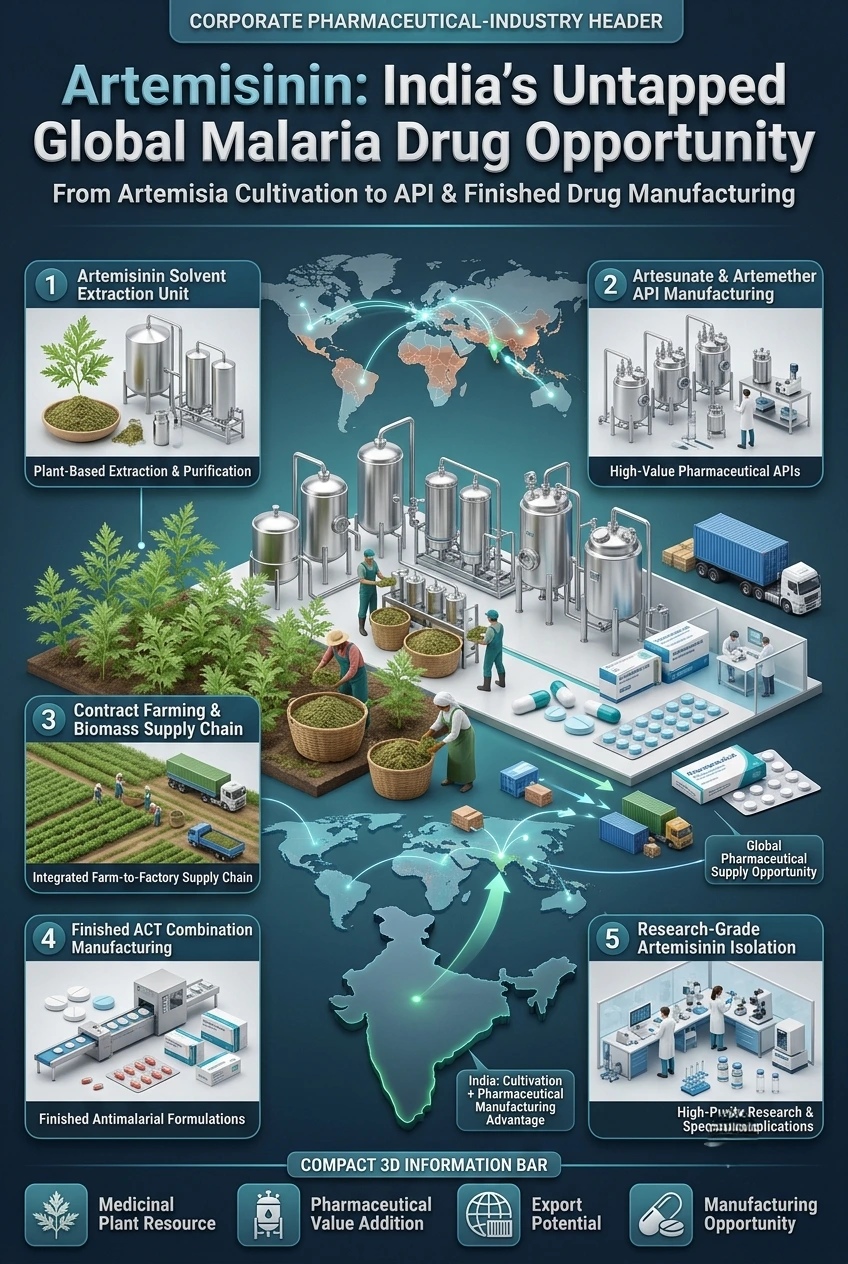
4. Finished Formulation Manufacturing of ACT Combinations
India has an excellent reputation in the formulation sector. Some of the most popular malaria treatments worldwide use Artemisinin-based Combination Therapies (ACTs). These include artemether-lumefantrine and artesunate-amodiaquine tablets, which doctors use to treat malaria.
Establishing a WHO-PQ-certified formulation facility can provide access to major procurement channels. These include procurement country tenders, the Global Fund, and UNICEF Supply Division. A WHO-PQ certification can therefore help manufacturers access international procurement opportunities.
Under the National Vector Borne Disease Control Programme, the opportunity is also available in the domestic market of high burden states such as Odisha, Chhattisgarh etc. The investment required in a formulation unit with ACT is Rs 4 to 8 crore and approval from WHO-PQ or CDSCO is required. This is one of the most solid pharmaceutical business models available to MSME investors, thanks to the long-term supply contracts offered by global health organizations.
5. Artemisinin Research-Grade Isolation for Nutraceutical and Oncology Applications
In addition to its role in malaria treatment, artemisinin is being investigated for anti-viral activity and its ability to induce apoptosis in cancer cells. It is also being studied for its potential role in autoimmune modulation.
Pharmaceutical R&D companies, CROs, and nutraceutical companies worldwide require high-purity artemisinin (99% or above). It is used for research and experimental formulation activities. This creates a niche market with premium pricing potential.
A research-oriented startup can enter this segment through chromatographic purification after solvent extraction. India already has strong expertise in HPLC-grade chemical production. Therefore, the business can be established in a relatively small laboratory-cum-manufacturing facility.
Partnerships with institutes such as IICT Hyderabad and other CSIR laboratories can create opportunities for research collaboration. These partnerships may also help expand the commercial offering through grant funding opportunities.
Related Article: Pharmaceutical Drugs Industry Consultants in India
Import-Export Opportunity Analysis for Artemisinin Startups
In the global trade of artemisinin, India is a unique country. However, the Indian market is also getting a considerable amount of Chinese origin artemisinin for formulation, as a result of low investment in the extraction process. Artemisinin is classified as artemisinin and derivatives, under HS Code 2932.99 by the DGFT (Directorate General of Foreign Trade) of India. India exports artemisinin-based products to Africa, Southeast Asia and Latin America, where procurement is becoming more transparent and open in global health fund mechanisms.
PHARMEXCIL (Pharmaceuticals Export Promotion Council) and APEDA provide export facilitation, market development assistance, and access to an international buyer database to entrepreneurs oriented towards exports. WHO-GMP and WHO-PQ certification continue to be the main quality gateway to the export market. The certifications allow Indian artemisinins to be competitive with Chinese suppliers, and are especially important as global buyers diversify their supply chains.
Indian MSME Success Stories in Artemisinin and Related Sectors
1. IPCA Laboratories: Pioneering ACT Manufacturing in India
Premchand Godha, founder of IPCA Laboratories, is a strong example of India’s domestic artemisinin value chain development. IPCA built a fully integrated business model. It covers everything from contract-based Artemisia cultivation in India to the export of finished ACT formulations. The company also successfully obtained WHO Prequalification for its Artesunate tablets. Today, IPCA exports its products to more than 120 countries.
This offers a clear lesson for new entrepreneurs. Vertical integration across herb sourcing, API synthesis, and finished formulations can create a strong competitive moat. Such an integrated model is difficult for price-focused competitors to replicate.
2. Strides Pharma Science: Export-Oriented Formulation Excellence
Under Arun Kumar’s leadership, Strides Pharma Science built a strong regulated-market formulation business. Anti-malarials were one of its key therapeutic areas. Indian MSME pharma companies can pursue WHO-PQ, US FDA, and EU GMP standards to enter regulated markets and potentially earn a price premium. The Strides journey highlights the need to invest in quality infrastructure as a strategic priority for entrepreneurs entering into artemisinin.
3. CIMAP-Supported Artemisia Farming Clusters in Uttar Pradesh
The Council of Scientific and Industrial Research (CSIR) in collaboration with the Central Institute of Medicinal and Aromatic Plants in Lucknow has helped agricultural entrepreneurs in Uttar Pradesh to grow Artemisia annua in place of traditional crops with success guidance. These clusters provide dried herb to the extraction facilities in Gujarat and Maharashtra. The model achieves results confirming that even small farmers and MSME agri-entrepreneurs can profitably enter into the artemisinin value chain by producing quality herbs with artemisinin content assays.
Start with clarity—choose the best business idea
How NPCS Helps Entrepreneurs Enter the Artemisinin Business
We at Niir Project Consultancy Services (NPCS) offer professional consulting services for the preparation of Market Survey cum Detailed Techno-Economic Feasibility Reports (DPRs) for establishing new industry/business. In our reports, you will find a detailed manufacturing process, market research and demand analysis, process flow diagram, product mix and capacity planning, machinery and raw material details, and complete project financials with profitability analysis. Our project report library also provides entrepreneurs with ready-to-refer feasibility blueprints for capital investment, operating cost, revenue estimation and regulatory pathway of artemisinin extraction, artemisinin formulation (ACT) and contract farming. We are here to assist our clients in assessing feasibility, profitability and long-term scalability before investing.
Artemisinin Sector: Key Business Metrics at a Glance
| Parameter | Details |
| Primary Raw Material | Dried Artemisia annua herb (0.6-0.8% artemisinin content) |
| Key Growing States in India | Uttarakhand, Bihar, Himachal Pradesh, Uttar Pradesh |
| Global ACT Market Size | USD 400-500 million annually (anti-malarial formulations) |
| Artemisinin Crude Price Range | USD 200-550 per kg (varies with global supply conditions) |
| Artesunate API Price | USD 900-1,500 per kg (WHO-PQ grade) |
| Primary Export Markets | Sub-Saharan Africa, Southeast Asia, Latin America |
| Key Regulatory Approvals | WHO-GMP, CDSCO Drug License, WHO-PQ (for exports) |
| PLI Incentive Available | Yes – under Bulk Drug PLI Scheme (Dept. of Pharmaceuticals) |
| CGTMSE Loan Ceiling | Up to Rs 2 crore (collateral-free for MSME applicants) |
| Investment: Extraction Unit | Rs 1.5 crore – Rs 3.5 crore (small to mid-scale) |
| Investment: API/Formulation Unit | Rs 3 crore – Rs 8 crore depending on certification level |
Conclusion: Artemisinin — A Strategic Bet for Serious Entrepreneurs
The artemisinin industry requires regulatory oversight, quality awareness and long-term planning, and commitment, extending over 3-5 years. But for the enterprising individual willing to play a long game, no business venture in the pharmaceutical manufacturing sector provides as much certainty of global demand, government policy support and domestic supply shortage as artemisinin.
With its agriculture base, pharmaceutical manufacturing capability and export infrastructure, India has the potential to become a major contributor in the global value chain of artemisinin. Entrepreneurial commitment and well-structured feasibility planning is what is required. To get more detailed information on project set-up, plant and machinery, financial modelling, consult the Invest India pharmaceutical portal and IBEF pharmaceutical sector overview and if needs be, take the time to get a thorough techno-economic feasibility report done before investing money.