
With Government Incentives, Demand–Supply Gap, Major Indian Players, and Startup Opportunities
Market Insight
India’s ultra thin copper foil segment sits at the intersection of three of the country’s most aggressively backed industrial growth stories: electric vehicles, advanced electronics manufacturing, and 5G infrastructure deployment. Moreover, despite the overall India copper foil market being valued at approximately USD 629.4 million and projected to cross USD 947.9 million by the early 2030s, the ultra thin sub-segment — classified broadly as foils below 12 microns in thickness — remains conspicuously underdeveloped in terms of domestic production capacity. However, the market does not lack demand; domestic manufacturers simply do not supply enough of it.
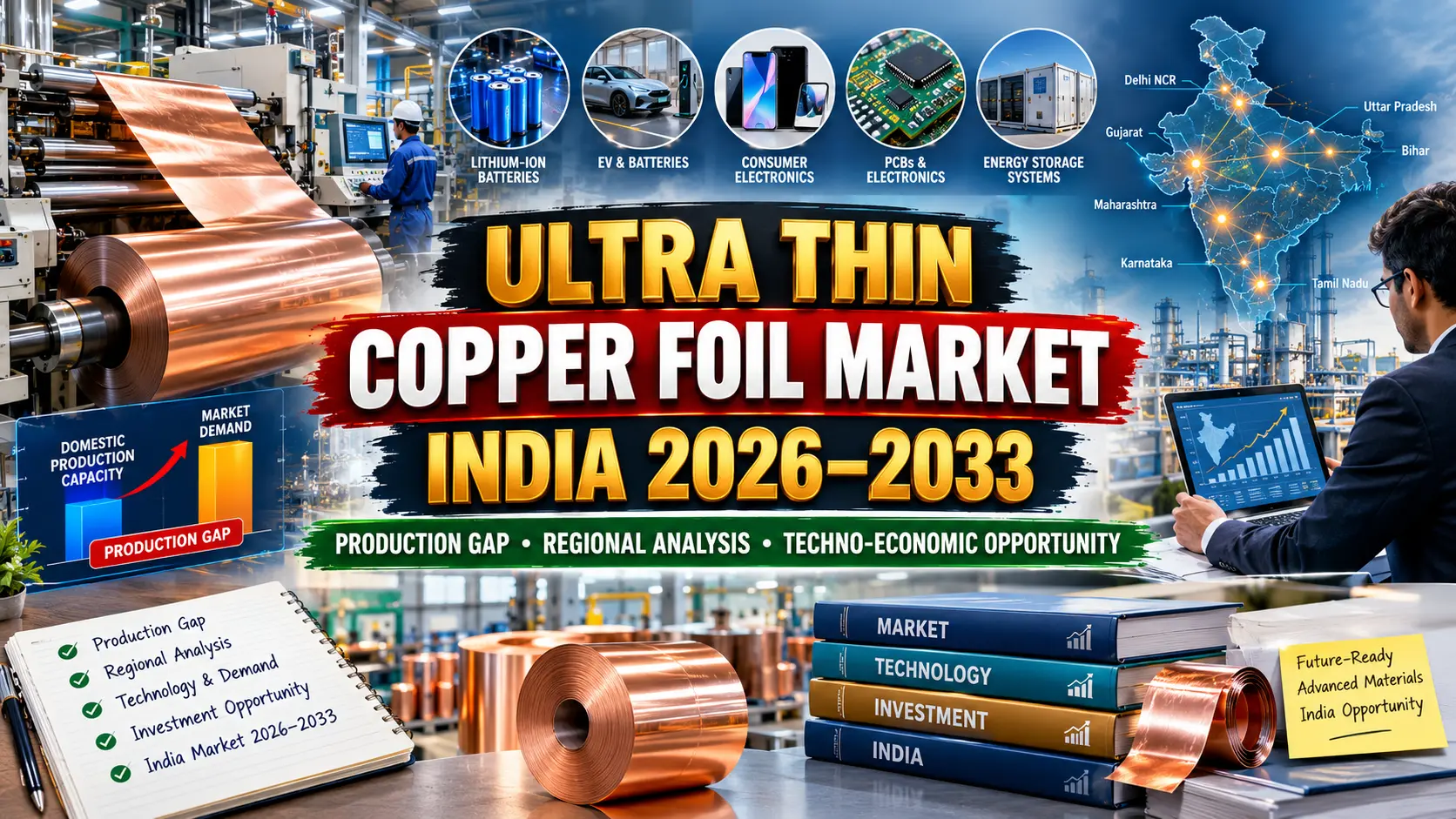
Demand–Supply Gap: India currently meets less than 20% of its domestic requirement for ultra thin copper foil (below 8 microns) through local production. Consequently, the remaining 80% or more is sourced through imports, primarily from China, Japan, South Korea, and Taiwan. Furthermore, China alone accounts for the lion’s share of global ultra thin copper foil capacity — estimated at over 80% of worldwide production — making India critically exposed to supply chain disruptions, currency fluctuations, and trade policy risks.
Introduction: Why Ultra Thin Copper Foil Is Now a Strategic Industrial Material
Not every industrial material gets upgraded to the status of a strategic national resource, but ultra thin copper foil has earned that distinction. Its importance lies not in its visibility but in its indispensability. It serves as the electrical backbone of printed circuit boards (PCBs), the current collector in lithium-ion battery cells, the shielding layer in 5G devices, and the conductive layer in flexible and wearable electronics. Without exaggeration, ultra thin copper foil forms an essential part of every device driving India’s digital and clean energy transition.
The Ministry of Electronics and Information Technology (MeitY) has identified electronic component manufacturing — particularly materials like copper foil, copper clad laminates, and specialty substrates — as critical gaps in India’s electronics supply chain. This recognition has translated into policy action through the Production Linked Incentive (PLI) scheme, the Scheme for Promotion of Manufacturing of Electronic Components and Semiconductors (SPECS), and the newly approved Electronics Components Manufacturing Scheme (ECMS), creating a structured financial incentive ecosystem for entrepreneurs.
Market Overview: Sizing the Ultra Thin Copper Foil Opportunity in India
Defining “Ultra Thin” in the Industrial Context
Copper foil is broadly categorized by thickness. Standard foils used in basic PCBs range from 35 to 70 microns. As electronic devices become smaller, faster, and more energy-dense, the industry has shifted sharply toward thinner foils. The ultra thin segment, commercially defined as foils ranging from 4.5 to 12 microns in thickness commands the highest unit pricing, the sharpest demand growth, and the most significant technical barriers to entry.
For context:
- 6-to-9-micron foils serve high-density interconnect (HDI) PCBs in smartphones, advanced computing hardware, and 5G base station equipment.
- 5-to-6-micron foils are preferred by lithium-ion battery manufacturers for anode current collectors, where thinner foil directly translates to higher energy density per cell.
- Below 4.5-micron foils represent the cutting edge of next-generation battery technology currently in pilot-scale development.
Market Size and Growth Projections
India’s high-end and ultra-thin copper foil market stood at approximately USD 89 million and is projected to reach USD 145 million at a compound annual growth rate of 8.5%. Moreover, this growth rate significantly outpaces the overall copper foil market’s growth and reflects the disproportionate acceleration in demand from EV batteries and high-frequency PCBs.
At the global level, the copper foil market — of which ultra thin is the fastest-growing segment — had a value of approximately USD 13.96 billion and is projected to scale past USD 39 billion during the forecast period, with Asia Pacific commanding more than 78% of consumption. Furthermore, the ultra thin electrodeposited copper foil sub-segment alone reached an estimated USD 3.63 billion and is growing at a CAGR of 6.8% through 2034.
For Indian entrepreneurs and institutional investors, however, the meaningful number is not the global figure. Instead, it is the gap between what India needs and what it can currently produce.
Application-Wise Demand Analysis
1. Lithium-Ion Batteries for Electric Vehicles — The Primary Growth Engine
The single largest emerging application for ultra thin copper foil in India is the anode current collector in lithium-ion battery cells. Each electric vehicle consumes approximately 50 kilograms of copper across its components, with battery-grade copper foil constituting a significant and high-purity portion of that requirement.
India’s EV market, which crossed 2.36 million vehicle registrations in the previous fiscal is on a trajectory toward 10 million annual units in the medium term. According to data tracked by the Society of Indian Automobile Manufacturers (SIAM), India is the world’s largest two-wheeler market with over 21 million units sold annually, and electric two-wheelers already account for more than 57% of all EV registrations. This volume creates an enormous baseline demand for battery cells and, consequently, for the ultra thin copper foil used within them.
The India EV battery market, currently valued at approximately USD 2.7 billion, is projected to approach USD 15.9 billion by 2034 at a CAGR of 21.7%. Every gigawatt-hour (GWh) of battery capacity requires several hundred metric tonnes of anode-grade ultra thin copper foil. With India’s battery demand projected to grow from 28 GWh to 272 GWh by 2030 — a 36.5% CAGR — the arithmetic of demand becomes overwhelming for domestic producers.
The PLI scheme for Advanced Chemistry Cell (ACC) battery storage, backed by an incentive outlay of ₹18,100 crore, is aggressively building cell manufacturing capacity. However, the upstream material supply chain — including ultra thin copper foil — has not kept pace, creating a structural materials gap that no amount of cell factory capacity alone can resolve.
2. Printed Circuit Boards — The Volume-Driven Demand Layer
While EV batteries generate the loudest headlines, however, PCBs remain the single largest application segment for copper foil globally, accounting for approximately 45% of total consumption. In addition, in India, the PCB market reached approximately USD 7.27 billion and is projected to expand to USD 25.48 billion by 2034, growing at a CAGR of 18.1%. Moreover, this growth is powered by India’s electronics manufacturing output crossing INR 11.3 lakh crore in FY2024-25, driven by smartphone production, IT hardware, defense electronics, and the 5G rollout.
Specifically, ultra thin copper foil is specifically demanded for HDI PCBs — compact smartphones, 5G network equipment, server hardware, and advanced automotive electronics specifically require this type. As a result, as Indian PCB manufacturers transition from standard single and double-layer boards to multilayer and HDI configurations, their raw material procurement shifts toward thinner, higher-specification copper foil grades. However, over 70-75% of India’s PCB demand is still met through imports, reflecting the nascent state of domestic fabrication infrastructure.
Furthermore, the India Electronics and Semiconductor Association (IESA) has repeatedly emphasized copper clad laminates and specialty copper foils as critical gaps in the domestic component supply chain. Meanwhile, the October 2025 government approval of seven new electronics component manufacturing projects including the first-ever domestic copper-clad laminate production by Kaynes Circuits India signals this gap is receiving targeted industrial policy attention.
3. Renewable Energy and Energy Storage Systems
India’s commitment to reaching 500 GW of renewable energy capacity creates a third demand vector for ultra thin copper foil. Solar photovoltaic cells, energy storage systems for grid applications, and inverter components all rely on high-conductivity copper foils. While the foil thickness requirements here are not as extreme as in battery applications, the sheer volume of planned renewable energy infrastructure — representing one of the largest public investment programs in any emerging economy — provides sustained baseline demand for domestic copper foil producers.
4. Flexible and Wearable Electronics — An Emerging Premium Segment
The Indian wearable electronics market is expanding at over 25% annually, creating demand for ultra thin copper foils below 5 microns that can bend, fold, and stretch without losing conductivity or structural integrity. Flexible printed circuit boards used in foldable smartphones, health monitoring wearables, and industrial IoT sensors require specialized rolled annealed (RA) copper foil processed to exceptional thinness and surface smoothness. This is currently almost entirely an import category in India.
5. Defense and Aerospace Electronics
India’s ongoing defense indigenization program has accelerated domestic procurement of advanced PCBs for radar systems, missile guidance electronics, communication equipment, and surveillance hardware. These applications require ultra thin copper foil of the highest specification — and, critically, cannot depend on Chinese imports due to security considerations. This creates a dedicated domestic demand pool that carries both higher margins and strategic importance.
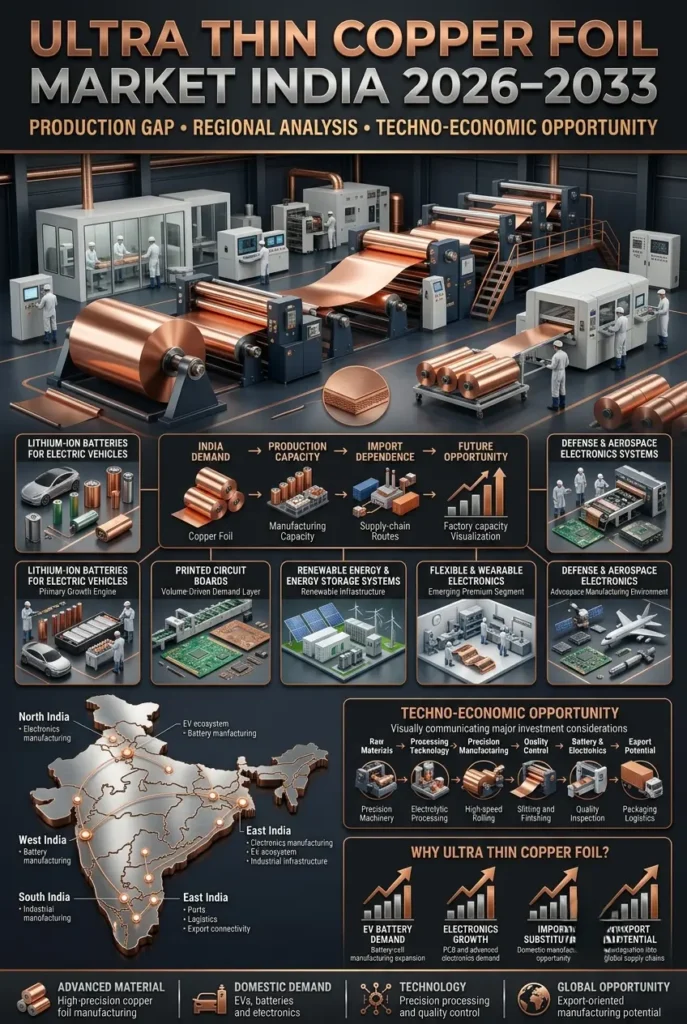
SWOT Analysis: India Ultra Thin Copper Foil Market
Strengths
India’s existing copper smelting and refining infrastructure provides a legitimate foundation for downstream ultra thin foil manufacturing. Hindalco Industries, India’s largest non-ferrous metals company and a global top-3 copper producer, has the raw material base and industrial capability to support specialty foil manufacturing. India’s established PCB and electronics manufacturing ecosystem provides a ready, proximate customer base. The country’s engineering talent pool — particularly in metallurgy, electrochemical engineering, and surface treatment — is capable of mastering the technical demands of ultra thin foil production.
Weaknesses
The fundamental weakness is the near-complete absence of domestic electrodeposition capacity for ultra thin copper foil. A single ultra thin copper foil production line requires capital investment of USD 25 to 40 million, and a commercially viable plant requires total investment exceeding USD 200 million. This is beyond the reach of most MSME entrants without structured equity and debt support. Qualification cycles with major PCB and battery manufacturers — running 12 to 24 months — create an extended period of non-revenue operation that strains working capital. Additionally, the specialized production equipment primarily comes from Japan and Germany, creating lead time and import dependency in the capital goods procurement itself.
Opportunities
The government’s ₹12,000 crore proposed incentive scheme for battery component manufacturing that explicitly includes copper foil as one of the five targeted materials (alongside cathode active materials, anode active materials, electrolytes, and separators) represents a catalytic first-mover opportunity. Entrepreneurs who establish domestic ultra thin copper foil production capacity in the next 24 to 36 months will benefit from early entry into a government-incentivized, import-substitution market with limited domestic competition and guaranteed downstream demand from both the EV battery PLI beneficiaries and the growing PCB manufacturing cluster.
Invest India, the national investment promotion agency, has actively highlighted battery materials manufacturing and electronic component production as priority sectors under the Make in India and Aatmanirbhar Bharat frameworks. State-level incentives in Gujarat, Tamil Nadu, Maharashtra, and Telangana further augment the central government’s support structure for electronics material manufacturers.
Threats
The dominant threat is the competitive intensity and cost advantage of Chinese producers. With over 80% of global ultra thin copper foil capacity concentrated in China and a well-established customer relationship base with Indian PCB and battery manufacturers, displacing imports requires not just matching price but also meeting stringent quality and consistency requirements developed over years of supplier qualification. Geopolitical risks — while providing India with policy arguments for import substitution — do not automatically solve the technical and capital barriers to domestic production.
Import–Export Dependency Analysis: The Strategic Vulnerability
India’s copper foil import bill from China alone stood at USD 79.60 million for the HS code category covering copper foil of thickness not exceeding 0.15mm. When imports from Japan, South Korea, Taiwan, and other specialized suppliers enter the market, they create a substantially higher total annual import outflow for copper foil — particularly ultra thin grades.
The Directorate General of Foreign Trade (DGFT) data reflects India’s persistent trade deficit in electronic components and materials of which ultra thin copper foil is a microcosm. While India has been extraordinarily successful in ramping up electronics assembly and export — electronics exports crossed USD 29 billion in FY2024 with a 23.6% year-on-year growth — the upstream materials supply chain remains stubbornly import-dependent.
This gap is not just an economic inefficiency. In the context of the global semiconductor and electronics supply chain restructuring triggered by geopolitical tensions, India’s 80%+ import dependency for a critical battery and PCB material represents a systemic supply chain risk that the government has explicitly recognized and is building policy responses to address.
Government Incentives and Policy Architecture
India’s policy support for ultra thin copper foil manufacturing encompasses multiple complementary schemes:
- Production Linked Incentive (PLI) Scheme — Offering incremental production-linked financial incentives of 4% to 6% over a five-year period, the PLI framework covers electronic components, advanced chemistry cell batteries, and related materials. Copper foil is explicitly included in the battery materials PLI framework under consideration.
- Scheme for Promotion of Manufacturing of Electronic Components and Semiconductors (SPECS) — Provides a 25% capital expenditure subsidy for setting up advanced electronics material manufacturing facilities, directly applicable to copper foil plant establishment.
- Modified Special Incentive Package Scheme (M-SIPS) — Offers 20 to 25% capital subsidy for electronics manufacturing facilities, potentially applicable to copper foil production infrastructure.
- Electronics Components Manufacturing Scheme (ECMS) — Approved by the Union Cabinet with a fiscal outlay of ₹22,919 crore, targeting import substitution in electronic components. The scheme aims to attract ₹59,350 crore in investments and create over 91,600 direct jobs, with electronic materials explicitly within scope.
- PM E-DRIVE Scheme — Allocating ₹10,900 crore for electric mobility infrastructure and component manufacturing, creating direct downstream demand for domestically produced copper foil.
- FAME India Scheme — Driving EV adoption through demand-side subsidies, guaranteeing consumption growth for battery components, including copper foil used in lithium-ion cells.
Entrepreneurs establishing copper foil manufacturing units in designated electronics manufacturing clusters, special economic zones, or states with targeted EV/electronics policies can potentially layer central government PLI incentives with state capital subsidies, land allocation at concessional rates, power tariff relief, and GST input tax credit benefits. According to the Ministry of MSME, technology-driven manufacturing projects in electronic materials also qualify for CGTMSE credit guarantee coverage and priority sector lending classification, materially improving project financing economics.
Major Indian Players in the Copper Foil and Ultra Thin Segment
Hindalco Industries Limited (Aditya Birla Group)
The undisputed domestic leader, Hindalco has committed ₹45,000 crore across its aluminium, copper, and specialty businesses, with a central focus on establishing India’s first dedicated EV copper foil manufacturing plant. The company has already been producing battery-grade foils at its Mouda plant in Maharashtra and is scaling up at its new Odisha facility targeting 25,000 tonnes of annual production capacity. Hindalco’s collaboration with a Japanese technology firm for advanced foil production and its MOU with U.S.-based C4V for lithium-ion battery material supply positions it as the anchor domestic player in the ultra thin copper foil segment. Hindalco accounts for approximately 28% of India’s organized copper foil market.
Sterlite Copper (Vedanta Group)
Part of the Vedanta metals conglomerate, Sterlite Copper operates one of India’s largest integrated copper smelting complexes in Tuticorin, Tamil Nadu. The company is pursuing downstream specialty copper product development, including collaboration with IIT Mumbai for next-generation surface-treated foils relevant to battery applications. Vedanta’s raw material integration advantage gives it a strong cost position for scaling copper foil production once capacity investments are committed.
Ganpati Wires
A mid-sized domestic manufacturer that has made a deliberate move into the ultra thin segment, Ganpati Wires recently launched 6 micron copper foils targeting HDI PCB applications. The company’s product range serves both the PCB interconnect and battery current collector markets, reflecting the growing technical maturity of second-tier Indian copper products manufacturers.
Mehta Tubes Limited
Having invested ₹120 crore in a dedicated production line for lithium-ion battery foils, Mehta Tubes represents the category of MSME-scale manufacturers making strategic capital commitments to ride India’s EV manufacturing wave. The company’s focused approach on battery-grade foil specifications signals that the segment is attractive enough for mid-market industrial investment.
Regional Analysis
Maharashtra leads India’s copper foil consumption with approximately 29% market share, driven by its concentration of electronics manufacturing, automotive component production, and industrial end-users in the Pune-Mumbai-Nashik industrial corridor.
Tamil Nadu is a significant consumption center on the back of its established electronics manufacturing cluster in Chennai and emerging EV ecosystem around Hosur, where Tata Motors, Ola Electric, and other EV manufacturers have established major production facilities.
Gujarat and Telangana are emerging as production-friendly destinations with aggressive state investment promotion policies for electronics material manufacturing, including capital subsidies and dedicated electronics manufacturing clusters with shared infrastructure.
Karnataka and Andhra Pradesh are seeing growing PCB and semiconductor manufacturing investments that directly pull upstream copper foil demand.
Startup Opportunity Insight: Why First-Movers Win This Market
The business case for entering India’s ultra thin copper foil manufacturing space rests on three non-negotiable structural realities:
First of all, demand is guaranteed and institutional. India’s PCB market is growing at 18.1% annually and will cross USD 25 billion by 2034. Moreover, every PCB plant requires copper foil as a direct input material. India’s EV battery market is growing at 21.7% annually. Similarly, every battery cell requires copper foil as an anode current collector. Therefore, these are not speculative consumer markets — they are industrial procurement relationships with long-term supply contracts and predictable volume offtake.
Second, the competition is structurally limited in the short run. Only two to three organized domestic players are currently manufacturing ultra thin copper foil in any meaningful volume. As a result, most domestic demand relies on imports, meaning the first serious domestic producer to achieve consistent quality, appropriate thickness specifications, and reliable supply can immediately capture 10 to 30% of the import-substitution opportunity under preferential vendor consideration from Make in India-committed buyers.
Third, the government incentive architecture reduces effective capital cost. In addition, with PLI incentives, SPECS capital subsidies, state government support, and MSME credit guarantee coverage, a well-structured project can substantially reduce its effective capital outlay relative to a fully market-priced investment.
Finally, entrepreneurs with experience in copper processing, electrochemical manufacturing, specialty metals, or advanced materials should look at this sector as a genuine 7 to 10 year investment thesis, not a short-cycle trade opportunity.
Feasibility Considerations for New Manufacturing Units
Plant Scale: A commercially viable ultra thin copper foil plant for the Indian market would ideally target 2,000 to 5,000 metric tonnes of annual production capacity in the first phase, focused on foil thicknesses of 6 to 12 microns (the higher-volume, lower-barrier entry point), with the technical roadmap to migrate toward 4.5 to 6 micron production as process control capabilities mature.
Technology Route: Two primary production technologies exist — electrodeposition (ED foil, used for PCBs and batteries) and rolling (RA foil, used for flexible electronics). For Indian market entry, electrodeposited foil targeting battery and PCB applications offers the better volume-to-capital ratio, though established Japanese and German suppliers must supply the specialized electrodeposition equipment.
Raw Material Access: Copper cathode of 99.99% purity (4N grade) is the primary raw material. With Hindalco and Sterlite/Vedanta both operating large-scale domestic copper refineries, raw material supply security is manageable. However, the specialty chemicals, surface treatment agents, and process gases required for ultra thin foil production require a separate supply chain development effort.
Locations: States with established electronics manufacturing clusters — Maharashtra, Tamil Nadu, Gujarat, Karnataka — offer the best proximity to end-customers. Odisha, with its strong metals base and emerging EV policy, is attracting attention for upstream battery material production.
SWOT Summary Table
| Favorable | Unfavorable | |
| Internal | Strengths: Domestic copper raw material base; established metallurgical engineering talent; proximity to growing PCB and EV battery manufacturers; Hindalco’s anchor investment creating ecosystem | Weaknesses: No large-scale domestic ultra thin electrodeposition capacity; high capital intensity (USD 25-40M per line); long 12-24 month buyer qualification cycles |
| External | Opportunities: ₹12,000 Cr battery component PLI; SPECS 25% capex subsidy; ECMS ₹22,919 Cr outlay; EV battery market CAGR 21.7%; PCB market CAGR 18%; Aatmanirbhar Bharat import-substitution priority | Threats: 80% Chinese global production dominance; established Chinese supplier relationships with Indian buyers; capital goods import dependency for production equipment; long-cycle trade policy changes |
About NPCS: Your Feasibility Partner for Ultra Thin Copper Foil Manufacturing Projects
Niir Project Consultancy Services (NPCS) — www.niir.org — is a leading industrial consulting and market research organization providing end-to-end support for entrepreneurs, MSMEs, and industrial investors evaluating new manufacturing ventures. NPCS has extensive experience in preparing Market Survey cum Detailed Techno-Economic Feasibility Reports (DPRs) for specialty metals, electronic components, advanced materials, and battery-related manufacturing sectors.
For an ultra thin copper foil manufacturing project, NPCS provides:
- Detailed Manufacturing Process Documentation covering electrodeposition routes, rolling and annealing processes, surface treatment protocols, and quality control procedures applicable to PCB-grade and battery-grade foil specifications.
- Market Research and Demand Analysis covering domestic consumption patterns, import substitution opportunity quantification, buyer mapping across PCB manufacturers, EV battery producers, and electronics companies, and export market potential.
- Process Flow Diagrams (PFD/BFD) documenting the complete production sequence from copper cathode input through electrolyte preparation, electrodeposition, surface treatment, slitting, and quality inspection.
- Product Mix and Capacity Planning tailored to the target market segments — whether 6 to 12 micron PCB-grade foil, 4.5 to 8 micron battery-grade foil, or RA foil for flexible electronics.
- Machinery and Raw Material Specifications including technical parameters for electrodeposition equipment, titanium drum specifications, copper sulfate electrolyte systems, and surface treatment chemical requirements.
- Import–Export Dependency Analysis covering the current import landscape by origin country, HS code-level trade flows, domestic vs. import pricing dynamics, and the policy-driven opportunity for import substitution.
- Project Financials and Profitability Evaluation including capital cost estimation, operating cost modeling, revenue projections at different capacity utilization levels, payback period analysis, IRR/NPV calculations, and sensitivity analysis for copper price and capacity utilization scenarios.
NPCS’s objective is to support entrepreneurs in evaluating the technical feasibility, financial viability, market demand, and scalability potential of new industrial and manufacturing projects — providing the structured analytical foundation that institutional lenders, equity investors, and government scheme administrators require for project approval and funding.
Citations and References
- Ministry of Electronics and Information Technology (MeitY) — meity.gov.in — Policy documentation on PLI schemes for electronics components, SPECS scheme, and the Electronics Components Manufacturing Scheme.
- Invest India — investindia.gov.in — Overview of the Electronics Component Manufacturing Scheme and semiconductor mission for supply chain self-reliance.
- India Brand Equity Foundation (IBEF) — ibef.org — Electric vehicle market data, FAME scheme implementation statistics, and EV ecosystem development tracking.
- Society of Indian Automobile Manufacturers (SIAM) — siam.in — Authoritative data on EV registrations, two-wheeler market volumes, and passenger vehicle sales trends in India.
- Directorate General of Foreign Trade (DGFT) — dgft.gov.in — Import-export data on copper and copper products including foil (HS 7410), trade policy, and duty structure notifications.