
The Indian Cu story is quickly evolving. On 18th August, 2026, Economic Times reported that state-run Hindustan Copper Ltd (HCL) has plans for capital expenditure of more than ₹7,000 crore in the next five to six years. The expansion is in mineral exploration, reopening of closed mines, capacity build-up and strategic international alliances. Not a typical business registration. The market is signaling that the domestic copper supply chain in India is going to change its fundamental course and this presents a big opportunity for MSMEs and entrepreneurs to create manufacturing opportunities along the value chain.
India today is a net importer of significant amount of copper. Whether it’s in an auto’s wiring harness or a solar plant’s busbar, or plumbing in a smart city or heat exchangers in industrial equipment, there’s no area of growth where copper doesn’t seem to be growing. HCL’s pledge of ₹7,000 crore alters the landscape of supply and brings opportunity for secondary manufacturers who have been looking for the confidence in domestic raw materials.
The MSMEs and Founders who are aware of this shift in times early enough can take a proactive step to build their Copper Product Manufacturing Units to thrive along with the largest PSU expansion in the metal in the country. For every entrepreneur, who plans to enter into the copper, copper alloy or copper product manufacturing, this development in Economic Times will be a starting gun.
Get Detailed Project Report (DPR): Copper and Copper Products and Projects
What Recent Economic Times Reporting Means
The Economic Times report dated 18 August, 2026, reveals that there is a slew of strategic intent in the HCL announcement. The company has acquired 135.52 million tonnes of copper ore reserves and resources in the past three years. It now has a total combined resource and reserve of 767.37 million tonnes, one of the greatest copper resource bases in Asia.
The investment of ₹7,000 crore covers four distinct areas: greenfield exploration in new domestic blocks, the revival of historically successful mines like Khetri in Rajasthan, capacity expansion at flagship operations like Malanjkhand in Madhya Pradesh, and strategic overseas acquisitions, especially through an evolving partnership with Chile’s state-backed copper mining company CODELCO.
HCL has signed several MoUs with RITES, Indian Oil Corporation, Coal India, Oil India and GAIL to further extend its mining reach in the country. Such partnerships indicate that copper is being considered as a national resource, rather than a commodity. It will provide a much more consistent domestic supply base for copper concentrate, copper cathodes and copper rod feedstock for MSMEs over the next three to four years.
Why India’s Copper Industry Is Growing Now
Infrastructure and Energy Are Driving Demand
The National Infrastructure Pipeline is India’s vision for large-scale infrastructure development. It calls for investments of more than ₹111 lakh crore. Every kilometre of metro rail uses copper. New power transmission lines also require copper. Data centres and renewable energy plants are major copper users. India’s copper demand is likely to grow at a CAGR of seven to nine per cent until the end of this decade. The infrastructure sector is driving this growth.
Electric Mobility Is a Copper Multiplier
An electric vehicle uses three to four times more copper than a conventional internal combustion engine vehicle. The Indian EV program will drive a structural increase in copper consumption in the wiring harness, motor windings, charging connectors and battery segments of the two-wheelers, three-wheelers, passenger vehicles and commercial vehicles markets.
Renewable Energy Cannot Function Without Copper
Copper is used in solar panels, wind turbines, inverters and grid-scale battery storage systems. To achieve India’s target of 500 GW of renewable energy capacity, the country needs a large amount of copper cables, conductors and components. This is one sector alone that provides a sustained demand for copper wire rod manufacturers, cable producers and connector fabricators.
Get Detailed Insights from This Book: Solar PV Power and Solar Products Handbook
India’s Import Dependence Is a Risk Being Addressed
The production of refined copper in India is about 573,000 tons per year. Very much of the consumption is still imported and covered by imports. This is precisely where HCL’s expansion plan is focused. Domestic production will be expanding in the next five years and as a result the price of feedstock will become more predictable for downstream manufacturers, something MSMEs desperately need to invest in the copper products industry.
Government Policies and Incentives Supporting Copper Manufacturing
Several enabling policies are currently being implemented by the Government of India which also favours copper and copper products manufacturers. Copper’s strategic importance is recognised under the Production Linked Incentive (PLI) scheme for specialty steel and metals. Under the Production Linked Incentive (PLI) scheme for specialty steel and metals, the government recognizes the strategic importance of copper. The government also considers copper a priority mineral under the National Critical Mineral Mission (NCMM), which has an outlay of ₹34,300 crore. Ministry of Mines is actively promoting the exploration and development of mines to supply the downstream industries.
MSME Ministry’s PMEGP scheme offers project finance loan support of up to ₹50 lakh of manufacturing units with a subsidy rate of 35 per cent in general areas and more in special category states, to MSMEs. SIDBI’s Credit Guarantee Fund Trust provides collateral-free loans to small scale manufacturers, which is important for the first-generation entrepreneurs of copper product manufacturing.
State bodies for industrial promotion are also busy. Jharkhand Industrial Area Development Authority (JIADA) provides land allocation and plug and play facilities near Ghatsila where HCL’s main smelter is situated at jharkhand.gov.in. The proximity advantage is available in RIICO’s industrial clusters of Khetri and Madhya Pradesh’s industrial clusters around Malanjkhand to HCL’s mine output. Businesses are able to establish in these zones and avail themselves of the capital subsidy schemes by the State and save on logistics costs.
Incentives, tax relief for 3 years and access to the Fund of Funds structure are available for eligible manufacturing startups in the metals sector as provided by DPIIT’s Startup India platform at startupindia.gov.in.
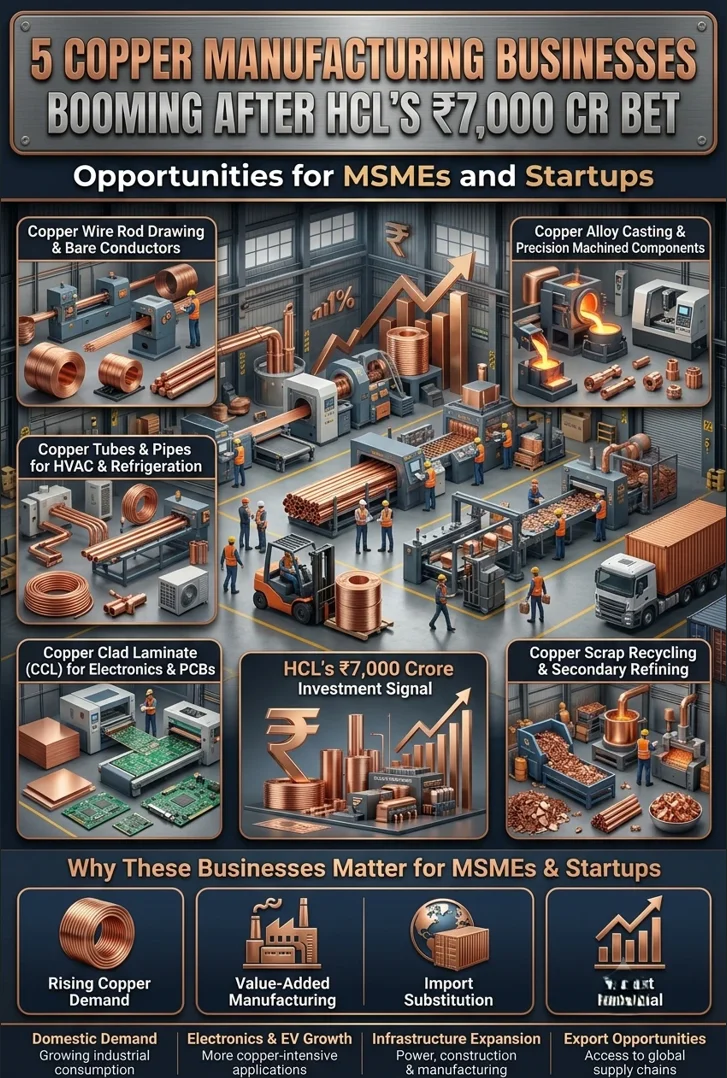
Five Manufacturing Business Ideas Emerging From the Hindustan Copper Expansion
Every one of these ideas is directly linked to the supply and demand signals embedded in HCL’s ₹7,000 crore announcement. Each is a manufacturing venture — not a trading or services play — and each has genuine scope for MSME-scale entry.
1. Copper Wire Rod Drawing and Bare Conductor Manufacturing
Copper wire rod is the foundational product from which all electrical wires, cables, and windings are made. HCL’s Taloja plant in Maharashtra already produces continuous cast copper wire rod, and an expanded HCL supply base means more rod availability for downstream drawers. A copper wire rod drawing unit takes wire rod and pulls it through a series of dies to produce bare copper wire in various gauges. These wires go into power cables, winding wires for motors and transformers, magnet wires, and flexible conductors. The investment scale for a mid-size drawing unit with 500 kg/hour capacity is within MSME reach. Target customers include cable manufacturers, transformer winders, motor producers, and switchgear companies — all industries growing strongly in India right now. The EEPC India at provides export market access support for copper wire products targeting Middle East, Africa and Southeast Asian buyers.
Access Complete Business Plan: Copper Wire Manufacturing Project Report
2. Copper Alloy Casting and Precision Machined Components
Copper alloys — brass, bronze, and cupronickel — serve industries as varied as defence, marine engineering, plumbing, automotive, and industrial machinery. A copper alloy foundry takes primary copper and alloys it with zinc, tin, lead or nickel to produce castings in standardised shapes. From these castings come valve bodies, pump impellers, bearing bushes, electrical connectors, and hydraulic fittings. This is a business where quality, consistency and technical knowledge create defensible competitive advantage. The growing defence manufacturing push under Make in India, the naval shipbuilding programme, and the oil and gas sector’s demand for anti-corrosive fittings all represent strong offtake segments. Register your unit at Make in India for sector exposure and explore defence vendor registration pathways with the Ministry of Defence.
3. Copper Tubes and Pipes Manufacturing for HVAC and Refrigeration
Air conditioning and refrigeration systems use copper tubes for heat exchange — no viable substitute has displaced copper in this application at scale. India’s HVAC market is growing at double-digit rates, driven by rising temperatures, urbanisation, and the expansion of cold chain infrastructure. A copper tube manufacturing unit draws copper rod into seamless or welded tube profiles in standard sizes used by HVAC original equipment manufacturers. Rooftop solar water heating systems, medical gas pipeline systems in hospitals, and food processing equipment also consume significant copper tubing volumes. This is an import-substitution play with built-in domestic demand growth, and the quality standards are well-established under Bureau of Indian Standards certifications at BIS India. Licensing and compliance follow a well-mapped process, making this a relatively straightforward regulatory pathway for new entrants.
View Full Project Details: Copper Flats and Copper Tubes Manufacturing Business
4. Copper Clad Laminate (CCL) Manufacturing for Electronics and PCBs
Printed circuit boards — the core of every electronic device — are made on copper clad laminates. India’s push to build a domestic electronics manufacturing ecosystem through the PLI scheme for electronics creates structural demand for CCL. Currently, a majority of CCL used in Indian PCB fabrication is imported from China, South Korea and Taiwan. A copper clad laminate manufacturing unit bonds thin copper foil to epoxy or PTFE substrate materials to produce CCL in standard grades: FR4, CEM-1, and high-frequency laminates. This is a technically demanding business with meaningful barriers to entry — which also means pricing power for quality domestic producers. The Invest India electronics sector page and IESA (India Electronics and Semiconductor Association) provide detailed ecosystem intelligence for new CCL manufacturers.
5. Copper Scrap Recycling and Secondary Refining Unit
Import–Export Opportunity Analysis
India’s copper product trade balance offers specific export windows for well-positioned MSME manufacturers. Copper wire and cable exports from India already reach over 80 countries. The Middle East, where large-scale construction and infrastructure projects are constant, is a natural target for Indian copper conductors and cables. Africa’s electrification drive creates demand for low-voltage copper wiring that Indian MSME manufacturers can competitively serve.
On the import side, as HCL scales domestic production of refined copper and copper rod over the next five years, import dependence for raw material will decline. This cost normalisation strengthens the economics of domestic copper product manufacturing for MSMEs. Entrepreneurs should register with DGFT to obtain Import-Export Code (IEC) and explore advance authorisation schemes that reduce customs duty burden on copper raw material imports during the ramp-up phase.
Related Article: Copper and Copper Products Industry Consultants in India
Indian MSME Success Stories in Copper Manufacturing
Precision Wires India Ltd — Magnet Wire Pioneer
Precision Wires India Limited (PWIL), headquartered in Mumbai, started as a small winding wire producer and grew into one of India’s largest magnet wire manufacturers. The company built its competitive position on quality consistency and on-time delivery to transformer and motor manufacturers. PWIL’s journey demonstrates that copper wire drawing and enamelling is a business where technical discipline and customer relationship management create durable competitive advantage. Today the company serves original equipment manufacturers across power, industrial machinery and automotive sectors.
Hindalco’s Birla Copper — From MSME Supply Chain to National Leader
While Hindalco Industries is a large corporate today, its Birla Copper division in Dahej, Gujarat, began as a focused downstream copper products operation. It later integrated backwards into smelting. Thousands of MSME vendors grew alongside Birla Copper’s expansion. These included component fabricators, wire drawers, packaging suppliers, and logistics operators. HCL’s ₹7,000 crore expansion will create a similar supply chain ecosystem around its mine sites and smelter locations.
Jain Irrigation’s Copper Microirrigation Components — Niche Product, Export Market
Jain Irrigation created various fittings and connectors from copper for drip systems. Niche focus on one application—agricultural microirrigation—created a unique product line. It enabled premium pricing and success in markets such as Israel, the US, and Australia. This is the kind of niche-manufacturing move that copper entrepreneurs should follow. Zero in on a target end-use, build technical expertise, and capture that customer segment. Avoid competing on price with bulk copper producers.
How Niir Project Consultancy Services Supports Copper Manufacturing Entrepreneurs
Entrepreneurs entering copper wire, copper tube, copper alloy, or copper recycling manufacturing need detailed project reports, equipment specifications, raw material sourcing guidance, regulatory compliance roadmaps, and financial projections before they commit capital. Niir Project Consultancy Services (NPCS), one of India’s most trusted industrial consultancy organisations, provides all of these through its comprehensive project feasibility reports and manufacturing technology handbooks.
NPCS’s Entrepreneur India platform carries detailed manufacturing project reports covering copper wire drawing, copper tube production, copper alloy casting, and secondary copper refining — with market analysis, process technology, equipment lists, plant layout guidance, manpower requirements, and financial projections built into each report. For a founder evaluating a copper products manufacturing unit, an NPCS project report is the most practical starting point before approaching banks for project finance.
NPCS also conducts training programmes, technology transfer workshops, and site-level consulting engagements for entrepreneurs setting up their first manufacturing units. The combination of published project reports and on-ground consulting makes NPCS a full-spectrum advisor for copper industry entrants at every investment scale.
Identify high-growth industries before others do
Data Table: India Copper Manufacturing Opportunity Snapshot
| Parameter | Data / Insight | Relevance for MSMEs |
| HCL Capital Investment | ₹7,000 crore over 5–6 years | Domestic raw material supply to increase |
| HCL Copper Ore Reserves | 767.37 million tonnes (combined) | India’s supply base is large and growing |
| Ore Reserves Added (3 yrs) | 135.52 million tonnes | Active exploration is yielding results |
| HCL Q1 FY27 Net Profit | ₹352 crore (162% jump YoY) | Financially strong PSU backing the plan |
| India Refined Copper Output | ~573,000 MT annually | Import gap remains; MSMEs can substitute |
| Malanjkhand Capacity Target | 5 million tonnes (planned) | MP/Central India cluster opportunity |
| Khetri Mine Capacity Target | 2.9 million tonnes (planned) | Rajasthan cluster opportunity |
| CODELCO Partnership | NDA signed; 4 Chile blocks under evaluation | Overseas supply security for India |
| India Copper Demand Driver | Infra, EV, renewables, electronics | Multiple downstream segments active |
| MSME Support Scheme | PMEGP (up to ₹50L, 35% subsidy) | Finance pathway for copper unit setup |
| Export Markets (Copper Wire) | 80+ countries; ME, Africa, SE Asia | Export-ready demand for MSME output |
| BIS Standard for Copper Tubes | IS 1545, IS 5445 series | Clear compliance pathway available |
Conclusion
For entrepreneurs and MSMEs, the opportunity window is now. The supply chain around a newly expanding PSU is most accessible to first movers. These are manufacturers who set up quality operations, build customer relationships, and establish supply credentials before the market becomes crowded. Copper wire drawers, alloy foundry operators, tube manufacturers, CCL producers, and scrap refiners who position themselves today will harvest the demand HCL’s expansion unlocks over the next five years.
India’s infrastructure ambition, EV transition, and renewable energy scale-up are all copper-intensive by nature. HCL’s expansion ensures the raw material base is available to serve that demand. The government policy environment, from PMEGP to CGTMSE to RoDTEP, provides the financial and export scaffolding for MSME entrants. Resources like NPCS at niir.org provide the technical and financial project intelligence needed to translate opportunity into bankable plans.