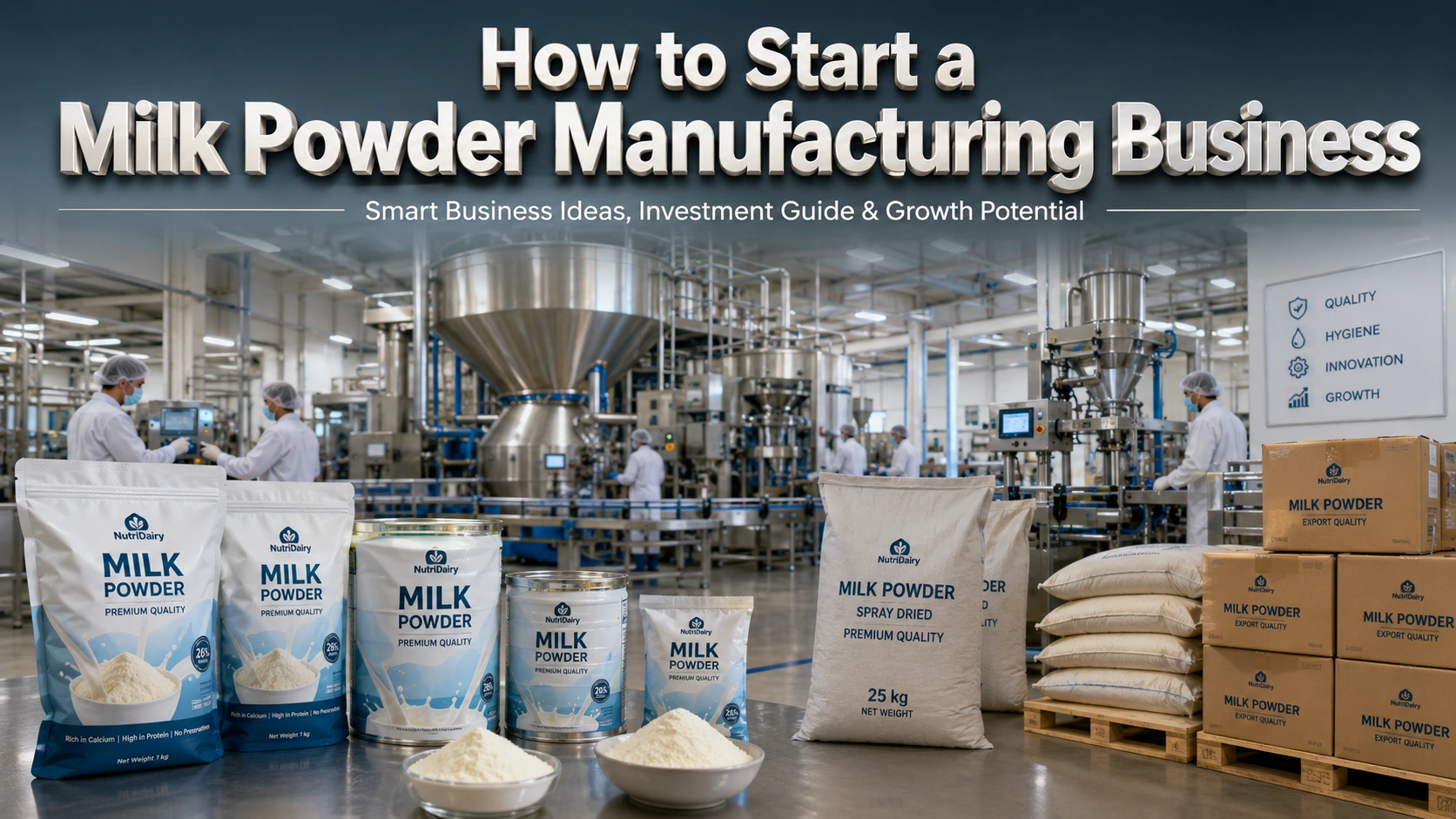

Milk powder manufacturing invariably appears in the top tier of business ideas, when seasoned industry advisors look at the world for a viable option for small businesses to expand and for the government to support, with export potential. The Indian dairy sector is undergoing a structural transformation, which is already the world’s largest in terms of output. Convenience is becoming a high priority for urban consumers. There are still gaps in the rural cold chain. But Southeast Asia export demand to the Middle East remains strong.
When entrepreneurs know the direction of demand, instead of where it is, this sector has a great synergy of stable raw-material access, increasing institutional buyers, and a policy environment that is actively incentivizing investment. The economics are very strong. Barriers to entry are not high at MSME size. And its long shelf life makes the logistics of the product very easy – a rare occurrence in a food-processing business of its size.
Why Milk Powder Manufacturing Deserves Serious Attention Right Now
More than 230 million MT of milk is produced in India every year. This volume provides both good feedstock supplies and a continuing problem which is seasonal surpluses during flush periods, leading to depressed farm gate prices. The structural solution of this imbalance is Milk powder conversion.
The powder-based dairy products are one such fastest-growing sub-segment in the organised dairy sector, according to National Dairy Development Board (NDDB). The two main sub-segments of skimmed milk powder (SMP) and whole milk powder (WMP) are essential components in infant nutrition, confectionery, bakery, pharmaceutical excipients and packaged beverages, all of which are experiencing growth of 8–12% per annum.
The earning formula is simple. Low margins on liquid milk products and high logistics costs. If converted to powder, its shelf life is increased from days to 18–24 months. It can lower the transport cost of solids by 60-70% per kg. It is launched at retail and institutional outlets at the same time.
If the plant operates at 1,000 litres per hour spray drying capacity, then the range of gross margin achieved from the conversion of liquid milk to SMP is 18-24% (excluding raw milk procurement and energy costs) for this particular blend. This is much better than most of the agro-processing investments with comparable investment levels.
Read the Complete Book Here: Modern Technology Of Milk Processing & Dairy Products (4th Edition)
Government Policies and Incentives: The Policy Tailwind Is Real
Dairy processing has been identified as a priority sub-sector under Ministry of Food Processing Industries (MoFPI) by Government of India. Production Linked Incentive (PLI) scheme of food processing also covers dairy products such as milk powder with incentives tied to incremental sales. This system gives an advantage to the quick-scalers.
In the PLI scheme, the incentive for the processors is 10% of the growth in sales from a base year. This presents an even more appealing scheme for the greenfield milk powder plants with a revenue of ₹10 crore corpus per annum. Some of the support mechanisms of the government include:
- Pradhan Mantri Kisan Sampada Yojana (PMKSY) — grant assistance up to 35% (in general areas) or 50% (in difficult areas and North-Eastern states) for cold-chain infrastructure and processing units to the farmers
- MSME Ministry CGTMSE — collateral-free loans up to ₹2 crore, easing equity burden for first-generation entrepreneurs
- Simplified norms for dairy processors entering institutional supply through FSSAI central licence streamlining. Simplified norms for dairy processors entering institutional supply under FSSAI central licence streamlining.
- Make in India registration — preferential access to government tenders for institutional supply
- APEDA market development assistance — for international certification, participation in trade fairs and market studies for dairy exporters
These schemes can cut down net equity deployment to 25-30% of the project cost that can be a significant edge for MSME sized operators.
Multiple Business Ideas for Startups: Viable Project Models in Milk Powder
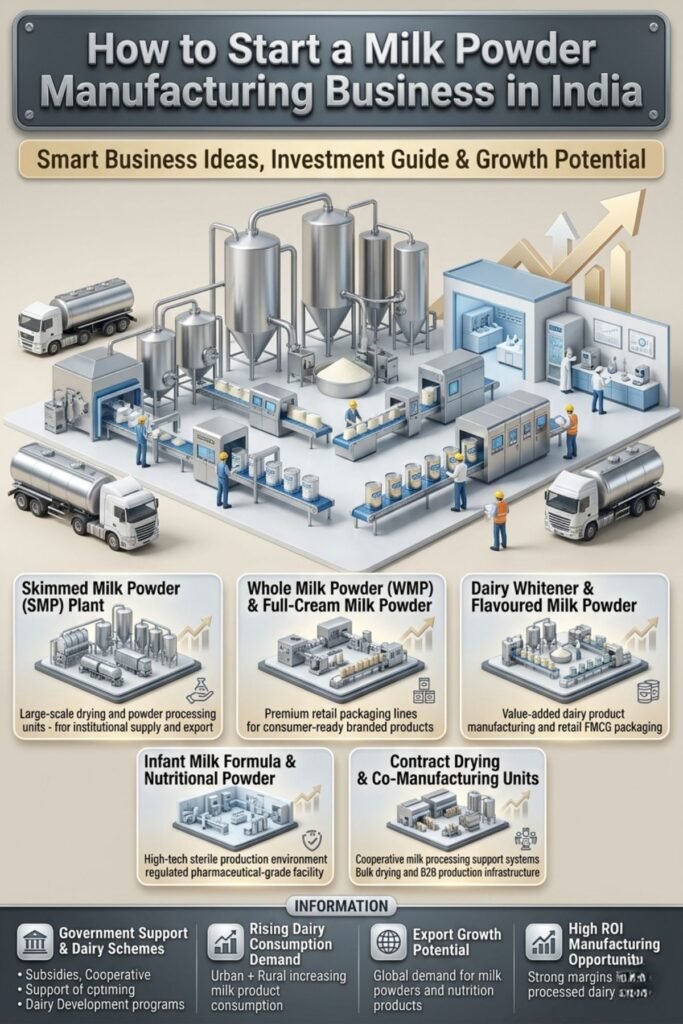
The milk powder industry is not a homogeneous industry. It has multiple different entry points, and they vary in their initial investment, risk level and potential income. Here are 5 successful models to consider.
1. Skimmed Milk Powder (SMP) Plant — Institutional and Export Focus
One of the most capital efficient points of entry in the dairy processing industry is a skimmed milk powder plant with an intake of 500–2,000 litres of raw milk per hour. This encompasses the pasteurisation, cream separation, evaporation and spray drying. There are instant institutional buyers for SMP from biscuit companies, baby food industry and blenders of dairy products.(Milk Powder Manufacturing Business)
Demand for exports has been steadily increasing from Gulf countries and Southeast Asia. Indian price competitiveness due to low cost of milk procurement compared to Oceania and Europe makes Indian SMP attractive to the overseas buyers. The capital investment may be recovered in 4-5 years if the MSME operator is operating at 70% capacity utilisation with current SMP price range of ₹280-320 per kg.
Get Detailed Project Report (DPR): Milk & Dairy Products: Types, Processing & Value-Added Products
2. Whole Milk Powder (WMP) and Full-Cream Milk Powder — Retail and Premium Channels
Whole milk powder keeps its fat, and is mainly used in the manufacture of chocolate, recombined milk and high-quality retail packs. The realisation per kg is much better, typically at the rate of ₹350-420 per kg, against SMP. There is an attractive niche in premium retail segment with branded milk powder for home use available for entrepreneurs who are ready to invest in packaging and branding.(Milk Powder Manufacturing Business)
There are also private label WMP contracts with large FMCG companies that offer a revenue floor also. A plant with a capacity of 500 kg/day with 8-hour shift can earn ₹1.5-2 crore per annum at the current market rate with EBITDA margins of 15-20% after optimisation of raw milk procurement through direct tie-ups with farmers.
3. Dairy Whitener and Flavoured Milk Powder — Value-Added Manufacturing
Dairy whitener is a modified milk powder that has been specially processed to have an optimum fat-to-protein ratio for use in tea and coffee. It is sold at a high price compared to standard SMP, and has a large customer base that is price insensitive in HoReCa, offices and institutional catering.
Flavoured milk powders (chocolate, strawberry, cardamom and saffron) cater to a growing market in tier-2 and tier-3 cities where ready-to-drink milk is not always available and quality cannot be guaranteed. The investment needed to shift from the standard SMP to the dairy whitener or flavoured powder is relatively small and this could be a good value-addition game for those who already have a stake in the dairy business.
4. Infant Milk Formula and Nutritional Powder — High-Regulation, High-Margin
The top-tier products of milk powder production are infant milk and nutritional powder. FSSAI’s Infant Foods regulations are very strict, and include aspects of composition, labelling, restrictions on marketing and quality requirements. The edges are very strong, though. The price of a tonne of standard SMP is about ₹3 lakhs. A tonne of the certified infant formula can convert to ₹12-18 lakh per tonne at the manufacturer level.(Milk Powder Manufacturing Business)
This segment is ideal for entrepreneurs who have a two-stage plan, with a period of early growth in SMP first (to develop process competency, cash flows, etc.) followed by nutritional powders later (3–5 years). Businesses that invest in ISO 22000 or HACCP certification from the outset are in a position to take advantage of this upgrade.
Related Article: How to Launch a Dairy Business in India
5. Contract Drying and Co-Manufacturing for Cooperatives
During the flush season, dozens of district level milk cooperatives in Maharashtra, Gujarat, Rajasthan and Punjab collect liquid milk in excess of their requirement but do not have powder drying facilities. A contract spray-drying system is an easier business model to manage than a raw milk business or a retail milk business because it involves a stable, predictable revenue stream, no raw milk buying or retail milk selling, and can be set up near cooperative milk-collection zones.
A toll processing agreement is made where the entrepreneur is paid some amount, which is ₹8 to 15 per kg, for every kg of powder produced. With a throughput of 1,000 kg/day, this model makes a whopping ₹25–40 lakh a year in processing fees alone (and can be used for own brand during low procurement times).
Import–Export Opportunity Analysis
India’s trade in milk powder is a telling and asymmetric one. The country exports SMP to the Gulf countries, Bangladesh, Nepal and the South East Asian countries, while at the same time importing WMP and specialty nutritional powders from New Zealand and Australia. This structural mismatch is a chance for domestic manufacturers to fill in the quality and certification standards.
The Agricultural and Processed Food Products Export Development Authority (APEDA) is actively encouraging the dairy industry to promote its products in the international market by providing financial assistance to industries in Halal, BRC and IFS certification.
The Gulf Cooperation Council (GCC) is a large dairy import market of the Gulf of Coordination. Indian exporters having the Halal certified facilities have an advantage of freight cost about $120 – 150 per tonne on sea routes of the standard length when compared with their Oceanian competitors. For a quality certified Indian SMP, the realisation in export market would be in the range of ₹300-340 per kg FOB while the realisation in domestic market would be in the range of ₹270-300 per kg — thus, the export channel would be value-accretive for the efficient manufacturer.(Milk Powder Manufacturing Business)
Up to 24 months after the beginning of the project, new entrepreneurs must concentrate on the domestic institutional market for cash flow, as well as on certifications and client relations, which will allow them to gain access to export markets.
Key Financial Benchmarks: Milk Powder Manufacturing at MSME Scale
| Parameter | Small Unit (500 LPH) | Medium Unit (2,000 LPH) | Large Unit (5,000 LPH) |
| Estimated Project Cost | ₹50–80 Lakhs | ₹1.5–2.5 Crore | ₹5–8 Crore |
| Land & Building | 5,000 sq ft (leased) | 10,000 sq ft | 25,000+ sq ft |
| Installed Spray Dryer Capacity | ~100 kg powder/hr | ~400 kg powder/hr | ~1,000 kg powder/hr |
| Raw Milk Requirement (daily) | 12,000 litres | 48,000 litres | 1,20,000 litres |
| Approx. Annual Revenue Potential | ₹80 L – ₹1.2 Cr | ₹3 Cr – ₹4.5 Cr | ₹8 Cr – ₹12 Cr |
| Gross Margin (Indicative) | 18–22% | 20–25% | 22–27% |
| Estimated Payback Period | 5–7 years | 4–5 years | 3–4 years |
| Key Certifications Required | FSSAI Central, BIS | FSSAI + ISO 22000 | FSSAI + HACCP + Export certs |
Indian MSME Success Stories: Learning from Those Who Built It
Parag Milk Foods — From Regional to National
Devendra Shah, the founder of ‘Parag Milk Foods’, started his venture by collecting milk and chilling it in Maharashtra. He understood early on that there was a better way to achieve sustainable margins than raw milk trading: value addition. His Gowardhan brand being built on a strong foundation of milk powder and cheese business became a national brand.
Shah has purchased spray drying equipment when others were selling liquid milk. He secured cooperative supply deals at good prices, and systematically developed retail distribution. The lesson learned is that expertise in powder processing manufacturing enables the development of several product lines without duplicate capital investment.
Start with clarity—choose the best business idea
Heritage Foods — Disciplined Capacity Expansion
Heritage Foods developed a disciplined model of procurement to processing in Andhra Pradesh and Telangana to develop its dairy processing business. The company’s investment in milk powder production capacity is to avoid distress milk sales and to provide a buffer against seasonal milk surpluses. This not only brought a bit of stability to cost of procurement, but also to farmer relationships.(Milk Powder Manufacturing Business)
For MSME operators, it is worth emphasizing that the capacity for milk powder production does not have to be explained only in terms of powder sales, as in the case of the Heritage model. It may serve as a buffer to make the whole liquid milk enterprise more profitable.
Shreeja Milk Producer Company — Cooperative-Scale Success
Shreeja Milk Producer Company in Andhra Pradesh is a farmer led dairy processing at scale. Producer company and milk powder was a part of its surplus absorption mechanism. This allowed the company to offer farmers higher prices for their produce than market rates, and to maintain its profitability.(Milk Powder Manufacturing Business)
New entrepreneurs can replicate this model by joining Farmer Producer Organisations (FPOs). These FPOs enable entrepreneurs to provide processing capacity, while farmers contribute scale and social acceptance.
How NPCS Supports Entrepreneurs Entering the Milk Powder Sector
At Niir Project Consultancy Services (NPCS) we prepare Market Survey cum Detailed Techno-Economic Feasibility Reports (DPRs) for the entrepreneurs in planning to establish their Milk Powder Manufacturing Projects. Our reports cover:
- Raw milk intake to complete manufacturing up to evaporation and spray drying, and packaging
- Detailed Market research and Demand Analysis
- Create Process Flow Diagrams, Product mix planning
- Identification of machinery specifications and suppliers
- The raw material need and procurement plan. Need and procurement strategy of raw material.
- A complete project financials, including capital cost estimates, operating cost analysis, break-even projections and IRR/NPV computations.
Our goal is to assist entrepreneurs in assessing feasibility, profitability and sustainability without letting off the guard down, but before investing capital with banks and institutional lenders.
FAQs
1. What is the minimum investment for starting a milk powder manufacturing unit?
For small scale units processing 500-1000 litres raw milk per hour, a typical project cost for the plant including machinery (spray dryer, multi-effect evaporator, pasteurizer, packaging line) and civil work is between 50-80 lakhs. Additional 10-20 lakhs as working capital for purchase of raw milk. Government subsidies under PMKSY and CGTMSE backed collateral-free loans may bring the equity contribution down to 25-30% of project cost.
2. How much raw milk is required to produce 1 Kg skimmed milk powder?
Approximately 9-10 litres of full fat raw milk at average cream separation rate will produce approximately 1 Kg of SMP. However, this ratio depends upon initial fat and SNF content of raw milk which is generally in the range of 3.0-3.5% fat and 8.5-9.2% SNF respectively but varies seasonally and with breed and procuring region. For entrepreneurs in regions producing milk of higher SNF content, particularly in Gujarat and Rajasthan, efficiency is usually higher.
3. What licences/registrations are compulsory before setting up and operating a milk powder unit?
Central FSSAI License; MSME/Udyam Registration; GST registration; Factory Act registration; BIS certification (for those that will cover standard products). Additional export specific: IEC (International Certification of Exporter/Importer) from DGFT, and for Gulf market Halal certification and APEDA registration is advised from the beginning.
4. What are the major cost drivers in milk powder manufacturing?
Raw milk purchase accounts for 65-70% of the total operating cost; hence the purchase strategy is the most significant profit leverage factor. Energy usage, mainly for evaporation and spray drying, is the next major component (10-15%). Installation of highly energy efficient multi-effect evaporator and heat recovery system results in payback of cost in 3-4 years. The entrepreneurs who go for forward/backward integration with farmer producer organizations or cooperative societies often are cost-competitive.
5. Is there demand for Indian milk powder in the export market, and if so, how to access it?
Yes, India has a strong export demand for Indian skimmed milk powder from the GCC (Gulf Co-operation Council), Bangladesh, Vietnam and some African markets. Halal certification (for GCC), BRC or IFS food safety certification, and country-specific labeling requirements are key to export access. New exporters are recommended to obtain APEDA registration and attend trade fairs in the markets of interest prior to approaching end-buyers directly.
6. How long it would take to setup and commence the operations of the plant?
A small to medium MSME scale plant requires typically between 12-18 months to be set-up from sanction to the first dispatch of product. The time includes 3-4 months for land acquisition and building construction, 5-7 months for plant & machinery purchase and installation and 2-3 months for plant commissioning, testing and obtaining regulatory approvals. Entrepreneurs using experienced project management consultancy services (starting from DPR stage) will always achieve faster execution and fewer deviations.
Final Thoughts: A Sector Built for Long-Term Builders
Manufacturing milk powder is definitely not a business which is designed to achieve short term profits. Instead, it’s a sector which truly values entrepreneurs with a structured, planned phased approach-investing upfront for certifications, investing time and effort in developing procurement relations and not falling prey to expediting the critical DPR process which makes and breaks a project.(Milk Powder Manufacturing Business)
The market is truly robust; there’s tangible support from the government and the unit economics are scalable with increasing volume. Furthermore, the upward mobility to value added products like nutritional powders and export is a long run of revenues and margins.
For the willing entrepreneurs who view this as a business which will likely take ten years, rather than three for an exit strategy, milk powder manufacturing in India has an option that is increasingly hard to find – a big, growing market, where operational efficiencies and quality yield sustainable, defensible competitive advantage.