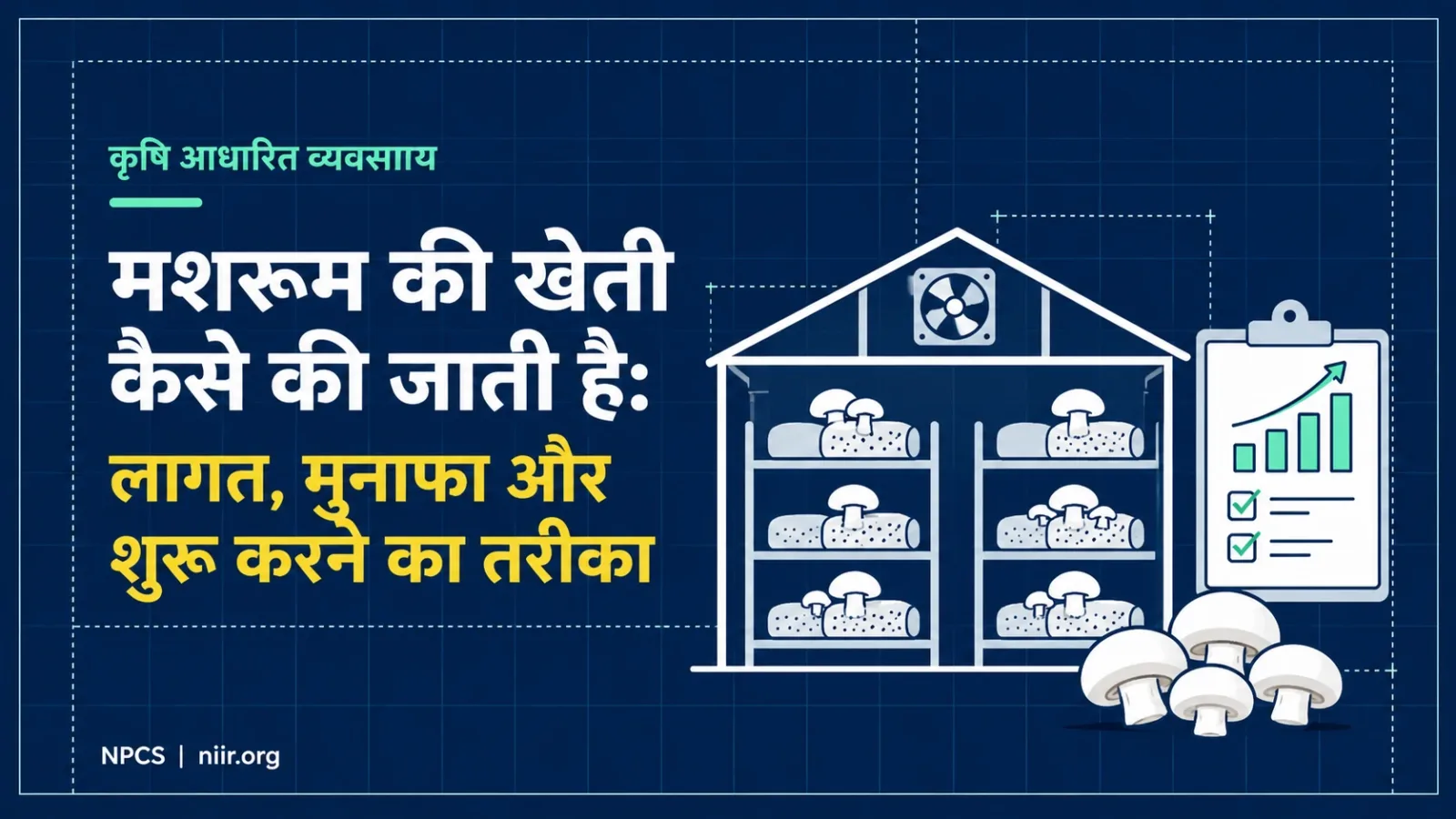
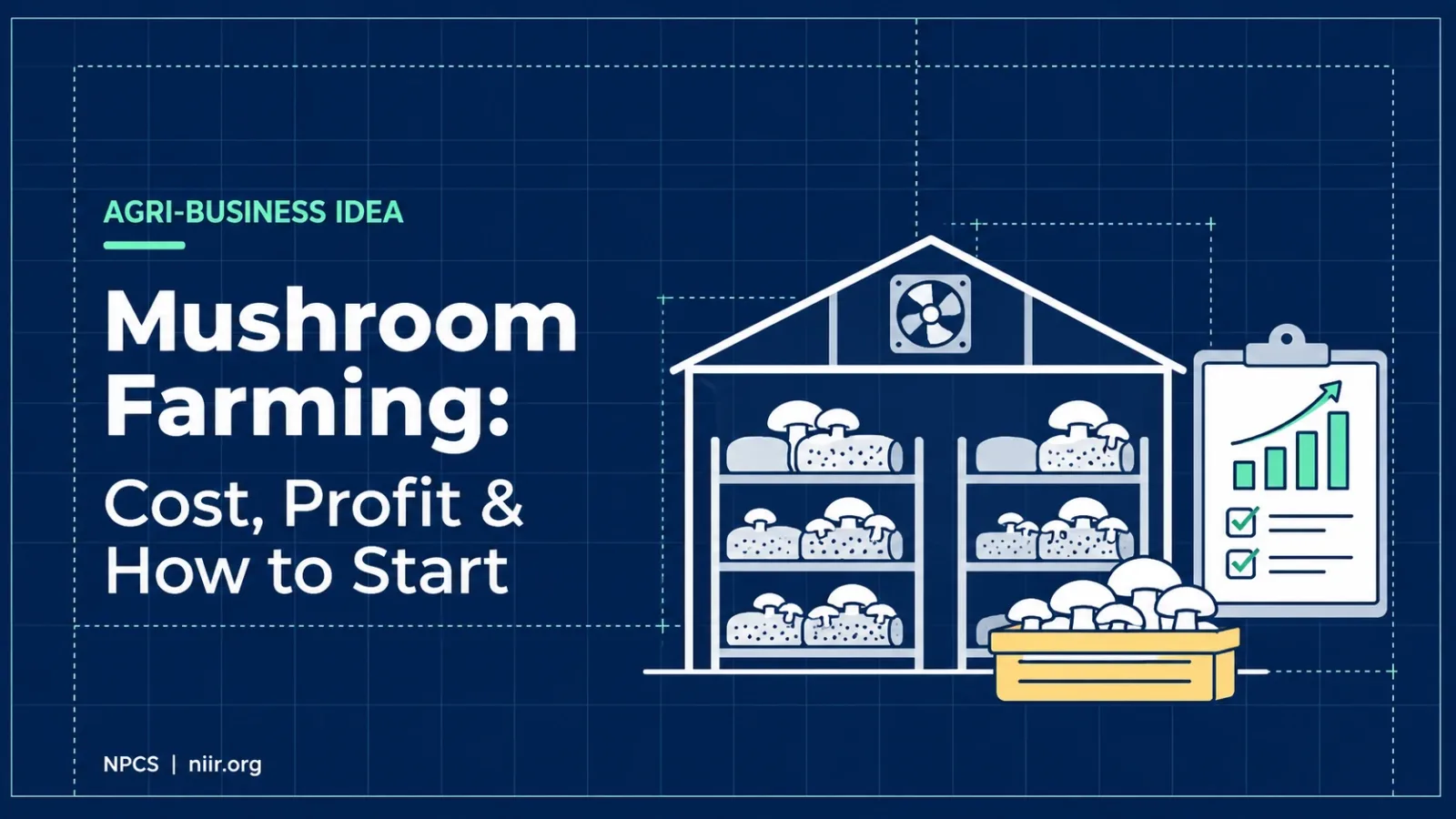
Mushroom Farming: Cost, Profit & How to Start
Contents 6 sections
Mushroom farming needs a room, not a field. The government's own benchmark for a low-cost unit is a 200 sq ft structure priced at ₹2 lakh, with half of that covered for private growers under the horticulture mission. What you earn from a mushroom farming business then depends on three numbers you can test before spending: yield per bag, selling price per kg and cost per bag. This page works from official cost norms, ICAR-DMR advisories and trial data instead, shows how to calculate profit for your own room and price, and marks where subsidy rules are narrower than the web suggests. If you are still comparing options, browse more agriculture business ideas first.
What setting up a unit costs, by official benchmark
The figures below are cost norms in the MIDH operational guidelines of April 2025, issued under the Mission for Integrated Development of Horticulture. They are ceilings used to calculate subsidy, not supplier quotes, so read them as a benchmark for the shape of your budget. As of November 2026 these are the latest guidelines we could open; confirm they still stand at the mission's website before you apply.
|
Item |
Cost norm |
Assistance for private growers |
Condition |
|
Low-cost small-scale unit (200 sq ft structure) |
₹2 lakh per unit |
50% |
Up to 5 units per beneficiary |
|
Production unit |
₹30 lakh per unit |
40%; 50% in North-Eastern and Himalayan states and scheduled areas |
Applies up to 50 MT capacity, pro rata |
|
Spawn making unit |
₹20 lakh per unit |
40%; 50% in those areas |
Credit-linked, back-ended |
|
Compost making unit |
₹30 lakh per unit |
40%; 50% in those areas |
Credit-linked, back-ended |
|
Integrated project (production, spawn, compost) |
Up to ₹80 lakh |
As sanctioned per component |
State-level committee can approve up to this size |
Inputs sit outside these norms. The spawn page of ICAR-DMR lists ₹80 per kilogram for button, oyster, milky, shiitake and paddy straw spawn, booked about 20 days ahead with half paid in advance. The page shows that rate as revised from 1 October 2018, so ask the directorate whether it still stands. Substrate, bags, power and labour change with district and species, so collect local quotes.
Which mushroom fits which season and room
Temperature decides the species. These ranges come from the crop advisories of ICAR-DMR, issued month by month in 2023 and 2024.
|
Mushroom |
Spawn run |
Fruiting |
Humidity |
What it means for a grower |
|
Button |
22-25°C |
16-18°C |
80-85% |
Needs cooling at fruiting; keep CO2 under 1,000 ppm |
|
Oyster |
25°C, give or take 2 |
22-28°C, by species |
85-90% |
Cool the hut when it passes 30°C |
|
Milky |
25-30°C |
28-35°C |
85-90% |
Suits the hot months |
Button leads the Indian market. ICAR-DMR's status paper puts it at about 70 per cent of production, with oyster at 17, paddy straw at 9 and milky at 3, out of roughly 0.24 million tonnes in FAO's 2023 count. It gives no year for the shares. Bihar, Odisha, Maharashtra, Uttar Pradesh and Uttarakhand lead by volume, which tells you where the mushroom market in India is already crowded and where buyers are used to local supply.
Read the table against your own months. Oyster and milky tolerate the temperatures of an ordinary room for part of the year. Button does not, unless you can cool the room.
Working out profit before you build
Profit in mushroom farming for one crop is kilograms harvested times selling price, minus straw, spawn, bags, labour, power and transport. Two published yields give you a starting point. A pink oyster trial at GB Pant University, Pantnagar, from 2015 to 2018 recorded 740.6 g of mushroom per kg of wheat straw. ICAR's Farmer FIRST project in Kangra, Himachal Pradesh, set up 78 button mushroom units and reported an average of 5.12 kg per bag, without stating the bag size. Both were supervised, so plan below them until your own first crops show what your room delivers.
The worked example below uses the Pantnagar yield on 100 kg of dry straw. The prices and the spawn quantity are my assumptions, placed there to show the arithmetic, so replace them with your mandi quote and your own recipe.
|
Line |
Working |
Result |
|
Fresh mushroom |
100 kg straw x 0.74 kg per kg |
74 kg |
|
Sales at ₹100 per kg (assumed) |
74 x 100 |
₹7,400 |
|
Sales at ₹150 per kg (assumed) |
74 x 150 |
₹11,100 |
|
Spawn at ₹80 per kg |
5 kg assumed per 100 kg straw x 80 |
₹400 |
|
Break-even cost per kg |
Your total cost for the 100 kg batch ÷ 74 |
Your number |
If your break-even cost per kg sits close to the price your buyers pay, the unit does not yet work, however good the yield looks.
Subsidy and loans: what the mission covers and what it does not
The horticulture mission pays its share as a credit-linked, back-ended subsidy, which means a bank loan comes first and the assistance follows the project. The percentages in the cost table apply to the cost norm, not to whatever you actually spend, so a unit that costs more than the norm gets assistance only up to the norm. Integrated projects of up to ₹80 lakh are approved at state level, so your first call is the district horticulture office.
Food processing is a separate route. If you plan to dry mushrooms or make pickle, the PMFME scheme is meant for micro food units, but its terms after September 2026 could not be confirmed at the time of writing, so check the food ministry's website before building a plan on it. For a loan-and-subsidy route that is not specific to mushrooms, the PMEGP scheme is the other place to start. A small first unit also fits the lists of business ideas under ₹5 lakh and village business ideas.
How to start, in order
1. Train first. ICAR-DMR in Solan runs a nine-day course for entrepreneurs and a five-day course for small and marginal growers. Fees and dates sit on its training calendar, and the version we could open was last updated in November 2024, so confirm the current schedule.
2. Choose the species from the temperature table. Match your coolest and hottest months to the fruiting range before you book anything.
3. Fix the room. Start with one clean, ventilated room that holds the band for your species, close to the 200 sq ft structure the low-cost unit norm assumes.
4. Book spawn early. Allow about 20 days with the directorate, or ask a nearby spawn lab for its culture details and date of preparation.
5. Run a trial crop. Fill a few bags, record kilograms per bag and the days to first harvest, then use those figures in the profit table instead of published ones.
6. Line up buyers before the first harvest. Visit the local mandi, hotels and retail stores with a sample, and note the price each will pay.
Growers weighing other farm-based options can compare the vertical farming guide and the beekeeping and honey guide before committing.
Questions about price, yield and spawn
Which mushroom sells for ₹1 lakh per kg?
No source we found supports a price near ₹1 lakh per kg for any mushroom in India. The priciest Indian mushroom is wild guchhi, the morel, which a Kullu wholesaler put at ₹4,500 to ₹5,000 per kg in June 2024, according to The Tribune, down from ₹10,000 to ₹13,000 before 2020. It is collected from forests, so it is not a farming option.
How much mushroom can a 1,000 sq ft room give in a month?
Multiply the bags your racks hold by the yield per bag, then divide by the crop length in months. As an illustration, 400 bags at 1 kg fresh per bag over a 45-day crop gives about 270 kg a month. Both inputs are assumptions, so replace them with your rack count and your trial-crop yield.
What is the price of 1 kg of mushroom seed?
Mushroom seed is called spawn. ICAR-DMR lists ₹80 per kilogram, a rate revised on 1 October 2018, so confirm it before budgeting. Private labs set their own rates, so compare at least two quotes.
Which mushroom is in high demand in India?
By production, button mushroom leads, so it is the species most buyers already know. Production share is not the same as price or local demand, though. Ask the hotels, retail stores and mandi traders in your own city which species they buy and at what price before you choose a species to grow.
Is mushroom farming highly profitable?
It can be, but the crop alone does not decide it; yield and the price you secure do. Across the 78 button units in the Kangra project, the benefit-cost ratio ran from 3.45 to 4.48, and the Pantnagar pink oyster trial reported 2.60. Those ratios come from supported or supervised work, so treat them as an upper guide.

Planning a new manufacturing unit?
NIIR prepares detailed project reports and feasibility studies for new projects. Share your requirement and the team will get in touch.