Corn Puff Manufacturing Process: Raw Materials, Machinery and Uses
Contents 9 sections
- Which corn puff are you making: puffcorn, corn murmura or a bakery puff?
- How corn puffs are made on an extruder line, step by step
- Which machines does a corn puff plant need?
- What raw materials go into corn puffs, and what should you specify?
- How to keep corn puffs crisp: packaging and shelf life
- What does a corn puff unit cost? Two government model projects
- Which licences and tax apply to a corn puff unit in 2026?
- Before you order a corn puff extruder
- Frequently asked questions about corn puffs
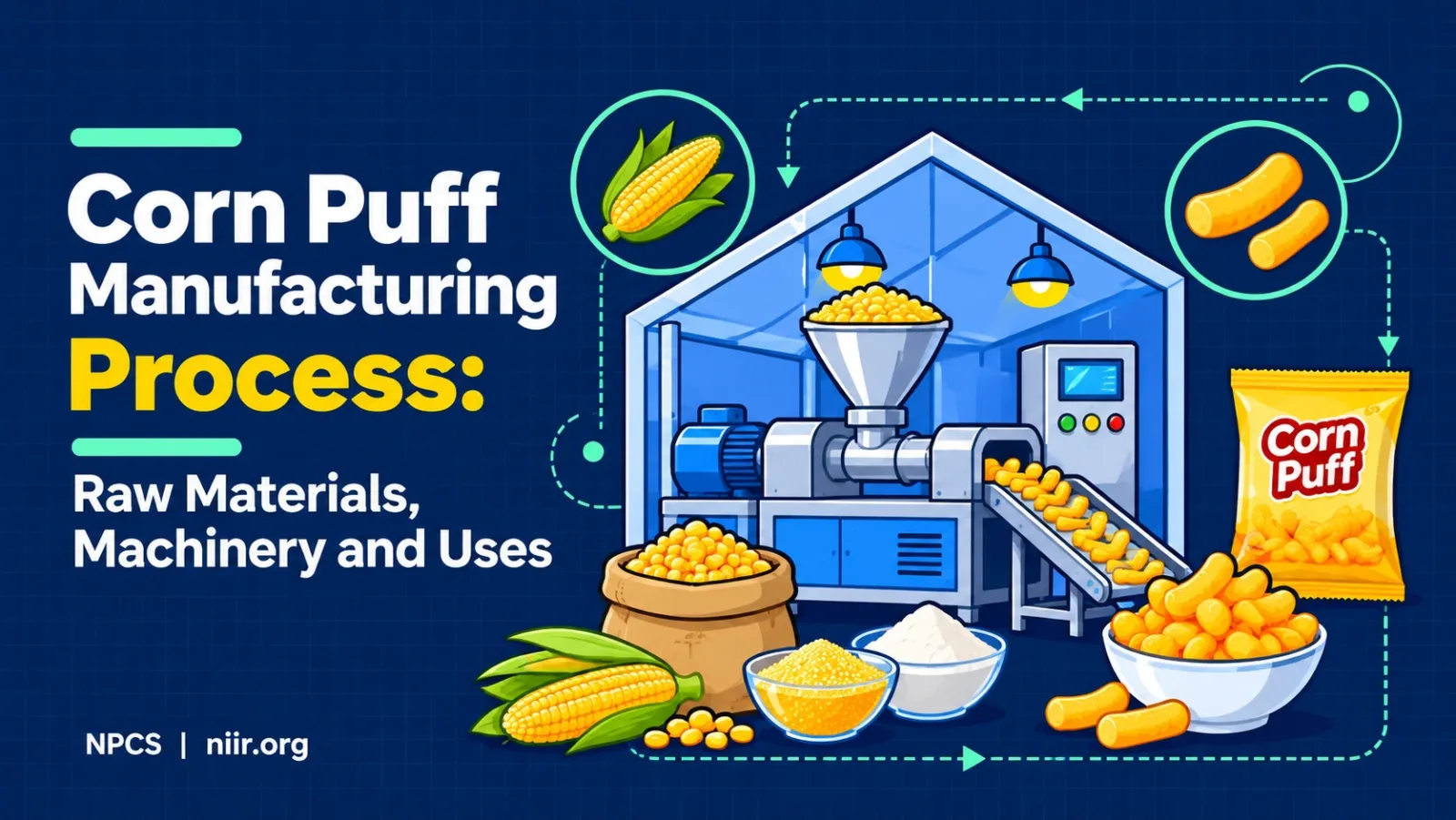
The corn puff sold in cheese and masala packets is made by extrusion. Corn grits, the hard inner part of the maize kernel with the germ and skin milled off, are wetted slightly and fed into a heated screw machine called an extruder. The screw cooks them into a hot dough and pushes it through a small hole. As the dough leaves, the drop in pressure flashes its water into steam and the piece puffs up, light and hollow.
A knife cuts each piece, a dryer crisps it, a drum coats it with oil and seasoning, and a machine seals it in a moisture-proof pouch. Three choices decide whether your puffs sell: the grit you buy, the water you add before extrusion, and how heavy the coating is.
Which corn puff are you making: puffcorn, corn murmura or a bakery puff?
Searches for corn puff mix three products, each needing a different plant.
|
Product |
How it is made |
Main input |
Key machine |
|
Extruded puffcorn (curls, balls, rings) |
Grit dough cooked and expanded through a die, then dried and coated |
Corn grits, oil, seasoning |
Extruder with die-face cutter |
|
Corn murmura (puffed whole kernels) |
Whole kernels popped in a stream of hot air |
Cleaned maize kernels |
Hot-air puffing chamber |
|
Bakery corn puff |
Puff pastry folded around a sweet corn filling and baked |
Flour, fat, sweet corn |
Dough sheeter and oven |
The NIFTEM reading manual on puff corn covers both factory routes; for corn murmura, air at 180°C to 260°C pops the kernels in a vertical chamber. This page follows the extruded route. The pastry version belongs with bakery production lines.
How corn puffs are made on an extruder line, step by step
Here is the line in order, with the point where batches usually go wrong.
1. Sieve the grits. Screen out fine flour: in a Food Chemistry study by Gujral and colleagues, flint corn grits, which carried more fine particles, expanded less than sweet corn grits.
2. Condition. Blend grits with measured water and let the mix rest so the water spreads evenly. Uneven water gives irregular shapes.
3. Extrude. The screw cooks the starch into a melt under pressure. In the same study, feed moisture affected expansion more than barrel temperature or screw speed. Too little water gives fragile, cracked pieces.
4. Cut at the die. A spinning knife sets the length; the die opening sets the shape.
5. Dry or toast. A hot-air dryer or oven takes the pieces to a glassy crisp. NIFTEM gives a water activity below 0.3 as the target.
6. Coat. Tumble the puffs in a drum under a warm oil spray, then dust in seasoning. The oil is the glue.
7. Cool and inspect. Puffs packed warm sweat inside the pouch and go soft.
8. Pack. A form-fill-seal machine weighs, fills and seals printed laminate pouches.
Which machines does a corn puff plant need?
A basic line has seven machines, and the extruder deserves most of your buying time.
|
Machine |
What it does |
What to check before buying |
|
Grit sifter |
Removes fines and lumps |
Screen size matched to your grit |
|
Ribbon or paddle mixer |
Adds water, blends the recipe |
Batch size matched to extruder feed |
|
Extruder |
Cooks and expands the dough |
Price and delivery of spare screws, barrels and dies |
|
Die-face cutter |
Cuts pieces to length |
Variable speed, quick blade change |
|
Dryer or continuous oven |
Removes leftover moisture |
Even airflow, accurate temperature control |
|
Flavouring drum with oil sprayer |
Applies oil and seasoning |
Even spray, easy cleaning between flavours |
|
Cooling conveyor and packing machine |
Cools, weighs, seals |
Pouch size range, nitrogen flushing option |
A single-screw collet extruder is cheaper and makes plain corn curls well. A twin-screw machine copes with mixed flours and holds output steadier, at a much higher price. Grits are abrasive, so the screw and barrel wear first: price a replacement set before you sign.
What raw materials go into corn puffs, and what should you specify?
Give every supplier a written specification.
|
Input |
What to specify |
|
Corn grits (degermed maize) |
Even size, few fines, moisture and aflatoxin test per lot |
|
Rice or millet flour (optional) |
Particle size close to the corn grit |
|
Edible oil |
Fresh stock, low free fatty acids |
|
Seasoning (cheese, tomato, masala, salt) |
Free-flowing, supplier food safety papers |
|
Printed laminate film |
Seal strength, print quality |
The coating is where the fat and much of the cost sit: in NIFTEM's cheese puff formulation, vegetable oil is 26% of the recipe against 63.5% corn flour.
The same manual warns that maize stored above 14% moisture loses price and carries a higher aflatoxin risk. Grits come from maize dry milling, explained in our maize processing guide. Supply is tighter too: APEDA's May 2026 maize dashboard expects exports to fall sharply as feed and ethanol buyers take more maize at home. Keep two grit suppliers.
How to keep corn puffs crisp: packaging and shelf life
Moisture is the first enemy: NIFTEM names lost crispness as the main way extruded snacks spoil, and found they kept better in laminated pouches than in plain polyethylene bags.
Coated puffs carry oil, though, and NIFTEM notes off-odours and off-flavours can build after 5 to 6 months. For heavily coated puffs, use a better oxygen barrier and consider nitrogen flushing. Set your best-before date from your own storage trial, not a competitor's label.
What does a corn puff unit cost? Two government model projects
A full line costs more than fifteen times a small shed unit, and almost all of the gap is machinery.
|
Item |
Small unit (UP MSME pre-feasibility) |
Commercial line (CFTRI model project) |
|
Capacity |
25 kg raw material an hour |
1 tonne a shift |
|
Products |
Kurkure-type shapes, including puff corn |
Low-fat expanded snacks |
|
Machinery |
One cooking extruder |
Extruder, dryer, grinder, destoner, mixer, grader, packing unit |
|
Plant and machinery |
₹4.25 lakh |
₹1.05 crore |
|
Total project cost |
₹7.42 lakh |
₹1.20 crore |
Both are older estimates (the Uttar Pradesh loan schedule starts in April 2019; the CFTRI page is undated), so treat them as the shape of the cost, not quotes. Your number moves with extruder output, dryer size and packing automation. Other lines at similar budgets are compared in our food manufacturing ideas.
Which licences and tax apply to a corn puff unit in 2026?
Older guides still quote figures that changed recently.
• Food licence: from 1 April 2026, the FSSAI turnover thresholds order puts food businesses with turnover up to ₹1.5 crore under basic registration, up to ₹50 crore under a state licence, and above that under a central licence. The old state licence cut-off was ₹12 lakh.
• GST: extruded or expanded savoury snacks are taxed at 5% from 22 September 2025, according to CBIC's GST rate ready reckoner. Recheck any price list built on the older rate.
• Subsidy: the PMFME scheme for micro food units ran on a temporary extension to 30 September 2026, and the ministry proposed a five-year renewal, PTI reported in August 2026. Check pmfme.mofpi.gov.in before counting the subsidy in a loan plan.
Before you order a corn puff extruder
1. Send your grits to two extruder makers for trial runs; compare samples after a week sealed and a week in an open bowl.
2. Agree the moisture and aflatoxin report each grit supplier sends with every lot.
3. Size the extruder to sales you can make in year one; a small machine on two shifts beats a large one standing idle.
4. Budget working capital for printed film, sold in minimum order runs, and three months of seasoning.
Prefer a dried fruit snack instead? Compare it with our guide to healthy snack manufacturing.
Frequently asked questions about corn puffs
Are corn puffs healthy?
They are a starchy snack, and the coating decides the rest. The puff itself is mostly cooked starch; the oil and seasoning add most of the fat and salt, and in NIFTEM's cheese puff recipe oil is about a quarter of the mix. Fried snacks, CFTRI notes, often carry 40% fat or more. Check fat and sodium on the label.
What is the difference between puffcorn and popcorn?
Popcorn is a whole kernel of a special maize that bursts when steam builds inside its hard hull. Puffcorn is made from milled grits, cooked in an extruder and expanded through a die, so its shape comes from the machine and it is not a whole-grain snack.
Can I make corn puffs without an extruder?
Not the packet kind. Curls, balls and rings need an extruder, because the shape and the puff both come from the die. Without one, you can puff whole kernels into corn murmura with hot air, or bake a pastry corn puff. Each sells to different buyers, so check demand first.
Can the same machine make jowar, ragi or rice puffs?
Yes, with changes to recipe, water and die settings. Millet and rice flours expand differently from corn grits, so expect trial runs for each new base. A twin-screw extruder handles mixed flours more easily. Sourcing millet grits is covered under millet processing.

Planning a new manufacturing unit?
NIIR prepares detailed project reports and feasibility studies for new projects. Share your requirement and the team will get in touch.