Green Hydrogen Plant: Production Process, Inputs and Cost Drivers
Contents 8 sections
- What does green hydrogen cost per kg in India, and what drives it?
- Which green hydrogen plants are running in India, and in which states?
- How a green hydrogen plant works, step by step
- Alkaline or PEM: which electrolyser suits an Indian plant?
- How much power, water and electrolyser capacity per tonne of hydrogen?
- What the National Green Hydrogen Mission offers a project
- Next steps if you are evaluating a green hydrogen plant
- Frequently asked questions about green hydrogen plants
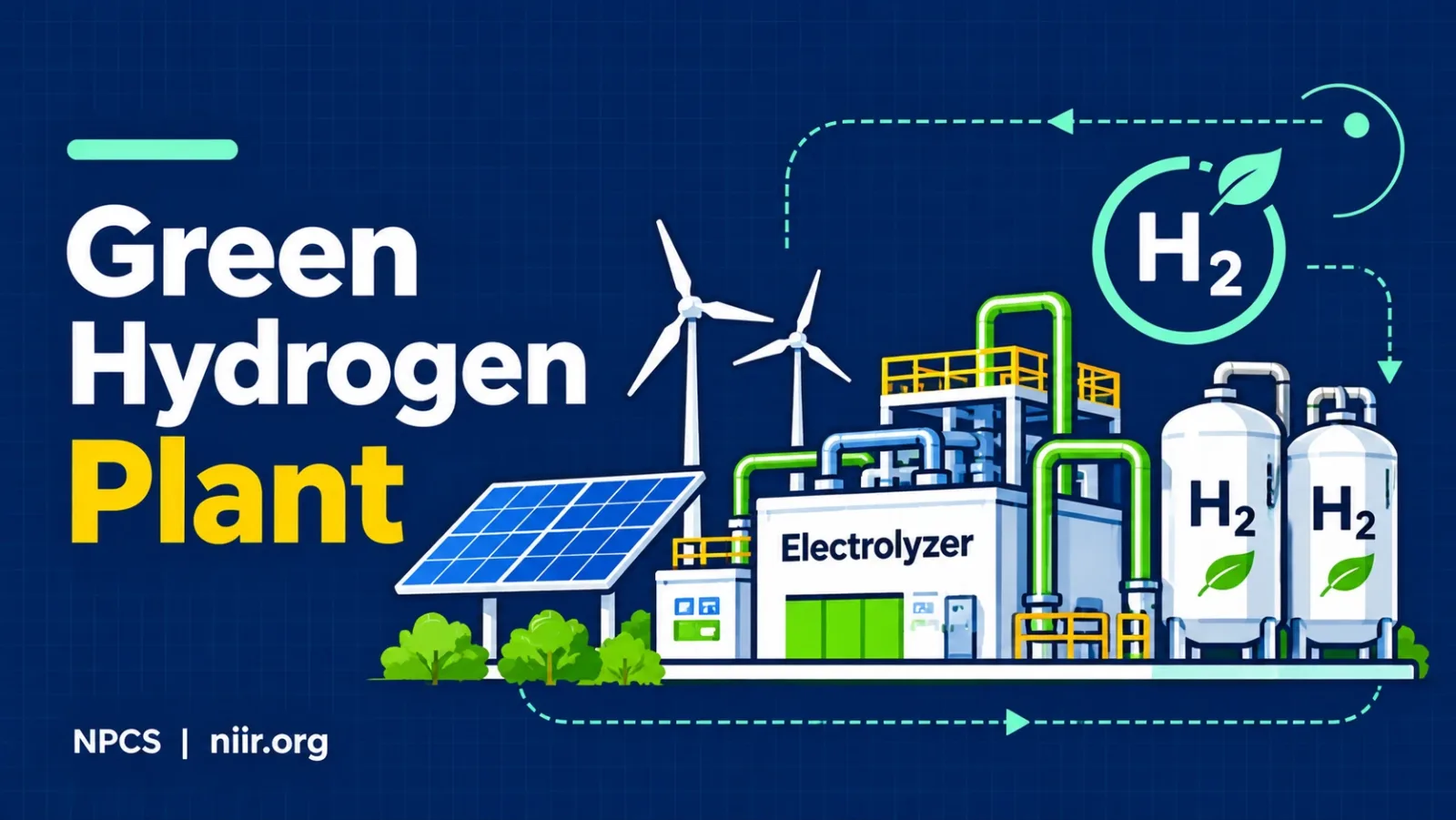
A green hydrogen plant splits purified water into hydrogen and oxygen in an electrolyser that runs on solar, wind or other renewable power. It has two raw materials, electricity and water, and electricity is where the money goes: each kilogram of hydrogen takes about 53 units (kWh) of power and 20 to 30 litres of water once purification and cooling are counted.
So identical machines can sell hydrogen at very different prices: your power tariff and the hours the electrolyser runs decide most of the cost per kg.
Indian Oil's Panipat refinery has contracted green hydrogen at ₹397 per kg including GST for 25 years, nearly double what its grey hydrogen from natural gas costs. Lock in a buyer and round-the-clock renewable power before you compare electrolysers.
What does green hydrogen cost per kg in India, and what drives it?
Tender results are the best price signal: firm bids for long contracts, not model estimates.
|
Contract |
Product |
Price discovered |
Volume and term |
|
Indian Oil Panipat tender, won by L&T Green (May 2025) |
Green hydrogen |
₹397/kg incl. GST |
10,000 t a year, 25 years |
|
Panipat refinery's own supply, per Indian Oil's research director |
Grey hydrogen |
₹180-200/kg excl. GST |
In house |
|
First green ammonia auction by the Solar Energy Corporation of India (SECI), Paradeep Phosphates (2025) |
Green ammonia |
₹55.75/kg |
75,000 t a year, 10 years |
|
SECI ninth auction, IFFCO Paradeep (Aug 2025, reported by Energetica India) |
Green ammonia |
₹49.75/kg |
1,00,000 t a year |
Four cost drivers sit behind every one of these bids:
• Power tariff. At 53 kWh per kg, each ₹1 added to the tariff adds about ₹53 to every kg.
• Running hours. An electrolyser on solar alone idles at night, spreading its capital cost over fewer kilograms.
• Plant cost. The IEA's Global Hydrogen Review 2025 puts installed electrolysis at USD 2,000 to 2,600 per kW as a 2024 global average, and USD 600 to 1,200 for Chinese systems, before the power plant.
• Stack replacement. The same review assumes a 50,000 hour stack life, so a plant running most of the year replaces stacks around year six.
Which green hydrogen plants are running in India, and in which states?
India's first pure green hydrogen pilot started in Assam in 2022; the largest plant running today is in Karnataka. The Ministry of New and Renewable Energy (MNRE) named three ports as green hydrogen hubs in October 2025: Deendayal (Gujarat), V.O. Chidambaranar (Tamil Nadu) and Paradip (Odisha).
|
Plant |
State |
Capacity |
Status |
|
Oil India, Jorhat |
Assam |
10 kg a day |
April 2022, India's first 99.999% pure pilot |
|
Torrent Power, Gorakhpur |
Uttar Pradesh |
72 t a year |
August 2025, blended into city gas |
|
V.O. Chidambaranar Port |
Tamil Nadu |
10 Nm³ an hour |
September 2025, first port pilot |
|
JSW Energy, Vijayanagar |
Karnataka |
3,800 t a year |
November 2025, largest commissioned |
|
L&T Green for Indian Oil, Panipat |
Haryana |
10,000 t a year |
Due December 2027 |
Every plant sits beside its buyer, because hydrogen is costly to move, so steel and metal industries and fertiliser units lead demand.
How a green hydrogen plant works, step by step
Each step names the main machine and its job:
1. Power intake. A transformer and rectifier convert renewable power to the direct current the stacks need.
2. Water treatment. A reverse osmosis unit and demineraliser bring raw water or seawater to electrolysis grade.
3. Electrolysis. The electrolyser stacks split water into hydrogen and oxygen.
4. Separation and cooling. Gas separators pull liquid out of each gas stream; pumps and chillers remove stack heat.
5. Purification. A deoxo unit strips trace oxygen and a dryer removes moisture to the buyer's purity specification.
6. Compression and storage. A compressor and buffer vessels keep flow steady when power dips; gas detectors trip the plant on a leak.
7. Conversion or dispatch. Many projects feed an ammonia or methanol unit next door, since those liquids ship more easily. Ammonia is also the base for urea fertilizer manufacturing.
JSW's plant also sells 30,000 tonnes of oxygen a year to the steelworks next door, the same gas an industrial gas plant sells.
Alkaline or PEM: which electrolyser suits an Indian plant?
Choose alkaline when power is steady and cost per kW matters most; choose a proton exchange membrane (PEM) unit when the plant must follow fluctuating solar and wind. A peer reviewed review on PubMed Central compares them:
|
Point of comparison |
Alkaline |
PEM |
|
Response to a change in power |
Seconds |
Milliseconds |
|
Stack life |
60,000-90,000 hours |
20,000-60,000 hours |
|
Stack cost (2020) |
€1,000-1,200 per kW |
€1,860-2,320 per kW |
India's biggest contract leans alkaline: Indian Oil says Panipat will use high pressure alkaline electrolysers made by L&T at Hazira, Gujarat. Compare suppliers on guaranteed kWh per kg, not price per kW: three extra units per kg cost three times your tariff on every kg, for decades.
How much power, water and electrolyser capacity per tonne of hydrogen?
Size the plant backwards from the buyer's tonnes:
|
For each tonne of hydrogen |
Requirement |
Basis |
|
Electricity |
About 53 MWh |
Energy Transitions Commission baseline, close to the IEA's 63% efficiency |
|
Water |
20-30 kilolitres |
9 litres per kg for the reaction plus treatment and cooling (RMI) |
|
Oxygen produced |
About 8 tonnes |
JSW: 30,000 t oxygen to 3,800 t hydrogen |
A 1 MW electrolyser at 53 kWh per kg makes about 19 kg an hour. Run 8,000 hours a year, that is roughly 150 tonnes; run 2,000 hours, under 40 tonnes, so each tonne carries almost four times the capital cost. That is why solar is paired with wind or storage.
What the National Green Hydrogen Mission offers a project
The National Green Hydrogen Mission (NGHM), launched in January 2023, has an outlay of ₹19,744 crore up to 2029-30, including ₹17,490 crore for the Strategic Interventions for Green Hydrogen Transition (SIGHT) programme, and targets 5 million tonnes a year by 2030, according to the Press Information Bureau's November 2025 update. For a developer:
• Incentives are bid for. SIGHT support is won in SECI rounds; by May 2025, 8,62,000 tonnes a year of production had been allocated to 19 companies.
• "Green" has a limit. The Green Hydrogen Standard for India allows at most 2 kg of CO₂ equivalent per kg of hydrogen, from water treatment to compression, so coal-heavy grid power will not pass.
• Certification and waivers. Since April 2025, plants that take incentives or sell in India need certification; inter-state transmission charges on their renewable power are waived on time-bound conditions.
MNRE said on 29 October 2026 that Indian companies had signed 23 offtake agreements for 5,55,610 tonnes a year, about 73% for export. Check the open SIGHT round and your state's policy (as of November 2026) before you plan.
Next steps if you are evaluating a green hydrogen plant
1. Name the buyer and the volume, purity and pressure it needs. Lenders fund long-term offtake contracts, not hopes of many small cylinder buyers.
2. Price round-the-clock renewable power first.
3. Decide what you sell: hydrogen, ammonia or methanol, plus oxygen. If your feedstock is farm waste, a compressed biogas plant may be simpler; see also our renewable energy manufacturing ideas.
4. Shortlist two electrolyser suppliers on guaranteed kWh per kg and stack life.
5. Test the numbers with a techno-economic feasibility study, then a detailed project report for lenders.
Niir Project Consultancy Services (NPCS) has prepared over 5,000 project reports across 40+ sectors since 1994. For a green hydrogen or green ammonia plant, an NPCS project report covers the process flow, equipment list, power and water balance, layout, manpower, project cost, cost per kg, break-even and cash flows.
Frequently asked questions about green hydrogen plants
Can an MSME set up a green hydrogen plant?
Yes, at pilot scale and beside a buyer. Torrent's Gorakhpur plant makes 72 tonnes a year for city gas, and the V.O. Chidambaranar port pilot cost ₹25 crore for 10 Nm³ an hour. Most small firms enter through the supply chain: water treatment skids, compressors, fabrication and maintenance.
Can a green hydrogen plant use seawater?
Yes, after treatment. RMI says seawater and wastewater can be purified for electrolysis with mature technology, adding no more than USD 0.10 per kg and about 1% to the power used. That suits coastal sites near the port hubs, where fresh water is often short.
What approvals does a green hydrogen plant need?
MNRE Minister Pralhad Joshi said in September 2025 that these projects are exempt from environmental clearance and can use a national single-window portal. You still need state industrial approvals, safety licences for storing and compressing hydrogen, and green hydrogen certification if you sell in India.
How much is 1 kg of hydrogen in India?
Grey hydrogen from natural gas costs Indian Oil about ₹180 to ₹200 per kg before GST; green hydrogen under the Panipat contract costs ₹397 including GST. Cylinder supplies cost more, since compression and transport add to every kg, and each ₹1 on the power tariff moves the green price by about ₹53.

Planning a new manufacturing unit?
NIIR prepares detailed project reports and feasibility studies for new projects. Share your requirement and the team will get in touch.