
Power Transmission Business Opportunities
India’s power sector just sent a defining signal to the startup and MSME ecosystem. A fresh analysis by ICRA has revealed that India’s power transmission market is on the verge of a capital expenditure of ₹5–6 lakh crore from FY27 to FY32, according to a report in The Economic Times recently. This is not a future forecast. It’s a real-life event that’s happening now and the impact is already manifesting opportunities for businesses along the value chain, technology services, and infrastructure support.
ICRA’s estimate includes enhancing existing transmission lines, increasing evacuation capacity for renewables, and building new transmission corridors. The India’s aim of achieving more than 900 GW of non-fossil fuel capacity by 2036 is simply not possible without this huge investment. Those who grasp the change early will be in the best position to benefit from India’s biggest infrastructure construction project.
The message from Economic Times reporting to the founders, MSMEs and industrial consultants is clear that the time to situate businesses within this supply chain is not tomorrow, but today.
Related Article: India Power Transmission and Distribution EPC Market: Growth, Opportunities, and Business Potential for Entrepreneurs
What Recent Economic Times Reporting Means
The economic times has picked up ICRA’s estimate of power transmission industry’s capital expenditure in India to be in the range of ₹5–6 lakh crore during the period 2026–27 to 2031–32. The complete report is here: ET — India’s Power Transmission Sector is Ready for ₹5–6 Lakh Crore Capex by FY32
Three things for business builders:
First: Key equipment suppliers’ outstanding orders and order inflows have grown by more than double since FY22. It is already in progress; it is not a future prospect.
Second: Only 12% of Tariff Based Competitive Bidding (TBCB) transmission projects were finished on time. This execution gap is a business opportunity. Each delay is a procurement issue which a smart MSME or startup can solve.
Third, grid curtailment for renewable energy producers has been as high as 33% in some areas. That means lost revenue for RE developers — and a pressing need for the faster and smarter transmission support services.
The Economic Times signal is just a reminder of what anchor contracts, long order books, and revenue visibility from the government will look like for MSME founders for the next 6 years at least.(Power Transmission Business Opportunities)
Why India’s Power Transmission Sector Is Growing at This Scale
The Renewable Energy Integration Imperative
By mid-2025, India has installed 226 GW of renewable energy. The government’s goal for the next ten years is to install an additional 470 GW of solar and wind power. For every megawatt of that power, some wires, some transformers, some substations, and some transmission lines are necessary to get it to the grid. For this transition, the Central Electric Authority (CEA) has planned for 137,500 circuit kilometres (ckm) of transmission lines and 827,600 MVA of substation capacity, both in interstate and intrastate networks.
Get Detailed Insights from This Book: Solar PV Power and Solar Products Handbook
HVDC as the Next Frontier
India’s High-Voltage Direct Current (HVDC) market will grow from USD 15 billion in 2025 to USD 31 billion by 2035, according to market projections. Engineers design HVDC corridors for low-loss power transmission over long distances. These corridors enable utilities to transmit power from generation centres in Rajasthan and Gujarat to load centres in Maharashtra and Tamil Nadu. In addition to current and future EHVDC installations, there is a market for startups and MSMEs with knowledge of HVDC installation, monitoring and maintenance.
Demand Beyond Renewables
Renewables are not the sole cause of power transmission growth. There is parallel demand for the improvement of transmission and distribution infrastructure from data centres, railway electrification, EV charging infrastructure and industrial expansion. This cross-sector demand translates to being one of the most robust supply chain business sectors in India today.(Power Transmission Business Opportunities)
Government Policies and Incentives Backing This Boom
The Union government has pledged ₹9.15 lakh crore to improve India’s power infrastructure in general by 2032. There are a number of policy instruments which directly promote the entry of MSMEs into this zone. The Ministry of MSME provides credit linked capital subsidy and technology upgradation assistance to the industrial manufacturing units.
Under DPIIT, Startup India offers tax holidays, simple compliance procedures, and government procurement initiatives, all relevant to startups developing products or services for the power transmission industry.
The National Monetisation Pipeline 2.0 has estimated a ₹2.3 lakh crore monetisation potential for power transmission assets from FY26 to FY30, enabling private participation through Build-Own-Operate-Transfer (BOOT) contracts. Project financing and equity-backed project structure are available to entrepreneurs via Invest India, the government’s body to facilitate investors.
Only Power Grid Corporation of India has planned capex of ₹1.08 lakh crore for FY26 to FY28. This will provide a predictable procurement flow and a direct sourcing opportunity for the MSME component manufacturers and service providers.
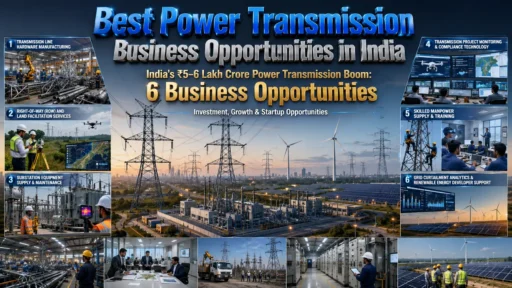
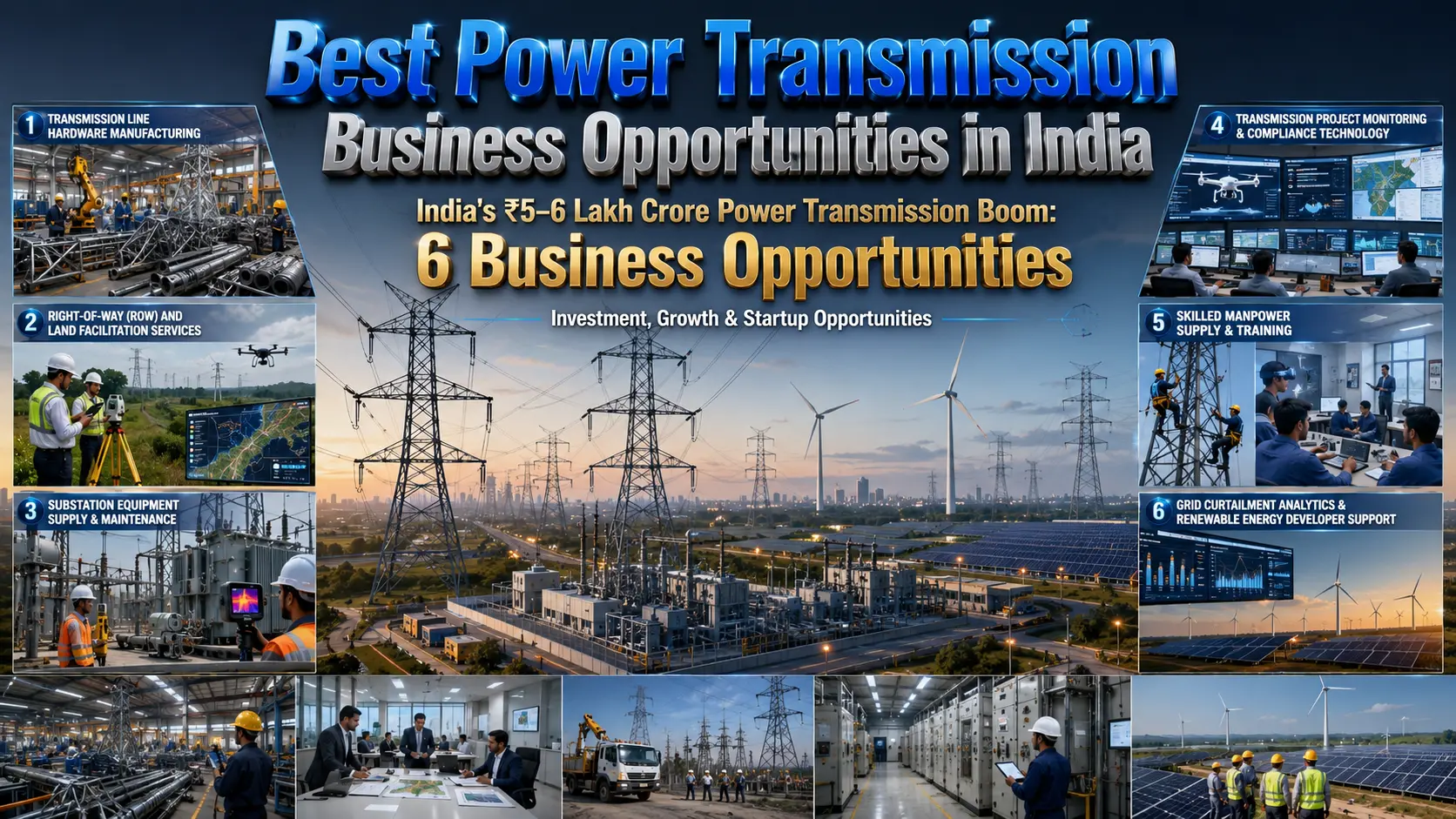
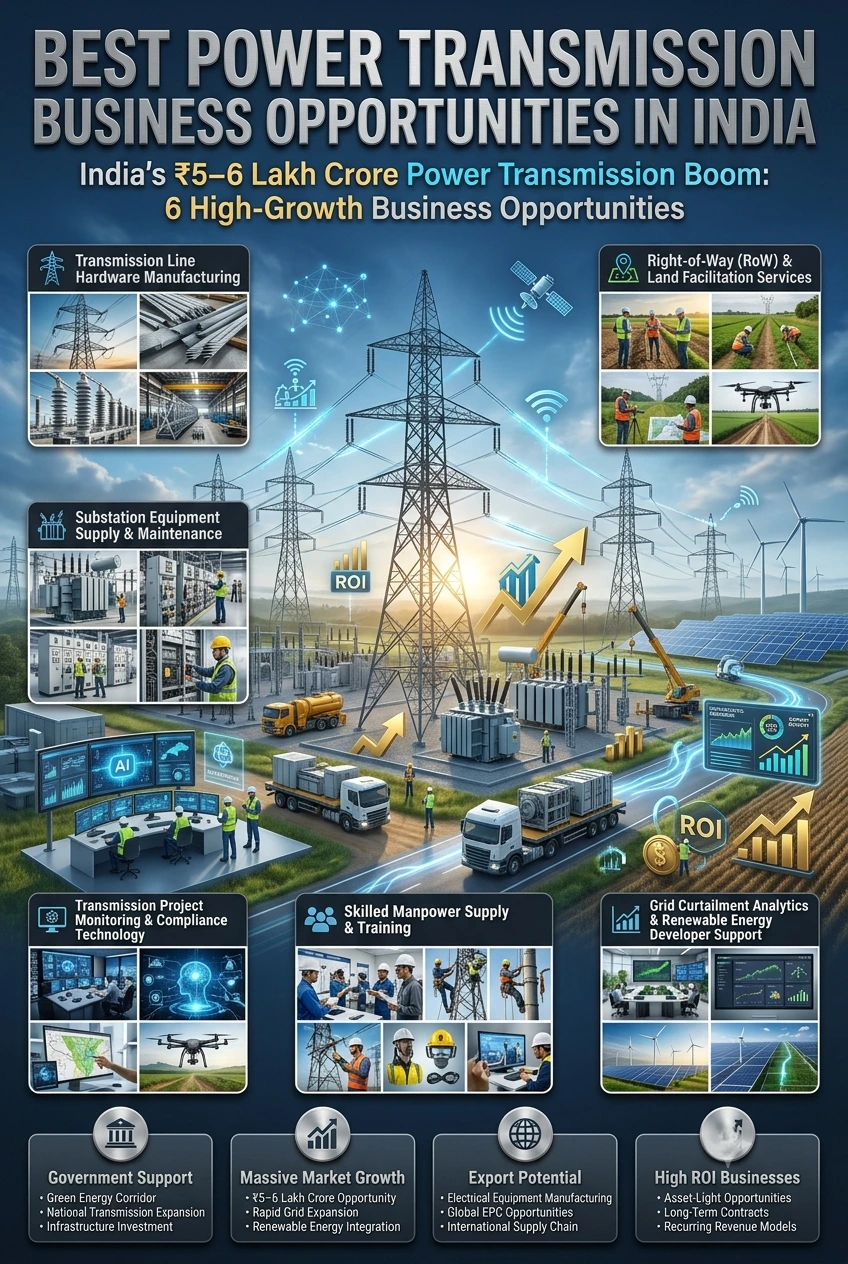
6 High-Potential Business Ideas Emerging from This Transmission Boom
1. Transmission Line Hardware Manufacturing
The sector requires millions of units of conductors, insulators, hardware fittings, earthing materials, and tower parts. MSMEs can establish light engineering capabilities to directly supply components to the EPC contractors executing TBCB projects. Companies have already confirmed the demand pipeline, with order books more than doubling since FY22.
2. Right-of-Way (RoW) and Land Facilitation Services
Land acquisition and RoW issues are clearly identified in ICRA’s report as the largest execution risk in the sector. New companies providing RoW facilitation, community liaison, documentation management and dispute resolution services will be instantly appealing to developers and state transmission utilities. This is a consulting play that demands high-value, added legal and field operations capabilities.
3. Substation Equipment Supply and Maintenance
The CEA has planned 827,600 MVA of substation capacity additions. This entails power transformers, circuit breakers, control panels, SCADA systems and maintenance services. There is an opportunity for existing MSMEs in the electrical equipment manufacturing or industrial services sector to expand their operations into substation supply chains with relatively low capital expenditure.(Power Transmission Business Opportunities)
Access Complete Business Plan: Power Transformer
4. Transmission Project Monitoring and Compliance Technology
There is definitely a market for project tracking platforms, compliance dashboards, and regulatory reporting tools because companies complete only 12% of TBCB projects on time. Construction monitoring or grid compliance SaaS startups still need to solve this existing pain point.
5. Skilled Manpower Supply and Training
ICRA has pointed out that a lack of skilled manpower is a major obstacle for the execution of transmission projects. VTIs, staffing agencies and apprenticeship websites for electrical, civil and mechanical skills are able to establish sustainable businesses providing trained employees to transmission contractors. Startup India offers recognition and compliance assistance for such skilling enterprises.
6. Grid Curtailment Analytics and RE Developer Support
Project returns are in direct line of sight to renewable energy developers, as they are subject to up to 33% grid curtailment. Data analytics, curtailment forecasting and grid integration advisory services startups can create subscription revenue streams for hundreds of RE developers who are looking to manage and dispute curtailment losses in a systematic manner.
Import–Export Opportunity Analysis
The transmission boom in India is also opening up opportunities for export and import of specialised equipment and components.
Import Opportunity: Advanced power transformers (above 400 kV), gas-insulated switchgear (GIS), fibre-optic sensing systems and HVDC converter stations are currently imported. Entrepreneurs can create import-trading or distribution businesses for these products with long-term supply contracts based on the timelines of transmission projects.(Power Transmission Business Opportunities)
Export Opportunity: India products like conventional conductors, galvanised steel towers, porcelain insulators and earthing equipment are competitive in terms of both quality and price. South Asia, Africa and South East Asia are the regions that run their own grid expansion programmes and can be targeted by MSME exporters.
Export oriented MSMEs are required to register themselves with the Directorate General of Foreign Trade (DGFT) to avail export incentives, duty drawback benefits and benefits under RoDTEP scheme. The transmission equipment segment is eligible for various MSME export promotion schemes offered by FICCI and the Engineering Export Promotion Council.
Indian MSME Success Stories in the Power Transmission Space
There are already good examples of MSMEs developing relevant businesses in the power infrastructure value chain in India.
KEC International: KEC is an EPC company that has been expanding its power transmission business, acquiring the skills and expertise of a cable manufacturer, in the design and construction of conductors, towers and project execution. Their journey is a good example of how over time; they can build up their skill sets to encompass the entire project.
Sterlite Power: This is a private transmission developer who has developed a portfolio of transmission investments via the TBCB route, and has proved that private entrepreneurs can be owners and operators of transmission assets within India’s liberalised environment.
MSMEs in Vadodara and Jaipur: Dozens of MSMEs are engaged in manufacturing tower parts, hardware fittings, and cable accessories, who have established anchor tie-ups with PGCIL and state utilities, providing stable income throughout the project cycles. The units are an example of how small and local manufacturing power equates to long-term government procurement relationships.
Choose the right startup backed by real market demand
About NPCS — Niir Project Consultancy Services
NPCS (Niir Project Consultancy Services) offers complete feasibility studies, market research and power transmission project reports for industries such as electrical equipment, conductor manufacturing, substation component and infrastructure services to entrepreneurs and MSMEs seeking to formally join the power transmission supply chain.
NPCS project reports clearly outline capital requirements, manufacturing processes, regulatory procedures, raw material sourcing, and financial returns. These reports help founders prepare for bank loans, investor funding, and government schemes. Whether you are setting up a new manufacturing unit or expanding an existing business into transmission equipment, NPCS feasibility analysis provides the strong foundation your business plan needs.
Key Data: India Power Transmission Sector — At a Glance
| Parameter | Data / Figure | Source |
| Projected Transmission Capex (FY27–FY32) | ₹5–6 Lakh Crore | ICRA / Economic Times |
| Planned Transmission Lines (ISTS + Intrastate) | 1,37,500 Circuit Kilometres | CEA |
| Planned Substation Capacity Addition | 8,27,600 MVA | CEA |
| Annual Required Line Addition | ~20,000 ckm | ICRA |
| India Installed Renewable Capacity (June 2025) | 226 GW | Kotak Neo Report |
| Additional RE Capacity Targeted | 470 GW | Government Target |
| HVDC Market Size (2025) | USD 15 Billion | Kotak Neo Report |
| HVDC Market Size (2035 Projected) | USD 31 Billion | Kotak Neo Report |
| TBCB Projects Completed On Schedule | Only 12% | ICRA |
| RE Grid Curtailment Rate | Up to 33% | ICRA |
| Power Grid Corp Planned Capex (FY26–FY28) | ₹1.08 Lakh Crore | Power Grid Corp |
Frequently Asked Questions (FAQs) — For Founders and MSMEs
1. How can an MSME get into the power transmission supply chain, if they have no experience?
MSMEs can start manufacturing components such as tower components, hardware fittings, insulators, and cable accessories. These sub-assemblies have a moderate cost, and manufacturers can market them to bigger EPC contractors or directly to State utilities. The pathway is through MSME registration under Udyam and association with existing contractors. Feasibility support is offered via NPCS project reports.
2. What is the cheapest investment required for a transmission equipment manufacturing unit to get it up and running?
The required investment ranges from ₹25 lakh for small hardware fitting units to ₹5–10 crore for conductor or transformer component manufacturing. The investment depends on the product segment. Eligible MSMEs can also access collateral-free loans of up to ₹1 crore under the CGTMSE scheme offered by the Ministry of MSME, Government of India.
3. Are there any government tenders which are particularly for MSMEs in this sector?
Yes. Power Grid Corporation of India (PGCIL) and state transmission utilities issue floating tenders having the MSME purchase preference clause in accordance with the Public Procurement Policy. Price preference & Lower EMD for MSMEs registered under Udyam. It is recommended to have regular tender monitoring carried out on GeM (Government e-Marketplace).
4. How does RoW facilitation work?
Right-of-Way facilitation refers to the coordination of farmer/ community contracts, documentation and resolution of disputes for right-of-way routes for transmission lines. Service providers get paid by project developers on a mileage or milestone basis. For example, the price of an average engagement is between ₹5,000 and ₹25,000 per tower location, depending on the complexity. This is a high-value service as the Economic Times has highlighted RoW delays as one of the top risks to execution in the sector.
5. Are there export markets for the manufacturers of transmission equipment in India?
Indian manufacturers’ products are competitive in conductors, galvanised steel towers, porcelain insulators and earthing equipment. Major export markets are Bangladesh, Sri Lanka, Nepal, Kenya, Ethiopia, Vietnam and Indonesia, all of which are embarking on growth in their own power networks. Export assistance and market development support is provided by DGFT and Engineering Export Promotion Council.
Conclusion: Act on This Economic Times Market Signal — The Window Is Opening Now
India’s power transmission sector is entering the most intensive investment phase in its history. The Economic Times’ coverage of ICRA’s ₹5–6 lakh crore capex projection is not just background reading — it directly signals where the next generation of MSME wealth will emerge.
The sector faces execution challenges — including land acquisition delays, skilled manpower shortages, equipment supply gaps, and grid curtailment management issues — which smart startups and MSMEs can solve through innovative business solutions. Every ₹1 of infrastructure capex generates multiple rupees of demand across the supply chain, services ecosystem, and technology layer.(Power Transmission Business Opportunities)
Economic Times market signals of this scale and clarity are rare. When ICRA projects ₹5–6 lakh crore in sectoral capex, backed by government targets, CEA planning, and Power Grid Corporation order pipelines, founders who act in FY26–FY27 will have established supplier relationships, compliance records, and market presence well ahead of the capex peak in FY30–FY32.
The grid infrastructure of India’s clean energy future is being built right now. Entrepreneurs who enter this space today with the right product, MSME registration, and supply chain partnerships will look back on 2025–2026 as their defining entry moment.