
SPICED Scheme for Spice Processing
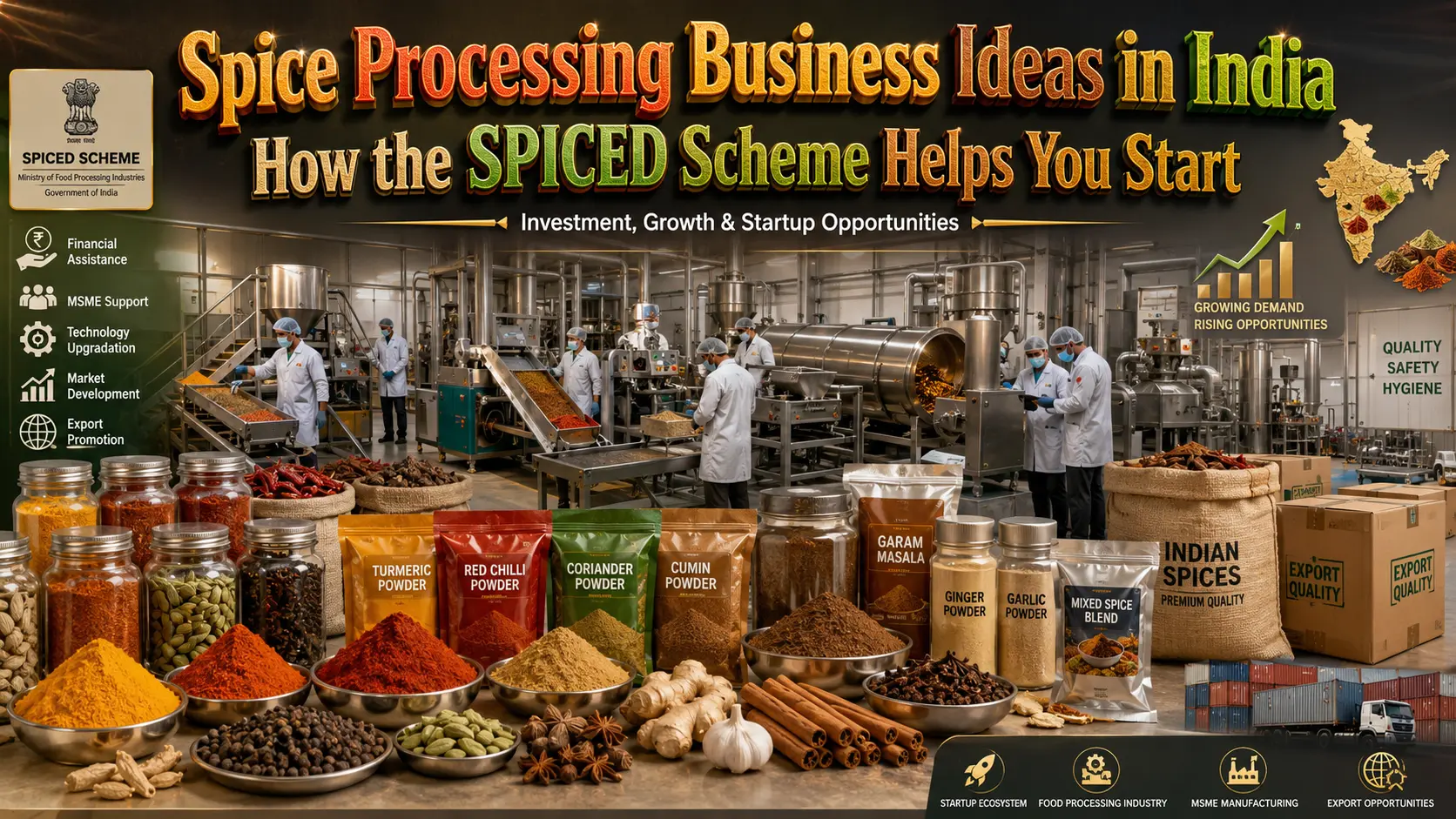
India has been the world’s spice basket since the beginning of times. Today however, the opportunity extends beyond the production and exchange of spices. The Government of India is actively supporting a new wave of business ideas that spans processing, packaging, exports and/or value addition. Launched by the Ministry of Commerce and Industry, the SPICED scheme, an initiative of the Spices Board of India, provides an outlay of ₹422.30 crore for supporting spice entrepreneurs, MSMEs, farmers and exporters in the spice industry. It is a unique opportunity for the government, the export infrastructure and market-based business planning for the entrepreneurs who are the founders and first-generation business planners.
Why India’s Spice Sector Is a High-Value Opportunity Right Now
India’s spice production accounts for almost one-fifth of the global production. More than 75 spice varieties, out of the 109 recognised by the ISO, are cultivated in the country and over 225 unique products are exported to almost every country. Current total spice exports are recently US$4.72 billion for a single financial year, and the domestic market is growing at the same rate. The Indian spices industry is expected to grow at a CAGR of more than 10% during the forecast period. Rising global demand for Indian flavors, the expansion of organized retail, and increasing customer disposable income are driving this growth.
The opportunity is not in bulk commodity trade, however. It is in the value addition area. India is now exporting a large quantity of raw spices but only a small proportion of the global value-added spice market, such as essential oils, oleoresins, nutraceutical grade curcumin, organic certified powders and branded ready-to-cook masalas. As a result, it is now possible for today’s entrepreneurs to sell processed and value-added products for premium prices, be sure to have institutional buyers, and enjoy active government support for export.
Get Detailed Insights from This Book: The Complete Book on Spices & Condiments (with Cultivation, Processing & Uses)
What Is the SPICED Scheme?
SPICED is Sustainability in Spice Sector through Progressive, Innovative and Collaborative Interventions for Export Development. The scheme is a comprehensive scheme under the Spices Board of India (visit: www.indianspices.com), approved by the 15th Finance Commission with an outlay of ₹422.30 crore. The applications are accepted from the exporters, farmers, FPOs and SMEs through the Board portal online.(SPICED Scheme for Spice Processing)
The scheme consists of a number of targeted missions. Mission Value Addition focuses on processing infrastructure, product development. Mission Clean and Safe Spices enables food safety compliance, food testing laboratories, and HACCP certification. The scheme also advocates promotion of spices with GI tag in international markets such as Coorg Arabica Coffee, Malabar Pepper, and Kashmir Saffron. Furthermore, Spice Incubation Centres offer a structured platform to launch new spice products and processing technology to start-ups and SMEs.
Key Components That Help New Entrepreneurs
First time exporters and SMEs are given preferential treatment in SPICED. The scheme provides finance for international trade shows, Buyer/Seller Meetings and Market Promotion events. It enables the establishment or upgrading of in-house testing laboratories, obtaining food safety certificates and upgrading to modern processing technology. In addition, the Spices Board has eight Crop-specific Spices Parks in India viz., Kerala, Andhra Pradesh, Rajasthan, Tamil Nadu, Madhya Pradesh, Gujarat and Uttar Pradesh providing common processing facilities to the growers and small processors/ exporters.
Government Policies and Incentives Supporting Spice Entrepreneurs
It is one of the most well-funded sectors of agri-business in India, beyond SPICED, because of a robust government support ecosystem. The PMEGP (PM Employment Generation Programme) under the Ministry of MSME offers capital subsidy on project cost ranging from 15-35%. The subsidy will be increased to 35% for women entrepreneurs in rural areas. This means that a project of ₹20 lakh can thus be accomplished at an effective cost of ₹13–17 lakh with PMEGP assistance. Also, by allowing loans of up to ₹1 crore without any collateral under CGTMS, it makes it simple for first generation entrepreneurs to enter the arena without any property assets.
APEDA (Agricultural and Processed Food Products Export Development Authority) provides Market Development Assistance (MDA) scheme to cover 50-75% of the cost of participation in international trade fairs. This is of great benefit for new exporters in their first 3 years of business. The Make in India (MII) scheme also promotes the manufacturing of processed spice products with extra incentives granted by the Ministry of Food Processing Industries (MoFPI) for establishing spice processing units in agri-cluster areas.
Business Ideas for Startups Under the SPICED Scheme
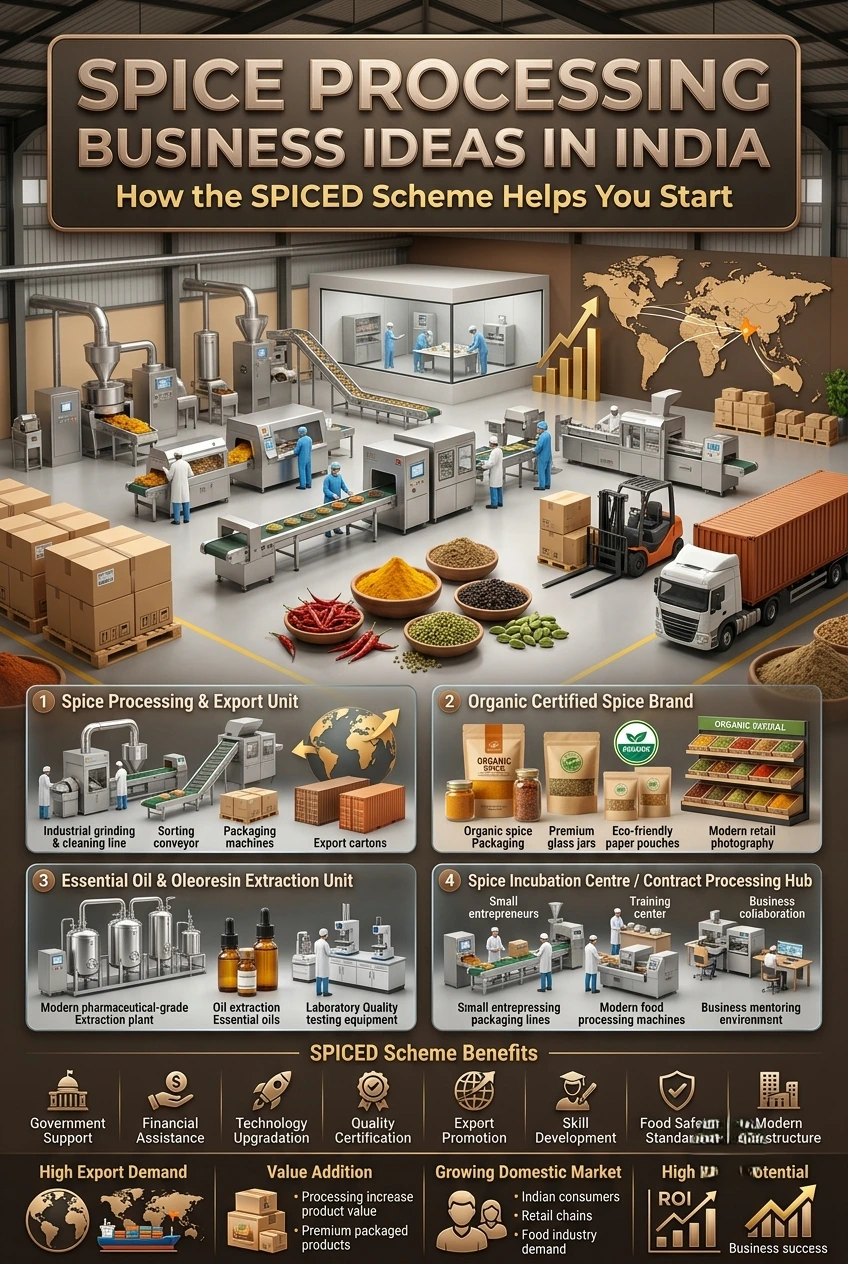
1. Spice Processing and Export Unit
The entry point for this sector is a small to medium scale spice cleaning, grading, grinding and packing facility. The investment varies from ₹15 lakh to ₹80 lakh based on capacity and machinery. The company purchases raw spices such as chilli, turmeric, cumin, and coriander from agricultural markets, processes them to meet food safety standards, and then packages and sells them to retailers and institutions. Even a small unit can start to export to Gulf or South East Asian countries after the first year, with the quality improvement funded from SPICED and APEDA export registration. The business logic is simple – the selling price at the farm gate and the selling price in FOB export depends on the product and the grade and can range from 40% to more than 100%. This makes the unit economics quite good even at relatively small start-up scale.(SPICED Scheme for Spice Processing
Get Detailed Project Report (DPR): Spices in Pouch Packing Manufacturing Plant Report
2. Organic Certified Spice Brand
Demand for organic spices has increased steadily across the globe as health-conscious consumers in the US, EU, and Japan demand organic spices. Organic certification from farmer groups, certification from NPOP India Organic/USDA NOP and selling to international retail giants, specialty food stores or direct-to-consumer e-commerce channels can help build an organic brand for a startup. SPICED is actively involved in promoting organic spices and githy; SAGGI (spices and agri-cultural products) is a unit under SPICED. Further, APEDA’s Market Development Assistance will cover exhibition fee at top quality organic food trade fairs in Europe. The initial investment required to launch a branded organic spice business is in the range of ₹10–30 lakh and the business have great potential to charge premium prices.
3. Essential Oil and Oleoresin Extraction Unit
Essential oils and oleoresins derived from spices are valuable products in the food processing, medical, nutraceutical and cosmetics sectors, including pepper oleoresin, turmeric/curcumin extract, ginger oil and cardamom oil. India is a major supplier of the world; however, the majority of extraction capability is the hands of big gamers. This makes space for mid-sized units to come in the market. The steam distillation or solvent extraction unit can be built at a cost of ₹50 lakh to ₹2 crore for 2-3 crops. The SPICED scheme can help with the technology upgrade and lab infrastructure for such units. Also, MoFPI provides capital subsidy for extraction unit for food purpose. With the ever-increasing demand for the nutraceutical segment worldwide, this market is one of the most promising segments of the spice sector.(SPICED Scheme for Spice Processing)
4. Spice Incubation Centre or Contract Processing Hub
Financial assistance to Spice Incubation Centres is one of the unique features of SPICED. An entrepreneur can establish a shared processing and product development facility for startups, SMEs, and women entrepreneur SHGs in a spice-growing cluster. The model is applicable especially in states like Kerala, Andhra Pradesh, Rajasthan, where raw spices are available in abundance but value addition infrastructure is less. There are three main revenue sources for the centre: processing fees, co-packing fees, rental fees for laboratory equipment and proprietary product development. Further, this model offers economies of scale that individual units cannot achieve because it enables all tenant businesses to share the cost of food safety certifications and quality testing.
Discover business ideas that actually make money
Import–Export Opportunity Analysis for Spice Startups
The story of Indian spices has two sides, both of which are ripe for startup opportunities. India exports spices to more than 180 countries. As per the trade data presented by the Spices Board of India top export markets are USA (14%), China (12%), UAE (9%), Bangladesh (8%) and Saudi Arabia (5%) respectively (see indianspices.com/box2info.html). The major spices such as chilli, cumin, spice oils and small cardamom contribute to more than 60% of export earnings. Value added products such as blended masalas, oleoresins and spice kits have been expanding at a faster rate than bulk commodities. So, a startup that specializes on the processing and branding process instead of the raw trade may benefit a great deal from a greater margin.
India imports substantial quantities of cloves, cinnamon, cassia and black pepper in order to fulfil the processing requirements. In the past, local entrepreneurs imported raw asafoetida (hing), processed it, and repackaged it for sale. Today, Indian entrepreneurs are addressing this dependency by cultivating asafoetida domestically. Likewise, the import of spice blending ingredients and re-exportation as finished and branded products is an emerging import-to-value-add play in the case of FMCG startups going for the South Asian diaspora markets in Australia, Canada and UK. Import-export licensing is regulated by the Directorate General of Foreign Trade (DGFT) and first-time exporters can register for simplified IEC to get started.(SPICED Scheme for Spice Processing)
Indian MSME Success Stories in the Spice Sector
Mahashian Di Hatti (MDH) – Dharampal Gulati:
Dharampal Gulati’s MDH story is one of the best learning experiences in the history of Indian FMCG. After Partition, Gulati started a small spice store and eventually gained a considerable market share in the branded masala market in India. His approach was to attention to standardisation of blends, uniformity of packaging and direct selling to consumers, not institutional or bulk trade. MDH teaches new entrepreneurs that customer loyalty and pricing power in the spice industry develop over time and become valuable competitive advantages.
Everest Food Products – V.S. Patel:
Everest showed that market penetration in new regional markets with culturally adapted blends (not a nationwide recipe) is an effective strategy. The company also benefited from its early investment in quality testing equipment, which made it easier to deal with international food safety checks than smaller competitors. The growth model for Everest illustrates that regional customisation and technology investment are not mutually exclusive approaches, they are complementary.
Goldiee Masale – Goel Family, Madhya Pradesh:
Goldiee is a good success story of tier-2 city MSMEs. The Goel family has developed a regional spice brand in Madhya Pradesh which now reaches more than 2 lakh retailers and is going global. They had a strong interest in allocating the product at low price points, in the wide availability of the product in depth markets and in the quality control of the product. They focused on building deep regional distribution, offering competitive prices, and maintaining strict quality control before expanding into digital and export markets. Goldiee’s journey proves that it is better to foster a powerful regional brand before thinking of pan-India distribution from the get-go, for a more sustainable unit economics and brand equity.(SPICED Scheme for Spice Processing)
How NPCS Can Help You Plan Your Spice Business
Niir Project Consultancy Services (NPCS) offer industry market survey cum Detailed Techno-Economic Feasibility Reports (DPRs) for start-up of new industries or businesses. Our reports for spice sector projects contain full detailed manufacturing processes, market research and demand analysis, process flow diagrams, product mix and capacity planning, machinery, raw material sourcing details, complete project financials and profitability analysis of the project. Goal is to enable any entrepreneur to assess feasibility, profitability and long term scalability, without spending a single rupee. Our DPRs are also prepared for submission to banks under PMEGP and CGTMSE schemes, thereby fast tracking the loan processing.
Related Article: How to Start a Spice Manufacturing Business in India (Complete Guide)
Spice Sector: Key Data Snapshot
| Parameter | Data / Insight |
| Total Spice Export Value | US$4.72 billion (FY 2024-25) |
| Annual Spice Production | ~12 million tonnes (India is world’s largest producer) |
| SPICED Scheme Outlay | ₹422.30 crore (Spices Board of India) |
| Market Growth Rate (CAGR) | ~10% (domestic spice market) |
| Top Export Products | Chilli (27%), Cumin (12%), Spice Oils & Oleoresins (12%), Small Cardamom (9%) |
| Top Export Markets | USA (14%), China (12%), UAE (9%), Bangladesh (8%), Saudi Arabia (5%) |
| Spice Varieties Grown in India | 75+ varieties (out of 109 recognised by ISO) |
| PMEGP Capital Subsidy | 15–35% (up to 35% for women entrepreneurs in rural areas) |
Key Reference Links
- Spices Board of India – SPICED Scheme Guidelines: www.indianspices.com
- APEDA – Agri Export Support & MDA Scheme: www.apeda.gov.in
- Ministry of MSME – PMEGP & CGTMSE Schemes: www.msme.gov.in
- DGFT – IEC Registration & Export Licensing: www.dgft.gov.in
- Ministry of Food Processing Industries – Processing Unit Subsidies: www.mofpi.gov.in
- PIB – Official SPICED Scheme Press Release: pib.gov.in – SPICED Scheme
Frequently Asked Questions (FAQs)
Q1. Who is eligible to apply under the SPICED scheme?
Who can apply for assistance? Exporters registered with the Spices Board (CRES holders), farmer, FPOs, SMEs and Spice Startups can apply for the assistance under this scheme. The scheme favors those who apply for the first time, as well as small businesses. Online applications can be submitted at the Spices Board’s website www.indianspices.com.
Q2. What is the minimum investment to start a spice processing unit in India?
Basic spice cleaning, grading and packaging unit may require just 10-20 lakh. A moderate scale unit having grinding and packaging machinery will require somewhere between 30-80 lakh. Entrepreneurs who qualify can significantly reduce their initial investment by availing of the PMEGP capital subsidy and the collateral-free CGTMSE loan.
Q3. How does the SPICED scheme help with export promotion?
SPICED funds participation in international trade fairs and buyer-seller meets. It also supports market development for GI-tagged spice products and organic certified exports. When combined with APEDA’s Market Development Assistance, which reimburses 50–75% of trade fair costs, a new exporter can access global markets at minimal upfront expenditure.
Q4. Which certifications are needed to export spices from India?
Required Documents for Export – Exporters need to get the following registration & certification: – – Spices Board Certification (CRES Registration) – IEC Certification (Importer Exporter Code) – FSSAI Central License – Food Safety & Standards Authority of India for exporting the spice to foreign market the following international standards & certifications have to be obtained: – HACCP or FSSC 22000 or ISO 22000 – For Organic Exporters need NPOP India Organic / USDA NOP Certification.
Q5. What are the most profitable spice products for MSME startups to focus on?
Value added products are best at margin. They include oils, Oleoresins (pepper, turmeric, cardamom), Organic certified powders, GI tagged spices and branded blended masalas are also have a higher rate. However, the sale volume for Bulk chilli & cumin are higher and the profit per unit are not high. Startups which are looking for limited budget are at better advantage if we decide with higher end product range initially.
Q6. What are Spice Incubation Centres and how can entrepreneurs access them?
Spice Incubation Centres are a relatively recent addition to the SPICED scheme. These centres provide entrepreneurs with a dedicated space to develop new spice products, test different recipes, and use shared processing facilities. Entrepreneurs registered with the Spices Board of India can apply through the SPICED portal to access these centres. The facility is especially useful during the product development stage, before investing in a manufacturing unit.
Conclusion: The SPICED Opportunity Is Bigger Than It Looks
India’s spice industry is not only expanding but transforming as well. Changing the paradigm from bulk raw export to value added, certified and branded products is opening up opportunities for a new generation of spice entrepreneurs. The SPICED scheme comes in to facilitate that transition with the framework, funding and institutional support.(SPICED Scheme for Spice Processing)
The door for startup founders and MSME investors is now more open than ever, with the government supporting them with Rs 422.30 crore while the CGTMSE facilitates loans without requiring any collateral and export subsidies from the APEDA offer market access for these businesses. The ones that will thrive, though, are those that think carefully about the product, the certification path and the market they’re going to go into from the start. This is where professional feasibility planning is a thing of difference.