Chemicals and petrochemicals are one of the unheralded success stories of Indian industry. Over the last 12 years, three Petroleum, Chemicals and Petrochemicals Investment Regions (PCPIRs) established at Dahej in Gujarat, Visakhapatnam–Kakinada in Andhra Pradesh and Paradeep in Odisha have attracted a whopping investment of ₹3.4 lakh crore, created more than 3.7 lakh jobs and spurred the creation of over 2,200 chemical manufacturing units, according to a recent report covered by Fortune India.
It’s no ordinary industry news. It represents an important fundamental change in the country’s manufacturing economy and heralds’ new opportunities for entrepreneurs, MSMEs, start-ups and investors who are ready to seize them. The opportunity field is expanding further with the Union Cabinet approving BHAVYA Ras Ayan Scheme, which has an outlay of ₹3,030 crore for setting up three new Chemical Parks. The opportunity for new players to open chemical manufacturing units downstream and in the specialties space has never been greater.
What Recent Reporting Means for Indian Entrepreneurs
Fortune India’s reporting of the government’s factsheet on chemicals and petrochemicals is an important piece of information for business start-ups. The numbers don’t lie, cluster-based industrial infrastructure in India is no longer just a dream but is working, scaled, and drawing in world capital.
The story is simple: in less than a decade, the three PCPIRs were economic engines, due to their strategic locations over a 12-year period. What’s important is what happens after. The creation of three new Chemical Parks under BHAVYA Rasayan (Cluster) Scheme, which is based on plug-and-play model, is redefining the entire industrial opportunity geography. The objective of these parks is to decrease India’s reliance on imports, promote the principles of circular economy and enhance its chemicals manufacturing capacity as a global hub.
This is important for entrepreneurs and MSMEs because it eliminates the most cumbersome challenge in chemical manufacturing — the need to establish common utilities, effluent treatment and logistics all over again. The new parks essentially provide a “reducers” approach for smaller manufacturers and downstream processors.
Why Businesses Should Pay Attention Now
Chemical and polymer production facilities located within or near PCPIR or Chemical Park benefit from dependable feedstocks, shared infrastructure, and regulatory benefits. As per the report by the Fortune India, FDI in this sector has more than doubled from ₹ 45,240 crore in last 10 years to ₹ 1,04,895 crore in last 12 years. Capital is already in from around the world. The tomorrow’s capital will benefit the MSME who can get into this ecosystem today.
Why the Indian Petrochemicals Industry Is Growing
There is a convergence of three structural drivers. Firstly, the reconfiguration of the global supply chain, popularly known as the China+1 strategy, is compelling the multinational buyers to proactively qualify Indian suppliers for specialty chemicals, polymer intermediates and fine chemicals. Secondly, the domestic demand for automobiles, construction, agriculture, textiles, electronics, and other industries is still far exceeding production capacity, leading to a significant supply deficit that domestic companies can profitably fill. Third, government policy has increasingly reduced risks of the chemical industry by allowing 100% FDI under the automatic route, facilitating the creation of clusters and infrastructure, promoting skill development and enforcing quality standards.
India is already the sixth largest chemical producer in the world, second largest producer and exporter of dyes and fourth largest producer of agrochemicals in the world. The sector aims to achieve a target of US$ 300 billion by 2028 and US$ 1 trillion by 2040 that will generate continued demand for new manufacturing capacity at all scales – MSMEs to large enterprises.
Read the Complete Book Here: The Complete Book on Distillation and Refining of Petroleum Products
Government Policies & Incentives for Chemical Manufacturers
The policy landscape for chemical industry in India is very favourable at this moment. The founders and investors should draw some connections between these schemes and their project plans:
- BHAVYA Rasayan Scheme (₹3,030 crore): Three new Chemical Parks based on plug and play model on clusters. The Union Cabinet has approved the proposal in the Union Budget 2026-27. Designed to minimize dependency on imports and to increase global competitiveness. Apply to the Department of Chemicals and Petrochemicals.
- The regions of Dahej (Gujarat), Visakhapatnam – Kakinada (AP) and Paradeep (Odisha) are covered by the PCPIR Policy. Single window clearance, common utilities and feedstock proximity built-in for manufacturing units.
- Four national 100% infrastructure completion including 1 in 2025–26 of the 10 Plastic Parks approved. Specialized in the downstream plastic processing.
- Chemical Promotion and Development Scheme (CPDS): Industry support by conducting Conferences, Exhibitions, Training programmes and Market studies.
- Protective measures applied to imports via 37 Quality Control Orders (QCOs).
- Production-linked financial incentive (PLI) Scheme for bulk drugs, agrochemicals and linked chemical group.
- Automatic Route: 100% FDI for most of the chemical sectors making India an open destination for foreign investment and technology tie-ups.
- CIPET (Central Institute of Petrochemicals Engineering and Technology): 51 centres across the country almost 6.72 lakh professionals trained (ready skilled workforce for new units).
Key government portals: Department of Chemicals & Petrochemicals | Invest India – Chemicals Sector | Invest Odisha – PCPIR
Manufacturing Business Opportunities Emerging From This Development
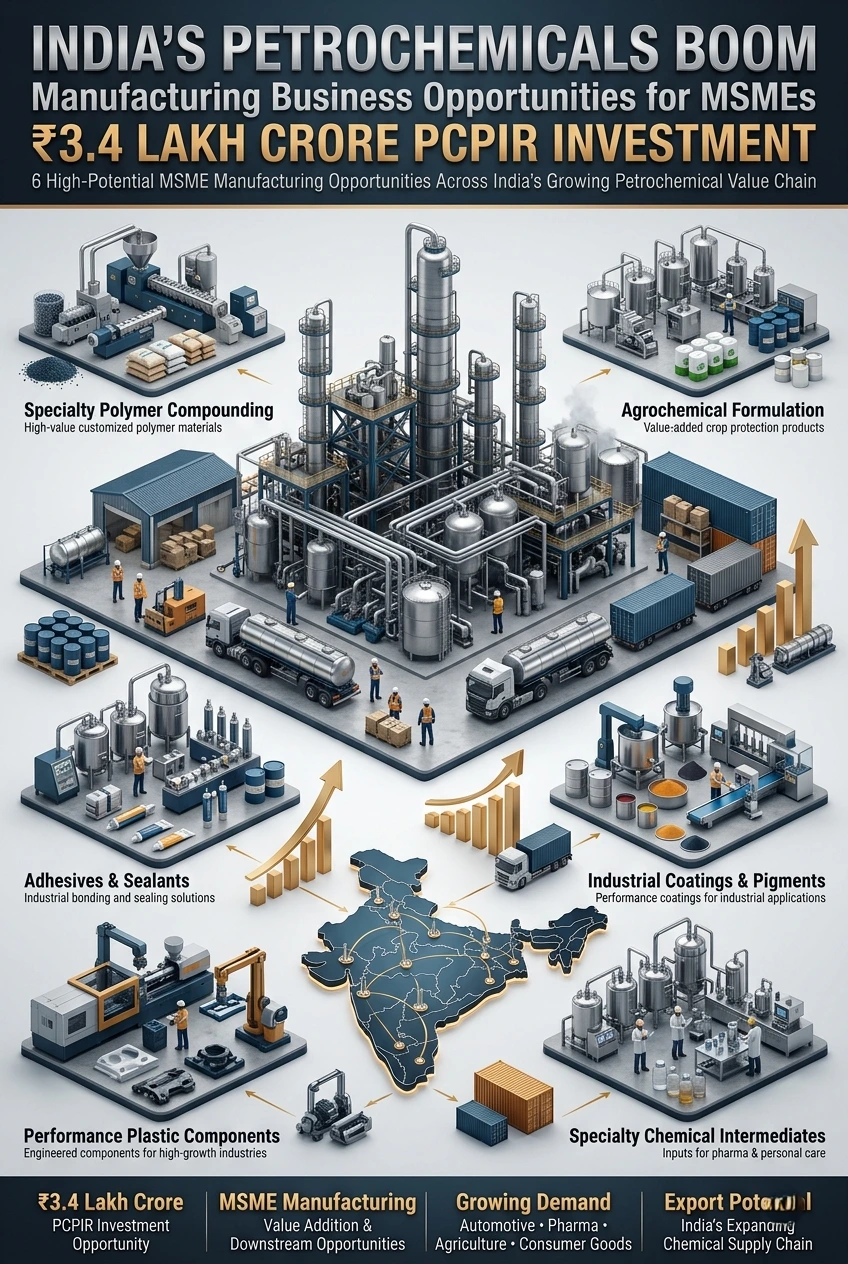
Fortune India report is indicative of a change of gear for chemical manufacturing. These are six specific manufacturing business opportunities that arise directly from the development reported:
1. Specialty Polymer Compounding Units
India is the third largest consumer of polymers, but still huge percentage of specialty and engineered polymers are being imported. Downstream gaps for compounding, blending, and specialty grades to be used in automotive, construction, and electronics applications are still broad, as more basic polymer feedstock is being produced within the country by PCPIRs. MSMEs can establish compounding units close to PCPIR areas that are supplied with feedstock directly from anchor refineries. The investment amount ranges from ₹50 lakh to ₹3 crore, depending on the capacity and product grade.
Get Detailed Project Report (DPR): Explore the Plastics, Polymers & Resins Project
2. Agrochemical Formulation Manufacturing
The country is the fourth largest producer of agrochemicals in the world, however, the formulation manufacturing in the country is not as large as active ingredient manufacturing. The Institute of Pesticide Formulation Technology (IPFT) has already developed 64 pesticide formulation technologies which are available for licensing by the industry. These technologies can be adopted by MSMEs establishing formulation units, and they can also get raw materials from PCPIR clusters and cater to domestic agricultural needs and emerging export markets in Africa, Southeast Asia and Latin America. The investment amount is from ₹30 lakh to ₹2 crore.
Explore This Book: Complete Technology Book on Agrochemicals
3. Adhesive & Sealant Manufacturing
Adhesives and sealants are being used at a fast rate by the construction, automotive, electronics and packaging sectors in India. The import share of most mid-range specialty adhesives is greater than 50%. During the production process of PCPIR-based base polymers and petrochemical inputs, there is a natural opportunity for MSME-scale manufacturing of adhesives for B2B customers. Proximity to their feedstock and common infrastructure for the units in PCPIR zones or new Chemical Parks under BHAVYA Rasayan helps them to cut their operating cost significantly. Investment value: ₹ 40 lakhs to ₹ 2.5 crore.
4. Industrial Coatings & Pigment Manufacturing
Although India is the world’s second largest producer and exporter of dyes, there is still plenty of scope for anti-corrosion, marine and infrastructure related industrial coatings products to achieve import substitution. The downstream coating formulation utilizing local pigments and petrochemical-based resin can be a MSME scale manufacturing play with good demand in domestic and export market. The investment is between ₹35 lakh and ₹3 crore.
View Full Project Details: Pigments and Dye Intermediates Projects
5. Performance Plastic Components Manufacturing
The national approval of ten Plastic Parks, with four already with infrastructure completed. These parks are specially designed for plastic processing and component production. In Plastic Parks, MSMEs can setup injection moulding, thermoforming or roto moulding capacities to meet the needs of Tier-II vendors to the automotive industry, electronics assemblage facilities, and medical device manufacturers. CIPET has a network of 51 centres which offer a ready trained workforce. The investment range is ₹25 lakh to ₹2 crore.
6. Specialty Chemical Intermediates for Pharma & Personal Care
Indian companies are now actively looking for alternative chemical intermediates to replace those from overseas. According to Fortune India’s reports on the sector, CIPET along with 18 Centres of Excellence have filed 85 patents and developed 105 new products and technology. This technical infrastructure has been created to assist new MSMEs in production of pharma intermediates & personal care chemicals. Buildings within PCPIR zones have the benefit of easy access to regulatory support and infrastructure. Investment amount: ₹50 lakh to ₹5 crore.
Access Complete Business Plan: Pharma Drugs & Fine Chemicals Manufacturing
Import–Export Opportunity Analysis
The chemical industry in India offers an interesting dual opportunity — the opportunity of reducing costlier imports as well as increasing the export of chemicals.
Export Markets
Indian chemical exporters are ready to cater to the Southeast Asian, Middle East and African markets as well as the ever-expanding European and North American markets. Global demand for the organic chemicals was strong with export of US$ 2,750.32 million during April-July FY26 from India. The cost competitiveness of the production, the availability of the feedstock from PCPIRs to India and the improvement of the quality standards to be followed by the 37 QCOs make it an attractive sourcing point for the international buyers who are shifting the sourcing chains from China.
Import Substitution
In FY2023-24, India’s net imports of chemicals have surpassed ₹6,00,000 crore. The specialty polymers, acrylonitrile, ABS resins, EVA copolymers and high-performance coatings are key categories that offer potential for high import substitution. MSMEs setting up domestic manufacturing in these categories benefit from a protected market with the benefit of QCO and price benefits over imported alternatives.
Trade Opportunities
The Port City Pedestrian and Infrastructure (PCI) road corridor between Visakhapatnam & Kakinada is special for export-oriented chemical manufacturers because of the port connectivity with Visakhapatnam Port, Gangavaram Port and Kakinada Port with direct links to international shipping routes. Paradeep PCPIR also provides coastal logistics benefits to bulk chemical exports.
Related Article: Profitable Petrochemical Manufacturing Business in India: Investment, Profit & Startup Guide
Indian MSME Success Stories in Chemicals & Petrochemicals
Vinati Organics — From MSME to Global Market Leader
Vinati Organics is one of India’s most educative chemical entrepreneurship stories. It started as a small chemical enterprise in Maharashtra. The founding family identified two specialty chemicals, IBB (isobutyl benzene) and ATBS (acrylamido tertiary butyl sulfonic acid). Both were traded internationally but had relatively few global suppliers. Today, Vinati holds about 65% of the global ATBS market. The company mastered the production process and focused on niche products rather than broad diversification. For new founders, the lesson is clear. In specialty chemicals, defining a niche and achieving cost competitiveness can lead to international leadership.
Sudarshan Chemical Industries — Building a Global Pigment Platform
Over the years, Sudarshan Chemical Industries has established a robust domestic pigment manufacturing platform and then in 2024-25, it made a transformative move across the globe with an acquisition of Germany’s Heubach Group, establishing a global pigment leader with 19 manufacturing locations across the globe. Indian chemical MSMEs can transform into global chemical manufacturers through disciplined scale-up and strategic M&A as illustrated by Sudarshan’s journey.
UFlex Ltd — Downstream Polymer Innovation at Scale
However, Ashok Chaturvedi’s UFlex proved that entrepreneurs in India can create global-scale businesses by investing in innovations in the downstream sector, rather than investing in resin production. The flexible packaging & polymer processing division of UFlex expanded its operations into India’s largest player in the packaging industry with international presence. Uflex demonstrates to MSME founders that you don’t need to be just in material production for value to be added.
Choose the right startup backed by real market demand
About NPCS – Niir Project Consultancy Services
NPCS (Niir Project Consultancy Services) offers project development assistance to entrepreneurs starting chemicals, petrochemicals, plastics or specialty manufacturing business:
- Detailed Project Reports (DPR): Techno-economic feasibility studies with plant capacity, equipment, raw materials, utilities, man power, and financial projections for chemical manufacturing projects.
- Market Research: Demand – Supply analysis, Pricing trends, Competition mapping and trade data for identified chemical markets.
- Feasibility Studies: Site selection, regulatory pathway, investment cost analysis and return-on-investment modelling for project based on PCPIR and Chemical Park.
- Technological Consultancy: Selection of process, sourcing of equipment, advice on technology licensing and plant layout design.
- MSME & Startup Advisory: Business plan preparation, bank loan documentation, scheme preparation & support for investors pitch.
Business Opportunity Data Table
| Parameter | Details |
| Industry | Chemicals, Petrochemicals & Downstream Manufacturing |
| Market Driver | PCPIR-led investment boom; BHAVYA Rasayan Scheme; China+1 supply chain shift |
| Investment Range (MSME) | ₹25 lakh – ₹5 crore (downstream/specialty); ₹10–50 crore (mid-scale manufacturing) |
| MSME Opportunity | Specialty chemicals, polymer compounding, agrochemical formulations, adhesives, pigments, coatings |
| Export Potential | High – India is 6th largest global chemical producer; strong demand from USA, Europe, Middle East |
| Government Support | BHAVYA Rasayan Scheme (₹3,030 cr), PLI, CPDS, 37 QCOs, 100% FDI under automatic route |
| Risk Level | Medium – regulatory compliance & feedstock pricing are key variables |
| Growth Outlook | Sector targeting US$ 300 billion by 2028 and US$ 1 trillion by 2040 |
Conclusion: So, why should entrepreneurs take action now?
These are not policy goals: Chemicals and petrochemicals investments in India’s PCPIR have crossed from potential to proven, with 2,200+ manufacturing units established, 3.7 lakh jobs created and total investments of ₹3.4 lakh crore. They are achieved results.
In this ecosystem, three new Chemical Parks are added in BHAVYA Rasayan Scheme. The message for entrepreneurs is clear: the next generation of cluster-based chemical production facilities is taking shape. Now, the founders who are willing to come in with carefully planned downstream or specialty chemical production will have the opportunity to be part of the growth of the ecosystem rather than catching up to it later.
India is targeting US$ 1 trillion in chemicals output by 2040. That trajectory demands tens of thousands of new manufacturing units across every downstream segment. The MSME founder who reads Fortune India’s reporting as a business signal—not just a news item—and acts on it with a well-planned project can tap into a sector with strong domestic demand, active government support, growing export opportunities, and a skilled workforce that 51 CIPET centres nationwide are actively training.
The opportunity is real. The infrastructure is operational. The policy support is in place. Prepare your Detailed Project Report, identify your target PCPIR or Chemical Park cluster, secure your technology, and start building.
For detailed project reports, feasibility studies, and market research to plan your chemical manufacturing venture, visit NPCS – Niir Project Consultancy Services | For sector intelligence, follow Fortune India – Economy Coverage.