
India Textile Industry Business Opportunities
That’s not about regular growth when a sector grows its market by 100% in 10 years and then doubles it again. This window contains plenty of business ideas to consider for entrepreneurial entrepreneurs, but it’s a structural shift; that’s what is going on here. In a statement cited by the,
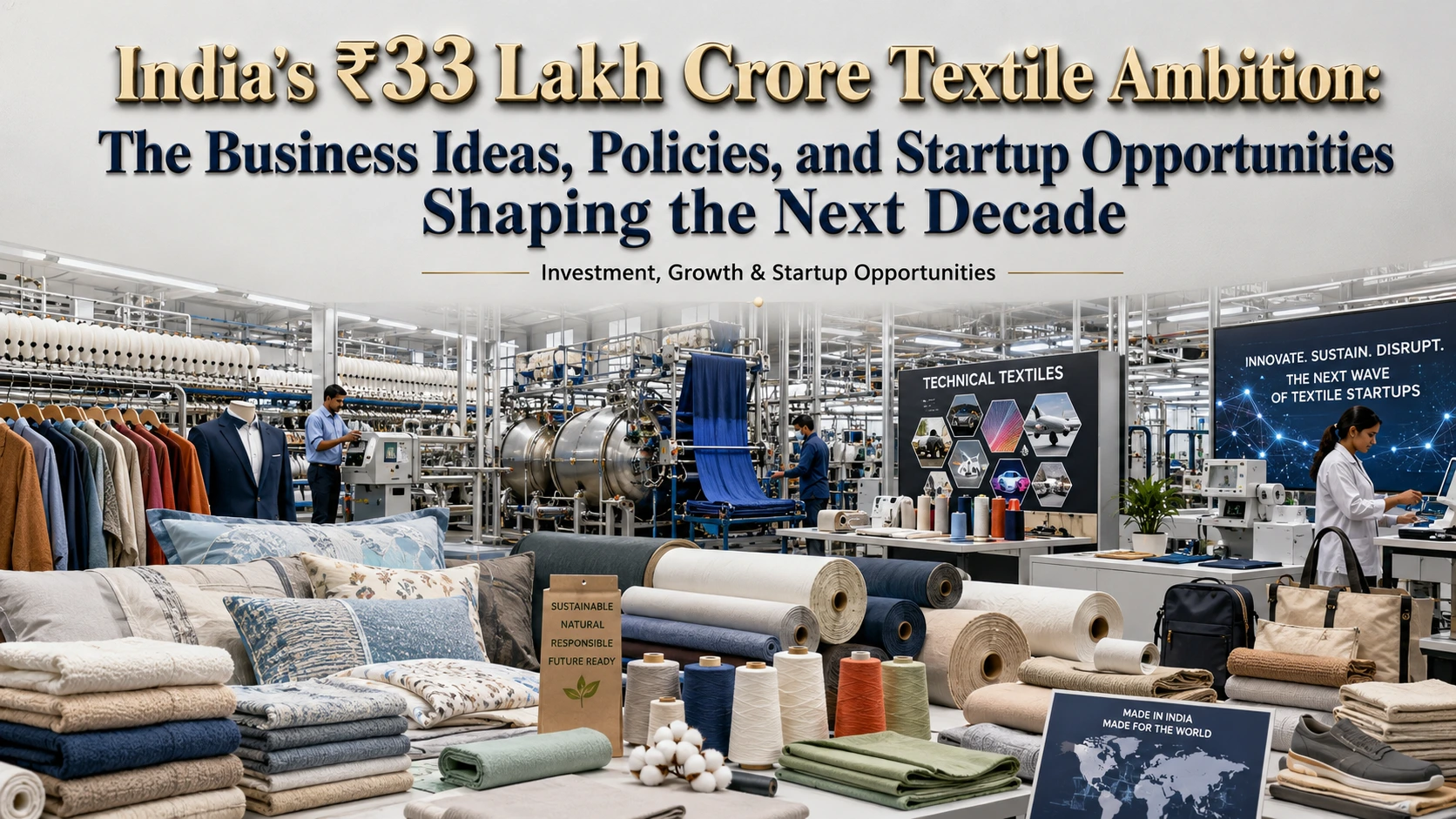
India aims to reach the textile market size of ₹33 lakh crore (including domestic consumption and exports) by FY2031, as compared to the current size of ₹16 lakh crore, said Union Minister for Textiles Giriraj Singh. The Minister told a press conference on notable achievements of the textile ministry that the market size of textiles had been expanded from ₹8.5 lakh crore to ₹16 lakh crore and would be expanded to ₹33 lakh crore by 2030-31. Such ambition, coupled with the architecture of policy and real government spending, is a clear indicator of one thing: the future of this industry is not to be defined by the legacy players alone.
The question that is not for start-up founders, MSME planners and first-generation entrepreneurs is whether the market is growing. It clearly is. The key issue is where the lucrative entry points are, what sectors are under-served and what form of government support is available? This article will take a look at all three.
Why the Textile Sector Demands Serious Attention Right Now
The textile industry is not a slow and well-developed industry in India. The industry is expected to grow by more than 12% CAGR to USD 350 billion by FY2031, according to India Brand Equity Foundation (IBEF). The domestic market has grown from ₹6 lakh crore to over ₹16 lakh crore, with the growth driven by rising domestic consumption, policy-driven export push and diversification of the product mix.(India Textile Industry Business Opportunities)
This is gathering speed with a number of factors playing into it. First, China Plus One is a thing and not an abstraction. Global brands are keen to de-globalize and diminish reliance on Chinese supply chains, especially those from Europe, the US and Japan. India has a sound base of cotton and has developed the concept of ‘clusters’ of manufacturing units and has a developing infrastructure to support it, making it a natural beneficiary. Indian textile products have already seen double-digit exports in the past six months to 111 countries.
Second, the value proposition being changed by technical textiles. It’s not just clothes and house furnishings. Other fast emerging sectors are defence grades, medical textiles, agrotextiles and geotextiles. The technical textiles industry has expanded from about USD 6 billion to USD 25 billion—now one of the fastest growing sub-sectors in the Indian manufacturing industry.
Third, domestic usage is expanding. Online apparel and textile sales recently hit USD 14.8 billion levels, and Tier-3 and Tier-4 cities became significant demand centres for the first time. It has a profound impact on the distribution equation of smaller manufacturers and brands.
Get Detailed Insights from This Book: The Complete Technology Book on Textile Processing with Effluent Treatment
Government Policies and Incentives: What’s Actually Available
Policy support in this sector is quite extensive, ranging from production assistance to infrastructure development, skilling and export facilitation. Entrepreneurs that are aware about these programs can significantly minimize the amount of money risk they face.(India Textile Industry Business Opportunities)
PLI Scheme for Textiles
The approved outlay for the Production-Linked Incentive (PLI) Scheme for Textiles, is ₹10,683 crore. It works particularly on the three segments where exports have the highest potential and institutional demand, namely Man-Made Fibre (MMF) Apparel, MMF Fabrics and Technical Textile Products. The scheme is based on a linkage between incentives and real output; therefore, it does not offer investment guarantees. It aims to generate ₹19,000 crore of new investments, a turnover of ₹3 lakh crore, and more than 7.5 lakh direct jobs over the next five years.
PM MITRA Parks
The Government of India is establishing seven Pradhan Mantri Mega Integrated Textile Regions and Apparel (PM MITRA) Parks as large integrated textile clusters in Tamil Nadu, Telangana, Gujarat, Karnataka, Madhya Pradesh, Rajasthan, and Uttar Pradesh. The total government expenditure is of ₹4,445 crore on each park with a Prime Minister’s 5F Vision (Farm to Fibre to Factory to Fashion to Foreign) in each. Together, these parks will welcome investment of ₹70,000 crore and create 20 lakh jobs. These parks provide plug-and-play facilities, concentration of the supply chain, access to qualified manpower and more, which is beneficial for a company thinking on setting up manufacturing unit in an ecosystem. To know more about it visit the Ministry of Textiles portal.
SAMARTH Skilling Scheme
SAMARTH scheme is targeted at skilling for the demand and placement in the textile value chain. It has a budget of ₹495 crore, which is extended till FY26, with its training target at 3 lakh workers. Trained workers are a key benefit for new unit operators to shorten the time to onboarding and accelerate production ramp-up.(India Textile Industry Business Opportunities)
RoSCTL and RoDTEP: Export Support
RoDTEP (Remission of Duties and Taxes on Export Products) and RoSCTL (Rebate of State and Central Taxes and Levies) provide benefits to export-oriented units. Both schemes lower the ’embedded tax’ on exported products, making them more competitive in the world market. India’s FTA network has grown from 10 agreements with 19 countries, to 18 agreements with 56 countries, providing larger, more accessible buyer markets for new exporters. Check the latest trade data at APEDA.
High-Potential Business Ideas Within India’s Textile Ecosystem
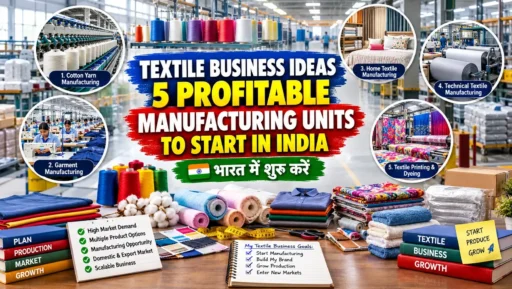
1. Man-Made Fibre (MMF) Fabric Manufacturing Unit
Historically, India’s textiles exports have been biased towards natural fibres with cotton being the most prominent. But the world has definitely turned into a market for synthetic/blended fabrics. European and American retail chains are dominated by polyester blends, nylon fabrics and viscose materials. The establishment of an MMF fabric manufacturing enterprise can solve this problem. The PLI scheme provides clear incentives for MMF production and access to raw material through the established ecosystem of polyester fibre in Gujarat and Surat makes backward integration relatively easy. A mid-scale machine manufacturing performance wear or lining fabrics or athleisure garment can reasonably aim at both domestic apparel brand and direct export buyers. The minimum investment in this sector is ₹30 crore and the government’s preference policy on procurement helps domestic manufacturers in institutional procurements with a non-export revenue channel as well.
2. Technical Textiles: Agrotextiles and Geotextiles
India is still in a position of underproduction of technical textiles with respect to the real demand. Agrotextiles (shade nets, crop covers and mulch mats) are directly supported by agricultural budgets through ICAR and state horticulture departments. Several national highway programs for large projects require the use of geotextiles in road construction, erosion protection, and drainage. The National Technical Textiles Mission (NTTM) with an outlay of ₹1480 crore supports R&D and start-up ideas under GREAT. A focused manufacturing unit in these types, even at the scale of investment of ₹1 – ₹3 crore can avail of captive government procurement, which is a more predictable revenue source than selling in the open market. This is one of the more promising business concepts for technically-minded entrepreneurs.
Access Complete Business Plan: Textile Bleaching, Dyeing & Finishing Projects
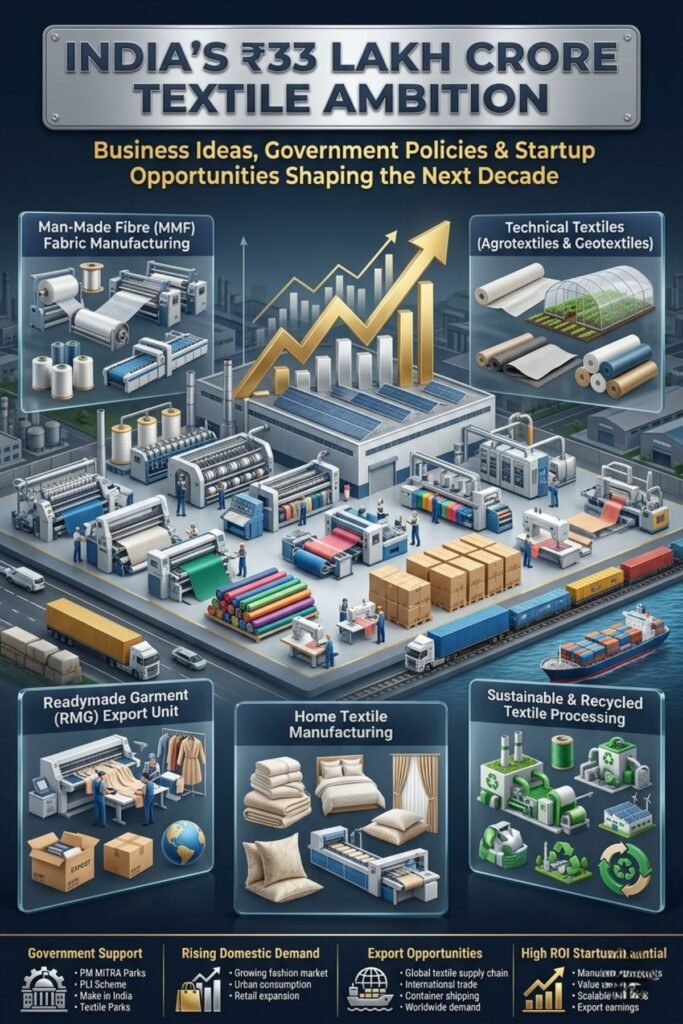
3. Readymade Garment (RMG) Export Unit
The political situation in Bangladesh has left a sourcing vacuum that foreign buyers are keen to fill right away. Textiles alone are imported into Europe every year at USD 125 billion, by European buyers. The capacity constrained RMG clusters in Tirupur, Ludhiana, Noida, Bengaluru etc. are indicators that there is real space for new units in these clusters. A modern stitching unit can meet international social and environmental certification standards such as GOTS and OEKO-TEX. This helps build strong relationships with premium buyers. Automation of the finishing process further improves efficiency and product quality. Stitching machine bases have increased significantly. They have risen from 46.10 lakh during the UPA era to over 2.87 crore today. This reflects higher supply capacity and more employment opportunities. A mid-size project with a daily capacity of 5-10 thousand pieces is feasible and possible to fund.(India Textile Industry Business Opportunities)
4. Home Textile Manufacturing: Towels, Bedsheets, and Curtains
Home Textiles is one of the high volumes, highly exportable categories with high visibility of demand. The KVIC has seen a turnover of ₹1.70 lakh crore in the recent fiscal year, which is another testament to the significance of the home textile market in both urban and rural India. On the export side, India exports home textile products to Walmart, IKEA, and Zara Home. These products are known for consistent quality and strong competitiveness. A new unit for manufacturing terry towels, printed bed sheets, or readymade curtains can enter this segment with a low investment of less than ₹2 crore in machinery. The infrastructure, raw material availability, and buyer base are already well established in clusters like Karur, Panipat, and Solapur.
5. Sustainable and Recycled Textile Processing
European and American retailers are pushing their supply chains toward recycled and sustainable textiles, in compliance with ESG mandates. The fastest-growing niche segment globally includes recycled polyester fibre (rPET), organic cotton processing, and waste-to-yarn conversion technologies. India produces significant amount of under-processed textile waste, which is a combination of pre-consumer and post-consumer waste. A recycled yarn or fabric manufacturing plant serves global supply chain demand, and domestic banks can provide it sustainability-linked financing in accordance with RBI guidelines. It is a high differentiation business idea with relatively less competition in the MSME level and is an export-oriented business.(India Textile Industry Business Opportunities)
Identify high-growth industries before others do
Import–Export Opportunity: Where the Real Trade Money Is
The journey of Indian textiles is picking up new momentum in its exports. Despite the headwinds in global trade, exports recently reached USD 37.8 billion, which is a strong growth. Notably, India has expanded its export market towards 135 countries, which is a structural change from reliance on the US-EU corridor. The FTA with the UK and the advanced stage of EU FTA negotiations will also enhance the price competitiveness of Indian textiles against other exporters like Vietnam, Bangladesh and Cambodia. Monitoring of the current data of export products at Apparel Export Promotion Council (AEPC).
India, however, imports significant amounts of specialty yarns, high performance fibres (aramid, carbon fibre) and technical textile machines. These are places where import substitution businesses can enter the market. The NTTM has already sanctioned 168 R&D projects worth ₹520 crore in these speciality fibres. We have seen a number of entrepreneurs producing high-tenacity yarns or coated fabrics, or composite textiles domestically and are seeing very little competition for this market.
For the first time-exporters, Interest Equalisation Scheme offers a subsidy of 2-3% on export credit, thus enhancing the working capital economics of smaller exporters who are playing on thin margin in global markets.
Indian MSME Leaders Who Built Scale in Textiles
Welspun India – B.K. Goenka
One of the most instructive cases in Indian home textile story is Welspun India with its headship of BK Goenka. The company came from a trading background of commodity textiles and made a conscious decision to bet on branded, certified and export quality home textiles to marquee global buyers. Now, Welspun is providing Walmart and Target in the USA and has created a vertically integrated system with spinning, weaving, dyeing and finishing all in the same building. The takeaway: differentiation via certification (hygrocotton, TENCEL licensing), and scale automation, made Welspun indispensable to its buyers. A new business can follow the same logic with the initial investment of ₹50 lakh — start with one certified product, one anchor buyer and reinvest aggressively.
Vardhman Textiles – SP Oswal
Under the leadership of SP Oswal, Vardhman Textiles became a vertically integrated textile empire with manufacturing clusters in Punjab and Himachal Pradesh with its various segments of spinning, weaving and processing. Consistency in quality and timely forward integration with fabric and garment processing was Vardhman’s strategy. Their model is that if you stay disciplined in one part of the value chain and master it, and then expand horizontally, you can grow from an MSME into a large-cap business. This is an important reminder to not pursue all the segments at once in the early stages of a new business.(India Textile Industry Business Opportunities)
KPR Mill – K P Ramasamy
KPR Mill is a very interesting example of vertical integration, workforce housing and welfare and the promotion of K P Ramasamy from Tamil Nadu. Established end-to-end facilities from spinning to branded garment sales, at the same time constructing worker’s hostels and social facilities, which resulted significantly in the reduction of worker’s attrition and the improvement of operational continuity. It is now a profitable and listed company and has good export connections. For new entrepreneurs the lesson of the day is clear: workforce stability in labour intensive manufacturing is a competitive differentiator, not a compliance burden.
Related Article: How to Start a Textile & Apparel Manufacturing Unit: ₹5 Cr Investment, ₹20 Cr Revenue Potential
How Feasibility Studies Minimizes Risk for an entrepreneur
Before an entrepreneur injects money into any new textile venture-a technical textile plant, an MMF fabric plant or an RMG export plant- it becomes mandatory to understand the financial feasibility of the business proposed. The Niir Project Consultancy Services (NPCS) offers consultancy in Market Survey cum Detailed Techno-Economic Feasibility Studies (DPRs) in setting up new industrial or business ventures. The report furnished contains information on manufacturing process, market survey and analysis, process flow chart, production process chart, product-mix and capacity plan, machineries and raw material requirement as also a comprehensive project financial profile along with profitability of the project. Our objective is to enable an entrepreneur in finding the feasibility, profitability and sustainability of a business and to use the investment with prudence not hope.
Key Indicators: India’s Textile Sector at a Glance
| Indicator | Base Value | Current/Target Value | Remarks |
| Total Market Size | ₹8.5 lakh crore | ₹33 lakh crore (target) | Domestic + Exports combined |
| Current Market Size | — | ₹16 lakh crore+ | As per Ministry of Textiles |
| Textile Exports | — | USD 37.8 billion | Including apparel & home textiles |
| PLI Outlay (Textiles) | — | ₹10,683 crore | MMF, technical textiles focus |
| Technical Textiles Market | USD 6 billion | USD 25 billion+ | Fastest-growing sub-segment |
| PM MITRA Parks | — | 7 parks across India | ₹70,000 cr investment target |
| Direct Employment | — | ~4.5 crore people | 2nd largest employer after agri |
| SAMARTH Skilling Target | — | 3 lakh workers (FY26) | Demand-driven, placement-oriented |
| Online Textile Sales | — | USD 14.8 billion | 22% share of total apparel retail |
| Export Destinations | — | 135+ countries | Diversified from US-EU corridor |
Frequently Asked Questions (FAQ)
Q1. What is the government’s target for India’s textile sector?
The Ministry of Textiles has set a formal target to increase India’s overall textile market – both domestic and exports – from ₹16 lakh crore to ₹33 lakh crore by FY2031 with the help of schemes like PLI for textiles, PM MITRA Parks and NTTM.
Q2. Which sub-sectors are the most viable business opportunities for a new entrepreneur?
Some of the most promising sub-sectors for new entrepreneurs include technical textiles (such as geotextiles and medical textiles), MMF fabric manufacturing, sustainable and recycled textiles, and home textile exports. These areas are either still underdeveloped in the domestic market or are benefiting from the “China Plus One” trend, which is driving increased export demand.
Q3. Which are the major government schemes applicable to textile startups?
Some of the relevant government schemes are: PLI Scheme for Textiles (₹10,683 crore outlay), PM MITRA Parks (₹4,445 crore), National Technical Textiles Mission (₹1,480 crore), SAMARTH Skilling Scheme (₹495 crore) and GREAT grant for technical textile startups, while for export units RoSCTL, RoDTEP and Interest Equalisation Scheme benefit.
Q4. How much money does it take to set up a textile manufacturing unit?
The investment depends greatly on the segment. Home textile unit in a mature cluster can be set up starting at ₹50 lakh – ₹2 crore for the machinery. MMF fabric unit eligible for PLI benefits starts from ₹30 crore for the machinery. Technical textile units focused on government tenders could be initiated from ₹1-3 crore level. A detailed feasibility report should precede any capital investment.
Q5. Is export a real business opportunity for first generation entrepreneurs in the textiles sector?
Yes. For categories such as home textiles, readymade garments and some products in technical textiles where India already has established buyers and competitive edge. The interest equalisation scheme reduces the cost of funding. The growing network of FTAs increases India’s access to markets. Beginning with one product, one or two key buyers and then expanding is a capital-efficient way to go about exporting.
Q6. Where do I find government data and details of the schemes relevant to the textile sector?
Relevant government websites: Ministry of Textiles, IBEF Textile Industry Page, PLI Textiles portal, AEPC and relevant state-level governments. MSME related support is available on the Ministry of MSME website and make in India portal.
Conclusion: The Window Is Open — But Only for Those Who Move with Clarity
The Indian textile industry is experiencing a serendipitous moment-where scale of demand, policy push, export opportunity and domestic consumption all converge to gain momentum. The 33 lakh crore figure looks like an optimistic aspiration, yet the underpinnings such as PM Mitra parks, PLI grants, NTTM grants, expanded Free Trade Agreements give it structural integrity.
For entrepreneurs, the opening isn’t an invitation to wait and watch the market unfold. It is a cue to jump into the appropriate sub-sector, with the correct cost-structure and market positioning, before the market has fully discounted the opportunity. Technical textiles, MMF manufacturing, home textile exports, and sustainable fiber manufacturing are no longer hypothetical ideas; they have become viable business propositions driven by immediate demand and backed by government incentives.(India Textile Industry Business Opportunities)
The best time to carry out feasibility studies and seize opportunities was day before yesterday; the next best is now.