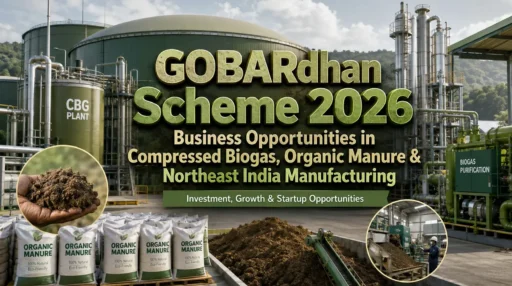
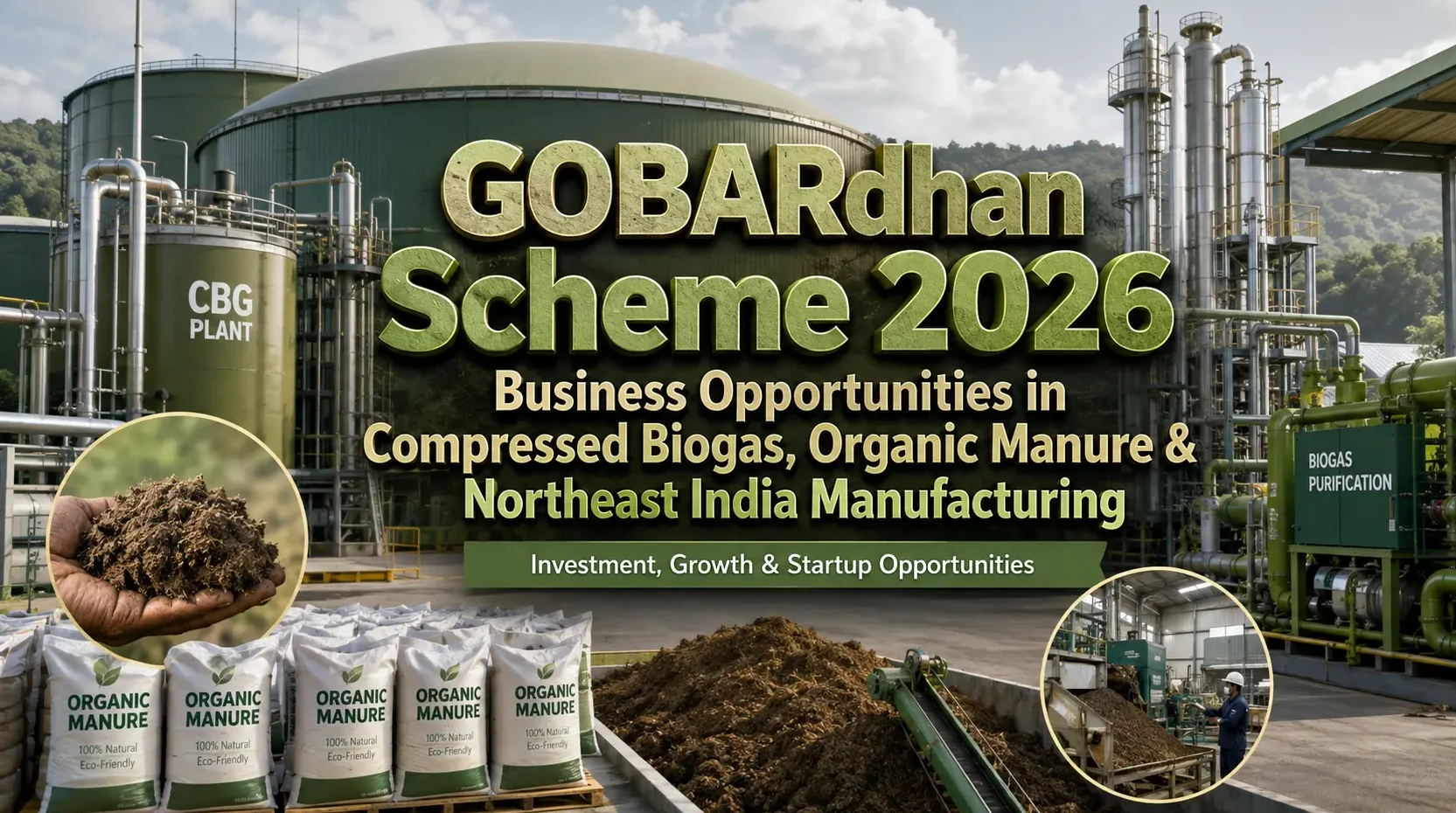

GOBARdhan Scheme 2026
Two landmark decisions from the Union Cabinet are setting the stage for one of the most significant manufacturing and infrastructure business cycles India has seen in recent years.
The Cabinet Committee on Economic Affairs headed by Prime Minister Narendra Modi on 6 August 2026 approved two major projects worth Rs 23,731 crore and Rs 8,970 crore respectively, for the Guwahati-Tezpur Corridor project on National Highway 15 (NH-15) in Assam and the GOBARdhan National Circular Bioenergy Scheme for India. These two decisions will infuse Rs 32,700 crore into Indian clean energy and infrastructure.
These are not just policy announcements, but market creation events for MSME entrepreneurs, MSMEs, manufacturers, investors, and exporters. They create immediate fundable and scalable business opportunities in Northeast India infrastructure supply chains, agri-processing, logistics, organic manure manufacturing, biomass processing and biogas plant manufacturing.
This is an article on what all of this means to entrepreneurs, which manufacturing industries now have a direct signal from the government, and why the early movers will have the edge in the next 12-18 months.
What Recent Reporting Means: Decoding the Twin Cabinet Decisions
The Union Cabinet on a single day approved two complementary policy moves, one in clean energy and another in infrastructure investment, a rare feat, reports Jagran and national media.
The GOBARdhan National Circular Bioenergy Scheme
GOBARdhan scheme is a national scheme with an aim to nearly ten times the domestic production of compressed biogas (CBG) to Rs 23,731 crore by 2035-36. It will be operational during FY 2026-27 to 2035-36 and will convert the agricultural residues, cattle dung, press mud and municipal organic waste into clean fuel and organic manure.
The six-pillar support architecture of GOBARdhan truly distinguishes itself from past schemes: assured CBG offtake by City Gas Distribution (CGD) entities, a stable administered price of Rs 2,110 per MMBTU, capital assistance, pipeline connectivity, credit guarantee support, and a technology development fund known as the CBG Ecosystem Challenge Fund.
The Guwahati-Tezpur NH-15 Corridor
The Rs 8,970.20 crore highway constructs a four-lane access controlled highway on NH-15 under the Build-Operate-Transfer (BOT) Toll model of around 135.871 km. The project involves five major bypasses covering a distance of 58.7 km, 15 major bridges, 30 minor bridges, 19 flyovers and an Emergency Landing Facility coordinated with the Indian Air Force at the Tezpur bypass.
The corridor links 8 PM Gati-Shakti Economic Nodes (industrial parks), 2 aspirational districts (Darrang and Udalguri), major tourist centres such as Kaziranga National Park, Orang National Park and Kamakhya Temple, 3 railway stations, 2 airports, and 2 inland waterway terminals for business.
These together provide a unique combination of an approved clean energy sector with assured demand and price along with a Northeast India logistics and manufacturing boom corridor.
Identify high-growth industries before others do
Why This Industry Is Growing: The Market Forces Behind Both Decisions
India currently imports over USD 100 billion worth of fossil fuels every year. The GOBARdhan scheme directly tackles the energy security issues and also establishes a new industry for making the domestic fuels from agricultural and municipal wastes which will be increased by ten folds with the domestic CBG production.
Agricultural residue is produced in excess of 500 million tonnes per year in India, of which 90% is burnt in the field. Even if a small portion of this is turned into CBG and organic manure, it can be a circular economy that is beneficial for both the farmers, municipalities and energy consumers.
In terms of infrastructure, Northeast India has been poorly served by logistic and highway connectivity, traditionally. The Guwahati-Tezpur route will reduce the journey time between the two cities by half, with average speed on the route rising by 50 per cent compared to the existing NH-27 and will be the northern bank route to the existing NH-27. This significantly cuts down on the logistics costs and market accessibility for manufacturers and exporters in Assam and Arunachal Pradesh as well as the Northeast region of the country.
Government Policies and Incentives Supporting These Sectors
Ministry of Petroleum and Natural Gas – GOBARdhan Scheme: Petroleum Ministry GOBARdhan Details
The scheme offers capital assistance, guaranteed CBG pricing at Rs 2,110/MMBTU, credit guarantee covers for CBG plants, and mandatory blending obligations on the credit line entities – making CBG production one of the least risky investments in manufacturing in India.
Ministry of Road Transport and Highways – NH-15 Corridor: MoRTH NH Projects
Industry is incentivised to develop MSME industrial parks along the NH-15 corridor as part of PM Gati-Shakti National Master Plan, an integrated infrastructure pipeline initiative of India.
Assam Industrial and Investment Policy: Industries and Commerce Department, Assam
Capital investment subsidy, power tariff concessions, SGST reimbursement, land concession are granted for the manufacturing units in priority sectors such as agro-processing and clean energy in Assam.
MSME Ministry – Credit Support: Ministry of MSME, Government of India
The MSMEs in CBG and infrastructure supply chain can avail of the credit guarantee facility of CGTMSE, MUDRA loans and SFURTI cluster scheme support for biomass-based industries.
Manufacturing Business Opportunities Directly Emerging from These Developments
1. Compressed Biogas (CBG) Plant Setup
The most direct and easily funded opportunity from these approvals is a CBG plant. The assured CBG offtake framework and stable pricing of Rs 2,110/MMBTU make it highly fundable. Plant can be installed near agricultural hubs, dairy clusters, sugar factories, or municipal waste plants. Sugar factories can supply press mud as feedstock. This scheme offers the promoters the benefit of capital assistance, credit guarantees, guaranteed procurement, which significantly lessen the revenue risk.
- Investment Range: Rs 5 crore to Rs 100 crore depending on plant capacity
- Feedstock: Cattle dung, Agricultural residue, Press mud, Municipal Organic Waste.
- Cost of sales: Rs 2,110/MMBTU for CBG sales and sales of the co-produced organic manure
- Why Now: They are required to blend obligation from FY 26-27 and the first movers will win long-term CGD offtake contracts
Related Article: Compressed Biogas (CBG) Plants: A Bankable Green Energy Business for New Entrepreneurs
2. Fermented Organic Manure (FOM) Manufacturing and Packaging
The co-product from every CBG plant is large volume of fermented organic manure. The organic farming market in India, Southeast Asia and the Middle East is booming, and FOM manufacturing and branded packaging presents a high margin downstream opportunity. As Assam is a gateway for Northeast India to meet ASEAN, it has a natural edge for producing in the state.
- The investment range of the processing and packaging lines is in between Rs 50 lakh to Rs 5 crore.
- End Markets: Organic farms, horticulture export zones, ASEAN and Middle East export.
- Margins: Much higher than manure, branded FOM fetches premium prices
- Directly co-located with CBG plant to avoid raw manure transportation (Linkage)
3. Biogas Upgrading Equipment and Bio-CNG Cylinder Manufacturing
Hundreds of biogas purification units and upgrading units, bio-CNG cylinder and cascade storage for T&D will be required to support the GOBARdhan scale-up. Much of this equipment is at present imported. Import substitution is a critical opportunity for local production of upgrading membranes, pressure swing adsorption (PSA) units and high-pressure cylinders, as CBG is promoted at national level.
- Investment Period of Rs 10 crore to Rs 80 crore in the building of a precision manufacturing facility.
- Target Clients: All the new plant developers for CBGs in India under GOBARdhan
- Import Substitution: Decrease reliance on the European and Chinese biogas equipments
- Export Potential: South Asian and African markets developing biogas programmes
Get Detailed Insights from This Book: Explore the Complete Handbook on Biogas and Its Applications
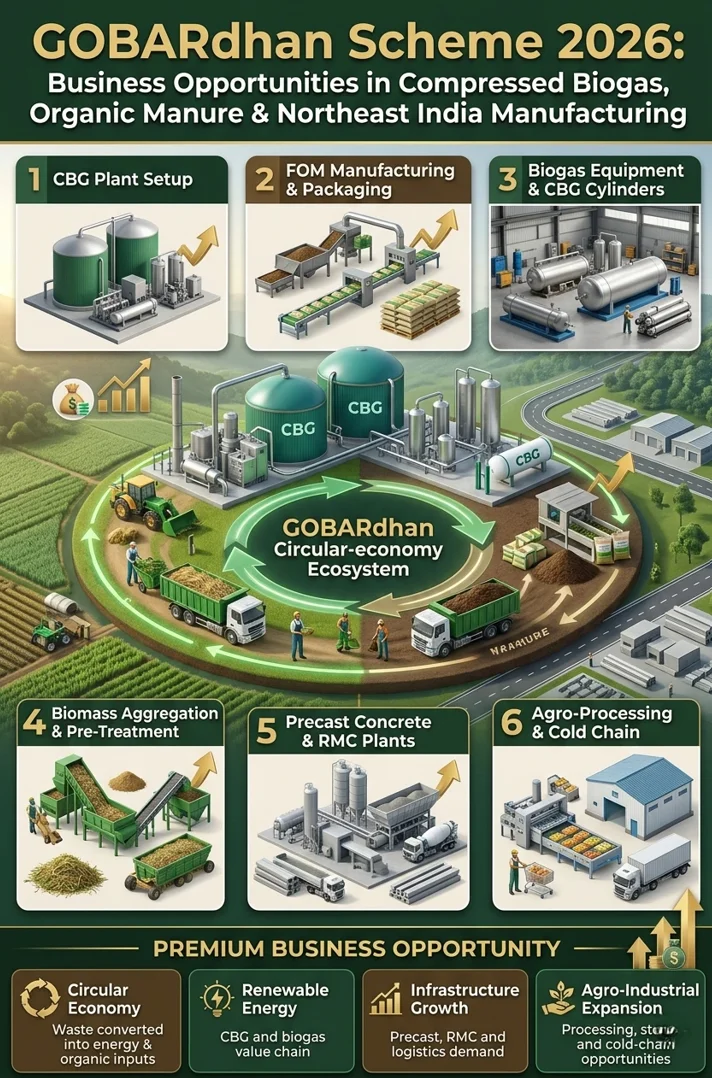
4. Biomass Aggregation and Pre-Treatment Business
High-quality feedstocks must be dry and pre-processed for CBG plants. A recurring B2B revenue model is Biomass Aggregation. It involves collecting agricultural residues, sorting, drying, and supplying them to CBG plants through long-term contracts. This gives MSMEs an opportunity to enter the market with lower capital investment. This opportunity goes up a 10th time with GOBARdhan’s 10x production target.
- Investment Range: Rs 30 lakh to Rs 2 crore – (Machinery & Logistics)
- The business model involves providing the CBG plants with feedstock according to contracts with a pre-defined price per tonne.
- Educational: Providing skill development training on biomass aggregation machines by the GOBARdhan team
- Rural Opportunity: At grass root level, mobilizes farmer groups and rural micro-entrepreneurs
Related Article: Biomass Power Plant Business in India 2026: Cost, Profit & Complete Startup Guide
5. Highway Construction Materials – Precast Concrete and RMC Plants
The Rs 8,970 crore NH-15 corridor will include 15 major bridges, 30 minor bridges, 19 flyovers, 5 major bypasses and other structures. These projects will create strong demand for ready-mix concrete (RMC), precast concrete elements, steel reinforcement and construction-grade aggregates in Assam. MSMEs can set up RMC plants or precast concrete yards near the corridor. This can help them secure multi-year supply agreements with major contractors. Project Size: RMC/Precast Plant up to Rs 25 crore with an investment range of Rs 2 crore to Rs 25 crore
- The construction procurement process starts from the very moment of the financial closure.
- Additional Demand: High volume of procurement over sustained periods in the construction phase (4-5 years)
- Location Advantage: Being near to Baihata Chariali, Sipajhar, Kharupetia, Dekiajuli bypass sites.
Read the Complete Book Here: The Complete Book on Construction Materials
6. Agro-Processing and Cold Chain Infrastructure Along the Corridor
The NH-15 corridor is a link between the agricultural heartland of Assam and the tourism circuit of the state and facilitates connectivity to the national and international markets. The aspirational districts of Darrang and Udalguri are good agricultural producers of rice, mustard, jute and horticulture crops. Agro Processing Units (rice mills, mustard oil extraction, fruit and vegetable processing, tea blending) and cold storage units along the corridor will be able to directly supply to the national retail chains at significantly lower logistics costs.
- Investment Range: Rs 1 crore to Rs 20 crore depending on product and capacity
- Key markets: Guwahati (Northeast hub), national retail, Bangladesh border trade, ASEAN export.
- Government Support: PMSMP (Prime Minister’s Micro Food Processing), NHM, MOFPI agro-processing cluster schemes
- Tourism Angle: Hospitality supply chains for Kaziranga and Kamakhya tourism – packaged foods, natural products
Explore This Book: Modern Technology of Agro Processing
Import-Export Opportunity Analysis
CBG Equipment Import Substitution
At present, India imports biogas upgrading systems, high pressure bio-CNG cylinders and PSA (Pressure Swing Adsorption) systems from Germany, China and the Netherlands. The demand of GOBARdhan is almost 10 times, thus generating a market for the domestic production of this equipment. Early entrants who create certified domestic manufacturing may provide not only the Indian market, but also new biogas markets in Bangladesh, Nepal and sub-Saharan Africa.
Organic Manure Export
The Indian CBG plants have gained popularity in South and Southeast Asia due to the increasing demand for the products that are produced in the process of fermentation, which are known as organic manures. The gateway to Northeast (NH-15 connectivity and Jogighopa multimodal logistics park) supports seamless export to ASEAN markets. FOM products are able to sell 2 – 3 times higher than the price of generic manure in the export market if they are certified and branded.
Agri-Exports from Assam via the NH-15 Corridor
There is a high export demand for Assam’s agricultural produce such as tea, bamboo products, bell pepper, large cardamom and organic rice in ASEAN countries, EU and the middle east. The NH-15 corridor significantly cuts down the time and cost to link the agricultural clusters in Assam with the Jogighopa multimodal logistics park and the inland container depot of Guwahati. In this way, these markets can be opened at a lower landed price.
Northeast India as ASEAN Gateway
Assam becomes more of an Indian gateway to the Southeast Asian countries with NH-15 corridor in operation. The north eastern route would be used by the importer who buys goods from ASEAN and sells them in the central and south India. This opens up opportunities in terms of bonded warehouse, cold chain and distribution hub at the NH-15 corridor.
Indian MSME Success Stories in Related Sectors
Biogas Seva (Pune, Maharashtra)
Biogas Seva is an MSME with a successful business model. It sells pre-engineered biogas plant components, including digesters, gas holders, and slurry management systems. These products serve rural biogas schemes under India’s SATAT programme. The firm showed that even a sizeable engineering unit can secure repeat orders from government-backed projects. It can achieve this by focusing on standardised, certified components instead of complete plant EPC projects.
Get Detailed Project Report (DPR): Industrial Biotechnology and Biogas
Eco Naturals (Hyderabad, Telangana)
Eco Naturals established a fermented organic manure processing and export business linked to biogas plants in Telangana. The firm exports FOM in branded 25 kg and 50 kg HDPE bags to organic farms in Sri Lanka and Malaysia under APEDA certification. Its model shows that the manure co-product can become a profitable secondary revenue stream rather than a waste management challenge.
Assam Agri Logistics (Guwahati, Assam)
Following infrastructure investments in Assam, several small logistics firms have repositioned as agri-cold chain operators connecting Assam’s agricultural clusters to national retail. One Guwahati-based MSME built temperature-controlled vehicles and collection points in Darrang district. It supplies retail chains in Guwahati and Kolkata. As NH-15 lowers transit times and costs, such models will become significantly more profitable.
About Niir Project Consultancy Services (NPCS)
Niir Project Consultancy Services (NPCS) is on of India’s most respected industrial consultancies, with over three decades of experience assisting entrepreneurs, MSMEs, and investors to evaluate and establish manufacturing businesses across sectors.
NPCS offers the following services directly relevant to opportunities emerging from the GOBARdhan scheme and the NH-15 corridor:
- Detailed Project Reports (DPR): Bankable, government-compliant DPRs for CBG plants, organic manure processing units, agro-processing facilities, and construction materials manufacturing
- Feasibility Studies: Market feasibility, technical feasibility, and financial feasibility analysis for new manufacturing investments
- Market Research: Demand assessment, competitive landscape analysis, and pricing intelligence for emerging sectors
- Technology Consultancy: Process selection, equipment sourcing, layout planning for biogas, agro-processing, and construction materials plants
- Project Finance Assistance: Preparation of loan applications, CMA data, and banker-ready project reports for MSME finance
Entrepreneurs can explore NPCS’s project report library and consultancy services at www.niir.org.
Industry Intelligence Data Table
| Parameter | Details |
| Industry | Compressed Biogas (CBG) / Bioenergy & Highway Infrastructure |
| Market Driver | GOBARdhan Scheme (Rs 23,731 Cr) + Guwahati-Tezpur NH-15 Corridor (Rs 8,970 Cr) |
| Investment Range | Rs 5 Cr to Rs 100 Cr (CBG plants); Rs 50 Lakh to Rs 10 Cr (ancillary/logistics) |
| MSME Opportunity | Biomass aggregation, bio-CNG cylinder manufacturing, organic manure packaging, logistics & cold chain |
| Export Potential | Organic manure (APAC, Middle East); CBG technology exports; Northeast gateway to ASEAN |
| Government Support | Capital assistance, CBG price guarantee (Rs 2,110/MMBTU), credit guarantees, pipeline connectivity |
| Risk Level | Medium – mitigated by price assurance, demand guarantee & sovereign-backed offtake |
| Growth Outlook | Sector set for ~10x production growth by FY 2035-36; NH-15 corridor to unlock 8 industrial parks |
Conclusion: Why Founders Must Move Now
The Guwahati-Tezpur corridor unlocks Northeast India’s agricultural, tourism, and logistics potential. It connects eight industrial parks and key multimodal nodes through a new access-controlled highway. For MSMEs in Assam, Arunachal Pradesh, and nearby states, this upgrade can significantly improve logistics.
Entrepreneurs who want to move forward should commission a bankable Detailed Project Report immediately. Connect with NIIR Project Consultancy Services (NPCS) to evaluate your investment, secure financing, and launch your business in one of India’s fastest-emerging industrial opportunities. For more details on these Cabinet decisions, read the original reporting at Jagran.com.