

How India’s New PLI for Polysilicon Manufacturing Is Opening Upstream Solar Value Chain for Startups & MSMEs
The nation has a serious problem with solar energy, and Economic Times just highlighted it. India has still not produced any kilogram of polysilicon locally despite its investments in manufacturing more than 213 GW of solar modules and 32 GW of solar cells. All Indian solar panels are based on raw material which is imported from China. This single weak link — at the heart of the solar value chain — has now turned India into the biggest vulnerability in its industrial landscape.
This is not a standard policy change. It is the biggest solar manufacturing opportunity in India ever provided upstream. Founders with insight on the supply chain, who are early and on the right side of the incoming PLI can be at the best position in the clean energy value chain of India. In this article, we discuss the implications of the development, identify the manufacturing companies that are appropriate now, and explain how to make your business as advantageous as possible.
Get Detailed Insights from This Book: Solar PV Power and Solar Products Handbook
What Recent Economic Times Reporting Means
The report published in Economic Times on August 7, 2026, is not just a policy statement; it’s a shift in India’s renewable energy manufacturing strategy. Indian solar firms have been constructing significant downstream capacity for years and accepting the monopoly of China on upstream inputs.
Now that’s an acceptance that officials have officially concluded. In a remarkable comment, Economic Times quotes MNRE Secretary Sarangi as saying that polysilicon should receive treatment as a “separate industrial activity.” This indicates the government will offer separate incentives for polysilicon rather than include it in the ambit of wider schemes. The fact that he also mentioned that polysilicon can be used in the semiconductor business makes this doubly strategic.
Key Market Signals from This ET Development
- India already has PLI schemes for solar panel and solar cell manufacturing with an investment of ₹240 billion.
- This is the same as or larger than the new polysilicon PLI (the government has not yet announced this).
- India has no domestic production of polysilicon and imports 100 per cent of its needs, mostly from China.
- Indian is 100% vulnerable with 97% of global polysilicon production goes to China.
- Outside China, the price of polysilicon is 2-3 times higher that the Chinese price — a huge gap that PLI must fill.
- In the past, MNRE has already extended the ALMM framework (March 2026) to solar ingots and wafers from June 2028, and the next logical step would be to include polysilicon PLI.
The report by the Economic Times is a green signal for MSMEs and startup founders to get to work on feasibility studies, site identification and technology scouting NOW (before the PLI is officially notified). First come, first served will be the first to get project approvals and technology partnerships and financing windows.
Why the Polysilicon Manufacturing Industry Is Growing Fast
India’s solar energy goals are not a choice; they are part of India’s national climate commitments. The nation has targeted 500 GW of non-fossil fuels power generation through to 2030. Most of that will be borne by Solar. India will require hundreds of millions of solar panels, each of which comes with polysilicon, if the current installation rate is maintained.
In the current scenario, if China decides to impose similar restrictions on polysilicon, then India’s entire solar manufacturing industry comes to a standstill. This is not a speculative risk – it is a proven geopolitical exposure. The US has already imposed a 15% tariff on the products that utilize Chinese polysilicon, and has established minimum price floors for polysilicon derivatives. India is closely watching all these developments.
The Supply Chain Logic
Solar manufacturing is a linear chain of value with upstream and downstream companies: Silica sand → Metallurgical-grade silicon → Polysilicon → Ingots → Wafers → Solar Cells → Solar Modules. India has developed solid capability at the end of this chain (modules and cells) and is now moving up stream. Polysilicon is at the absolute highest end and the most sophisticated and expensive end of the market.
Another application that makes high purity polysilicon doubly strategic is the manufacture of semiconductor chips, which also utilizes high purity polysilicon (9N — 99.9999999%). The India Semiconductor Mission (ISM) also brings in the extra demand for domestic polysilicon not covered by the solar PLI.
This “twin demand” – solar + semiconductor – is what makes the polysilicon PLI a highly compelling industrial-scale manufacturing opportunity.
Government Policies & Incentives for Solar Manufacturing
The policy regime in India is the most comprehensive ever seen in the country for solar manufacturing. The Ministry of New and Renewable Energy (MNRE) has been introducing incentives one after the other across the value chain and now the final piece of the jigsaw puzzle is polysilicon.
Key Policy Instruments
- Existing Solar PLI (Phase I & II): India has already announced the commitment of ₹240 billion of PLI incentives for solar panel and cell manufacturing. This has resulted in a rapid growth in capacity at the downstream end.
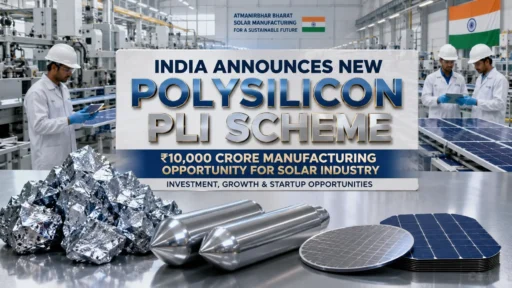
- New Polysilicon PLI (Proposed 2026): MNRE is setting up a separate PLI for domestic Poly production. The scheme is expected to provide incentives based on actual production, which should significantly reduce investor risk, with a capacity of 10+ GW.
- ALMM Framework Expansion (March 2026): MNRE added solar ingots and wafers in the Approved List of Models and Manufacturers, which will come into effect from June 2028. This will result in compulsory domestic procurement, which will directly benefit upstream manufacturers such as polysilicon manufacturers.
- India Semiconductor Mission: India’s need for high-purity polysilicon for making chips has also been identified. The semiconductor mission allows for a parallel demand channel for polysilicon makers, enhancing the projects economics.
MSMEs and start-ups can avail of policy guidance under Make in India initiative and funding and regulatory support under Startup India Platform. Special regulatory treatment and incentives are available for startups under the Department for Promotion of Industry and Internal Trade (DPIIT) in the form of DPIIT recognition benefits.
Get Detailed Project Report (DPR): Renewable Energy Projects and Green Power
State-Level Policy Incentives
The state governments in several Indian states are framing their policies to make the states solar power manufacturing hubs with lucrative incentives:
- Rajasthan: Solar Park Policy offering land, power, and water support for upstream solar manufacturers.
- Gujarat: 25-year land lease arrangements for solar manufacturing with Renewable Energy Park incentives.
- Andhra Pradesh: Industrial infrastructure support for manufacturing of renewable energy under AP Industrial Development Policy 2023-27.
- Tamil Nadu: Green Energy Corridor incentives, single window clearance for solar manufacturing investments.
5 Manufacturing Business Ideas for Startups & MSMEs Under the Polysilicon PLI
The new PLI policy for polysilicon is directly leading to these manufacturing opportunities in India. Every idea aims at a different part of the upstream solar value chain which the PLI policy will support, incentivize or demand.
1. Trichlorosilane (TCS) Manufacturing Plant
Budget for investment: ₹80–150 crore in a medium-scale TCS plant.
Key Inputs: Silicon tetrachloride (SiCl₄), hydrogen chloride (HCl), metallurgical-grade silicon and industrial hydrogen.
Application: PLI direct supply to polysilicon manufacturers. Serves specialty chemical and semiconductor industry as well.
Advantage: TCS manufacturers who are first movers will get guaranteed offtake contracts from polysilicon PLI beneficiaries.
2. Metallurgical-Grade Silicon (MG-Silicon) Manufacturing
Polysilicon is made by reducing silica (quartz) in an electric arc furnace to produce metallurgical-grade silicon. In India, silica sand is a natural raw material available in large quantities, especially in the states of Rajasthan, Andhra Pradesh and Odisha, which makes it a natural domestic manufacturing play. The production of MG-silicon requires a lot of energy but is suitable in countries where industrial energy is inexpensive.
Investment Range: ₹50–100 crore for a 5,000–10,000 MT/year plant.
Key Location Advantage: Silica sand deposits, cheap electricity (Odisha, Chhattisgarh, Jharkhand).
Market: Domestic Polysilicon plants + Aluminium alloy industry + Silicon chemicals.
This is the condition when PLI silicon suppliers start to become Tier-1 suppliers for PLI supported polysilicon manufacturers.

3. High-Purity Quartz Sand Processing & Refining
The purity of quartz sand (SiO₂) is greater than 99.9%, which is an essential material for MG-Silicon and Polysilicon manufacturing. There is abundant raw silica present in India, however, very little infrastructure of beneficiation and high-grade processing units are available in the country. This is an opportunity for specialized mineral processing businesses to fill this gap.
Investment requirement: ₹20 to 60 crores for processing plant & beneficiation plant (flotation and acid leaching).
Key Processes: Froth flotation, Magnetic separation, acid leaching and thermal treatment for Ultra-high purity grades.
Export Opportunity: High purity quartz is fetching high prices in international markets. India can also go on to export quartz along with its local solar supply.
Guidance on export procedures and licensing is available from Directorate General of Foreign Trade (DGFT).
4. Polysilicon Manufacturing (Siemens Process) — Large-Scale
Investment Range: ₹400–1,200 crore for 3,000–10,000 MT/year capacity.
Technology Partners: Germany’s Wacker Chemie, South Korea’s OCI and US-based REC Silicon are potential technology licensing partners.
PLI Benefit: The market development phase market cost of Indian polysilicon will be offset by PLI incentives, just like the solar module PLI was for solar modules.
Domestic polysilicon plants are essential national facilities, once scaled up – Long-Term Moat. Domestic Sourcing will be required to meet ALMM compliance requirements and will ensure a guaranteed demand.
5. Specialty Gases Manufacturing for Solar & Semiconductor Grade Applications
Specialty gases such as silane (SiH4), hydrogen chloride (HCl), chlorine, nitrogen and hydrogen play a key role in polysilicon manufacturing. Manufacturers use these gases in very high purity and require them in large quantities. Most companies import these specialty gases or source them from a very small number of local suppliers. As India expands polysilicon and semiconductor manufacturing, the demand for specialty gases is expected to explode.
Investment needed: Rs 30-80 crore for a specialty gas production/purification plant.
Key Products: Silane gas (SiH₄), high purity HCl, Nitrogen Trifluoride (NF₃), Ultra pure Hydrogen.
Market Scope: Dual revenue stream, serving both polysilicon PLI plants AND semiconductor fabs that are being constructed as part of the India’s chip mission.
MSME Angle: Specialty gas cylinder distribution, gas purity testing laboratories, gas handling equipment manufacturing businesses are viable MSME scale supporting businesses.
Import–Export Opportunity Analysis
According to industry analysis, if India does not address domestic manufacturing, the country’s solar equipment import bill will rise to $30 billion by 2030. Polysilicon is the most valuable single imported component in the solar supply chain. According to the DGFT trade data, China sells $3.89 billion worth of solar cells and modules — all made from polysilicon that India does not manufacture.
Related Article: Solar Policy Tightens: Domestic Manufacturing Gets a Stronger Push
Import Substitution Opportunity
Domestic polysilicon production — if at large scale — will replace the single biggest import in India’s solar supply chain. Even if 30% of the current import bill is achieved, initial movers can generate annual manufacturing revenues of ₹2 lakh crore for the country.
Export Opportunity
Within 8-10 years, India could produce silica sand that competes in the Southeast Asian market, supported by abundant reserves, improved technical capabilities, and PLI cost support. Once India’s producers have scaled up production, countries such as Vietnam, Malaysia, Bangladesh and Sri Lanka that rely on Chinese polysilicon will be its initial export markets.
High purity quartz sand processing firms can embark on the export journey at an early stage of 2-3 years as specialty quartz enjoys premium price in international market and the raw material advantage of India is instantaneous.
Indian MSME Success Stories in Solar Manufacturing
Waaree Energies — From Small Beginnings to Global Scale
Waaree Energies started as a relatively small solar module manufacturer and today operates India’s largest solar module manufacturing capacity, exceeding 13 GW. Benefited directly from the solar PLI scheme and ALMM-driven domestic procurement mandates. The company’s trajectory — from MSME-scale operations to a publicly listed solar giant — is the template that polysilicon PLI beneficiaries will likely follow over the next decade.
Websol Energy Systems — Decades of Persistence
Websol Energy Systems, based in West Bengal, has manufactured solar cells since the 1990s — through multiple policy cycles, import competition, and technology shifts. Today, Websol is expanding aggressively as PLI support and ALMM mandates create reliable domestic demand. Their story proves that upstream solar manufacturing in India rewards patient capital and technical depth.
REC Group (India Manufacturing Arm)
While REC Group is a Norwegian company, its India manufacturing operations demonstrate that high-quality solar wafer and cell manufacturing at industrial scale is achievable in India when right policy incentives and technology partnerships are in place. The polysilicon PLI is designed to replicate this model at the upstream end of the chain.
Identify high-growth industries before others do
About NPCS — Niir Project Consultancy Services
NPCS (Niir Project Consultancy Services) is India’s most trusted industrial feasibility and project report consultancy, with over four decades of experience across manufacturing, chemical, agro-processing, and technology sectors. For entrepreneurs and MSMEs exploring opportunities in polysilicon manufacturing, specialty chemical production, quartz processing, or specialty gas manufacturing, NPCS provides:
- Detailed Project Reports (DPRs) covering plant layout, machinery, raw materials, and financial projections.
- Feasibility reports aligned with PLI application requirements and DPIIT norms.
- Market research covering demand projections, import substitution analysis, and export viability.
- Technology and equipment sourcing guidance for upstream solar manufacturing.
- Bank loan documentation and SIDBI / NABARD financing support packages.
NPCS has helped thousands of founders and MSMEs across India convert policy opportunities like the new polysilicon PLI into bankable, investable projects. Visit NPCS — Industrial Project Consultancy to explore ready-to-use project reports for polysilicon, quartz processing, specialty chemicals, and related solar manufacturing segments.
India Solar Manufacturing Value Chain — Data Snapshot (2026)
| Segment | India Capacity | Import Dependence | PLI Outlay | Target (2030) |
| Solar Modules | 213+ GW | ~20% | ₹4,500 Cr (existing) | 500 GW installed |
| Solar Cells | 32 GW | ~40% | Part of Solar PLI | 100 GW domestic |
| Ingots & Wafers | Nascent | ~90% | ALMM (Jun 2028) | 50 GW domestic |
| Polysilicon | NIL | 100% (China) | New PLI – proposed | 10+ GW capacity |
| Semiconductor-grade Poly | NIL | 100% | Semiconductor Mission | Strategic target |
| Silica Sand (raw) | Abundant | N/A | Ancillary support | Self-sufficient |
Source: MNRE, Economic Times, PV Tech, Industry Estimates (August 2026)
Conclusion: The Upstream Solar Gold Rush Starts Now
Economic Times has shone a spotlight on the single most strategic manufacturing gap in India’s energy independence story. Moreover, The proposed polysilicon PLI — announced by MNRE on August 7, 2026 — is not just a government scheme. Instead, It is the starting pistol for India’s upstream solar manufacturing decade.
For example, Think about what happened when the solar module PLI launched: India went from near-zero domestic module capacity to 213 GW in under five years. Similarly, The polysilicon PLI will trigger a similar transformation — but this time at the upstream end, where margins are higher, competition is thinner, and strategic value is immense.
Therefore, The founders and MSMEs who act on this NOW — running feasibility, mapping technology partners, engaging state industrial bodies, and building technical teams — will capture the most valuable positions in India’s clean energy manufacturing ecosystem. However, Those who wait for the formal PLI notification will be competing in a crowded room for whatever slots remain.
Meanwhile, India’s 500 GW renewable target by 2030 is non-negotiable. As a result, The polysilicon supply chain will be built — the only question is whether it is built by Indian entrepreneurs or international capital. Furthermore, The Economic Times development of August 7, 2026 is your signal. In addition, The Make in India initiative and MSME Ministry infrastructure are ready to support qualifying ventures. Therefore, Use them.
The solar value chain’s missing link is about to be found. Make sure your business is the one that fills it.