The Number That Should Change Your Plans
Today, there are more than 63 million MSMEs in India. But less than 1.5% of them have a proper Factory Licence. There is something about that one fact that’s why so many small factory shops stall — not because they’re not in demand, not because the product is shoddy, but because it’s not in the bank’s purview and the government’s scheme is not within reach.
Think about that. You may have a working production line, a paying customer and a team of 8 skilled people – and still not be eligible for a collateral-free loan from CGTMSE, a capital subsidy from PMEGP or a GST refund on your inputs. All for the fact that the paper work was never done right from the beginning.
As per Ministry of MSME data, MSME industry accounts for around 30% of the Gross Domestic Product (GDP) and more than 110 million jobs in India. The possibility of the sector is not in doubt. The problem is that, despite a lot of interest, the only real problem is entering the system and the gruesome way that is accomplished — poorly documented and messy from scratch.
This Guide solves the problem. Step by step.
Get Detailed Insights from This Book: Best Businesses You Can Start with Low Cost
Where the Supply Chain Still Breaks
India’s manufacturing import bill portrays an uncomfortable story. The import of items where small-scale domestic production is either not available or inadequate, such as electronics components, specialty chemicals, precision engineering parts, processed agri-products and packaging materials, exceeds ₹9 lakh crore per year.
Low value addition at the MSME level has been a structural impediment for India’s competitiveness in manufacturing sector, as stated in the Annual Report of DPIIT on a regular basis. The number of small manufacturing units per lakh of population in the states with abundant raw material is less than the average. It is not a matter of raw material or labour it is organised and licensed, bankable production capacity that is the gap.
Pressure from the demand side is increasing. Currently, there are many government procurement portals like GeM (Government e-Marketplace), organised retail chains and e-commerce platforms who are demanding suppliers to be GST-registered, Udyam-certified and in many cases BIS or FSSAI compliant. No matter how efficient informal units are, they are just locked out.
According to the Confederation of Indian Industry (CII), almost 40% of the potential manufacturing capacity of MSMEs in India is untapped annually because of unregistered, undercapitalised MSMEs without access to formal credit, government tenders, export markets etc. There is no such thing as being too ambitious. It is structure.
TABLE 1: State-wise MSME Manufacturing Activity & Key Industrial Clusters
| State | Key Manufacturing Hub | Dominant Sectors | Udyam Units (Approx.) | Priority under Scheme |
| Maharashtra | Pune, Nashik, Nagpur | Auto components, Pharma, Food processing | 6.2 lakh+ | PLI, PMEGP, CGTMSE |
| Gujarat | Ahmedabad, Surat, Vadodara | Chemicals, Textiles, Engineering goods | 5.8 lakh+ | PMEGP, MSME Clusters |
| Tamil Nadu | Coimbatore, Chennai, Tirupur | Textiles, Leather, Auto parts | 4.9 lakh+ | MUDRA, SFURTI |
| Uttar Pradesh | Kanpur, Agra, Meerut | Leather, Food, Light engineering | 8.9 lakh+ | PMEGP, Stand-Up India |
| Rajasthan | Jodhpur, Jaipur, Kota | Handicrafts, Chemicals, Minerals | 3.1 lakh+ | ASPIRE, NSIC |
| West Bengal | Howrah, Durgapur, Haldia | Engineering, Jute, Steel fabrication | 3.8 lakh+ | CGTMSE, MUDRA |
Source: Ministry of MSME – Udyam Registration Portal | State-wise MSME data, current registration records
Get Detailed Project Report (DPR): Comprehensive Guide to Steel and Ferrous Metal Products
Why Now Is the Right Time to Enter Manufacturing
India is seeing a more viable small-scale manufacturing scenario than in the last 20 years thanks to four forces.
The Make in India and Atmanirbhar Bharat initiative has led to an active preference by the government from existing Indian suppliers across the defence, electronics, pharma, food processing and textiles sectors. Production Linked Incentive (PLI) Scheme provides incentives of 4-6% based on production in 14 sectors with a total amount of ₹1.97 lakh crore. Small manufacturers in component production chains are directly benefitted.
Secondly, access to credit has increased significantly. Collateral-free loans of up to ₹5 crore are now available for Udyam registered units under the Credit Guarantee Fund Trust for Micro and Small Enterprises (CGTMSE). Under the PMEGP scheme, capital subsidy is provided to new manufacturing projects at 25-35% of the project cost and the ceiling for manufacturing is ₹50 lakh.
Thirdly, formalisation has become a business imperative. The Government e-Marketplace (GeM) has achieved a cumulative procurement volume of Rs. 4 lakh crore and MSME sellers have more than 55% of all registered sellers. An immediate channel to a registered, compliant, unit.
Fourth, logistics expenses are declining. The PM Gati Shakti National Master Plan covering the coordination of all transportation facilities including rail, road, port and warehouse is helping to bring down the sourcing and output distribution costs for units even in Tier-3 areas. India’s logistics cost to GDP (LC/GDP) is expected to reduce to less than 8% in the medium term from its current 13-14% as per the NITI Aayog’s logistics report.
Step-by-Step: Setting Up Your Manufacturing Unit
Step 1 — Define Your Product and Scale
Use one product. Not three. Not a range of products. One SKU, which is thoroughly researched, has a buyer or distribution line identified before you invest a single rupee in machinery. A small food processing unit in Ludhiana or a plastic moulding unit in Rajkot that is aware of its customers’ lives survives. A unit on hope does not…
Step 2 — Choose the Right Location
Where you locate your business will have the greatest impact on costs, more than any other single factor. State industrial development corporations (SIDCs), including the Maharashtra Industrial Development Corporation (MIDC) in Maharashtra, Gujarat Industrial Development Corporation (GIDC) in Gujarat, and Karnataka Industrial Areas Development Board (KIADB) in Karnataka, develop and manage industrial estates with pre-arranged infrastructure, streamlined pollution compliance processes, and direct connectivity to MSME clusters. The lease rates in such zones generally range between ₹8 and ₹25 per sq. ft per month, varying from state to state and zone to zone.
A small unit requires 500-1500 sq.ft. of covered production area and 200-400 sq.ft. storage and admin area. Budget accordingly.
Step 3 — Register and Get Your Licences
This is where most first-time entrepreneurs put it off till later, and end up paying for it later. Fill In all the Registrations Before the Production. These are the things you need:
- All MSMEs are required to register with Udyam. Free, online, Aadhaar-linked. Enables the CGTMSE, PMEGP, GeM seller access and priority sector lending. Register at udyamregistration.gov.in.
- GST Registration: Necessary when the yearly turnover is more than ₹40 lakhs (₹20 lakhs for service providers). Voluntarily register even below the aforesaid threshold if the customer is a B2B customer requiring input tax credit.
- Factory Licence (Factories Act, 1948): If you have 10 or more workers on your premises with power or 20 or more without power. Apply to the State’s Chief Inspector of Factories. Timeline: 30–60 days.
- Pollution NOC (Consent to Establish & Operate): To be obtained from the State Pollution Control Board prior to construction. The majority of the small manufacturing units are under green or orange category — processing is faster.
- Trade Licence (Municipal): From local Municipal corporation or panchayat. A basic requirement for any business building.
- BIS Certification (if applicable): Mandatory for regulated product categories including electrical goods, steel, cement, and certain consumer products. Check the Bureau of Indian Standards (BIS) mandatory list before finalising your product.
- FSSAI Licence (for food manufacturing): State licence if turnover is upto ₹20 crore and Central licence if turnover is more than ₹20 crore. Submit applications on FSSAI website before commencing food production.
- Fire Safety NOC: From the state Fire Department. For factory buildings > some size and risk class.
The total cost of licensing and registration for a typical small manufacturing enterprise is ₹25,000 – ₹75,000. Time to all clearances: 60-90 days, if you move promptly.
Build a profitable business with the right idea
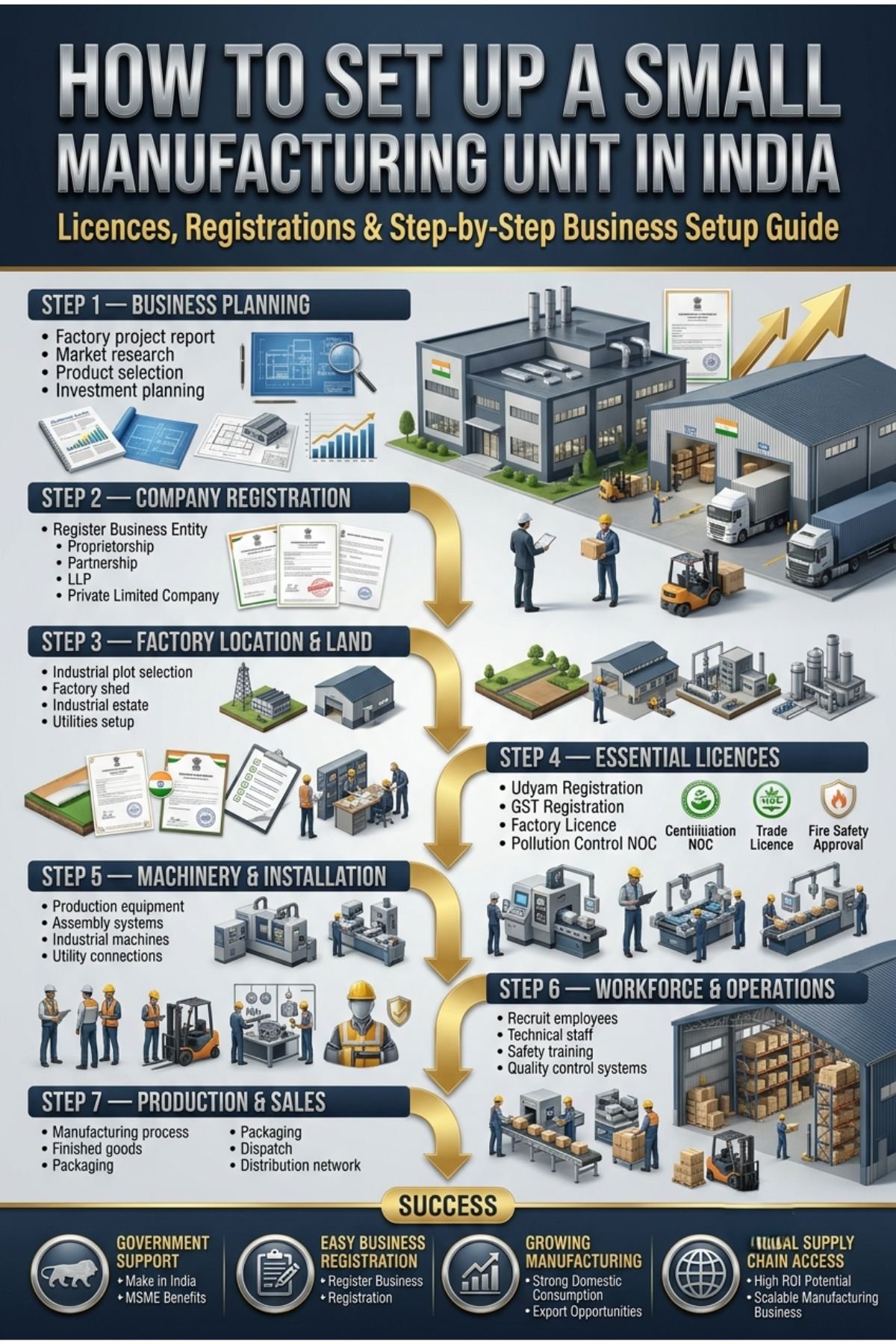
Step 4 — Set Up Plant and Procure Machinery
Use of established Indian OEM machinery sources wherever possible. Coimbatore is the machine tool centre of India, where machine tool fabricators and equipment suppliers offer machine tools for food processing, packaging, light engineering, and textile machinery at costs 30–40% lower than imported alternatives. Rajkot is a source of plastic processing and engineering machine. Agricultural implements and metal fabrication equipment are covered under Ludhiana.
Purchase from vendors always provide AMC (Annual Maintenance Contracts). In a small unit, downtime is absolutely fatal. A ₹50,000 AMC with a line running is better worth than the saving.
Step 5 — Hire and Train a Lean Team
The minimum size is 500-1000 sq. ft. and will require 5-8 individuals: one production supervisor, two to four machine operators, one quality/packing worker, and one person for dispatch and administration. For trained operators utilise the skill India portal of the government or ITI pass-out programmes. Monthly wage cost in a Tier-2 city for this team is of ₹1.5 – 2.5 lakh.
TABLE 2: Capital Investment Breakdown — Small vs. Medium Manufacturing Unit
| Cost Head | Small Unit (INR) | Medium Unit (INR) | Notes |
| Land & Civil Works (Lease) | ₹3,00,000 | ₹8,00,000 | Owned land reduces capex by 30–40% |
| Plant & Machinery | ₹8,00,000 | ₹25,00,000 | Semi-automatic to automatic line |
| Utilities & Installation | ₹1,00,000 | ₹3,00,000 | Power connection, DG set, plumbing |
| Furniture & Office Setup | ₹50,000 | ₹1,50,000 | Admin, storage, basic IT |
| Working Capital (3 months) | ₹2,00,000 | ₹7,00,000 | Raw material, wages, overheads |
| Licences, Registration & Contingency | ₹50,000 | ₹1,50,000 | GST, Udyam, NOC, Factory Act |
| TOTAL CAPITAL REQUIRED | ₹15,00,000 | ₹46,00,000 | Excludes bank loan interest cost |
Source: NPCS Primary Research & SIDBI MSME Pulse Report | Figures are indicative and vary by sector, state, and year of setup.
Financial Snapshot: What to Expect
The values below are representative of a typical Light Manufacturing Unit (LMI) (Plastics / Packaging / Food Processing / Assembled Consumer Goods) in a Tier-2/Tier-3 Indian city.
Capital Expenditure
Small unit: ₹15 – ₹20 lakh. Medium unit: ₹40 – ₹50 lakh. These include three months working capital, civil works, machinery and utilities.
Monthly Operating Costs
Small unit (8 workers, 1 shift): ₹2.5-₹4 lakh monthly (wages, raw material, power, rent and overheads).
Revenue Potential
When operating at 60% capacity utilisation: ₹5 – ₹7 lakh per month. At 100% capacity: ₹8 – ₹12 lakh per month. These projections are based on the standard market prices for products and no export premium.
Margins
Gross margins: 30-42% depending on the volatility of raw material prices and product. Net margins after all overheads, loan repayment and depreciation: 14-22% at stable operation.
Payback Period
Well managed – 18-30 months for a small unit. Many times, units that receive a PMEGP subsidy (which is not to be repaid) pay back in 12–18 months.
Related Article: How to Write a Business Plan for a Manufacturing Startup in India
TABLE 3: Key Government Schemes for Small Manufacturing Entrepreneurs
| Scheme | Nodal Agency | Max. Benefit | Key Eligibility |
| PMEGP | KVIC / District Industries Centre | 35% subsidy on project cost | First-gen entrepreneur, project cost up to ₹50 lakh (mfg) |
| CGTMSE | SIDBI + MoMSME | Collateral-free loan up to ₹5 crore | Udyam-registered MSME, no third-party guarantee needed |
| MUDRA – Tarun | Scheduled Banks / NBFCs | Loan up to ₹20 lakh | Non-farm micro enterprises, no collateral required |
| PLI Scheme | Ministry of Commerce / Line Ministries | 4–6% production-linked incentive | Sector-specific; minimum investment thresholds apply |
| SFURTI | Ministry of MSME | Up to ₹5 crore for cluster development | Traditional industries, artisan clusters, khadi units |
| Stand-Up India | SIDBI / Commercial Banks | Loan ₹10 lakh – ₹1 crore | SC/ST & women entrepreneurs, greenfield manufacturing only |
Source: Ministry of MSME – Scheme Details | SIDBI – CGTMSE & Credit Schemes | Benefits as per current scheme guidelines.
Expert Consultancy for Your Project
Niir Project Consultancy Services (NPCS) has been one of the most referred industrial consultancies in India for more than 45 years having assisted entrepreneurs in the preparation of Detailed Project Reports (DPRs), techno-economic feasibility studies, plant layout projects and market research studies in over 50 countries of the world. Their reports encompass detailed information on investment needs, machinery specifications, compliance checklists and financial forecasts for hundreds of manufacturing industries, ranging from agro-processing to specialty chemicals, textiles to construction materials. Banks use NPCS reports for loan appraisals, entrepreneurs use NPCS reports for scheme applications and investors use NPCS reports for due diligence. For information, visit niir.org or entrepreneurindia.co.
Your Next Step
There’s no perfect time to begin. Only prepared and unprepared starts exist.
Choose a product category for this week. Ask if it needs the BIS, FSSAI or other industry specific approvals; it is this factor that will make the biggest difference in time and cost of compliance. After that register your Udyam Registration. It is free, takes 20 minutes and opens all government schemes and formal credit channels mentioned in this article.
For further information on detailed project report with financials, machinery specifications, licence checklists with respect to the selected product, contact NPCS at niir.org or visit sector-specific project reports at entrepreneurindia.co. The info is available. It’s up to you to make the choice.
ENTREPRENEUR SPOTLIGHT
Sunita Devi, Jaipur, Rajasthan — started a handmade paper and packaging products unit in an industrial estate on the outskirts of Jaipur with an initial investment of ₹12 lakh, partly funded through a PMEGP subsidy. Within 18 months she had secured supply contracts with three regional e-commerce packaging firms. Her core lesson: ‘I spent six months delaying because I thought licences would take too long. When I actually applied, Udyam took one day, and GST took three. The delay was entirely in my head.’ Her unit now employs 14 people and turns over ₹1.2 crore annually.
Frequently Asked Questions
1. What is the minimum investment needed to start a small manufacturing unit in India?
A working small manufacturing unit can be started with 10-20 lakh (depending on product). That can include minimum necessary machines, 3 months working capital and licensing fee. Food processing, simple packaging units, assembly units are on lower side, on other hand if it requires machinery-heavy things such as metal works or chemical related plants; will start with 25 lakhs onward.
2. Which licences are mandatory before starting production?
Basic Registrations required are Udyam Registration, GST (if applicable), and pollution NOC from the respective State Pollution Control Board. You will need a Factory License in case your business employs 10 or more workers utilizing power. Product-related clearances like FSSAI (for food products) or BIS (for specific products notified by govt.) would also be necessary where applicable. Failure to do so can lead to closure notices and a bar on obtaining bank loans.
3. Where should I source raw materials for my manufacturing unit?
Raw material hubs are present in India: Steel and metal raw materials (Chhatisgarh, Jharkhand, Odisha); textiles (Gujarat, Tamil Nadu); agri inputs (Punjab, Haryana, Maharashtra); plastics and petrochemicals (Gujarat – Hazira/Dahej belt). Sourcing from within a particular state helps achieve substantial savings in logistics cost and better assured supply.
4. Is a small manufacturing unit profitable in India?
A well-managed, licensed small manufacturing unit in a demand-driven product category can achieve net margins of 14–22% at stable operation. However, profitability hinges on cost control for raw material, plant capacity utilization beyond 70 percent, and that the machinery does not lie idle. The ones involving a component of the PMEGP scheme manage to achieve breakeven points earlier than others in the industry, which is at between 14-20 months against a sectoral Average of 24-30 months.
5. Which government schemes provide the best support for first-time manufacturing entrepreneurs?
The easiest way to avail funds for an early-stage founder is PMEGP with a capital subsidy of 25-35%. The candidate should not have experience of running any type of business. CGTMSE eliminates the collateral barrier for bank loans up to ₹5 crore. MUDRA Tarun provides loans up to ₹20 lakh for micro enterprises. All three require Udyam Registration as a base condition. Detailed scheme eligibility is available.
6. How can NPCS help me set up my manufacturing unit?
Niir Project Consultancy Services (NPCS) creates sector wise DPR’s including the list of Machinery, layout of a plant, raw material and list of required licenses along with a five years project cost analysis. Banks and DIC offices accept these reports for loan and scheme applications. For over 45 years, NPCS has served entrepreneurs across manufacturing, agro-processing, chemicals, and infrastructure sectors. Access reports and consultancy at niir.org.