The highway sector is going through a critical stage of change in the Indian context. As reported by MagicBricks, The National Highways Authority of India (NHAI) has identified 54 highway and expressway projects totalling 2,442 km and with a capital investment of ₹1.80 lakh crore for award in the current financial year, the company said in a statement. These projects are spread across 13 states, and will be implemented under three models: Engineering, Procurement and Construction (EPC), Hybrid Annuity Model (HAM), and Build-Operate-Transfer (BOT).
This announcement is pivotal for any entrepreneur, MSME founder, manufacturer, or investor. It’s a direct market signal. With each kilometre of expressway awarded, there is demand for steel, cement, bitumen, precast concrete, crash barriers, road studs, signage, geotextiles, drainage systems, and components for construction equipment. In addition to materials, entire service ecosystems spring up along newly constructed corridors: logistics, hospitality, fuel retail, warehousing and cold chain. There’s only one window to set up a business for this wave of infrastructure, and it is this one.
What Recent Reporting Means
MagicBricks, one of India’s most credible real estate and infrastructure intelligence platforms, in a recent report has said that NHAI’s project pipeline does not contain an exhaustive list of projects for the current fiscal year, but is rather a carefully curated mix. The previous year’s ambitious project number and length of 124 projects, with 6,376 km of length have been reduced this year to 54 projects of 60,418 km, a policy of quality over quantity and prioritising projects with high impact corridors and good readiness for implementation. There are 26 projects funded under the EPC (full government funding), 21 projects funded under HAM (co-funded by government and private players) and 7 projects under BOT (fully private concession).
Identify high-growth industries before others do
Why This Matters for Each Stakeholder
Hyper-local demand for building materials, safety equipment and construction-grade products is generated along the 13 different states of construction work on the 2,442-km entrepreneurs & Startup Founders programme. Early movers who put in place supply contracts with EPC contractors will reap multi-year recurring revenues.
MSMEs: MSMEs in the road construction industry traditionally have been considered Tier-2 and Tier-3 suppliers to large enterprises. It is the segment that the updated MSME Classification and Credit Guarantee schemes are aimed at. Incentives are also being introduced in government procurement policies for procurement from MSME-registered suppliers.
Manufacturers: There will be an unprecedented demand for standardised materials including crash barriers, road studs, pipe culverts, precast box drains, signage boards, and bituminous mixes, all at high volumes. Certification with BIS and NHAI vendor registration to the manufacturer will help them to become first-mover.
The BOT model on 7 of the 54 projects creates direct investment opportunities in concessions. HAM projects have fixed annuity-linked returns for private developers who have access to project debt.
Exporters: India’s highway development will result in excess supply of manufacturing capacity in road construction materials, specifically crash barriers and traffic management systems, that can be deployed in the highway markets of Africa, Southeast Asia and SAARC.
Why This Industry Is Growing
India’s national highway network has expanded more than 60 per cent in a span of less than a decade, to almost 1,46,000 km as of March 2025. The Ministry of Road Transport and Highways (MoRTH) got the highest allocation of ₹3.10 lakh crore in the Union Budget for FY 2026-27, which is about 8 per cent more than the previous year.
NHAI surpassed its construction target of FY26 by 15% and achieved 5,313 km of construction, Bharatmala Pariyojana Phase I has achieved 26,000 km of project awards and 19,800 km of completed roads with total expenditure exceeding ₹4.9 lakh crore. The sectoral growth trend is multi-decade as NHAI now is looking to upgrade 25,000 km of two-lane highways to four lanes and 16,000 km of four lane highways to six lanes. MagicBricks always has a front-row seat to these infrastructure developments, and these are the main sources of value creation in the real estate along highway corridors, and hence compounding business opportunities for entrepreneurs who enter early.
Government Policies & Incentives
There are a number of government schemes that directly benefit entrepreneurs who want to enter into the highway construction supply chain:
- Bharatmala Pariyojana (MoRTH): India’s flagship highway programme to connect 34,800 km of roads. The empanelling of contractors through gov.in, project details at morth.gov.in.
- MSME Registration & Credit Support: Register your business on the Udyam Registration Portal and avail of collateral-free credit guarantees offered by CGTMSE and also avail the various categories of MUDRA loans as extended in Budget 2026–27.
- MSME suppliers of road safety equipment, road construction materials may register on GeM Government Procurement Portal (gov.in) to avail government tenders directly.
- PM Gati Shakti National Master Plan: Multimodal connectivity framework, with highway projects in sync with rail and port infrastructure and logistics, to create sustainable demand for supply. Information on PM Gati Shakti Portal.
- Foreign direct investment in roads and highways is fully allowed under the automatic route and international JVs are allowed for technology intensive road material manufacturing.
The 13 states in the project have MSME incentive policies that include capital subsidies, electricity tariff concessions, and land allotment for industrial units for providing services in highway construction.
Manufacturing Business Ideas Directly Emerging from NHAI’s Highway Push
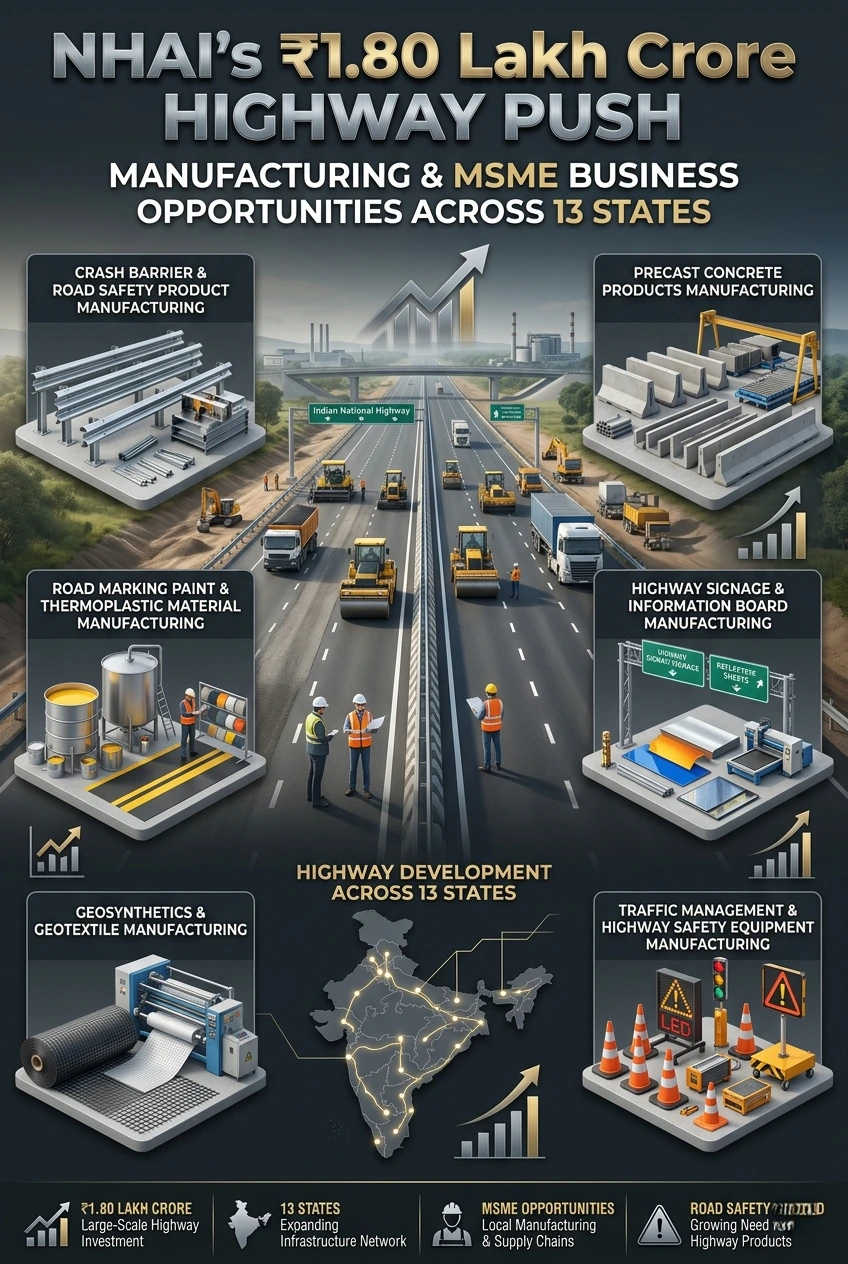
Demand for these 54 highway projects directly creates the following six manufacturing opportunities across 2,442 km. Each opportunity offers a practical MSME entry point and follows procurement specifications used in EPC and HAM contracts.
1. Crash Barrier & Road Safety Product Manufacturing
W-beam steel crash barriers, concrete barrier segments, end terminals, and reflective delineators are all needed for every kilometre of kilometres of access-controlled expressway. Millions of linear metres of crash barriers in a 2,442 km highway programme. MSMEs producing Hot Rolled Steel Crash Barriers conforming to IRC:119 specification can go on as NHAI approved vendor and can directly supply to EPC contractor for Hot Rolled Steel Crash Barriers. Initial investment: ₹2-4 crore for small plant having roll-forming machines. This segment also supports the export to Bangladesh, Nepal and Sri Lanka, where the highway programmes are gaining momentum.
Access Complete Business Plan: A Business Plan for Highway Guard Crash Barrier with Metal Beam (Roll Forming) And Galvanizing Plant
2. Precast Concrete Products Manufacturing
Precast box culverts, pipe culverts, precast drain covers, median barriers and retaining wall panels are essential components of highway construction. These precast products can drastically reduce on-site construction time for concrete elements. This advantage is crucial for meeting NHAI’s milestone schedules. MSMEs with precast yards near project sites can supply multiple EPC contractors. Investment range: ₹1.5–5 crore depending on scale. In the project states, logistics costs are natural competitive, when located near highway alignments.
Read the Complete Book Here: The Complete Book on Cement & Concrete Products Manufacturing
3. Road Marking Paint & Thermoplastic Material Manufacturing
Completed highway sections require lane demarcation, edge lines, raised pavement markers, and retroreflective thermoplastic road markings at required intervals. India is now importing a good amount of high-quality road marking stuffs. Domestic MSME manufacturer can produce IS standard thermoplastic road marking compounds, glass beads for retro reflectivity which can replace imports and provide an assured project pipeline with the government. The investment required is from ₹75 lakh to ₹2 crore. After maintenance contracts (15-20 years BOT) are in effect, the market grows one more layer.
4. Highway Signage & Information Board Manufacturing
New highways under IRC and NHAI specifications require compulsory road signage. This includes directional, regulatory, and warning signs. Kilometre posts and overhead variable message signs are also required along the highway. A manufacturing facility can produce aluminium composite signboards, high-intensity retroreflective signs, mounting structures, and kilometre pillars. Such a facility can supply thousands of units for a single project. Units made with NHAI-approved material specifications and BIS-certified materials can help manufacturers qualify for tenders from highway contractors. Investment: ₹50 lakh to ₹1.5 crore in a well-equipped signage fabrication unit.
5. Geosynthetics & Geotextile Manufacturing
Woven and non-woven geotextiles now play a key role in highway construction for subgrade stabilization, erosion control, drainage separation and slope protection. Engineers already use geogrid reinforcement to strengthen embankments. The geosynthetics market is poised to grow rapidly alongside highway construction. A few large companies currently meet most of the demand, creating opportunities for MSMEs in states with easy access to polypropylene or polyester raw materials. The investment required is ₹ 2–6 crore for extrusion and weaving lines. African countries, who have similar highway programmes, actively procure geosynthetics from Indian manufacturers.
Related Article: India Geosynthetics Industry Growth: Why Geotextiles, Geogrids and Geomembranes Are in High Demand
6. Traffic Management & Highway Safety Equipment Manufacturing
Traffic cones, delineators, portable variable message signs, speed sensor housings, and emergency road telephones are essential expressway components. NHAI’s growing demand for advanced safety features creates opportunities for MSME manufacturers. Units producing polycarbonate and HDPE road safety equipment can secure regular tenders from EPC contractors and highway management companies if they meet IRC specifications. It requires an investment of ₹40 lakhs to ₹1.5 crores.
Import–Export Opportunity Analysis
Import Substitution Opportunities
India currently imports specialised materials such as high-intensity retroreflective sheeting, mainly from the USA and South Korea. It also imports advanced geogrids from the UK and Germany. Specialist polymer-modified bitumen additives mainly come from the Middle East and Europe.
As domestic highway construction expands, MSME manufacturers can develop BIS-certified alternatives. These products can help reduce imports and capture a significant share of the replacement market. The government’s Make in India initiative further supports this opportunity. NHAI also allows locally manufactured alternatives that comply with IRC and IS standards through its vendor approval process.
Export Markets
Capacity building for domestic highway boom is a strength of Indian manufacturers and can be exported. The ADB has ongoing road infrastructure programmes in Bangladesh and Sri Lanka. Two countries, Bangladesh and Sri Lanka, have ongoing road infrastructure programmes under the ADB. In Africa, countries like Nigeria, Kenya, Ethiopia and Tanzania are building thousands of kilometres of roads where Indian road safety products and precast concrete products can compete in price. Existing trade relations and EXIM Bank Lines of Credit with the respective Development banks of Africa can be used to facilitate orders by the exporters.
Indian MSME & Startup Success Stories in the Highway Ecosystem
There are already examples of MSMEs and mid-sized companies in India which created valuable businesses by providing goods to the highway construction industry:
Saferoads India (Precast & Safety Products): Precast and Safety Products Manufacturer based in Pune, MSME which started in Civil Construction and developed its business on the Bharatmala Pariyojana project contractors. Today it provides to various EPC companies and PWDs in Maharashtra and Karnataka states.
Greenply Infra Solutions (Geosynthetics, Gujarat): It was a polypropylene woven sack manufacturer which transformed into a woven geotextile for highway applications, in Surat. It now serves the needs of the NHAI approved contractors in Gujarat and Rajasthan and has started export to Bangladesh.
An average size unit in Coimbatore that commenced its business with supplying state highway signage and went on to manufacture national highway retroreflective road signs with BIS certification and NHAI vendor certification. The company is currently tendering in all parts of South India.
These examples show the benefits of investing in product certification, vendor registration, and locations close to project sites. Companies that took early action in these areas were more successful than those that waited for the market to mature. The latest NHAI announcement, as reported by MagicBricks, sends a clear policy signal. It could support the next wave of businesses serving highway and infrastructure projects.
About NPCS – Niir Project Consultancy Services
Niir Project Consultancy Services (NPCS) is India’s leading Industrial Consultancy organization and Feasibility Study organization. NPCS offers entrepreneurs/investors the following to join the manufacturing segment of the highway construction supply chain:
- Detailed Project Reports (DPRs): techno-economic feasibility reports, plant layout, detailed machinery specification, procurement of raw material, investment needs and financial projections of manufacturing units.
- Market Research Reports: Sector specific demand analysis, pricing trends and competitive landscape studies of road construction inputs.
- Technology Consultancy: advising new companies about manufacturing process selection, technology transfer and equipment acquisition.
- Bank-Ready Project Profiles: Bankable project reports prepared in a format suitable for loan processing by MSME institutions, NABARD, SIDBI, and banks.
Industry Opportunity at a Glance
| Parameter | Details |
| Industry | Highway & Expressway Construction Supply Chain |
| Market Driver | NHAI’s 54-project, 2,442-km, ₹1.80 lakh crore FY 2026–27 pipeline across 13 states |
| Investment Range (MSME) | ₹40 lakh to ₹6 crore depending on product category |
| MSME Opportunity | Crash barriers, precast concrete, road signage, geotextiles, road marking materials, safety equipment |
| Export Potential | SAARC, Africa, ASEAN markets — especially road safety products and geosynthetics |
| Government Support | Bharatmala, CGTMSE, MUDRA, 100% FDI (automatic route), State MSME Policies |
| Risk Level | Low to Medium — assured government pipeline with multi-year project durations |
| Growth Outlook | Multi-decade; 25,000 km 4-laning + 16,000 km 6-laning underway; ₹3.10 lakh crore MoRTH budget FY27 |
Key Reference Links
- NHAI — National Highways Authority of India (Project Pipeline & Vendor Registration)
- Ministry of Road Transport & Highways (MoRTH)
- Udyam MSME Registration Portal
- GeM — Government e-Marketplace (MSME Procurement)
- EXIM Bank India (Export Finance & Lines of Credit)
- PM Gati Shakti National Master Plan
- IBEF — India Roads & Highways Sector Overview
Conclusion: The Highway Boom Is an Entrepreneur’s Runway
As per MagicBricks, NHAI has identified 54 highway and expressway projects worth ₹1.80 lakh crore. These projects cover 2,442 km and offer one of the best-defined market opportunities of this economic cycle. The government has identified 13 states, outlined procurement models and provided a list of projects. It’s not speculation for entrepreneurs; it’s a published pipeline.
Every NHAI project kilometre creates supply chain demand worth multiples of the direct construction cost. Manufacturers of crash barriers, precast concrete products, road marking materials, and signage boards can register as NHAI vendors. They can also obtain BIS certification. This will position them to supply projects scheduled to commence over the next 18–36 months. Meanwhile, BOT and HAM concession models offer investors structured, annuity-linked returns in one of the world’s most active highway programmes.
The market timing argument is simple: vendor registration and plant setup take 6–12 months. Construction ramp-ups on awarded projects begin within 6–18 months of award. Entrepreneurs who start today will be ready when project sites hit peak procurement demand. Those who wait will find entrenched suppliers already filling the pipeline.