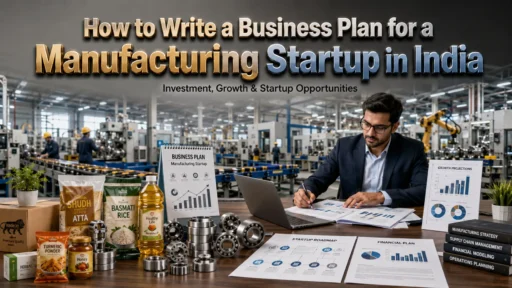


Write a Business Plan for a Manufacturing Startup
The Number That Should Stop You Cold
Seventy-two percent. It refers to the percentage of India’s manufacturing imports that originate from a single country – components and finished goods, and capital equipment – from China. Given that more than 27.3 million people work in this sector and it accounts for about 17% of GDP.
Seventy-two percent. It is India’s reliance on China for major manufacturing segments – components, finished goods and capital equipment. That is not a figure but a business opportunity that is sitting in the open for a sector which contributes about 17% of GDP (Ministry of Statistics, mospi.gov.in).
Each time a rupee worth of Chinese products is spent on by Indians, it is a rupee that could have been spent on an Indian manufacturer. Every supply chain that was broken in a global shock — and several have — is testament to buyers’ search for Indian solutions. There’s an appetite. There has been a radical change in the policy landscape. The credit lines are as wide as ever.
It is not the lack of ambition that is the problem with most aspiring manufacturers. It is a legitimate and numbers-based enterprise plan which they can submit to a bank, state government, or personal investor. A plan that outlines not only the dream, but also the machine capacity, the payback period, and margins — specifically. This guide is designed to be built, step-by-step.
The Gap — Why Indian Manufacturing Still Has Empty Shelves
India produces less than it consumes of what it needs. More than ₹19 lakh crore worth of goods are imported into the country each year and a large portion of it is of the products which the country’s factories can produce if only more units. The issue is two-fold – while there are millions of micro-manufacturers in India, there is a small and thin section of small and medium industrial manufacturers.
The Annual Survey of Industries (Ministry of Statistics) indicates that more than 63% of the registered manufacturing units in India have less than 10 employees. They operate at sub-scale, do not have cost parity and seldom export. Some of the areas that are most lacking in their own supply of these are:
- Electronic components (Tamil Nadu, Pune and Rajkot clusters)
- Agro-processing and food packaging (Bihar, UP, MP)
- Plastic and polymer products (Gujarat, Delhi-NCR)
- Chemical intermediaries (Gujarat, Maharashtra)
- The electronic sub-assemblies (Bengaluru, Noida, Chennai)
To realize the goal of achieving import dependency reduction with the manufacturing sector, the Confederation of Indian Industry (CII) estimates the need for 8–10 lakh new businesses in the MSME band. A number of states have operating industrial land banks, but they have routinely been underused, such as Uttar Pradesh, Rajasthan and Odisha. It’s a space that a new manufacturing company can fill, but not with a revolution, it’s with a well-funded and well-planned unit.
Get Detailed Insights from This Book: Modern Technology of Agro Processing & Agricultural Waste Products
Table 1: State-wise Manufacturing Opportunity — Key Clusters and Supply Gaps
| State | Key Manufacturing Cluster | Primary Gap Segment | Industrial Policy Incentive | Avg. Land Cost (₹/sq ft) |
| Gujarat | Vapi, Ankleshwar, Surat | Chemical intermediaries, textiles | 25% capex subsidy (GIDCL) | ₹12–18 |
| Maharashtra | Pune, Aurangabad, Nashik | Auto components, engineering goods | MSInvest incentives up to 30% | ₹18–28 |
| Tamil Nadu | Coimbatore, Hosur, Sipcot | Precision engineering, textiles | SIPCOT land at concessional rates | ₹10–22 |
| Uttar Pradesh | Noida, Agra, Kanpur | Leather, plastics, garments | ODOP scheme + 10 yr tax holiday | ₹5–12 |
| Rajasthan | Bhiwadi, Neemrana, Jodhpur | Cement, ceramics, handicrafts | RIICO subsidised plots | ₹4–9 |
| Odisha | Paradip, Kalinganagar, APIIC | Steel downstream, agro-processing | 15% capex subsidy + land at cost | ₹3–7 |
Why Now — Tailwinds That Won’t Wait
There are three forces at the same time. The Production Linked Incentive (PLI) scheme for 14 industries from mobile phones to food processing provides incentives of 4–6% on incremental manufacturing; PLI is a scheme that gives incentives to the manufacturer based on incremental manufacturing over a base level. Although your unit may not fit the requirement criteria of PLI, the scheme is attracting Tier 1 manufacturers to India, and Tier 2 & Tier 3 suppliers are in great demand.
Second: India’s per-capita income hit the ₹1.7 lakh mark per year and the demand for packaged foods, personal care items and industrial consumables is growing faster than supply. Third, global buyers are looking for diversification from single sourcing and India is in the reckoning of every serious buyer now from Europe, the US and South East Asia.(Write a Business Plan for a Manufacturing Startup)
On the upside, the conditions have really gotten better. There are some schemes you should be aware of before you start writing your business plan:
- Prime Minister’s Employment Generation Programme (PMEGP): Subsidy on project cost up to ₹ 50 lakh for manufacturing, with an interest of 15-35%. Finance up to ₹10 lakh without any collateral. Managed by KVIC and State agencies.
- MUDRA Tarun Loan: For MSMEs who have no collateral, they can avail loans up to ₹10 lakh. Fastest disbursing credit window for first-time manufacturers.
- CGTMSE (Credit Guarantee Fund Trust for MSEs): No collateral, bank loans to ₹5 crore — good for first generation entrepreneurs who don’t have property.
- Online registration for Udyam Registration: MSMEs will be able to avail benefits of priority sector lending, government procurement quotas, and fast statutory clearances through Udyam Registration online application.
- Market access support, IP protection fast-tracks and regulatory easing for registered startups in manufacturing – Make in India / Startup India.
Setting Up Your Manufacturing Unit — Step by Step
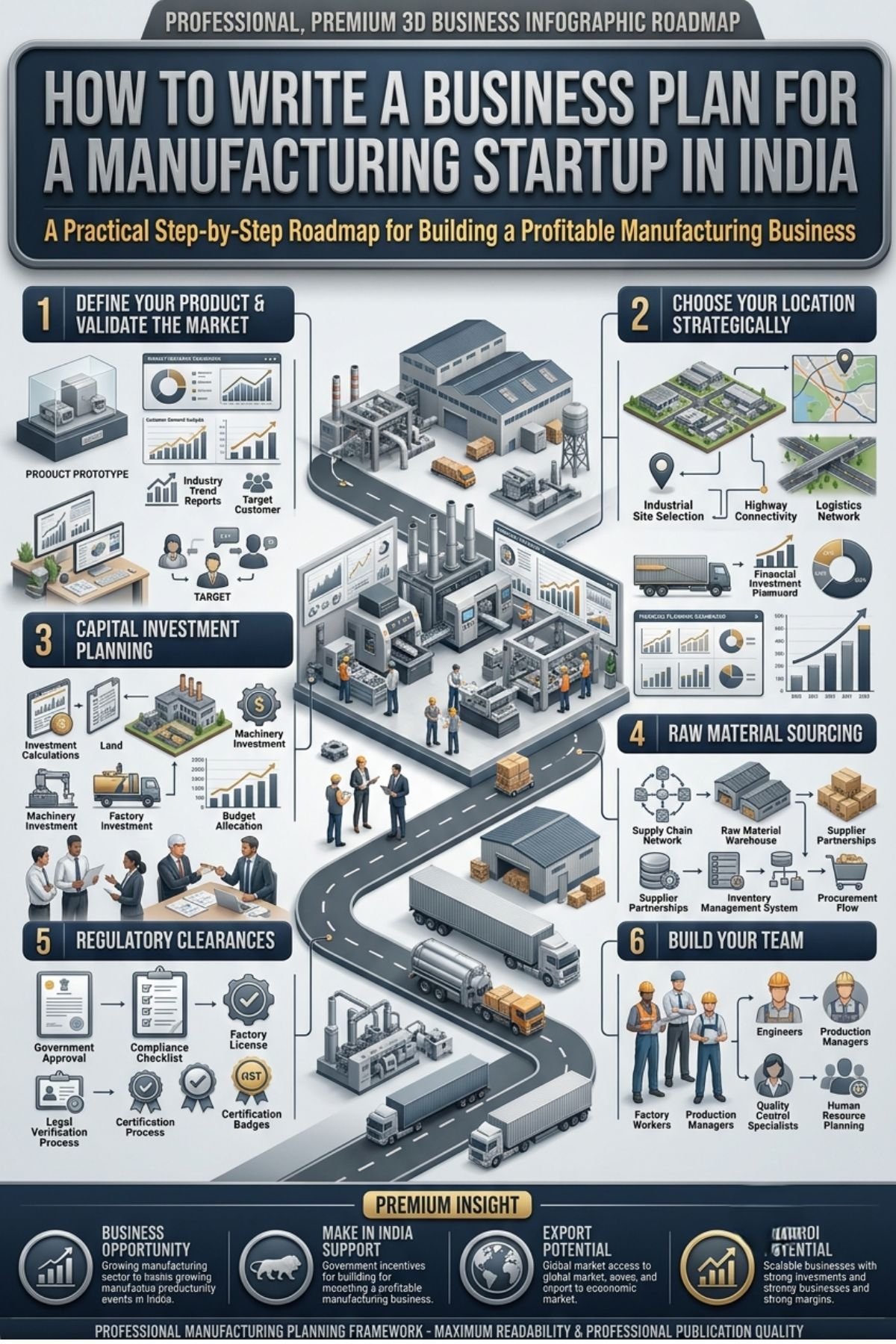
Step 1 — Define Your Product and Validate the Market
Do not skip this. Talk to 20 buyers before you purchase one machine. Your business plan should begin with evidence of demand, such as purchase orders, letters of intent or just at least documented conversations with distributors. This will be required by a bank loan officer. This will be requested by a MSME ministry official. Have it ready.
Step 2 — Choose Your Location Strategically
Your logistics cost, availability of labor and power tariff are all determined by your location. For agro-processing, arrange in the vicinity of raw material aggregations – Vidarbha to soybean, Malwa to wheat, coastal Tamil Nadu for seafood. If you are in the precision engineering business, you have no dearth of skilled machinists in Rajkot and Coimbatore. MIDC, Gujarat Industrial Development Corporation (GIDC) and Rajasthan Industrial Infrastructure Corporation (RIICO) offer plug and play sheds in the range of ₹4,000 to ₹12,000 per month, which is much less expensive than purchasing land at the beginning.(Write a Business Plan for a Manufacturing Startup
Step 3 — Capital Investment: What It Really Costs
For a small and realistic manufacturing firm in India with an average production of 500-2000 units a day, depending on the product manufactured, the minimum investment required is as follows:
- Land / shed: ₹3–12 lakh per year on lease, or ₹15–40 lakh outright for 1,000–2,500 sq ft
- One to three machines (Core Machines): ₹8 – ₹35 lakh based on the level of automation.
- Setting up of utility connection like power, water, compressed air: ₹2–5 lakh
- Working capital for 90 days (raw material + wages + overheads): ₹5-15 lakh
- Cost of Contingency and Pre-Operative expenses ₹1-3 lakhs
Total capital requirement for a lean manufacturing unit in the sector is in the range of ₹ 20 – 60 lakh. For larger units (with revenues of ₹1–5 crore), they require combined debt and equity of ₹1–3 crore.
Step 4 — Raw Material Sourcing
Talk to your suppliers first, before taking out a loan. Indian raw material hubs by sector: steel from Raipur (Chhattisgarh) and Bhilai, plastics and polymers from Dahej (Gujarat), cotton yarn from Tiruppur (Tamil Nadu), chemicals from Vapi and Ankleshwar (Gujarat), wheat and rice from Punjab and Haryana for food processing. Your business plan’s margin assumptions are safeguarded by purchasing from reputable mandis or APMC markets that have reliable pricing mechanisms.
Step 5 — Regulatory Clearances
All manufacturing facilities require a baseline for compliance. Core registrations and approvals: Udyam Registration (msme.gov.in) — Free, Online, in 10 minutes. Factory License as per the Factories Act with 10+ workers powered. State Pollution Control Board NOC (Consent to establish, then consent to operate). GST Registration — It is compulsory after the turnover exceeds ₹ 40 lakh. BIS certification in case of making standardised products. Food Safety and Standards Authority (FSSAI) license of food products. Permission to use fire in local NOC and building. The total amount of money is between ₹40000 and ₹1.5 lakh and the total clearance time is 3-6 months.(Write a Business Plan for a Manufacturing Startup)
Step 6 — Team
Start lean. Generally, a unit having daily production capacity of 1000 units requires: 1 production supervisor (ITI / Diploma Engineering), 4 to 8 skilled/semi-skilled workers, 1 quality check man, 1 admin-cum-accounts man. The average income in this range per month: ₹1.8–3.5 lakh, based on the state and industry.
Related Article: Top 15 Small Business Ideas with Low Investment in India
Timeline: Registration to First Production
- Month 1: Company Registration (LLP/ Pvt Ltd), Udyam Registration, Bank Account
- Month 2-3: Location was decided, utility connections were applied, Pollution NOC was filed
- Month 3–4: Machinery ordered, civil modifications to shed
- Month 4–5: Machinery installation, trial runs, Factory License obtained
- Month 5–6: First commercial production, GST filing begins
Table 2: Investment Breakdown for a Mid-Scale Manufacturing Unit (₹ in Lakhs)
| Investment Head | Minimum (₹ Lakh) | Moderate (₹ Lakh) | Full Scale (₹ Lakh) | Notes |
| Land / Shed (lease deposit + rent 12 months) | 3.00 | 8.00 | 20.00 | Own land eliminates this |
| Core Machinery & Equipment | 8.00 | 20.00 | 60.00 | Second-hand saves 30–40% |
| Utility Setup (power, water, compressed air) | 2.00 | 4.00 | 8.00 | State subsidy may apply |
| Working Capital (90-day raw material + wages) | 5.00 | 14.00 | 35.00 | CC limit from bank covers this |
| Pre-operative Expenses & Licences | 1.00 | 2.50 | 5.00 | One-time cost |
| Contingency (10%) | 1.90 | 4.85 | 12.80 | Always budget this |
| TOTAL | 20.90 | 53.35 | 140.80 | Central estimate for planning |
ENTREPRENEUR SPOTLIGHT
Ramesh Waghmare from Pune, Maharashtra
With an initial investment of ₹28 lakh (including ₹18 lakh obtained from CGTMSE), Ramesh established a precision sheet metal fabrication shop in the Bhosari MIDC corridor. In 14 months, his unit was delivering to two Tier-1 auto component companies. In the second full year, the revenue touched the milestone of ₹1.2 crore. His key lesson:
Don’t wait until things are in order, go in with one anchor customer and then go in for the loan – the bank will talk differently to you.(Write a Business Plan for a Manufacturing Startup)
— Annual turnover of ₹4.8 crore; 22 employees; supplied 6 OEM vendors.
Financial Snapshot — What the Numbers Look Like
The figures are based on an average size manufacturing unit of ₹50-60 lakh. Product category: industrial/agro-processing. Scale up and down for your sector.
- Capital Expenditure: ₹50-60 lakh (including machinery, utilities, pre-operative expenses and 90 days working capital margin).\
- Monthly Operating Cost: ₹4.5-7 lakh (raw material: 55-60%, wages: 15-18%, power & utilities: 6-8%, overheads: rest)
- 60% Capacity: ₹8-11 lakh per month (Rev)
- Revenue at 100% Capacity: ₹13–18 lakh per month
- Gross Margin: 38-48% (based on raw material procurement efficiency)
- Net Margin at Maturity: 16 to 22% when fully utilised
- First production estimated to be between 28 and 42 months; 70%+ capacity in Year 2
These are not best-case projections. They represent a realistic level of performance for well-managed units that obtain their raw materials from within their country and that distribute them to an established market. The poor working capital cycle (the most common failure point) can squeeze margins to 6–8%. Monitor Debtor Days on a weekly basis.(Write a Business Plan for a Manufacturing Startup)
Access Complete Business Plan: Project Reports & Profiles
Table 3: Government Schemes for Manufacturing MSMEs — Eligibility and Benefits
| Scheme | Administered By | Max Loan / Benefit | Key Eligibility | How to Apply |
| PMEGP | KVIC / KVIB / DIC | ₹50 lakh (manuf.); 25–35% subsidy | New unit; no prior bank default | kviconline.gov.in |
| MUDRA Tarun | Scheduled banks / MFIs | ₹10 lakh; zero collateral | Existing/new micro enterprise | Bank branch or Udyami Mitra portal |
| CGTMSE | SIDBI + Govt of India | Guarantee up to ₹5 crore | MSE registered; viable project | Through lending bank |
| PLI Scheme | Ministry-wise nodal dept. | 4–6% incentive on incr. sales | Sector-specific; min. investment threshold | investindia.gov.in/pli |
| TReDS (invoice discounting) | RBI-regulated platforms | Immediate liquidity on invoices | MSME supplier to large buyer | M1xchange, Receivables Exchange |
| CLCSS (tech upgrade) | Ministry of MSME | 15% subsidy on loan up to ₹1 crore | Existing SSI/MSME unit upgrading | Through SIDBI/scheduled banks |
Where to Get a Bankable Feasibility Report
Niir Project Consultancy Services (NPCS) at niir.org is one of the most extensive sources of techno-economic feasibility studies, project layout designs and detailed project reports in India that include more than 5,000 manufacturing categories that can be presented to bankers or SIDBI. The machine specifications, raw material sourcing guide, regulatory compliance checklist and financial projections are all presented for bank submission in NPCS reports. NPCS also provides end-to-end project consultancy for first-time founders who don’t have in-house technical expertise in creating these documents. They are also regularly included in entrepreneurindia.co, an in-depth coverage of Indian MSME manufacturing. This is a useful and time-saving beginning if, for the first time, you are writing a business plan and want a template you can use that has another industry financial model validated.
Turn your budget into a successful business plan
The Next Step — And It Is Not What You Think
Stop researching. Start writing. The worst thing first generation manufacturing entrepreneurs do is conduct market research for 6 months, but do not spend any time on a draft business plan. You will learn more about your own business model than you will in six months of reading industry reports through a 20 page, rough, number-heavy, honest draft.
Here is the action item this week: Grab the financial snapshot under section 5, input the real raw material cost of your product and your proposed selling price, and calculate the margin. If it’s above 18% (at maximum capacity), then it’s worth a business to build. If it’s below 12%, you need to rethink your product-market fit before you ask for even 1 rupee from someone.(Write a Business Plan for a Manufacturing Startup)
Do Your Udyam Registration Then – before you go near any Bank – do your Udyam Registration at udyamregistration.gov.in (it’s absolutely free and can be completed in 10 mins.). It’s a starting point for every scheme, priority loans, every government tender preference.
Frequently Asked Questions
Q1. How much money do I need to start a small manufacturing unit in India?
The initial investment in setting up a lean manufacturing unit could be around 20-30 lakh, including land/ shed lease, core machinery, and 3 months’ working capital. Small units aiming for 1-5 crore turnover will need around 50-150 lakh for the project cost. Try to take a CGTMSE-backed loan and lower the equity.
Q2. What licences do I need before starting production?
Compulsory baseline includes: Udyam Registration (udyamregistration.gov.in), GST Registration (If turnover is more than 40 Lakh), and State pollution control board consent to operate. Factory License is required if you employ 10+ workers using power. BIS certification applies for goods covered under mandatory Quality Control Orders. FSSAI license applies to food manufacturing.
Q3. Where can I source raw materials reliably in India?
Source as close to the production cluster as possible. Steel: Raipur and Bhilai. Plastics and polymers: Dahej and Surat (Gujarat). Cotton: Tiruppur (Tamil Nadu). Chemicals: Vapi and Ankleshwar (Gujarat). Agri raw materials: buy directly from the APMC mandis of states which are producing it-Punjab, Haryana, Maharashtra, Karnataka, among others-prices are available and ascertainable by anyone. Transparent buy price – important for your business plan credibility.
Q4. What are realistic profit margins in Indian manufacturing?
For a well-run mid-scale manufacturing unit, gross margins of 38-48% are achievable. Net margins at mature capacity utilisation (above 75%) typically settle at 16-22%. Poorly managed units – especially those with high debtor days or raw material stockouts – see net margins compress to 6-8%. The margin range varies significantly by sector: food processing tends toward 10-15% net; precision engineering 18-26%; specialty chemicals 22-30%.
Q5. Which government schemes offer the most practical support for new manufacturers?
For First time founders: – PMEGP ( via kviconline.gov.in ) subsidies of 25-35% on project cost for value up to 50 Lakhs – CGTMSE takes away the collateral hurdle of bank loans for loans up to 5 Cr – MUDRA Tarun Scheme provides loan up to 10 Lakhs at Zero Collateral – For units currently running production & ready to scale: CLCSS scheme provides 15% subsidy on loan taken for technology up-gradation. The common requirement for most schemes is Udyam Registration.
Q6. Can NPCS help me build a bankable project report?
Yes. Niir Project Consultancy Services website niir.org have detailed project reports of about 5000+ manufacturing categories including plant layout, machinery and equipment’s details, raw material requirements, techno economic feasibility, investment capital, profit estimates, balance sheet, Government of India approvals and also gives complete guidelines to be followed as required by a bank or for MSME. For founders who need a validated, investor-ready feasibility study without building one from scratch, NPCS is a time-efficient and cost-effective resource. Reports are also available through entrepreneurindia.co.
Key Data Sources & Citations
- Ministry of Statistics & Programme Implementation (MoSPI) — mospi.gov.in
- Confederation of Indian Industry (CII) — cii.in
- KVIC Online (PMEGP Applications) — kviconline.gov.in
- Udyam Registration Portal (MSME) — udyamregistration.gov.in
- NIIR Project Consultancy Services — niir.org
- Entrepreneur India — entrepreneurindia.co