Introduction: Rural manufacturing business ideas
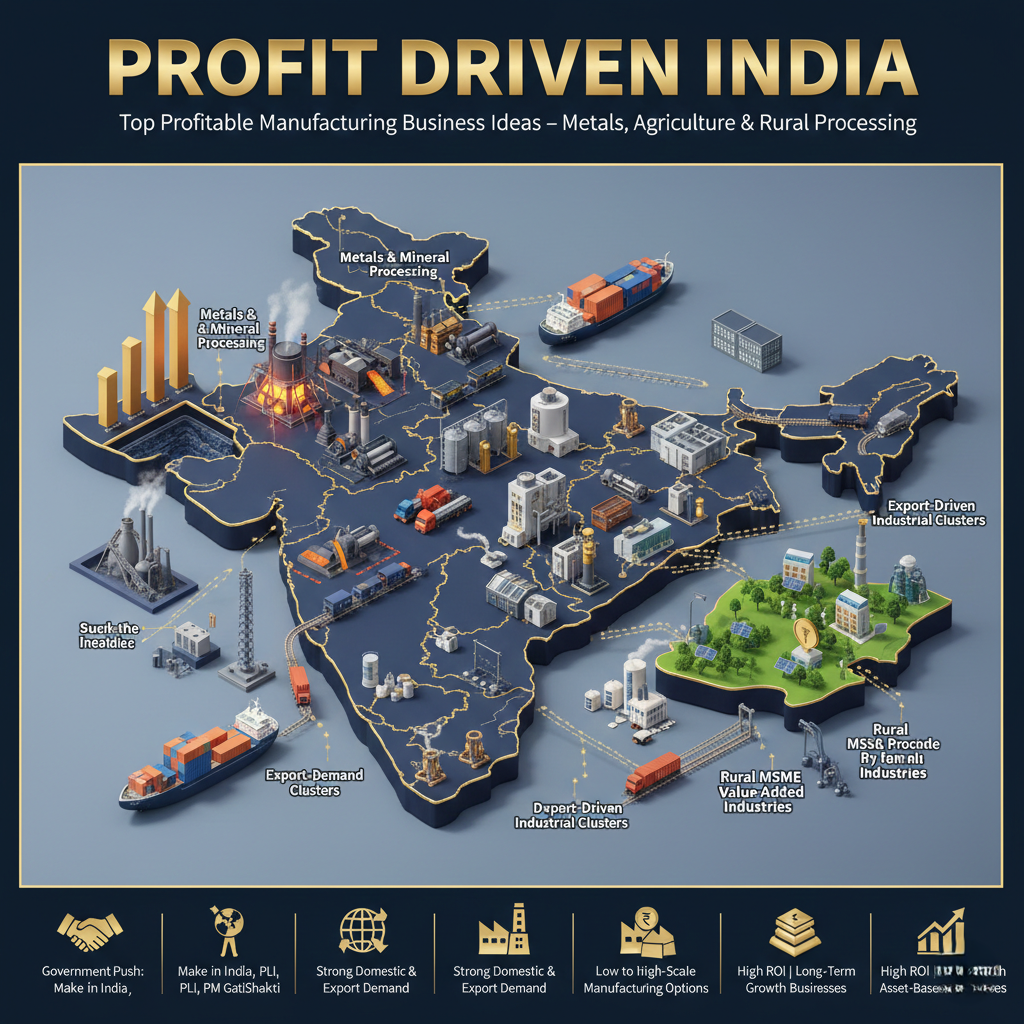
India’s manufacturing sector is entering a new phase of growth that is based on domestic demand, rural development, and expansion of infrastructure. While industries such as electronics and electric vehicles tend to dominate headlines, more fundamental sectors – such as metal recycling, agricultural inputs and rural processing – provide equally good and more stable business opportunities.
These sectors attract because they offer recession-resistant demand and manageable entry barriers for MSMEs and opportunities for scalable operations. Entrepreneurs who are seeking long-term viable and practical manufacturing businesses are increasingly looking towards aluminium and copper ingots, liquid micronutrient fertilisers and wool processing units.
This article dives into these three opportunities for manufacturing, their production processes, demand drivers and profitability potential to help you make the right industrial choice.
Read More: The Complete Technology Book on Hot Rolling of Steel (2nd Edition)
1. Manufacturing of Aluminium and Copper Ingot from Scrap
Aluminium and copper ingots are the foundation of modern industrial production. These metals are crucial for construction, power infrastructure, automotive manufacturing, electronics, and renewable energy systems.
Manufacturing Overview
Scrap based metal recycling is currently one of the most suitable manufacturing models for small and medium manufacturing enterprises. The process involves:
- Sorting and grading scrap metals
- Cleaning and shredding materials
- Melting in furnaces
- Removing the impurities by means of fluxing
- Casting molten metal into ingots
Copper recycling is more demanding in terms of impurities, as it is used to make electrical components, whereas it is relatively easier for new entrants to recycle aluminium.
Raw Materials and Costs Consideration
Key inputs include aluminium scrap, copper scrap, flux materials, and sources of energy (electricity or furnace oil). Scrap procurement is the single largest cost – in some cases over 70% of total cost of production – and so, stable sourcing is a key to profitability.
Market Demand and Market Growth Factors
India’s spur in infrastructure development, renewable energy installations and EV manufacturing are driving the increase in demand for recycled metals. The present production rate of aluminium demonstrates potential for expansion because it remains below the global production average. The need for copper is rising because grid modernization and solar power development require more of this metal.(Rural manufacturing business ideas)
Profitability Outlook
Well-managed scrap-based metal units typically have margins of 8-15% operating margin. The success of the operation depends on organizations which manage their energy needs while they establish scrap material supply agreements and maintain compliance with environmental standards.
Read More: Handbook On 100% Export Oriented Jute & Jute Products (Eco Friendly Projects)
2. Liquid Micronutrients to Foliar Spray Production
Indian farmers are beginning to adopt liquid micronutrients as agriculture practices shift toward precise and effective methods. The fertiliser solutions contain essential trace elements which include zinc and iron and manganese and boron that support crop health and increased yield production.
Production Process
The production process for liquid micronutrients requires less effort than the production process for bulk fertilisers. The process involves:
- Dissolution of micronutrient salts or chelated compounds
- Mixing stabilisers and surfactants
- Adjusting pH, adjusting formulation consistency
- Quality testing and packaging
The business becomes appealing to new entrepreneurs because it needs only a small amount of initial capital.
Raw Material and Compliance
Some common inputs are Zinc Sulphate, Ferrous Sulphate,Chelating Agents, Solvents and Packaging Materials. Moreover, Manufacturers need to adhere to regulation with regards to fertilisers, accurate labelling and ensuring consistent product quality to gain farmer trust.
Market Demand / Market Growth Trends
Government initiatives like soil health awareness programs and more adoption of high-value crops are leading to the rapid increase in demand for micronutrient fertilisers. Moreover, Liquid forms are increasing at a faster rate than granular forms because of ease of use and quicker crop response.
Read More: Fibre Optic Manufacturing – Detailed Project Report, Profile, Business Plan, Industry Trends, Market Research, Survey, Manufacturing Process, Machinery, Raw Materials, Feasibility Study, Investment Opportunities, Cost and Revenue, Process Flow Sheet
Profitability and Scalability
Moreover, Operating margins in the liquid micronutrient sector can reach 18% – 25%, especially for companies who build a good dealer network and brands in the region. Additionally, This segment also provides greater scalability in contract manufacturing and distribution partnerships.
3. Processing of Wool from Raw Wool
Firstly, India is one of the major producers of raw wool in the world, however, but a lot of wool is sold with little value addition. Therefore, Processing wool to yarn, blankets, carpets or technical materials provides opportunities for rural-based manufacturing businesses.
Manufacturing Process
There are several stages in wool processing:
- Sorting and grading raw wool
- Scouring for removal of grease and impurities
- Carding and combing fibres
- Spinning or felting according to end products
Processing may be of small semi-mechanised units or advanced mini textile mills.
Raw Materials and Operations
Firstly, Major wool producing states are Rajasthan, Gujarat and Karnataka. Moreover, Processing results in different yields depending on the fibre quality making it important to get expertise in grading and sourcing. Therefore, Labour skills have a large influence on product quality and efficiency.
Read More: A $60,000 crore Steel Import Gap: new Startup Ideas to lower India trade deficit (Citing import value 61,171 crore data on the ministry of steel website)
Demand Drivers
Overall, The general trend towards natural and environmentally friendly materials is renewing the interest for wool products. Moreover, Demand is still very high in the fields of carpets, blankets, insulation materials, defence textiles and home-furnishing products for export.
Profitability Outlook
However, While the processing of wool is not a high growth industry, there are stable margins to be had of around 12% – 20% especially to businesses that moreover, focus on value added products and not just selling the raw fibre.
How to Select the Right Opportunity in Manufacturing
Each of these sectors has its own benefits based on your business objectives and resources:
- Aluminium and Copper Ingots: Perfect for entrepreneurs who are interested in the possibility of starting a large-scale industrial operation with a stable infrastructure-driven demand.
- Liquid Micronutrients: Startups with limited capital should choose this approach because it enables them to develop their brand and distribution while they pursue rapid business expansion and high profit margins.
- Wool Processing: The program benefits rural entrepreneurs who seek to operate businesses that will generate stable social and economic value throughout their operations.
Entrepreneurs need to assess market demand and necessary funding and legal restrictions and available resources in order to develop sustainable business operations.
Read More: 10 High-Demand Downstream Steel Product Manufacturing Ideas in India
Key Manufacturing Tips in India
- Establish trustworthy raw material sourcing networks.
- Focus on energy efficiency and controlling the operational costs.
- Invest in quality control systems to maintain customer trust.
- Stay compliant with environmental and industry regulations.
Develop strong distribution partnerships for faster market penetration
Conclusion
Overall, The manufacturing industry in India will develop through both advanced technological sectors and essential industrial sectors which include metal recycling and agricultural input production and rural processing. Moreover, Aluminium and copper ingots from infrastructure development, furthermore, liquid micronutrients are in line with the trends of modern agriculture, and finally, wool processing to support sustainable rural value addition.(Rural manufacturing business ideas)
Moreover, Entrepreneurs that are focused on operational efficiency, consistent product quality, and long-term market demand can establish successful and resilient manufacturing businesses in these sectors.
Frequently Asked Questions (FAQs)
- Which manufacturing sector has the lowest startup cost?
Liquid micronutrient production typically requires the lowest capital investment compared to metal recycling or textile processing.
- Is scrap-based aluminium manufacturing profitable?
Yes, it can be profitable if scrap sourcing, energy costs, and quality control are managed effectively.
- Do micronutrient fertilisers require government approval?
Yes, manufacturers must follow fertiliser regulations and ensure proper product registration and labelling.
- Is wool processing still relevant in modern markets?
Yes, natural fibres are gaining popularity due to sustainability trends and demand in home textiles and insulation products.
- Which sector offers the fastest growth potential?
Liquid micronutrients often scale faster because they require less capital and rely on brand-driven expansion.
- Can MSMEs get government support for these businesses?
Yes, several schemes from the Ministry of MSME and agriculture departments provide subsidies, loans, and technical assistance.(Rural manufacturing business ideas)