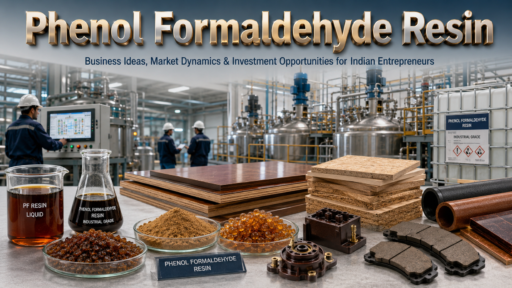


India’s specialty chemical market is growing at a phenomenal pace and one of the business segments being focused upon by the entrepreneurs is manufacturing of Phenol Formaldehyde (PF) Resin. This industrial polymer has a wide range of applications in plywood, automotive parts, electrical products, laminates, insulation, and the abrasive industry, and people commonly refer to it as phenolic resin. Although PF resin is one of the oldest synthetic polymers, it remains highly significant today because modern manufacturing industries still widely use it for its durability, heat resistance, and bonding strength.
The global phenolic resin market is projected to rise significantly over the next few years owing to the growing demand from the construction, automotive, insulation, and electronics sectors, according to the report on the phenolic resin market by Grand View Research.
The production of PF resin is a good long-term business prospect for Indian entrepreneurs to venture into the manufacturing industry. There is a continued demand for phenolic resins in India due to the expanding demand of engineered wood products, growth in automobile industry, expansion of electrical industry, and infrastructure development. Meanwhile, there are also emerging export prospects in the Southeast Asian, Middle Eastern, and African markets.(Phenol Formaldehyde Resin Manufacturing)
As opposed to low margin commodity manufacturing, PF resin manufacturers can get rewarded for technical quality, formulation expertise and customer relations. Consistent, niche applications can generate a much higher profit margin for businesses than do the general suppliers of industrial chemicals.
Related Article: India’s PCPIR Chemical Clusters: ₹3.4 Lakh Crore Opportunity for MSME Manufacturers
What is Phenol Formaldehyde Resin?
Manufacturers form Phenol Formaldehyde Resin, a synthetic thermosetting polymer, by reacting phenol with formaldehyde. It is highly appreciated for its:
- High heat resistance
- Strong bonding properties
- Excellent electrical insulation
- Fire-resistant nature
- Chemical resistance
- Mechanical durability
PF resin can be primarily classified into two types:
Resole Resin
Resole resin is widely used in:
- Plywood adhesives
- MDF and particle boards
- Industrial insulation products
- Wood laminates
Novolac Resin
Novolac resin is mainly used in:
- Brake pads
- Clutch facings
- Grinding wheels
- Foundry shell moulds
- Friction materials
The global phenolic resin market will grow at a compound annual rate of 5.6% during 2015 through 2020, as the demand of phenolic resins in the industries for heat resistance and durability is anticipated to spur the long-term growth of the market.
The global phenolic resin market is projected to grow at a compound annual growth rate of 5.6% from 2015 to 2020, driven by rising industrial demand for heat-resistant and durable materials that supports long-term market growth.(Phenol Formaldehyde Resin Manufacturing)
Why the PF Resin Industry is Growing in India
The demand for phenolic resin products is on the rise in India due to its fast industrialization. This growth is occurring at the same time from several industries.
Construction industries use vast amounts of plywood, laminates, and insulation products that contain large quantities of PF resin adhesives. Government-funded housing developments and commercial infrastructure projects continue to boost demand.
The automotive sector is another important growth sector. Manufacturers use novolac phenolic resins in brake linings, clutch components, and molded automotive parts because these resins provide high-temperature and mechanical resistance. Growth in the auto component manufacturing segment is also being driven by the Indian government’s thrust on automobile manufacturing through the PLI scheme. The PLI Scheme for Automobile & Auto Components is an opportunity for entrepreneurs to learn more.
The electronics/technology industry is also growing quickly. India’s surge in electronics manufacturing is driving high demand for phenolic laminates in electrical insulation parts, printed circuit boards, and switchboards.
Domestic availability of the key raw materials like phenol and formaldehyde also enable the Indian manufacturers to enjoy a cost-benefit over many of the international competitors.
The Indian phenolic resin market is growing in the automotive, wood processing and electrical industries as a result of the rapid industrialization across the country, Chemanalyst India Phenolic Resin Market Report says.
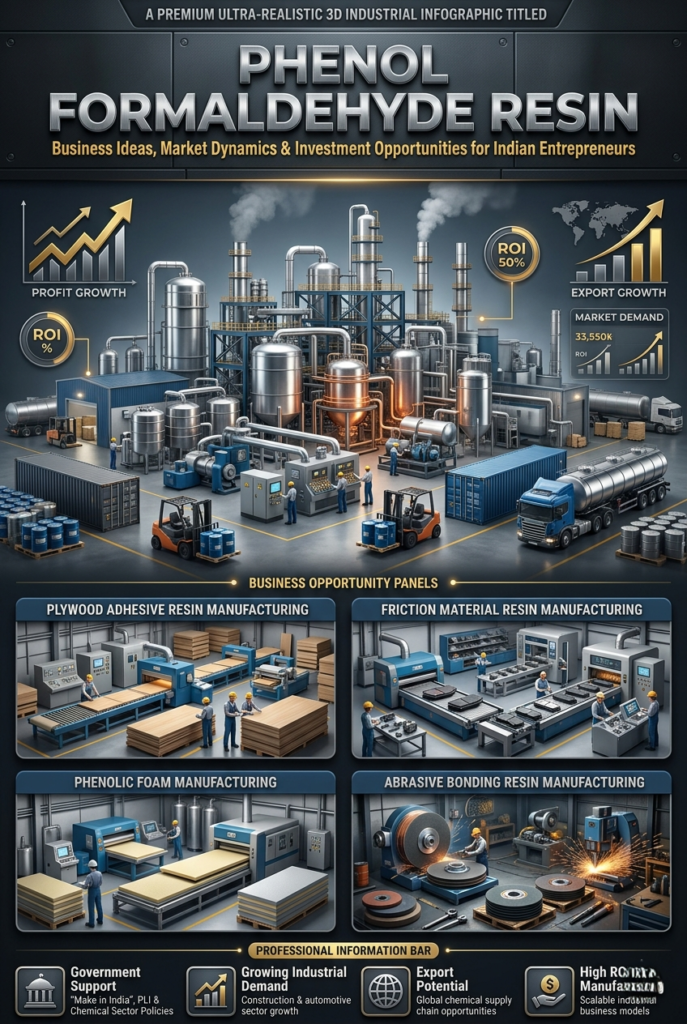
Best Business Opportunities in the PF Resin Industry
One of the most significant benefits of this industry is the range of business models that are available for startups and MSMEs.
1. Plywood Adhesive Resin Manufacturing
One of the most sought-after opportunities in India is this one. There is huge usage of PF adhesive resin by plywood producers in all across Gujarat, Haryana, Punjab, Andhra Pradesh and West Bengal daily.(Phenol Formaldehyde Resin Manufacturing)
This business offers:
- Stable year-round demand
- Good repeat customer rate
- Alternatively, lower market entry costs than specialty grades.
Get Detailed Insights from This Book: Phenolic Resins Technology Handbook (2nd Revised Edition)
2. Friction Material Resin Manufacturing
The specialty novolac resins in automotive and engineering industries have relatively high-profit margins.
Key advantages include:
- Improved margins to standard adhesive resins
- The long-term OEM supply opportunity is the most significant.
- Good customer retention after approval.
But it has a lot of technical requirements to meet, and it may be several months for approval from customers.
3. Phenolic Foam Manufacturing
The excellent fire resistance and insulation properties of phenolic foam are increasing the popularity of this material. It is becoming more and more popular in:
- Cold storage facilities
- Pharmaceutical warehouses
- HVAC insulation systems
- Commercial buildings
Due to limited competition in India, the premium pricing potential is still there in this segment.
Get Detailed Project Report (DPR): Phenolic Foam
4. Abrasive Bonding Resin Manufacturing
Phenolic bonding resins are very important for the grinding wheel industry. There are good customer opportunities for suppliers to enter this niche market from the industrial clusters in Pune, Rajkot, and Coimbatore.
This segment is enhanced by:
- Consistent industrial demand
- Strong customer loyalty
- Technical product differentiation
Investment and Profit Potential
The amount of investment required for the project of PF resin manufacture varies depending on the production capacity and the type of products.
Estimated Investment Range
| Plant Type | Estimated Investment |
| Small Specialty Resin Unit | INR 2–4 Crore |
| Medium Standard Resin Plant | INR 5–10 Crore |
| Advanced Specialty Resin Plant | INR 10–25 Crore |
The big investment areas are:
- Reactor systems
- Storage tanks
- Pollution control equipment
- Laboratory setup
- Transfer for utilities and working capital.
Profit Margins
Product specialization and customer relations are very important to profitability.
A typical EBITDA margin is:
- Standard PF Resin: 12–18%
- Specialty PF Resin: 22–32%
Specialty applications tend to be more profitable due to the fact that the customer will look more at the performance and quality of the product/service than it would be the price.
Government Support for MSME Entrepreneurs
The Indian government has actively been promoting specialty chemical industry through various schemes and incentives.
There are a number of key support programs including:
- MSME capital subsidies
- CGTMSE collateral-free loans
- The PLI schemes are for chemicals.
- State industrial incentives
- Subsidized industrial land in some states
CGTMSE Official Portal the entrepreneurs an opportunity to explore for collateral-free MSME financing support.
Entrepreneurs will also find it useful to read PLI for Chemicals & Petrochemicals Analysis to understand the government’s production linked incentive (PLI) policy for chemical manufacturing.
It is advisable to the entrepreneurs to regularly visit the MSME India Official Portal to avail latest MSME schemes and industrial support.
Choose the right startup backed by real market demand
How NPCS Helps Entrepreneurs Start PF Resin Projects
NPCS (Niir Project Consultancy Services) is one of the top industrial consultancy firms in India which assist entrepreneurs in finding lucrative industrial projects in Chemical and Specialty polymer industry.
NPCS provides:
- Detailed Project Reports (DPR)
- Techno-Economic Feasibility Reports
- Market Research Studies
- Plant & Machinery Guidance
- Financial Projections
- Break-Even Analysis
- Raw Material Analysis
- Business Planning Support
Their reports provide useful information for entrepreneurs to take into account when they are considering whether to start a manufacturing plant or not.
NPCS project report is of great use in the following ways:
- Bank loan approvals
- Investor presentations
- MSME subsidy applications
- Plant setup planning
Through its market intelligence and industrial consultancy, NPCS assists new entrepreneurs in reducing the risk in their investments and in better planning of their projects.
Future Outlook of the PF Resin Industry in India
The PF resin industry in India seems to have a bright future due to:
- A rise in the construction and furniture industry
- Growth in the auto industry
- Rising electronics production
- Rising demand for fire resistant materials
- The potential of exporting to ASEAN and Middle Eastern markets will be explored.
The Grand View Research outlook says the Indian phenolic resin market will grow steadily over the coming decade, driven by expanding industrial applications and rising manufacturing demand.(Phenol Formaldehyde Resin Manufacturing)
As India moves toward greater industrialization, the demand for specialty polymers and advanced industrial resins will likely grow steadily over the next decade.
Technical quality, niche specialty, and consumer-oriented product development can make for very profitable enterprises in this industry.
References and Useful Government / Institutional Links
The following official government and institutional resources are recommended for further reading and for direct application to the schemes discussed in this article.
- Startup India – Official Portal –https://www.startupindia.gov.in/
- Ministry of Micro, Small & Medium Enterprises (MSME) –https://msme.gov.in/
- Udyam Registration Portal –https://udyamregistration.gov.in/
- Department for Promotion of Industry and Internal Trade (DPIIT) –https://dpiit.gov.in/
- Small Industries Development Bank of India (SIDBI) –https://www.sidbi.in/
- MUDRA / PMMY Official Portal – https://www.mudra.org.in/
- CGTMSE Official Portal –https://www.cgtmse.in/
- Ministry of Micro, Small & Medium Enterprises –https://msme.gov.in/
- JanSamarth Portal (Government Loan Schemes) –https://www.jansamarth.in/
- Niir Project Consultancy Services (NPCS) –https://www.niir.org/