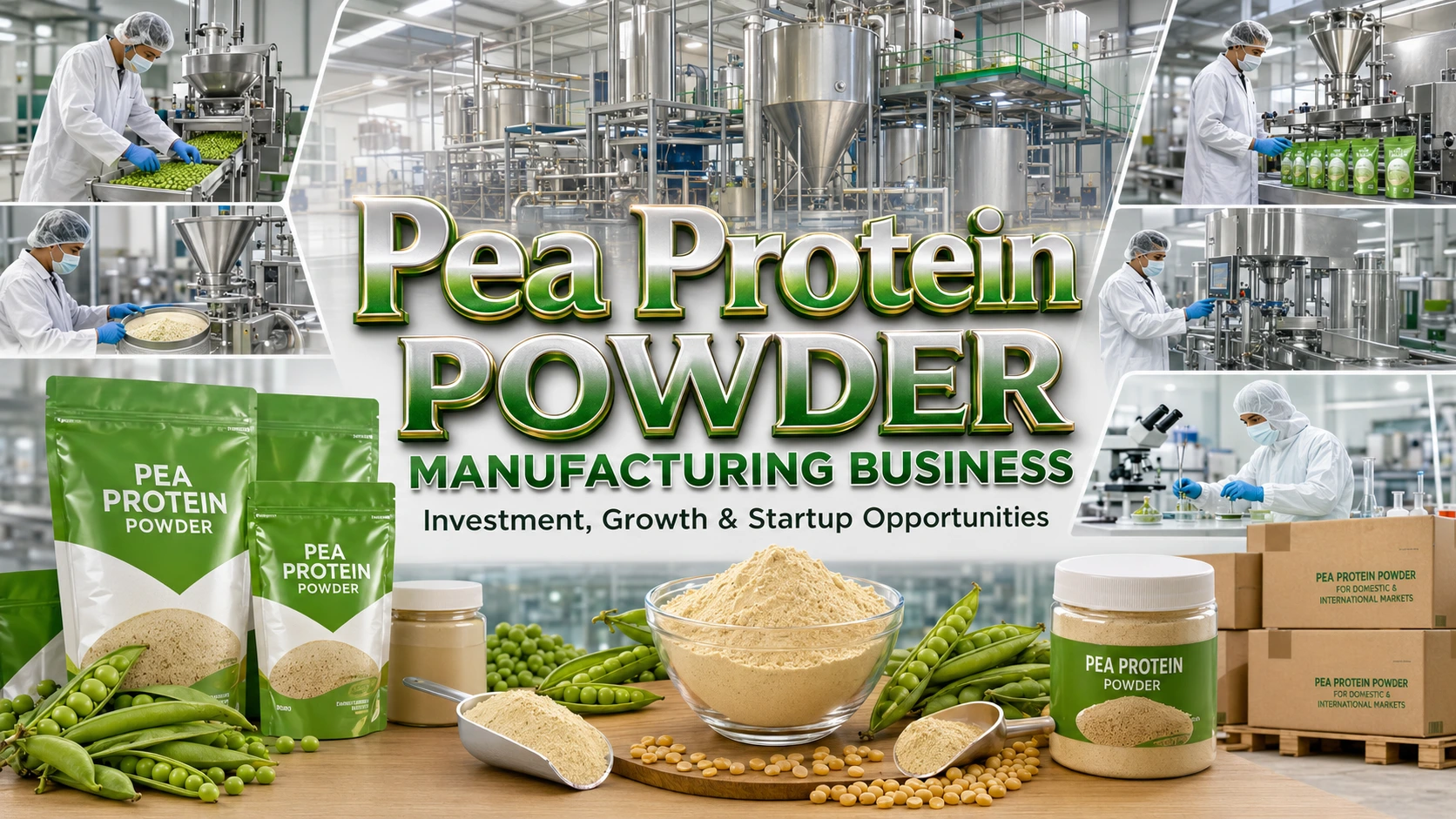

Pea Protein Powder Manufacturing Business
In India, plant-based nutrition has become mainstream. It’s becoming a serious manufacturing opportunity. There are many business ideas in the food processing industry, but none as simple as pea protein powder production for one reason alone – it has real, measurable demand with strong margins.
Pea protein isolate and concentrate are needed domestically to satisfy a variety of brands such as fitness, D2C nutrition, bakery manufacturers, and export buyers alike. The segment has a unique advantage for the manufacturing business start-ups with low raw material cost, high processing margin with export pull.
This article demystifies the working of the sector, the various government schemes that are available to support the new entrepreneur and how the entrepreneur can practically get to the ground running without making unnecessary guesses.
Why Pea Protein Powder Manufacturing Is a Business Worth Backing
In fact, India’s pea protein market is already in billions of dollars and industry analysts predict that it will continue to grow steadily during the coming decade. Isolates lead the way as they are easily soluble, and do not impart any taste that may not fit with Indian food and beverage formulations.
The rest of the plant-based protein market continues to grow at a respectable double-digit rate, meanwhile. The sports nutrition brands, bakery manufacturers, dairy-alternative companies, and even public nutrition programmes are developing new demands for allergen-free, cost-effective protein ingredients. No longer a niche category.
Related Article: 5 Pea Protein Business Ideas That Can Earn ₹1 Crore/Year
The Profit Math Behind This Manufacturing Business
Why consultants are still recommending that entrepreneurs focus on this segment. The main raw material in the production of these peas, which are yellow in color, costs anywhere between ₹40 and ₹60 per kg. The processed pea protein isolate, on the other hand, fetches ₹250 to ₹450 per kg price in the domestic B2B market and export buyers are willing to pay more.
Gross conversion margins are typically still positive even after wet processing costs, enzyme costs and energy costs are taken into account. Not much other agro-processing category in India provides that type of price multiplier. Consequently, a well-managed unit can pay for itself more quickly than most of the traditional food manufacturing operations – if the unit founder has the ability to manage quality and to be assured of consistent raw material purchase.
Why Timing Matters Right Now
As people move towards vegetarian, vegan and flexitarian diets, demand for plant-based, allergen-free ingredients continues to grow in urban settings. Moreover, pea protein is already used in food and beverage applications in India to a greater extent, and the sports and medical nutrition segment is expanding at a faster rate.
Indian entrepreneurs with a business plan in hand have an opportunity to establish their business before the market is saturated and the Indian food manufacturers are actively searching for their suppliers. If it was delayed for another 2-3 years, it might be against much more seasoned and moneyed players.
Government Policies and Incentives Supporting New Businesses
A feasibility discussion is impossible to have without an understanding of the government support that is available. Thankfully, India’s food processing industry not only provides a paper trail of assistance to new manufacturing companies in this area but also has real solutions.
PMFME Scheme for Micro Units
The Pradhan Mantri Formalisation of Micro Food Processing Enterprises scheme was set up by the Ministry of Food Processing Industries that provides credit-linked capital subsidy of up to ₹10 lakh at 35 per cent for individual micro enterprises entering food processing. It also provides support to self-help groups and cooperatives who are keen to construct shared infrastructure facilities, with subsidies up to ₹3 crore in the case of common infrastructure.
Purchasing a pea protein manufacturing business is a significant first investment, and ensuring that the business is formally registered is crucial for a first-generation entrepreneur starting such a small-scale processing unit.When a first-generation entrepreneur decides to start a small pea protein processing unit, the initial capital investment is significant and formal registration is important.
Production Linked Incentive Scheme for Food Processing
Businesses with higher manufacturing capacity can tap the Production Linked Incentive Scheme for Food Processing Industry with the outlay of ₹10,900 crore. This scheme incentivises approved companies for incremental sales in segments such as innovative food products, organic food products and also pays for branding and marketing costs overseas.
The scheme has a special category for small and medium enterprises. Even start-ups that are too small to apply directly can benefit indirectly, as bigger PLI beneficiaries often require contract manufacturers and ingredient suppliers. This dependency opens the door to a real opportunity for new players in the supply chain.
MSME Registration and Startup India Benefits
All the new entrants in this field need to register under Udyam, the registration portal of the ministry of MSME so as to guarantee them collateral-free loans, priority sector lending and delayed payment protection from buyers.
Startups qualifying for it can also be registered under Startup India under the auspices of the Department for Promotion of Industry and Internal Trade that provides tax benefits and compliance advantages. These registrations transform a tiny manufacturing concept into a legally recognized business that investors and purchasers can rely on.
Raw Material Sourcing: The Real Challenge Founders Underestimate
Many new businesses put a lot of emphasis on the machinery and marketing and overlook the sourcing of raw materials, which ultimately determine the success or failure of the business in its first two years. Although India has now become a net exporter of processing grade yellow pea, there is still an appreciable demand for the variety from Canada and Russia and hence its prices can be influenced by the global trade policy and duty. Founders who establish direct links with commodity traders – or who are able to secure pulses from their own pulse-growing belts, rather than having to purchase when they need them – are able to safeguard their margins better.
You should also consider signing a partial forward contract for raw materials once the business begins to grow. Many new entrepreneurs overlook this seemingly small step when launching a new product. However, it can help prevent unexpected costs that have caused many small food manufacturers to struggle or shut down in recent years.
Get Detailed Insights from This Book: Profitable Agro Based Projects
Multiple Business Ideas for Startups in Pea Protein Manufacturing
This sector is not just a business; it is a group of business ideas that are related to one another and have various stages of investment. Therefore, founders have an option to select the entry point in accordance with their capital, skills, and risk appetite. Here are five practical models to be considered seriously.
1. Small-Scale Pea Protein Isolate Manufacturing Unit
This is the basic making play. The entrepreneur installs wet extraction and drying facilities to process raw yellow peas into protein isolate or protein concentrate powder. The business then exports the powder in bulk to food manufacturers, protein brands, bakeries, and nutrition companies. The equipment list includes a grinder, protein extraction tanks, a centrifuge or decanter, and a spray dryer. This product has a high price multiplier compared to the raw pea, so it incentivizes investors who make a commitment to quality control and cold-chain free storage. First-time manufacturers often start with a semi-automatic production line and expand capacity as they secure buyer contracts. This approach limits initial capital risk while demonstrating the business model to lenders and investors.
2. Contract Manufacturing for D2C Nutrition Brands
The direct-to-consumer supplement market in India is growing rapidly, with the majority of these brands not having manufacturing plants. Rather, they rely on contract manufacturers to mix pea protein isolate with flavours, sweeteners and other actives, and to fill pouches using their own brand. This is one of the business ideas that requires less protein extraction capital as the founder can easily get bulk protein isolate and work only on blending and testing for quality and packaging. Then the real difference starts to kick in in the form of relationships with emerging nutrition brands as well as FSSAI compliance and batch traceability, and also in the form of revenue that is typically quicker than the building of new extraction capacity.
3. Export-Oriented Pea Protein Concentrate Business
The UAE, UK, USA and Southeast Asia are among the markets experiencing continued growing demand for allergen-free, non-GMO protein ingredients. An export-oriented unit specifically targets international nutraceutical and sports nutrition consumers, bypassing the highly competitive domestic retail market. The path demands APEDA registration, stringent quality certification and document of each batch but also brings in the possibility of better realisation per kg compared to most domestic sales. The early founders who have established first-hand buyer relationships through trade fairs, B2B platforms have more often than not locked up long-term supply contracts that provide a much better stability in cash flows compared to one-off domestic orders.
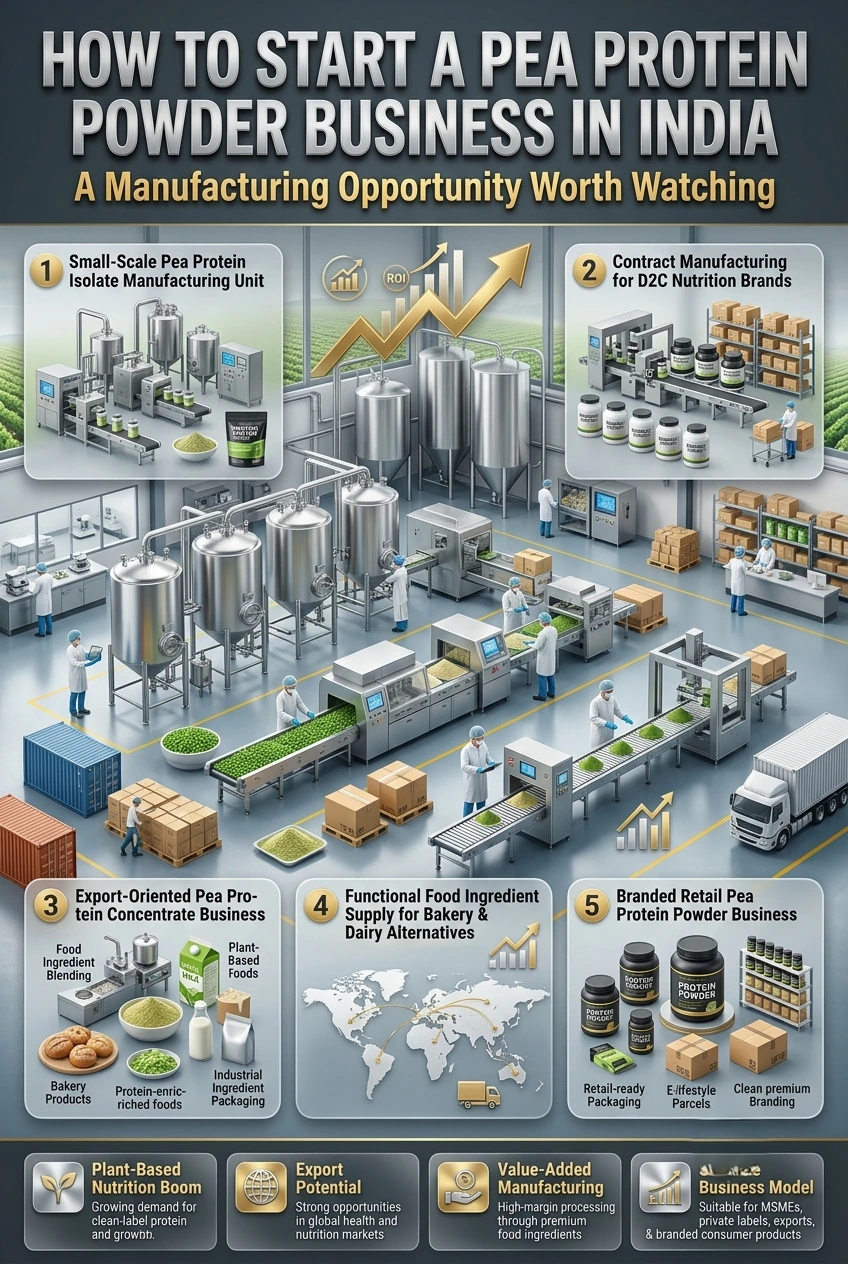
4. Functional Food Ingredient Supply for Bakery and Dairy Alternatives
This business concept provides pea protein as a functional ingredient to bakery manufacturers, plant-based dairy companies, and meat analogue manufacturers, rather than selling directly to the consumer. Applications in this area are those that are sought by food technologists who want protein fortification without affecting taste or texture. The neutral flavour and compatibility make pea protein ideal for protein bars, vegan cheeses, biscuits and plant-based milk. It requires more technical contact with buyers, such as sample development and application assistance, but also develops sticky, recurring B2B relationships that are more difficult for other players to win over once they are in place.
5. Branded Retail Pea Protein Powder Business
This is the most consumer-centric opportunity: to launch a brand of pea protein powder for retail, available online, via quick-commerce and through modern trade. It requires more marketing dollars than previous models and a more sophisticated and effective product formulation and third-party testing to gain trust in a market filled with mislabelled supplements. But the profit margin around a finished product with a trade mark is very often significantly higher than the sales of the bulk ingredients. When a founder’s team is successful in building a brand in this sense, they tend to have a blend of skills that include manufacturing knowledge, a clear understanding of their point of difference, a clear dietary positioning, such as keto, allergen-free or clean-label nutrition, and labelling that is transparent.
Get Detailed Project Report (DPR): Setup Plant Of Pea Protein Isolate/Concentrate
Choosing the Right Entry Point for Your Capital
One of the most frequent pitfalls of a first-time entrepreneur is choosing a more ambitious model rather than one that they can do with the capital available to them and the amount of risk they are willing to take. A founder who has ₹30 lakh and has better contacts in the industry does far better when he starts as a contract manufacturer rather than taking out loans for establishing a full isolate plant.
Likewise, a founder who has technical backgrounds in food science, but has a limited sales network can be more accommodating with the functional ingredient supply model as it is less about aggressive branding and more about product quality. Matching the business concept with real-world strengths, not the widest possible margin, is the best predictor of survival to eighteen months.
Import–Export Opportunity Analysis
Despite being one of the world’s largest producers and consumers of pulses, India has to import a significant proportion of yellow peas, mainly from Canada and Russia, as the domestic production does not suffice the demand for processing grade pulses entirely. This provides a fascinating double opportunity for new players.
Entrepreneurs can establish a relationship with import trade houses or domestic clusters of pulse growers from Madhya Pradesh, Uttar Pradesh, Rajasthan etc. on the raw material side. The finished product – pea protein isolate and concentrate – also has real export potential, as more and more food manufacturers worldwide are looking to a more diverse, cost competitive supply chain that extends beyond Europe and North America.
Trade data compiled by the Agricultural and Processed Food Products Export Development Authority shows that protein ingredients are the ones gaining ground in emerging export markets, further supporting a manufacturing enterprise that might eventually be able to combine the two markets instead of relying on one market.
Founders should also keep a check on the changes of import duty structure on pulses as it is directly impacting the landed raw material cost from time to time. Businesses that source both domestic and imported peas and switch between them based on price and availability can protect their profit margins better than businesses that rely on a single source.
For a manufacturer, the dependence on imports that some observers fear is a plus. Manufacturers can use imported pulses when domestic production falls short, allowing them to maintain continuous production despite fluctuations in local supply. This flexible sourcing approach helps ensure stable operations and reduces the impact of domestic production shortages.
Indian MSME Success Stories Worth Learning From
There are more practical lessons to be learnt from real founder journeys than from any theory. Three Indian startups in this vast nutrition-protein space show how there are several equally viable routes to success.
Origin Nutrition: Solving a Personal Problem
Chirag Gupta and his wife, Aditi Mammen Gupta, founded Origin Nutrition after Chirag struggled to find clean, plant-based protein options in India because of his lactose intolerance. Instead of continuing to import expensive products, the couple built their own formulation, tested it repeatedly, and eventually launched a vegan protein brand that earned recognition as one of India’s top protein brands. Their decision logic offers a clear lesson: solving a genuine personal problem, backed by rigorous product testing, often builds more customer trust than chasing a trend.
Wellbeing Nutrition: Format Innovation as a Differentiator
He launched Wellbeing Nutrition, and found the success was from unique formats like oral thin strips and slow-release capsules – not by directly challenging rivals with ingredients. Before launching, he invested time into R&D and post-funding he pulled institutional rounds from prominent consumer investors. The takeaway for new pea protein makers: Innovate around the format, format of delivery or format of use, not just in the ingredient alone because price alone wars quickly thin margins.
Synthite Industries: Backing Innovation with Institutional Research
Synhte Industries, an experienced agro-processor collaborated with IISc and a global research partner to bring a plant-based protein drink powder made from lentils and yellow peas to market. This model demonstrates the realization within established agro-processors that pea and pulse proteins form a legitimate growth area worthy of a research investment. While a useful learning, this is a practical take-away for any new entrepreneurs: research with food technology institutes or independent laboratories drastically cuts down the formulation risk by almost the first unit.
Taken together, these three journeys point to the same underlying truth. Manufacturing success in this category rarely comes from copying an existing product. It comes from solving a specific customer problem, differentiating through format or application, and validating formulations with proper research before scaling production.
Getting the Feasibility Numbers Right Before You Invest
Every business idea in this article sounds promising on paper. However, the real decision between a small blending unit and a full isolate manufacturing plant depends on project cost, machinery selection, raw material logistics, and realistic demand estimates specific to the founder’s target market and location.
This is exactly where structured feasibility planning earns its value. Niir Project Consultancy Services (NPCS) prepares Market Survey cum Detailed Techno-Economic Feasibility Reports for entrepreneurs setting up new industries, including manufacturing ventures in the plant-based protein space. These reports cover the manufacturing process, market research and demand analysis, process flow diagrams, product mix and capacity planning, machinery and raw material details, and complete project financials with profitability analysis.
For a founder comparing a ₹40 lakh blending unit against a ₹2 crore isolate manufacturing plant, having verified financials before committing capital is not a luxury. It is basic risk management that protects both the entrepreneur and future lenders.
Find the most profitable startup for your investment range
Pea Protein Business: Cost and Market Snapshot
The table below summarises indicative figures that founders commonly use during early feasibility discussions. Actual numbers vary by location, machinery choice, and scale, so treat this as a starting reference rather than a final budget.
| Parameter | Small-Scale Blending Unit | Mid-Size Isolate Manufacturing Plant |
| Approximate Investment | ₹25 lakh – ₹50 lakh | ₹1.5 crore – ₹3 crore |
| Raw Material Cost (Yellow Peas) | ₹40 – ₹60 per kg | ₹40 – ₹60 per kg |
| Finished Product Price (Isolate/Blend) | ₹250 – ₹350 per kg | ₹300 – ₹450 per kg |
| Gross Conversion Margin | Around 45% – 55% | Above 60% |
| Primary Buyers | D2C brands, local nutrition stores | Export buyers, bulk food manufacturers |
| Applicable Government Support | PMFME credit-linked subsidy | PLISFPI, MSME priority lending |
Frequently Asked Questions
Is pea protein powder manufacturing profitable for a first-time entrepreneur?
Yes, as long as the owner controls sourcing and production quality of all the raw materials. The generally prevailing gross margin remains around 45-60 per cent (which are high profit levels in comparison with almost all food processing enterprises in food industry).
What is the minimum investment needed to start this business?
You can establish a mini-unit with blending and packaging facilities with an investment of around ₹25 lakh to ₹50 lakh. In contrast, setting up a full-scale isolate production plant requires an investment of ₹1.5 crore or more, depending on the plant capacity and level of automation.
Which license and registrations are mandatory?
Founders need FSSAI licensing, Udyam MSME registration, GST registration, and, for exporters, an APEDA registration and Import Export Code from the Directorate General of Foreign Trade.
Can a small unit qualify for government subsidy support?
Yes. Micro enterprises can apply for the PMFME scheme’s 35 percent credit-linked capital subsidy, up to ₹10 lakh, through the Ministry of Food Processing Industries.
Is export a realistic option for a new manufacturer?
Yes, but exporters need consistent quality certification and batch documentation. Many new manufacturers start with domestic B2B supply first and add export buyers once quality systems stabilise.
How important is a feasibility report before investing?
It is essential. A detailed techno-economic feasibility report clarifies machinery selection, realistic demand, and project financials, which reduces the risk of over-investing in the wrong capacity.
Conclusion: A Manufacturing Business Idea Backed by Real Numbers
Pea protein powder manufacturing is not a hype-driven business idea. It rests on measurable demand, favourable raw material economics, and active government support through schemes such as PMFME and PLISFPI. Entrepreneurs who enter with a clear feasibility plan, the right registrations, and a defined buyer strategy stand a genuine chance of building a scalable, export-ready manufacturing business in one of India’s fastest-growing food processing categories.
The runway is present right now. Competition won’t stay away forever. Founders who build today on a validated vision can establish themselves as leaders in this vertical tomorrow.