

India’s spice industry is one of the most dynamic areas in which businesses can discover ideas for today. Ginger oil and ginger powder are high-value manufacturing options that have high local demand, and are becoming increasingly popular overseas. The country is the world’s biggest producer of ginger but a considerable amount of raw ginger is not processed. Entrepreneurs can create profitable, scalable businesses right there, in that gap. If you are a first-generation founder, MSME investor, or someone looking to venture into agro-processing businesses, this sector is a strong opportunity and requires relatively low capital.
Ginger-derived products find their application in various industries ranging from food and beverages to pharmaceuticals, aromatherapy, personal care and traditional medicine. This demand is from multiple industries, which provides a buffer against any slowdowns in any single industry. Additionally, the government favours food processing and agro-based industries, which is a good opportunity.
Why the Ginger Processing Sector Is Worth Entering Now
India is one of the leading producers of raw ginger, accounting for more than 20 lakh metric tonnes of production per year. However, industries underutilize value addition to raw materials through processed derivatives such as essential oils, oleoresins, dried powders, and encapsulated extracts. This under processing provides a structural opportunity for new manufacturing units.
The demand for ginger oil has surged worldwide in various applications, such as aromatherapy, cosmetics, and functional food. In the interim, ginger powder has grown to be a common component in packaged food products, ayurvedic medicines, and nutraceuticals. The export value of spice based processed products has recorded year on year growth as per APEDA (Agricultural and Processed Food Products Export Development Authority) data.
The processing margins in this segment are much higher than those in raw commodity trade. Farmers can sell a kilogram of raw ginger at the farmgate for ₹30–60, while processing the same quantity into essential oil or standardized powder can increase its value by five to fifteen times. The value-multiplication logic is what makes the processing of ginger a worthy business for manufacturers and investors.
Get Detailed Insights from This Book: The Complete Book on Ginger Cultivation and Value-Added Products
Government Policies and Incentives Supporting This Business
MoFPI has actively encouraged and helped to promote agro-based manufacturing under the Pradhan Mantri Formalisation of Micro Food Processing Enterprises (PM FME) Scheme. In this scheme, micro-units can avail credit linked subsidy of up to 35% of the project cost capped at ₹10 lakh per micro-unit. This programme applies directly to the processing of spices and manufacturing of essential oils.
The Credit Guarantee Fund Trust for Micro and Small Enterprises (CGTMSE) is a scheme by the Ministry of MSME that provides collateral-free loans for first-generation entrepreneurs establishing manufacturing units. Moreover, with the MUDRA Yojana (Pradhan Mantri MUDRA Yojana) for working capital funding, smaller ginger processing units can enter the market with very little cost.
The Ministry of Commerce and Industry operates quality development and export promotion programmes under the aegis of the Spices Board of India which is geared towards the spice manufacturers. Registered units can avail Certification support, attend International Trade fairs and Buyer-Seller meets. Moreover, the Production Linked Incentive (PLI) Scheme for Food Processing is relevant for medium scale ginger processing industries who want to expand and provide incremental incentives to the companies in the increment of turnover and capacity.
Detailed benefits at the State level include power tariff concessions, land allocation in food processing parks, stamp duty exemptions etc. which further minimize establishment costs. Make sure to look for notifications and state-wise incentive matrices on the relevant portals under Make in India and DPIIT (Department for Promotion of Industry and Internal Trade) for the sector.
Business Ideas in Ginger Oil and Ginger Powder Manufacturing
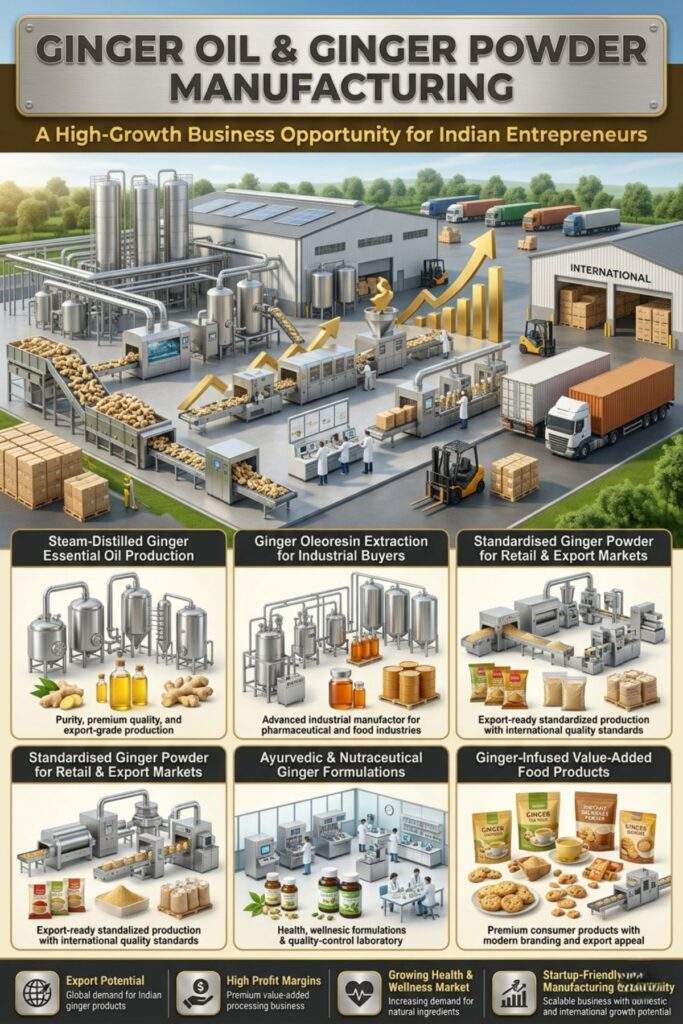
1. Steam-Distilled Ginger Essential Oil Production
The most commercialized method of extraction of ginger essential oil is steam distillation. This process involves the passage of steam through dried ginger rhizomes, extraction of volatile aromatic compounds from the rhizomes, and subsequent condensation and separation of the compounds. The resulting oil delivers a fresh, spicy taste, making it highly desirable for pharmaceutical formulations, flavour production, cosmetic products, and aromatherapy applications. Setting up a mid-scale steam distillation unit requires a capital investment of ₹20–35 lakh, which covers equipment such as a distillation column, condenser, steam boiler, and storage infrastructure. Oil yields of between 1.5% to 3.5% of good quality dried ginger have been reported. Strong margins as oil trading at a large premium over raw spice. The model diversifies revenue streams and provides pricing stability by bringing together local B2B customers and overseas export customers.
2. Ginger Oleoresin Extraction for Industrial Buyers
Manufacturers utilize ginger oleoresin, a concentrated and standardized extract, in the food industry, pharmaceutical products, and nutraceutical formulations. Unlike the essential oil, oleoresin is also rich in the non-volatile pungent compounds including gingerols and shogaols, which makes it interesting for the industrial use in flavours and health-supplement applications. Manufacturers usually carry out the extraction in a solvent (ethanol or ethyl acetate), followed by solvent recovery and standardisation. The business model is ideal for business people who are into B2B sales for FMCG business, food ingredient distributors, and manufacturers of ayurvedic products. The cost of investment for a simple Oleoresin extraction plant is approximately ₹30-50 lakh. Buyers are willing to pay for consistent pungency levels (measured in Scoville units or HPLC assays), not weight, and this type of quality pays a substantial premium.
Get Detailed Project Report (DPR): Ginger Cultivation, Ginger Processing and Ginger value added Products and Projects
3. Standardised Ginger Powder for Retail and Export Markets
This is because ginger powder production is the easiest to access by food processing entrepreneurs. Moreover, We clean and dry the ginger rhizomes, grind them into a fine and uniform particle size, and pack them for retail and institutional use. However, The challenge and the differentiation opportunity is to control moisture, microbiological compliance and the flavour profile. In addition, There are supermarkets and online stores selling retail grade ginger powder with brand names. The export grade product must satisfy the specifications of customers from abroad like US FDA, EU food safety norms, FSSC 22000 or other requirements. The cost of setting up a good small-scale unit is around ₹15–25 lakh with dryers, grinders, sifters and packaging line. Entrepreneurs capable of spending on quality testing and packaging design can establish private label supply contracts with big food companies or FMCG distributors to guarantee revenue predictability from the start.
4. Ayurvedic and Nutraceutical Ginger Formulations
The amalgamation of traditional medicine and modern wellness has resulted in a strong demand for ginger health products, such as capsules, tablets, herbal powders, functional teas, and digestive supplements. An entrepreneur who situates the manufacturing site at the convergence of food and pharma could take care of both. Furthermore, Clinically proven properties of ginger – anti-nausea, anti-inflammatory, digestive stimulant – make it a choice active ingredient of nutraceutical brands. Additionally, Wellness brands can offer higher prices to manufacturers that have FSSAI certification (and Ayush GMP, if they choose. The investment in the formulation manufacturing of ginger products is also more – usually around ₹40-70 lakh for a small-scale pharma grade plant – but the returns at a unit level are significantly better than that of commodity powder or oil supply.
5. Ginger-Infused Value-Added Food Products
In addition to raw derivatives, there is a strong growing segment of finished good product containing ginger in retail packaging, such as ginger tea blends, ginger based health shots, candied ginger, ginger flavoured honey and ginger chutney. These are finished goods, which have much higher retail prices than primary processed ingredients. Vertical benefits the entrepreneurial with a consumer brand orientation, providing direct-to-consumer distribution through ecommerce and modern retail, as well as export to diaspora markets. Capital requirement is moderate ranging from anywhere between ₹20–40 lakh for a small FMCG grade production and packaging plant. It is not necessarily a manufacturing strength that creates the key competitive advantage, rather it is the ability to brand, to innovate recipes and to manage distribution channels.
Discover business ideas that actually make money
Import–Export Opportunity Analysis
India is already in the top 10 countries in the world that export ginger products. Agricultural and Processed Food Products Export Development Authority (APEDA) plays an active role in assisting the exporters of spices with market development assistance, certification assistance, and trade facilitation. The U.S., United Kingdom, the European Union, Japan, and the Gulf Cooperation Council (GCC) countries are the major markets for the export of ginger oil and ginger powder.
Export aggregators and commodity traders are the most convenient entry into export for small manufacturers, as they also buy from processing units. Moreover, Increased quality and scale enable the company to pursue direct export deals with food ingredient buyers, essential oil distributors, and nutraceutical firms. But the import side offers an opportunity too, as ginger oil from China and Indonesia sometimes outcompetes Indian ginger oil. Structural advantage are available to domestic manufacturers that can achieve the quality standards set by the international industry but with lower logistics costs.
To receive export incentives, entrepreneurs must register with APEDA and apply for an RCMC (Registration-cum-Membership Certificate). We also recommend satisfying the export norms laid down by the Spices Board for these products to facilitate entry into regulated markets.
Indian MSME Success Stories in Spice and Ginger Processing
Synthite Industries – From Kerala to Global Leader
Synthite industries is Kerala based owned by the Kothari family and is India’s biggest producer of spice oleoresins and essential oils. It was a small extraction unit that has now become a multi-hundred crore business that caters to some of the leading food manufacturers, flavour houses and nutraceutical brands all over the world. The secret to Synthite’s success was to maintain a degree of standardisation: all batches of oleoresin given the same pungency and colour profile. The message for new business is: In B2B ingredient markets, reliability is worth much more than price.
AVT Natural Products – Diversification as a Growth Strategy
Moreover, AVT Natural Products Ltd of the AVT Group (A.V. Thomas Group) in Kerala has established a niche for the business in plant extracts which include oleoresins from spices and essential oil. Additionally, They were early adopters of solvent extraction and supercritical CO2 extraction technology and thus were able to cater to pharmaceutical grade purchasers in regulated countries. They’ve shown that it’s possible to achieve long-term pricing power and customer retention even if the up-front investment in superior extraction technology is higher.
Keya Foods International – Branding the Powder Business
Keya Foods, a Kolkata-based company, has proved that branded spice powder, including that of ginger powder, can fetch a premium retail price when distributed and packaged correctly. Moreover, By focusing on quality sourcing, hygienic processing and attractive packaging design, the company successfully broke into the modern retail and ecommerce outlets. Furthermore, The Keya Foods model for the MSME farmers who are starting their business in the manufacture of ginger powder, highlights the significance of the investment in the brand along with the investment in the production.
Related Article: Potential Value-Added Products of Ginger and Production Methods
How NPCS Supports Entrepreneurs in This Sector
We at Niir Project Consultancy Services (NPCS) offer professional consultancy for preparation of Market Survey cum Detailed Techno-Economic Feasibility Reports (DPRs) for establishing any new industry/business. Our reports provide entrepreneurs with detailed manufacturing processes, market research and demand analysis, process flow diagrams, product mix and capacity planning, machinery and raw material sourcing details and complete financials of the project with a profitability analysis. We want to make sure you assess the feasibility, profitability, and long-term scalability of a project before investing a single rupee — not just guess.We want to make sure you do not invest a single rupee in a project based on guess work; it’s evaluation and data-driven.
Ginger Oil & Ginger Powder Manufacturing – Key Business Parameters
| Parameter | Ginger Essential Oil | Ginger Powder |
| Estimated Setup Investment | ₹20–35 Lakh | ₹15–25 Lakh |
| Raw Material (Dry Ginger/kg) | ₹120–180 | ₹80–150 |
| Approx. Output Price (per kg) | ₹3,000–8,000 | ₹180–300 |
| Key Markets | Pharma, Cosmetics, Flavours | Food, Ayurveda, Export |
| Estimated Annual Revenue* | ₹40–80 Lakh | ₹30–60 Lakh |
| Applicable Certification | FSSAI, ISO, Spices Board | FSSAI, APEDA, Spices Board |
| Export Potential | High (US, EU, GCC) | Moderate to High |
* Indicative estimates for small-scale units; actual figures vary by capacity, location, and market positioning.
FAQ (Frequently Asked Questions)
1. Minimum investment needed for establishing a ginger powder manufacturing unit.
A small-scale ginger powder manufacturing unit may be set up with an investment of approximately Rs. 15-25 Lakh. This includes equipment like dryers, grinders, sifters, packaging machine, and basic shed. Working capital cost for procurement of raw material would be extra.
2. Is a license required for manufacturing ginger oil or ginger powder.
Yes, at a minimum an FSSAI license for food processing activities is required. If it is to be exported then a registration with spices board and APEDA would be important, for an ayurvedic or nutraceutical formulation then an Ayush GMP certification would be beneficial. The MSME should also register under Udyam for Government Scheme benefit.
3. Is there any Government financial support for setting up of ginger processing unit?
Yes. A credit-linked subsidy of up to 35% of eligible project cost can be obtained under PM FME Scheme. Loans up to the limits specified may be availed for working capital needs under the MUDRA Yojana at nominal rate of interest and without collateral. Collateral-free loans to first generation entrepreneurs under CGTMSE would also be beneficial. State governments provide further incentives by establishment of food processing parks.
4. Which countries import Indian ginger oil & ginger powder?
Key importing nations are the United States, United Kingdom, Germany, France, Japan, etc., as also a lot of Gulf countries. The US & EU being major markets for standardised Ginger Oleoresins and Essential oils for pharmaceutical and food industry applications. Gulf countries have strong demand for culinary grade ginger powder.
5. Difference between Ginger Essential Oil & Ginger Oleoresin.
Ginger essential oil is extracted via steam distillation which comprises predominantly of the volatile volatile compounds giving aroma. It finds its use in perfumery, aromatherapy and flavoring agents. Ginger Oleoresin is extracted by the use of solvents it contains both the volatile and non-volatile components, retaining especially the pungency factor from Gingerols and shogaols present in Ginger. Oleoresin is useful in pharmaceutical and nutraceutical application due to its ability to deliver flavor & bio actives in a consistent form with defined standards.
6. Is it feasible for a 1st generation entrepreneur to set up this business.
Yes. The technology barriers in the ginger processing sector are relatively lower compared to electronics and heavy chemicals. The first-generation entrepreneur may be able to recover the investment cost within 18 to 30 months if properly planned and backed up with feasibility reports, licenses and an ascertained market whether institutional or export oriented. The success factor would hinge upon the consistency of raw material source, the quality control of the product and the capability to Market the product to Institutional Buyers or abroad.
Conclusion
The industry of ginger oil and powder production falls in the desirable section of agro processing opportunities, characterized by readily available raw material, increasing market demand from both domestic and international consumers, positive government support policies and a comfortable investment amount for the start-ups. The success of any entrepreneur who opts for good infrastructure, appropriate certifications, defines product and target consumers clearly and executes well will find the business both rewarding and sustainable. The opportunity is certainly tangible. Relevant data and favourable government policies support it, making this the right time to capitalize on it.
For detailed project report and feasibility study on manufacture of Ginger oil / ginger powder contact NPCS,www.niir.org for DPR preparation and market analysis.