Food Processing Business in Uttar Pradesh
Uttar Pradesh produces the highest amounts of wheat, sugarcane, and potatoes in India, but farmers and businesses often sell these crops as raw or minimally processed products. Other regions then add value to a significant portion of them, while some receive little or no further processing. That is the biggest opportunity in the State’s manufacturing sector. The food processing industry that the entrepreneurs of Uttar Pradesh have established is located on the top of the world’s largest agricultural raw material base and can get the raw material within hours of processing, instead of days. It isn’t a demand-driven sector. The crops are already available. Mega Food Parks in Bareilly, Ambedkar Nagar, and other locations already offer plug-and-play facilities. State and central subsidy schemes have also focused on expanding food processing capacity, which has lagged behind the state’s agricultural production for years.
Why Uttar Pradesh’s Food Processing Sector Is a Genuine Opening
Begin with raw material scale. Uttar Pradesh is the largest sugarcane growing state of India, which is also a leading state in the production of wheat, potato and mango, but the processing capacity of value-added products like juices, purees, processed potato products, and flour milling beyond basic atta, is underbuilt in comparison to the volume of raw production. The industrial land is allocated by the state’s Infrastructure and Industrial Development Department and the experience of sugar processors such as the Dhampur Sugar Mills, and Balrampur Chini Mills, shows the scope that can be achieved in sugar processing, but diversification in other food goods downstream is much less advanced.
This opening is reinforced by government support. The PM Formalisation of Micro Food Processing Enterprises project under the Ministry of Food Processing Industries and the state Mega Food Park infrastructure at various locations provide capital subsidy, common cold storage and processing infrastructure which results in the overall reduction of entry capex for a fresh food processing unit. The entry cost for an average fruit and vegetable processing plant is close to four to seven crore rupees while the potato processing unit for chip, flakes or frozen is eight to fifteen crore rupees with the requirement of special cold chain.
Units operating inside the proposed food park infrastructure usually need 6 to 9 months to obtain a license from the state pollution control board and register with the FSSAI. Central schemes are added-on to state incentives and are managed by the Ministry of Micro, Small and Medium Enterprises.
Get Detailed Insights from This Book: Handbook on Fruits, Vegetables & Food Processing with Canning & Preservation
Business Selection Logic
The processing depth has a significant impact on the margin structure. Existing small units compete for the basic grain milling and basic processing (minimal processing) with margins between eight and twelve per cent. Instead, value-added processed products such as frozen potato products, fruit concentrates, and packaged snacks can achieve 18–26% margins because processing increases the potato’s value and allows buyers to capture more of that value.
There is often a seasonal to year-round progression with regard to scalability. A founder will often begin with one processing line of a single crop, establish good quality and customer contacts, and introduce a second crop line to run the plant for additional time during the year, as the single-crop seasonality is the most frequent cause of new food processing units not using their capex to any significant degree in year one.
Risk mainly comes from fluctuations in raw material prices, which depend on the monsoon and harvest quality. The business also relies on cold-chain logistics. If the refrigerated system breaks down between the farm and processing unit, the entire lot can spoil.
Product and Project Opportunities Worth Evaluating
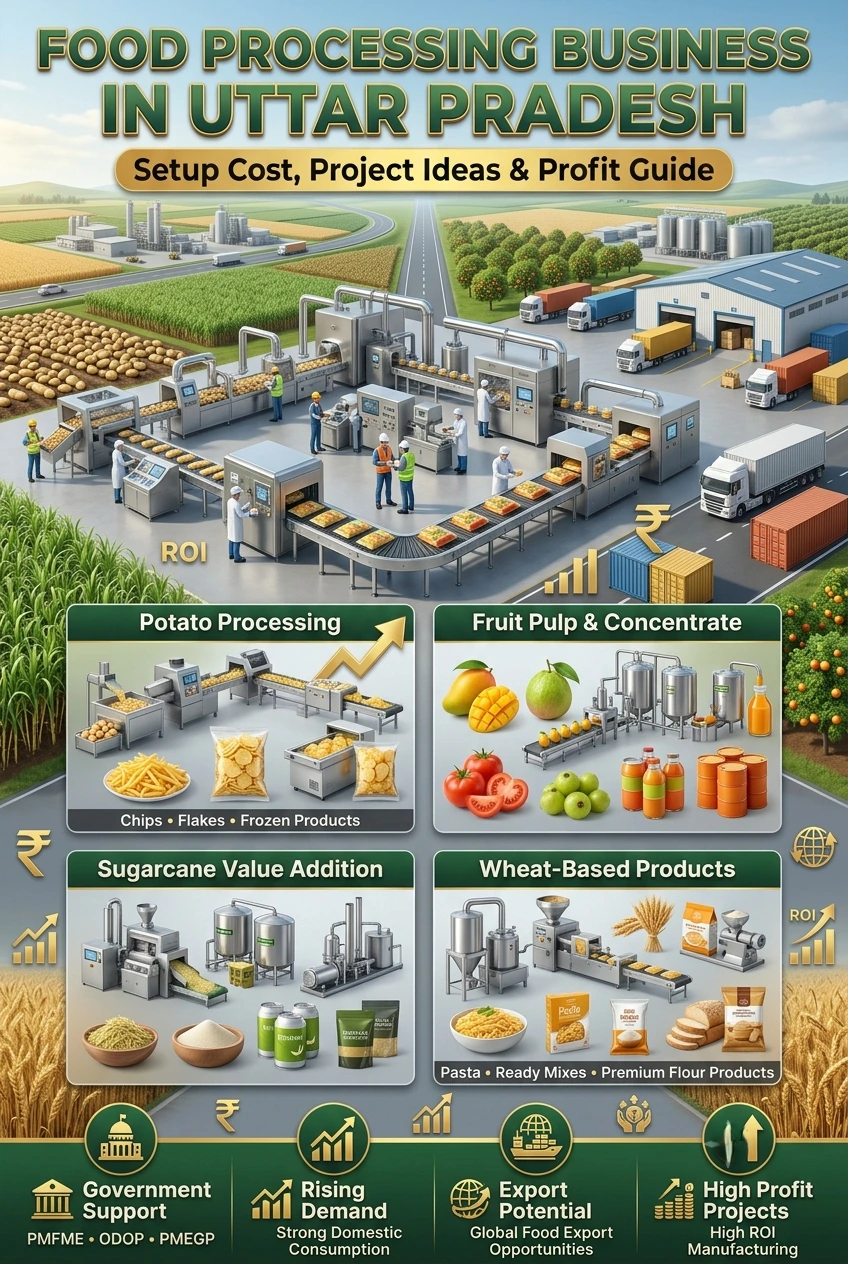
Potato Processing (Chips, Flakes, Frozen Products)
The potato belt of Uttar Pradesh, particularly around Agra and Farrukhabad, supplies raw material for chips, flakes and frozen French fries. India still imports these products in significant quantities for fast-food chains. The dedicated processing line, which requires capex of Rs 10 to 15 crore, goes straight to the branded snack makers and the booming quick-service restaurant supply chain. Margins are twenty to twenty-six percent with demand growth tied to packaged snack growth and quick service restaurant growth.
Explore This Book: Potato and Potato Products Cultivation, Seed Production, Manuring, Harvesting, Organic Farming, Storage and Processing
Fruit Pulp and Concentrate Processing
Mango pulp and concentrate processing units serve domestic factories and export buyers in the Middle East and Europe. These units use the abundant mango crop grown around Lucknow and Malihabad in Uttar Pradesh. A special cell dedicates a capex of ₹6–9 crore to target sales in the branded juice and beverage sector. Margins are between eighteen and twenty-four per cent; realization from export documentation starts higher than domestic only sales.
Sugarcane By-Product Value Addition
The sugarcane processing base in UP also supports ethanol, bagasse-based products, and molasses-based chemicals, but large sugar mills have yet to fully harness these opportunities. A new dedicated by-product processing unit that cost Rs eight crore to Rs 12 crore capital investment, addresses ethanol blending programmes and industrial chemical buyers. Margins range from sixteen to twenty-two percent, while the central government’s steadily increasing ethanol blending targets directly influence demand.
Related Article: Top 10 Value-Added Products Manufactured from Sugarcane Bagasse Waste
Wheat-Based Value-Added Products (Pasta, Ready Mixes)
The wheat flour milling segment is already competitive but there’s not much competition in the value-added wheat products like pasta, ready-to-cook mixes, fortified flour blends. Five to eight crore rupees’ capex is dedicated for the branded pack food segment and the modern retail segment. The margins are around 20-26 per cent, as the raw material is close and the local market in Uttar Pradesh has a huge demand for these product categories.
Indian Entrepreneurs Who Built This
Vivek Saraogi diversified his business into ethanol and power co-generation using sugarcane by-products to make Balrampur Chini Mills one of the largest integrated sugar producers in India, thus protecting the company from the sugar price cycle, which adversely affected single-product enterprises. The Dhampur Sugar Mills group, headquartered at Bijnor, was not far behind, going for ethanol and specialty sugar products before many saw commodity sugar productions as having low margins.(Food Processing Business in Uttar Pradesh)
The point that can be drawn from both examples is that a new entrant in Uttar Pradesh’s food processing industry should come up with a plan to diversify from the raw material base for attractive margins, rather than sticking to commodity processing. The sequencing is important: these firms didn’t do value addition from the get-go — they first developed commodity scale processing and then leveraged the foundation to construct new lines of business into higher margin products without having to build new raw material supply chains.
Import-Export Opportunity Analysis
India still imports a meaningful share of processed potato products, including frozen fries, for its growing quick-service restaurant sector, despite Uttar Pradesh growing more than enough raw potato to supply that demand domestically. That gap is a direct addressable market for a founder building potato processing capacity in the state.
On the export side, mango pulp, processed vegetables, and certain wheat-based products from Uttar Pradesh already reach Middle Eastern and African buyers through documentation and quality certification coordinated by the Agricultural and Processed Food Products Export Development Authority, and that demand continues to grow as those regions diversify food import sourcing. A founder who builds export documentation and FSSAI export certification into a business plan early captures pricing that domestic-only sale does not offer, particularly for mango and fruit-based products where India already holds a quality reputation.
Get Detailed Project Report (DPR): Uttar Pradesh Business Opportunities Guide
Government Reference and Feasibility Planning
Processing and cold chain infrastructure for food manufacturing connects back to India’s broader energy and refining base more than most founders trace, since packaging materials, refrigeration, and transport logistics all depend on stable fuel and petrochemical input availability. The Annual Report 2024-25 of Ministry of Petroleum and Natural Gas, Government of India — accessible at mopng.gov.in — documents the scale of domestic refining capacity supporting this broader industrial and logistics chain that food processing manufacturing depends on daily.
Founders serious about entering this sector typically commission a Market Survey cum Detailed Techno-Economic Feasibility Report before finalizing machinery orders and crop sourcing agreements. Niir Project Consultancy Services prepares these specifically for entrepreneurs entering food and agro-processing manufacturing, covering process flow, machinery and raw material specification, capacity planning, and full project financials — replacing assumption with a number a bank or investor can actually evaluate. The Federation of Indian Chambers of Commerce and Industry and Invest India both track food processing investment trends worth reviewing alongside any state-specific subsidy claim.
Conclusion
A food processing business Uttar Pradesh entrepreneurs build today sits on top of raw material abundance that the state’s own processing capacity has not yet caught up to, and that gap is the entire investment case in one sentence.
The decision hierarchy is straightforward. Locate within or near an existing Mega Food Park to access shared cold storage and processing infrastructure rather than building standalone facilities. Choose value-added processing over basic milling or minimal processing wherever capital allows, since the margin difference runs ten percentage points or more. Plan for multi-crop capacity utilization from the outset, since single-crop seasonality is the most common reason new food processing units underperform their capex in the first two years of operation.(Food Processing Business in Uttar Pradesh)
Uttar Pradesh’s raw material base will keep growing regardless of processing capacity catching up to it, which means the addressable market for a new entrant only expands over time rather than shrinking as more competitors enter. For a founder who plans crop sourcing and cold chain logistics carefully before committing capital, a food processing business Uttar Pradesh offers one of India’s most reliable raw-material-backed manufacturing opportunities available today.
Find the most profitable startup for your investment range
Capex vs Margin Overview by Product
Source: Industry estimates; NPCS sector analysis
| Product | Capex Range | Gross Margin | Target Buyer |
| Potato Processing (Chips/Flakes/Frozen) | ₹10-15 Cr | 20-26% | Branded snacks & QSR chains |
| Mango Pulp & Fruit Concentrate | ₹6-9 Cr | 18-24% | Beverage companies + export (ME/EU) |
| Sugarcane By-Product Value Addition | ₹8-12 Cr | 16-22% | Ethanol blending programmes & chemical buyers |
| Wheat-Based Value-Added Products | ₹5-8 Cr | 20-26% | Packaged food brands & modern retail |
Frequently Asked Questions
From a founder’s perspective — practical, decision-oriented questions:
What capex is needed for a food processing business Uttar Pradesh buyers will actually order from?
A basic fruit or vegetable processing unit can start near four to seven crore rupees, while potato processing for chips or frozen products needs eight to fifteen crore rupees given specialized cold chain equipment requirements.
How does locating within a Mega Food Park help?
Shared cold storage, processing infrastructure, and faster licensing cut both capex and approval timelines considerably compared to a standalone site, typically bringing commissioning timelines down to six to nine months from application.
How is seasonality managed in this sector?
Most successful units plan multi-crop processing from the outset, running potato or mango lines during their season and shifting to wheat-based or other products the rest of the year, rather than leaving capacity idle for months.
Is export a realistic goal for a new entrant?
Yes, particularly for mango pulp and processed vegetables, where India already holds export credibility. FSSAI export certification and documentation teams should plan these requirements early instead of adding them after a domestic-only launch.
What is the biggest operating risk in this sector?
Cold Chain Dependence: A lapse in the refrigerated supply chain from the farm to the processing unit could waste an entire batch. Therefore, businesses should treat cold-chain investment as a fundamental capital expenditure rather than a residual operating cost.(Food Processing Business in Uttar Pradesh)