
This is a Techno-Commercial Indian processed food market Investors, MSMEs, and Food Entrepreneurs of First-Generation Entrepreneurs.
MARKET INSIGHT
India’s processed food sector, with an estimated market size of USD 354.5 billion in 2020, is projected to expand to USD 700 billion by 2030 and USD 1.1 trillion by 2035. The industry currently makes up 32% of the entire food market in India, remains one of the top 5 producing, consuming and exporting food sectors in the country and has witnessed FDI inflows in excess of USD 13.4 billion since 2000. However, the extent of actual food processing in India is still very low as compared to the global standard, hence this is one of the most investable sectors in India for MSMEs and for first-generation food entrepreneurs.
Executive Overview: The Structural Case for Processed Food Investment
India is losing a huge percentage of its agriculture produce between the farm and the table. Post-harvest losses affect an estimated 15–18% of total fruit and vegetable production, resulting in annual losses worth tens of thousands of crore rupees. Mangoes from Ratnagiri reach Kolkata without refrigeration, while traders sell much of the tomato surplus accumulated in Nashik mandis at a fraction of its potential processing value. This is the fundamental issue that is the reason for the existence of processed food industry in India and it is also the fundamental commercial opportunity.(Indian processed food market)
India is a second largest producer of fruits and vegetables, largest milk producer and a leading country in the production of marine products, cereals, spices, pulses, etc. However, the processing rate of fruits is estimated at only 4.5% and vegetables at only 2.7%, which are comparatively low rates compared to other agricultural economies. More than 65% of all food is sold processed in the United States. This figure is higher than 50% in China. In India, the percentage of children in most categories is well below 20% over the years. The solution to filling this gap not only is a food security imperative, but an opportunity for investors ready to invest at the right size and at the right time with the right product.
India Brand Equity Foundation (IBEF) data shows that the Indian food processing industry has achieved an approximate market size of Rs. At present, 30,49,800 crore (USD 354.5 billion) and is expected to cross double to Rs. 60,22,100 crore (USD 700 billion) by 2030. These are not forecasts of aspiration – they are forecasts based on the demand that comes from demographic growth, urbanization, increases in disposable incomes and the structural change towards convenience-format foods.
Get Detailed Project Report (DPR): Fruits and Vegetables Value addition, Food Processing, Dehydration, Canning and Preservation, Processed Food Projects
Market Size, Segmentation, and Forecast 2026-2033
The Indian processed food market is not a single market, it’s a collection of distinct sub-sectors with different dynamics, different infrastructure needed, different entry barriers. The packaging food products market estimated size was USD 129 bn with bakery comprising 22.5 percent with dairy, snacks food, beverages, condiments & food and snacks food being the subsequent sub-segments respectively.
While analysts estimate the total food services market—including organized food restaurants and institutional catering—and the food delivery market separately at USD 150 billion by 2031, together they will create a massive, unmatched ecosystem for manufacturers, food packaging material suppliers, food ingredient producers, and food processing companies.
Indian Processed Food Market: Key Segment Data
| Segment | Approximate Market Value | Growth Outlook | Key Driver |
| Overall Food Processing Market | USD 354.5 Billion | USD 700 Bn by 2030; USD 1.1 Tn by 2035 | Urbanization, incomes, convenience demand |
| Packaged Food Market | USD 129 Billion | CAGR 6.24% to USD 238 Bn by 2034 | Quick commerce, Tier-2/3 expansion, health focus |
| Dairy and Milk Products | Largest processing segment | Organised sector growing 200-400 bps in FY27 | Value-added dairy demand: cheese, paneer, yogurt |
| Fruits and Vegetables Processing | Severely underpenetrated (4.5% / 2.7%) | High CAGR on low base; strong export pull | Post-harvest loss reduction, cold chain investment |
| Ready-to-Eat (RTE) / Ready-to-Cook (RTC) | Fastest-growing format | CAGR 8-17% across studies | Working population, dual-income households |
| Snacks and Savouries | Part of USD 129 Bn packaged food market | Strong urban and Tier-2 expansion | Youth demographics, impulse purchase growth |
| Spices and Condiments | Globally significant; India dominant supplier | Steady 8-10% CAGR; export-oriented | Indian cuisine diaspora, global food flavor trends |
| Marine and Seafood Processing | USD 7.8 Billion in exports | Strong global demand | Export-oriented; Southeast Asia, EU, US buyers |
| Edible Oils | USD 15 Bn+ in imports | High import substitution potential | Domestic refining gap; sunflower, soybean, palm |
| Organic and Functional Foods | Nascent but rapid growth | CAGR 20%+ to USD 9 Bn by 2025 | Health-conscious urban consumer; premium pricing |
Demand-Supply Gap: The Commercial Signal Every Investor Must Read
DEMAND-SUPPLY GAP HIGHLIGHT
Only 4.5% of fruits and 2.7% of vegetables are processed in India while the US and China process 65%+ of their fruit and 50%+ of their vegetables. In addition to cocoa and beverage imports, which amount to USD 513 million and USD 1.5 billion, respectively, per year, imports of edible oil alone are more than USD 15 billion per year, and are import substitution opportunities that domestic MSMEs can pursue with strategic manufacturing investments. More than 40% of the perishable agricultural produce is lost before reaching consumers in India.
The demand-supply imbalance in processed food is happening at several layers at once, and has multiple implications for investors and entrepreneurs in India.
Gap 1 — Raw Agricultural Processing Deficit
India is growing about 354 million tonnes of food grains and 368 million tonnes of horticulture production every year. However, only a small percentage of it goes on to be processed in any way before reaching the end consumer. This means primary fruits and vegetables reach the market without processing into pulp, paste, juice, dried slices, IQF segments or ready-to-cook products, exposing them to price crashes, perishability and other logistical losses. Just at the basic level of penetration would generate hundreds of thousands of Crores of additional value.
Gap 2 — Cold Chain Infrastructure Shortfall
Ministry of Food Processing Industries (MoFPI) has sanctioned 399 projects of Cold Chain under PMKSY, but the cold storage capacity available is limited only to certain commodities & areas, meaning that large agricultural areas with huge production potential don’t have any temperature-controlled storage facilities. Though it is expanding at around 10.86% CAGR, the cold chain market still has huge investment potential, especially in Tier-2 and Tier-3 agricultural catchment areas.
Gap 3 — Import Dependency in Key Categories
There is a significant shortfall in domestic production in some food product categories. Oils imported into India are more than USD 15 billion per annum and mainly include palm oil imports from Malaysia and Indonesia and sunflower oils from Ukraine and Russia. Importation of cocoa and chocolate is more than USD 513 million. Bio beverages (specialty juices, craft drinks and flavoured waters) account for USD 1.5 billion of imports. These are not niche categories, but mainstream consumer products for which systematic under capacity of domestic processing is there in India.
Gap 4 — Quality and Value Addition in Exports
From 2020 to 2024, more than 527 Indian food products were flagged by EU for not meeting the safety and quality standards. In both ways, it is a weakness and an opportunity: Companies that invest in FSSAI-grade, HACCP certified and internationally compliant processing will crowd out the non-compliant producers in export markets and be able to claim premium pricing tiers that commodity-grade processors are not able to claim.
SWOT Analysis – Processed Food Sector in India
Strengths
The food processing industry is based on the world’s largest agricultural base in India. The country is the second largest producer of fruits and vegetables, largest milk producer and a major producer of spices, pulses, cereals and oilseeds. Indian food processors have a foundation of demand that few countries can boast of, with this raw material abundance and the domestic consumer base of 1.45 billion people with a growing middle class. There is a clear policy support (PLISFPI, PMKSY, PMFME) in place, with over Rs. invested through the various schemes. The government has announced investments of Rs 17,000 crore to create processing capacity and cold chain infrastructure. Gulf, south-east Asia, Europe and Japan are all connected with India, which gives its processed food exporters an advantage over its South American, or eastern European, competitors.(Indian processed food market)
Weaknesses
Infrastructure fragmentation is the biggest challenge in the sector. The small and marginal farmers who produce raw materials for the food chain are weak in their quality control because of their weak post-harvest capacities and also their inability to get raw materials of good quality. This creates inconsistent quality during raw material sourcing and continues to affect downstream processing. The food processing industry also faces a human capital deficit because only approximately 3% of its workforce receives formal training. The absence of the integrated cold chain logistics between production clusters and processing units also brings into the processing units’ temperature sensitive raw material (mangoes, tomatoes, strawberries, fish) that may arrive in a not so good condition. Contract farming and farm to factory linkages are largely unorganized except for a few organized corporate players.
Opportunities
Three trends are driving this opportunity landscape in the processed food space. The first is India’s rapid urbanization. By 2031, more than 600 million people are expected to live in urban areas, creating a huge addressable market for packaged food products, convenience foods, and ready-to-eat foods. Secondly, APEDA (Agricultural & Processed Food Products Export Development Authority) is aggressively establishing India’s footprints in the international processed food market, where the value of total exports of processed food products has crossed USD 7.8 billion and total agri-food exports USD 49 billion. Thirdly, BHARATI, a government initiative for 100 MSMEs (agri-food) to be ready for exports, is a sign of institutional commitment towards MSMEs in the export ecosystem. The food segment of millets has been identified as a target segment in the millets scheme, with a dedicated PLI scheme of Rs. 800 crore outlay” is an early-mover opportunity in functional/health-based processing.
Threats
Food inflation volatility is a genuine threat to the processed food sector because it drives down input costs and prompts necessary price changes every once in a while, with the potential to impact consumer loyalty. Operational overhead and complexity of regulatory compliance requirements such as FSSAI licensing, BIS quality standards, HACCP requirements and agricultural marketing rules applicable to the state level especially for smaller units. The fragmentation of the market is a consequence of the dominance of big organized players who have a strong cold chain, pan-India distribution and marketing budgets, resulting in pressure in mainstream categories. Lastly, the increasingly stringent import requirements for food safety put by the EU on food exporters are demanding more investment in laboratory testing, traceability systems and paperwork for the smaller exporters.(Indian processed food market)
Application-Wise Analysis: Where Processed Food Demand Is Growing
1 Dairy Processing is the biggest organised sub-sector.
India is the world’s biggest milk producer with milk production exceeding 230 million tonnes a year. However, value added dairy is still underdeveloped in comparison with milk production scale, with products like cheese, flavoured yoghurt, paneer, whey protein, infant formula and specialty butter being significantly underdeveloped. The annual turnover of Amul is about Rs. 80,000 crore is a testament to the potential of organised cooperative scale dairy processing but there are hundreds of regional clusters which are not adequately provided with such infrastructure. The organised dairy sector is expected to grow 200–400 basis points faster than nominal GDP, making dairy processing one of the most attractive areas for MSMEs and institutional investors.
Get Detailed Insights from This Book: Complete Dairy Industry Market Research Report
2 Fruits and Vegetables — The Largest Untapped Processing Opportunity
India is leading the world with fruit and vegetable production, with little exception. But opportunities for fruit processing are 4.5% and vegetable processing are 2.7%, the opportunity is extraordinary. The mango pulp, tomato puree, dehydrated onion, IQF peas and sweet corn, fruit juices, vegetable soups and frozen mixed vegetables are all products with well-established domestic and export markets which currently are based on a small number of organised processors. The government is actively developing the infrastructure ecosystem for this sub-sector through 36 new projects sanctioned by the MoFPI under PMKSY for a total capacity of 28.48 lakh MTs of processing and preservation capacity, benefitting 1.4 lakh farmers.(Indian processed food market)
Download the Full Guide: Handbook on Fruits, Vegetables & Food Processing with Canning & Preservation
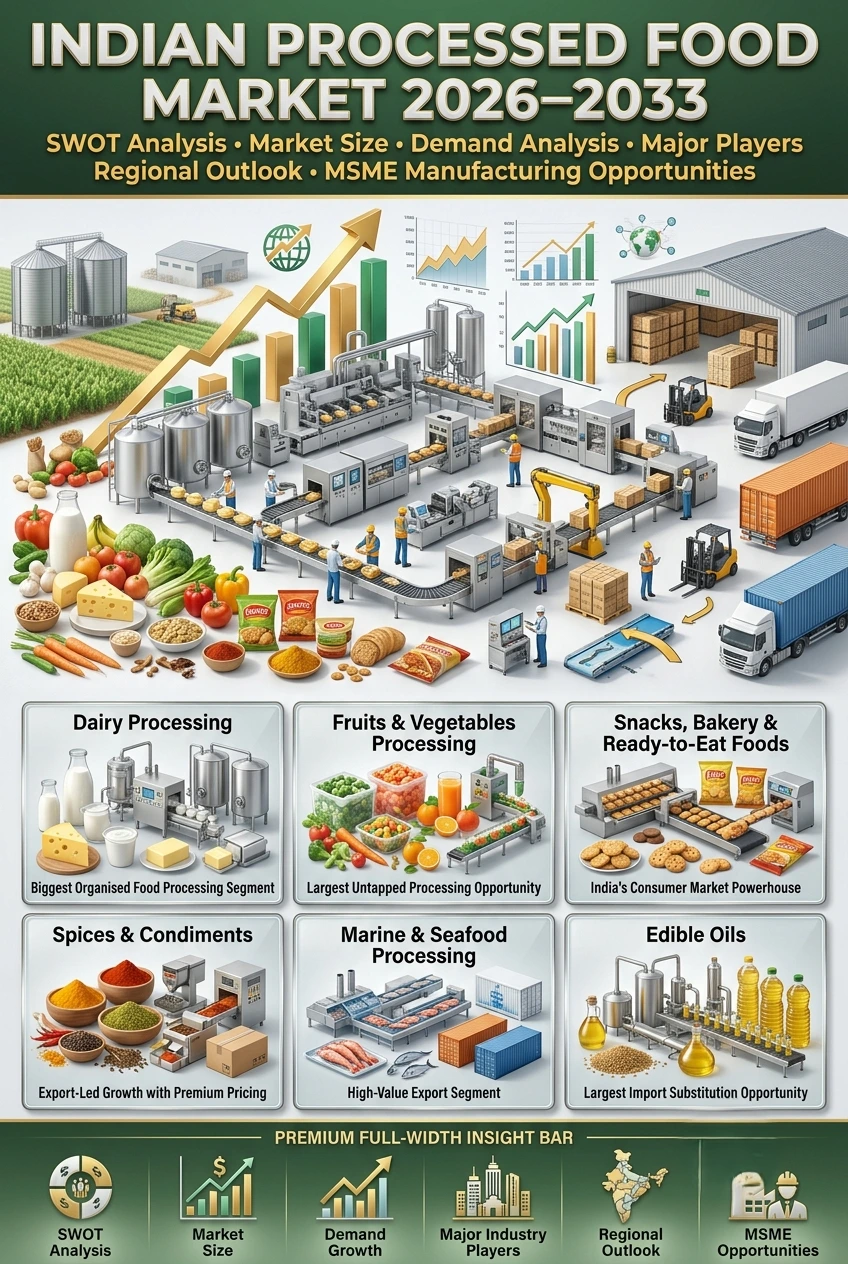
3 Snacks, Bakery, and Ready-to-Eat — The Consumer Market Powerhouse
The snacks and bakery category is the most competitive segment of India’s processed food market. It includes biscuits, namkeens, extruded snacks, bread, and cookies. Parle-G is the world’s largest biscuit brand by volume. The bakery is responsible for about 22.5% of packaged food market. Quick commerce apps (Blinkit, Zepto, Swiggy Instamart) have carved out a new segment for packaged food which is giving a financial boost to area brands that are willing to sell on digital platforms.
MSMEs can access capital relatively easily in the snack processing segment, but they must differentiate their products, comply with FSSAI regulations, and build strong connections with retailers.
Related Article: Bakery Products Manufacturing Business Ideas: Opportunities, Challenges & How to Start
4 Spices and Condiments — Export-Led Growth with Premium Pricing
India is the largest exporter of spices in the world accounting for around 25% of the world’s spice trade. The transition from commodity spice trade to value added spice products like ground and blended spices, oleoresins, essential oils and masalas have provided big margin uplift to the spice processors in organized market. The classic examples of Indian MSME-spice brands that have expanded to become a national and international brand are MDH and the Everest brands. Exports of spices are continuing to grow and APEDA is actively promoting spice exporters through quality certification and market linkage initiatives.
Check Out This Recommended Book: The Complete Book on Spices & Condiments (with Cultivation, Processing & Uses)
5 Marine and Seafood Processing – Export and premium priced
Marine products exports are among the highest among processed food exports which have reached USD 7.8 billion annually in India. The largest, and second biggest shrimp exporter in the world, Shrimp is followed by fish fillets, squid and cuttlefish. The key markets are the USA, the EU, Japan, China and South East Asia. Processing penetration also shows some increase, with value added products like marinated shrimp, seafood individually quick-frozen (IQF) and ready-to-cook seafood packs taking a bigger share of the export markets. This segment values quality consistency and food safety certification, more than any others.(Indian processed food market)
6 Edible Oils – The Biggest Import Substitution Opportunity
Edible oil has become India’s biggest food import item with its annual import bill of more than USD 15 billion and is one of the biggest import bills in the country after crude oil. The vast majority is the combination of sunflower oil, soybean oil, and palm oil. The government’s National Mission on Edible Oils and Oilseeds aims to boost domestic production, but it has yet to address the processing gap caused by the lack of crushing and refining facilities near oilseed-producing areas. Acquisitions of solvent extraction, oil refinery, and palm oil fractionation plants in the vicinity of the growing areas in the States of Rajasthan, Madhya Pradesh and Andhra Pradesh are good opportunities for import substitution.
View Full Project Details: Edible Oils in India Market Research Report
Import-Export Dynamics: Mapping Trade Flows for Investment Intelligence
Indian food trade is a very interesting position, in some categories the country is a big exporter while in others it is a big importer, due to uneven development of its processing capacity.
Export: Overall Agricultural and Food Export has grown beyond USD 49 bn in the last full financial year. Exports of food products from the PLISFPI approved food companies have grown with a compound annual growth rate of 13.23% from baseline, our major export are to processed fruits and vegetables, spices, seafood, rice (basmati) and value-added milk products. Food product sales to you have risen by Rs. 58,758 crores to Rs. This places a total of 1,08,854 crore, which translates directly into export revenue growth, with the CAGR of 10.82% for organized food processing capacity. India’s exports of processed food were valued at USD 7,886.62 million in the latest full-year data, APEDA is seriously eyeing up exports in the denomination of Rs. By 2030, agri-food exports of scheduled products would be worth 4,28,450 crore (USD 50 billion).(Indian processed food market)
The red-hot import is edible oils with some USD 15 billion representing almost 30% of total agricultural imports (value). Secondary import categories include cocoa, specialty beverages, processed fruit (such as temperate fruits like apples, pears and kiwi), and processed dairy (such as infant formula and cheese). These imports indicate a lack of processing capacity at the enterprise level in certain product-geography combinations, which can be filled with an appropriate investment into manufacturing.
Choose the right startup backed by real market demand
Regional Analysis: India’s Processed Food Production Geography
Maharashtra — The Food Processing Capital
Maharashtra is the largest producer by value for processed food industry with the trading hub of Mumbai, manufacturing hub of Pune and fruit/vegetable processing hub of Nashik-Sangola-Pune belt. The signature agro-processing activities in the state include grape wine production, grape raisin processing, tomato processing and onion dehydration. The state of Maharashtra also has a number of Mega Food Parks and prominent organized food company manufacturing facilities by ITC, Nestle, PepsiCo and Britannia. About 12% of the national packaged food market is dominated by the state of Maharashtra.
Gujarat — Dairy, Oil, and Spice Processing Hub
Gujarat has Amul’s co-operative dairy empire – the most successful food processing co-operative in Asian history – edible oil crushing and refining, salt processing and marine products processing along its 1600 km coastline. The major food processing centres are Ahmedabad, Rajkot, Junagadh and Surat. Gujarat food processors have export logistics benefits with its proximity to the Dahej and Mundra ports.
Punjab, Haryana, and Uttar Pradesh — Grain, Dairy, and Pulse Processing
The northern agricultural belt which produces wheat, rice, sugarcane and dairy products provides a solid raw material base for flour milling, rice processing, sugar refining and dairy product manufacturing. Food processing centres are well developed in Amritsar, Ludhiana, Chandigarh and Agra etc. The PMFME scheme specifically focuses on formalizing micro-enterprises in this region, where many food processors operate in the informal sector and can connect with organized food chains.
Andhra Pradesh and Telangana — Aquaculture, Chilli, and Poultry
Andhra Pradesh is the leading state in shrimp farming and marine product processing industry with a lion share in the export of sea products from the country. The state also accounts for the major production of red chillies which provides a natural base for the production of spices, oleoresin and capsicum oleoresin. The poultry processing industry is booming, and organised players are extending chilled and frozen chicken exports.
Tamil Nadu and Kerala — Spices, Coconut, and Seafood
Coconut processing (Coconut Oil, Desiccated Coconut, Coconut Milk), Black Pepper, Cardamom and Sea Food are the key industries. The state government has fully developed and operationalized the Kerala Model Coconut Processing Park and spice processing clusters in Malabar and the Cardamom Hills, creating strong industrial infrastructure. In view of the large contribution of sea Food Exports by the State, MPEDA (Marine Products Export Development Authority) has been providing good quality of infrastructure and market linkage to the seafood exporters.(Indian processed food market)
Major Indian Players: The Organised Sector Landscape
MAJOR INDIAN PLAYERS
Amul (GCMMF), ITC Foods, Britannia Industries, Nestlé India, and Dabur India lead India’s organised processed food market segment. While, Cooperative giant, Amul stated it generated approximately 80,000 crore rupees on an annual basis; the food organisation generates the maximum revenue across the Indian food market. MSMEs and the unorganised sector together contribute to large portions of the spice processing, milling of grains, regional snack production and pickle manufacturing, which are small manufacturer industries where competitive advantages exist as small manufacturers have access to local knowledge and source.
| Company | Segment Focus | Scale / Key Facts |
| Amul (GCMMF) | Dairy — Milk, Butter, Cheese, Ice Cream, Paneer | Revenue ~Rs. 80,000 crores; cooperative of 3.6 million dairy farmers; strongest food brand in India (brand value USD 4.1 billion) |
| ITC Foods | Staples (Aashirvaad), Biscuits (Sunfeast), Snacks (Bingo), Ready Meals | Revenue Rs. 17,194 crores from foods; among largest FMCG conglomerates by market cap (Rs. 4 trillion) |
| Britannia Industries | Biscuits, Bread, Dairy, Cakes | Revenue Rs. 16,038 crores; FY2024 exports to Middle East, Africa, and Asia; pioneer in bakery industry |
| Nestle India | Instant Noodles (Maggi), Coffee (Nescafe), Dairy, Chocolates | Revenue Rs. 19,100 crores; largest single listed food company by revenue; multinational with deep India roots |
| Dabur India | Juices (Real), Honey, Health Foods, Ayurvedic | Revenue over Rs. 12,000 crores; strong distribution in 100+ countries; leader in natural/ayurvedic food products |
| Parle Products | Biscuits, Snacks, Confectionery | Private company; Parle-G among world’s largest-selling biscuits by volume; pan-India rural reach |
| Hindustan Unilever | Condiments (Kissan Ketchup), Soups, Tea (Brooke Bond) | Part of India’s largest FMCG company; strong distribution network; food a growing segment |
| Tata Consumer Products | Tea, Coffee, Salt, Organic, International Foods | Rapidly growing; acquired multiple food brands; strong e-commerce presence |
Government Policy Infrastructure: The Enabler Layer
The Government of India has constructed one of Asia’s most comprehensive policy scaffolds for food processing investment. The Union Budget 2026-27 allocated Rs. 4,064 crores to the Ministry of Food Processing Industries (MoFPI), with Rs. 1,200 crores specifically for PLISFPI, Rs. 1,700 crores for PMFME, and Rs. 915 crores for PMKSY. Between April 2000 and June 2025, the food processing sector attracted Rs. 1,15,596 crore (USD 13.4 billion) in FDI under the 100% automatic FDI approval route — a reflection of global investor confidence.
PLISFPI (Production Linked Incentive Scheme for Food Processing Industries), with a total outlay of Rs. 10,900 crores over six years, has approved 170 applications, increased processing capacity by 35 lakh MT per annum, and generated 3.39 lakh direct and indirect jobs. Critically for MSMEs, 69 of the 168 approved applicants were small and medium enterprises — confirming that the scheme is not exclusively a large-corporate instrument.(Indian processed food market)
PMFME (PM Formalisation of Micro Food Processing Enterprises) has approved assistance to 92,549 micro food processing enterprises, providing credit access, quality certification support, and market linkage. The scheme opens up the massive ecosystem of informal food processors to formal registration, FSSAI licensing and scale up- pickle makers, papad makers, spice blenders and grain millers etc. Entrepreneurs under any of these central government sponsored scheme can use the DPIIT investment facilitation platform as a single-window for filing an application.
Startup and MSME Investment Opportunity Analysis
STARTUP OPPORTUNITY INSIGHT
With fruit and vegetable processing penetration below 5%, edible oil imports exceeding USD 15 billion, and the PMFME scheme subsidizing 35% of project costs for micro enterprises, the Indian processed food sector offers one of the most accessible high-growth manufacturing opportunities available to first-generation entrepreneurs. Capital entry points range from Rs. 10 lakhs for micro spice processing units to Rs. 5 crores for mid-scale IQF fruit processing — both eligible for government financial support and FSSAI certification pathways.
Priority Sub-Sectors for New Entrants
Fruit and Vegetable Processing — Pulp, IQF, Dehydration
The most commercially proven entry routes include mango pulp plants in Maharashtra and Uttar Pradesh. Tomato pulp plants are common in Andhra Pradesh and Maharashtra. Dehydrated onion and garlic processing units operate mainly in Rajasthan and Gujarat. IQF vegetable units are concentrated in Punjab and Himachal Pradesh.
Each product has a defined market. Key buyers include domestic ingredient manufacturers, fast-food chains, and export markets. Conventional buyers typically source from a small group of established processing plants.
Export-grade mango pulp in aseptic packs can generate gross margins of 20% to 35%. These margins are particularly achievable for quality-compliant and HACCP-certified facilities.
Dairy Value Addition — Cheese, Paneer, Greek Yogurt, Whey Protein
In line with a move by organized Indian milk consumers from commodity milk to value addition products namely the likes of cheese, flavored yogurts, artisanal paneer, fortified ghee and the more premium whey protein concentrate, there will be a definite jump in customer base for the SMEs in the organized segment that can service food service and retail. A 1,000-5,000 kg/day production facility at cheese or flavored yoghurt production needs an initial investment between 50 lakhs – 3 crores and would necessitate FSSAI grade A product. This is an obtainable challenge for most budding entrepreneurs, given access to a dependable milk procurement source.
Spice Processing and Oleoresins
India’s spice processing sector rewards product consistency and export certification above all else. However, an entrepreneur who makes the decision to focus on the turmeric powder, cumin, and blended masala space with BRC Global Standard and APEDA export registration would be able to reach high-value export markets in Gulf countries, Europe and USA, largely driven by high consumption from Indian expatriates and interest from the world food sphere. 1 crore, making this one of the most accessible high-growth segments for food entrepreneurs.
Edible Oil Refining and Mustard Oil Processing
The import substitution opportunity in edible oils — particularly sunflower, soybean, and mustard — is among the largest in Indian food processing. Smaller entrepreneurs can enter the mustard oil segment by establishing expeller units near Rajasthan, Madhya Pradesh, or Bihar farming clusters, which supply the raw oilseed at competitive prices. A 10-tonne per day mustard oil expelling and packaging unit requires approximately Rs. 50 lakhs to Rs. 1 crore in capital and targets both retail and food service buyers who prefer Indian cold-pressed oils.
Millet-Based and Functional Food Products
The PLI scheme for millet-based products (PLISMBP) with Rs. Allocation of Rs 800 cr proves that the government understands millet is not just a health need but a great export possibility. Millets flour, millet biscuits, millet breakfast cereals, and millet-snacks have the earliest stage of entry. In these sections, very few domestic firms are there to compete, there’s huge export potential especially from the health fanatic buyers from western nations. The opportunity is very big, First-mover advantages exist in these spaces too timeously too.(Indian processed food market)
Techno-Economic Feasibility Overview for Food Processing Units
| Parameter | Micro / Home Processing Unit | Small-Scale Unit | Mid-Scale Processing Plant |
| Examples | Pickle, papad, masala blending | Spice processing, fruit pulp, dal milling | Mango pulp, IQF vegetables, dairy |
| Capital Investment | Rs. 5-25 Lakh | Rs. 25 Lakh – Rs. 2 Crore | Rs. 2 Crore – Rs. 15 Crore |
| Key Equipment | Pulverizer, packaging machine, heat sealer | Grinder, evaporator, cold storage, packing line | Industrial evaporator, pasteurizer, IQF tunnel, aseptic filling |
| Regulatory Compliance | FSSAI Basic Registration | FSSAI State License; GST; Udyam Registration | FSSAI Central License; HACCP; APEDA for exports; BIS where required |
| Gross Margin Range | 25-40% | 20-35% | 15-28% |
| Payback Period | 1-3 Years | 2-4 Years | 3-6 Years |
| Government Support | PMFME (35% subsidy); MUDRA Loan | PMKSY grant; CGTMSE collateral-free loan up to Rs. 2 crore | PLISFPI (incentive on incremental sales); Mega Food Park unit |
Frequently Asked Questions (FAQ)
Q1. What is the minimum investment required to start a food processing unit in India?
The entry point varies enormously by product and scale. A home-based or micro food processing unit — making pickles, papads, spice mixes, or traditional namkeens — can be started with Rs. 5-25 lakh, particularly under the PMFME scheme which provides up to 35% capital subsidy for eligible micro enterprises. A small-scale spice processing or fruit pulp unit requires Rs. 25 lakhs to Rs. 2 crores. A mid-scale dairy value-addition unit or IQF fruit processing plant typically requires Rs. 2 crores to Rs. 15 crores. Every category is eligible for some form of government financial support — the PMFME scheme, PMKSY grants, CGTMSE collateral-free loans, and PLISFPI incentives — making debt financing significantly more accessible than in most other manufacturing sectors.
Q2. What is the mandatory regulatory compliance for a food processing startup?
Food Businesses: All Indian food businesses are to be licensed or registered irrespective of their size. Small food businesses (turnover under Rs 12 lakhs) must get a Basic Registration. Food units with an annual turnover under Rs 20 crores will have a state license; those with turn over more than this must have a Central license. You should also obtain GST Registration, Udyam Registration under the Ministry of MSME, and a Factory License under the Factories Act wherever applicable. Export units should also obtain APEDA registration. HACCP Certification is gradually becoming a necessity for institutional buyers and for the food exported outside India. Specialized FSSAI approvals might also be needed for cold storage, meat processing plants, seafood and dairy units.
Q3. Which food processing products have the best export potential from India?
According to current APEDA trade data strongest growing export product baskets are: (1) marine product (majorly shrimps) – exported over 7.8 billion dollars (2) Basmati & Non-Basmati Rice; (3) Spices & Spice Products such as Oleoresins & Essential Oils; (4) Processed fruits and vegetables – dehydrated onion, pulp and tomato products and (5) Value added products on cereals – including millet products. Organics (NPOP accredited) are well accepted in US and European markets and fetch good value price. The Gulf (UAE, Saudi Arabia, and Kuwait) represents India’s largest focused export market for processed foods. A large Indian population lives in these countries, and their cultural preference for Indian food further drives demand.
Q4. How does the PMFME scheme help micro food processing entrepreneurs?
The PM Formalisation of Micro Food Processing Enterprises (PMFME) scheme — with an outlay of Rs. 1,700 crores allocated in the current budget — provides 35% capital subsidy (maximum Rs. 10 lakhs per unit) to existing and new micro food processing enterprises. As of mid-2024, the scheme has approved 92,549 micro enterprises for assistance. Beyond direct financial support, PMFME provides backward linkage through the One District One Product (ODOP) framework, quality and FSSAI compliance support, skill training, and market linkage facilitation. Entrepreneurs who register under PMFME gain access to this ecosystem of support while simultaneously formalizing their business under FSSAI and GST — creating a foundation for scale-up to organized sector classification over time.
Q5. What is the role of cold chain in a food processing business plan?
Cold chain is not optional infrastructure for food processors — it is the difference between a viable business and a post-harvest loss statistic. For fruits and vegetables, dairy, marine products, and ready-to-eat meals, maintaining the cold chain from raw material procurement through processing, storage, and distribution determines product quality, shelf life, consumer safety, and export eligibility. India’s cold chain market stands at approximately Rs. 2,28,700 crore and is growing at a CAGR of around 10.86%, driven precisely by food processing sector growth. Under PMKSY, the government has approved 399 cold chain projects — but the overall infrastructure gap remains large. For entrepreneurs, investing in or co-locating near existing cold chain infrastructure dramatically reduces capital requirements while ensuring raw material quality.
Q6. Which states offer the best location advantages for food processing MSMEs?
Location selection for a food processing unit should follow raw material availability, not urban infrastructure. Maharashtra is ideal for fruit-based processing (mangoes, grapes, tomatoes); Gujarat for dairy, oil seeds, and spices; Punjab and UP for grain milling, rice processing, and wheat-based products; Andhra Pradesh and Tamil Nadu for seafood and chilli processing; Kerala for coconut products; and Rajasthan for mustard oil and dryland spice processing. States with established Mega Food Parks under PMKSY offer additional infrastructure advantages, including shared effluent treatment, raw material aggregation centres, power supply, and logistics connectivity. These facilities significantly reduce capital and operational costs for food processing MSMEs operating within these zones.
How NPCS Supports Food Processing Entrepreneurs
Niir Project Consultancy Services (NPCS) is among India’s most experienced industrial project consulting firms, providing Market Survey cum Detailed Techno-Economic Feasibility Reports (DPRs) for food processing ventures across fruit and vegetable processing, dairy, grain milling, spice processing, marine products, edible oil, bakery, and ready-to-eat segments.
For a food processing manufacturing project, an NPCS DPR provides:
- Detailed manufacturing process with step-by-step process flow diagrams (PFD/BFD), covering raw material receiving, processing sequence, packaging, and quality checkpoints
- Market research and demand analysis: product-specific consumption data, regional demand mapping, buyer profiling, and export market sizing for target food product categories
- Product mix and capacity planning aligned with raw material availability, seasonal supply patterns, and market demand cycles
- Machinery and equipment specifications: selection guidance for food-grade processing equipment, packaging machinery, cold storage systems, and effluent treatment
- Import-export dependency analysis: identification of import substitution opportunities and export market entry pathways through APEDA and relevant export promotion councils
- Project financials and profitability evaluation: detailed capital cost estimation, operating cost modeling, revenue projection, IRR and NPV calculation, and government incentive eligibility assessment
References and High-Authority Citations
- India Brand Equity Foundation (IBEF) — Food Processing Industry Overview and Market Data
- Ministry of Food Processing Industries (MoFPI), Government of India — PLISFPI, PMKSY, PMFME Scheme Data
- APEDA (Agricultural and Processed Food Products Export Development Authority) — Export Statistics and Processed Food Trade Data
- Invest India — Food Processing Sector Blog and Investment Data
- DPIIT (Department for Promotion of Industry and Internal Trade) — Investment Facilitation, PLI Applications, and Policy Framework
- Press Information Bureau (PIB) — PLISFPI Performance Data and Employment Statistics